Beauty & skincare DTC · GEO / AEO
AI SEO for beauty brands: get named when shoppers ask what to put on their skin
How does a beauty or skincare brand get named in AI answers?
A beauty brand gets named when it stops marketing and starts stating facts. AI engines quote percentages, full ingredient lists and usage guidance, then cross-check the communities where skincare buyers verify claims. A small brand that owns one specific concern with that evidence can beat drugstore giants on the exact questions its formula answers best.
Beauty is the category where shoppers treat AI like a dermatologist. They ask ChatGPT which serum layers safely with tretinoin, which moisturizer will not wreck a damaged skin barrier, which brand to trust on sensitive skin. Each answer names a handful of brands, and the same drugstore names win by default. AI SEO for beauty brands is the work of getting your formulas into those answers: product pages that state facts an engine can quote, concern pages that own specific skin problems, and proof in the places beauty buyers verify claims. In our audit data, 12 of 14 beauty brands never appeared in a single AI answer. The lane is open.
Here are the ones I'd recommend:
- 1CeraVe
- 2La Roche-Posay
- 3Vanicream
The default derm trio takes another answer. The indie formulas built for exactly this are nowhere in it.
"What moisturizer should I use with tretinoin?"
- 72%
- of 181 audited brands were cited zero times across four AI engines
- Source: CiteVantage 181-brand audit
- 12 of 14
- beauty brands in our audit data were absent from every AI engine tested; none earned a full citation
- Source: CiteVantage ecommerce citation audits
- +290%
- organic clicks in 18 days on a DTC store running the same catalog playbook we apply to beauty
- Source: CiteVantage RIPT Apparel case study
| Signal | Finding | Source |
|---|---|---|
| Brands cited zero times across four AI engines | 72% of 181 audited | CiteVantage 181-brand audit |
| Beauty brands in crowded categories (lash serums, hair growth oils) absent from every engine | 12 of 14 | CiteVantage ecommerce citation audits |
| Beauty brands in that same slice earning a full citation | 0 of 14; the other two got passing mentions only | CiteVantage ecommerce citation audits |
| Indie skincare makers named when the query got specific (ingredient, maker, place) | 12 of 18, including two sole-answer citations | CiteVantage founder-tier Perplexity audit |
| Organic clicks from the catalog playbook we run on beauty stores | +290% in 18 days (2,170 to 8,450 monthly) | CiteVantage RIPT Apparel case study |
| Product meta titles refreshed at catalog scale | 5,000 in 3 days, about 46 times faster than manual | CiteVantage 5K Meta Titles case study |
Real buyer questions
What shoppers ask AI before choosing a beauty brand
- "Best vitamin C serum for sensitive skin under $40"
- "Can I use niacinamide and retinol in the same routine?"
- "Cheaper alternative to Drunk Elephant Protini that actually works"
- "Best fragrance free moisturizer for rosacea prone skin"
- "Fungal acne safe sunscreens that do not pill under makeup"
- "Is this clean beauty brand legit or just marketing?"
- "Best small batch skincare makers that are not on Amazon"
- "What order should I apply serums in at night?"
- "Which Korean skincare brands are good for oily skin?"
Every question above is a shortlist your brand is either on or missing from.
Why does AI hand your concern to the same drugstore names?
-
ChatGPT hands your exact skin concern to a drugstore giant while the formula you built for it never comes up.
-
Your product pages say "glow" and "clean" but never state the percentages, full INCI list or usage facts an engine can quote.
-
Buyers ask AI whether your hero ingredient layers safely with retinol, and the answer quotes a competitor's ingredient page.
-
Sephora, Ulta and publisher roundups get cited for your hero product's category, so the shortlist is built before anyone reaches your site.
-
Your five-star reviews live on your own site and Instagram, exactly where AI engines never look when they verify a skincare brand.
-
You compete in a broad category, and that is where beauty brands vanish: 12 of 14 crowded-category brands in our audit data were absent everywhere.
How does AI SEO for beauty brands actually work?
Concern-level AI audit
We test the routine and concern questions your buyers actually ask ("best X for rosacea", "safe with retinol", "dupe for Y") across ChatGPT, Perplexity, Gemini and Google AI Overviews, then hand you a scored gap map in plain English: who gets named, why, and what to fix first.
Ingredient-transparent PDPs at scale
Every SKU rebuilt around quotable facts: active percentages, full INCI, texture, usage and layering guidance, plus Product schema engines can parse. Done with the supervised catalog pipeline that refreshed 5,000 meta titles in 3 days, not months of manual editing.
Concern pages that own one skin problem
Answer-shaped pages built one concern at a time: who it is for, which ingredients matter, what to avoid, which of your products fits where in the routine. The structure an engine can lift whole, with your brand attached as the source.
Proof where skincare buyers verify
Honest presence in the skincare communities, review platforms and expert roundups engines cross-check before recommending anything people put on their face. No fake reviews, no paid placements. Corroboration that survives a check.
Citation tracking by concern
A monthly re-run of your question set across the engines, reported plainly: which concerns name your brand now, which still default to the drugstore trio, and the single next move that closes the biggest gap.
The AI SEO playbook for beauty brands
01 · Step
Baseline the concern questions your buyers ask
We build the question set the way beauty buyers actually type: concern plus skin type plus constraint, like "fragrance free moisturizer for rosacea under $30". Then we run it across four AI engines and record exactly who gets named today. Most beauty brands start at zero, so the baseline becomes your before photo.
02 · Step
Turn every PDP into a quotable ingredient record
Engines cannot quote "radiant glow". They can quote 10% niacinamide, a full INCI list, texture notes, and what not to layer it with. We rebuild product pages around stated facts plus Product schema, using the same supervised catalog pipeline that refreshed 5,000 meta titles in 3 days.
03 · Step
Own narrow concerns instead of broad categories
Broad categories are where beauty brands disappear: 12 of 14 crowded-category brands in our audit data were absent from every engine. Specificity flips it. When we audited 18 indie skincare makers on precise ingredient and origin questions, 12 were named, and two were the only brand in the entire answer.
04 · Step
Build the third-party proof skincare buyers trust
Before an engine recommends something people put on their face, it cross-checks communities, review platforms and expert roundups. We build honest presence exactly there. Raw authority does not decide the outcome: in our ongoing audits we have watched DA-10 sites beat DA-90 sites inside ChatGPT answers.
05 · Step
Track citations by concern and compound the wins
Every month we re-run your concern questions across the engines and report the movement in plain English: questions that now name you, questions that still default to drugstore brands, and the next move. Won answers tend to stay won, so each cited concern keeps sending buyers without new spend.
| Engine | What it weighs before naming a brand | Where beauty brands usually lose |
|---|---|---|
| ChatGPT | Brand recognition plus corroboration across reviews, communities and the open web | It defaults to household derm brands unless a smaller brand is the better-corroborated answer for that exact concern |
| Perplexity | Live retrieval of quotable pages, with Reddit and review sources weighted heavily | Product pages full of marketing language with no ingredient facts worth quoting |
| Google AI Overviews | Existing rankings plus Product and Organization schema it can verify | Platform-default titles and thin or missing structured data across the catalog |
| Gemini | Google's index and entity clarity: schema, consistent profiles, a clean brand definition | The brand reads differently on the site, the social profiles and the retail listings |
| Copilot | The Bing index and verifiable brand authority underneath it | The store was never properly indexed or verified in Bing at all |
| Grok | Real-time conversation on X plus the open web | Nobody on X is talking about the brand, so there is nothing to pull |
Qualitative view from our ongoing multi-engine citation audits, including the beauty slices in the table above.
Proof · Ecommerce SEO
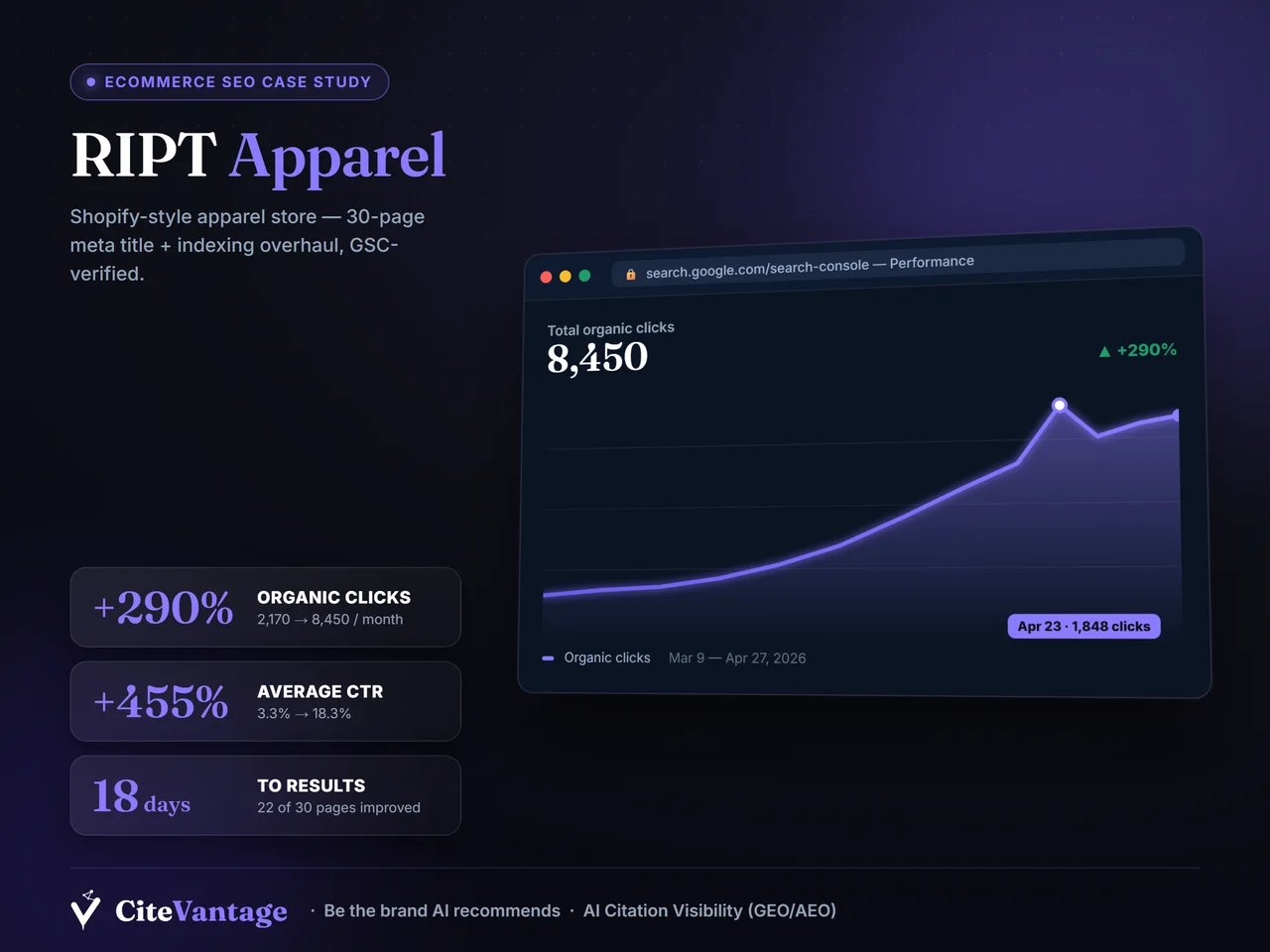
RIPT Apparel
RIPT Apparel had strong product pages and weak search performance. In 18 days we rewrote 30 meta titles, fixed indexing, and took the store from 2,170 to 8,450 monthly organic clicks. Every number below comes straight from Google Search Console.
+290% organic clicks
Start here
AI Visibility Sprint
one-time projectThe full foundation, built and proven in 14 days. Scoped to your niche, delivered like a team. Current pricing lives on the pricing page.
90-Day Cited Guarantee: newly cited by a major AI engine on your agreed buyer questions within 90 days, or we run a second sprint free.
See where AI hides your brand
Send your site and what you sell. We run your real buyer questions across ChatGPT, Gemini, Perplexity, Copilot and Google AI, then send the screenshots and a one-page action plan. Free, within 24 hours.
- Real screenshots of what AI says about you
- Your AI Visibility Score and the top 3 gaps
- No pitch, no sales call unless you ask
Request your free audit
Two fields to start. Abdul runs each one personally.
beauty questions, answered
Is AI SEO for beauty brands different from regular ecommerce SEO?+
It builds on it. Regular SEO earns rankings. AI SEO for beauty brands adds what answer engines need before recommending something people put on their skin: quotable ingredient facts, Product schema, concern pages and third-party proof in the communities buyers trust. Same foundation, one extra layer that decides who gets named.
Why does ChatGPT keep recommending the same drugstore brands?+
Because they are the safest answer. Household derm brands carry years of corroboration across reviews, communities and expert roundups, so engines default to them on broad questions. The counter is specificity: on narrow concern questions with clean evidence, our audits have shown small skincare makers getting named, sometimes as the only brand in the answer.
My category is crowded. Can a small serum brand actually get cited?+
Not on the broad query, realistically. In our audit data, 12 of 14 beauty brands in crowded categories were absent from every engine tested. But when we audited 18 indie skincare makers on specific ingredient and maker questions, 12 were named. The play is owning three narrow concerns outright instead of losing one broad category.
I have 200 SKUs. How do you fix every product page?+
With a supervised AI pipeline, not manual edits. We cluster the catalog, design a title, description and schema formula per cluster, then generate, QA and deploy in batches. We refreshed 5,000 product meta titles in 3 days this way, about 46 times faster than doing it by hand.
Will this help my Google rankings too?+
Yes, the foundations overlap almost entirely. The same catalog and indexing playbook we run on beauty stores took a DTC store from 2,170 to 8,450 monthly organic clicks in 18 days, with click-through rate rising from 3.3% to 18.3%. Every number is verified in Google Search Console.
How fast can a beauty brand expect results?+
Google-side movement can land within weeks: our lead case study moved in 18 days. AI citations build more unevenly, and narrow concern questions usually flip first. We baseline your questions before work starts and re-test monthly, and the 90-Day Cited Guarantee covers the window. Current terms live on our pricing page.
More questions? See the full FAQ or just ask us.