Real estate & construction · GEO / AEO
The real estate SEO agency that gets agents named when buyers ask AI who to trust
How do real estate agents get recommended by ChatGPT?
Real estate agents get recommended when AI can verify them, so a real estate SEO agency now starts with what an engine can check: RealEstateAgent or LocalBusiness schema, a complete Google Business Profile, consistent name and address details, and neighborhood guides that answer real buyer questions. Steady reviews and local citations give the engines the cross-source proof they need to name you on specific city and specialty searches.
Here are the ones I'd recommend:
- 1Realty Austin
- 2Compass Austin
- 3Keller Williams
The agents AI names get the call. Everyone else waits for referrals.
"Who are the best real estate agents in Austin?"
Home buyers and property investors now ask ChatGPT things like "best real estate agent in Austin" and "reliable home builders near me" before making a single call. A real estate SEO agency used to chase a Google ranking. Now AI answers with three or four names it can verify, and everyone else never enters the conversation. AI visibility for real estate is the work of becoming one of those names: agents, brokerages, builders and construction companies all follow the same playbook of verifiable entity data, neighborhood answers and cross-source proof. We have run this at scale. In one 30-day engagement we coordinated a 17-site real estate network to Top 3 rankings, and in our audit of 181 brands, 87% were cited zero times across four AI engines. The gap is real, and it is still early enough to claim.
- 87%
- of 181 audited brands were cited zero times across four AI engines
- Source: CiteVantage 181-brand audit
- 17
- real estate sites we ran in parallel to Top 3 rankings in 30 days
- Source: CiteVantage Bright Realty case study
- 800M+
- weekly ChatGPT users, a growing share asking for local recommendations
- Source: OpenAI, 2025
| Signal | What engines look for | Where it lives |
|---|---|---|
| Entity clarity | A machine-readable statement of who you are: RealEstateAgent or LocalBusiness schema with your services and service areas | Your website markup |
| Google Business Profile | A complete, active profile with categories, photos and hours that match your website exactly | Google Business Profile |
| Name, address, phone consistency | Identical details everywhere; conflicting listings read as two different businesses and fail the check | Directories, portals, social profiles |
| Review depth and recency | Steady, recent reviews with substance, not one burst of five-star one-liners from two years ago | Google, Zillow, realestate.com.au, Facebook |
| Answer-shaped local content | Neighborhood guides and project pages that directly answer buyer questions an engine can lift and quote | Your area and project pages |
| Third-party corroboration | Portals, local press and industry directories repeating your claims independently of you | The wider web |
| Verifiable track record | Sold listings, completed projects and case pages an engine can point to when it explains its pick | Your site plus portal history |
Local SEO for real estate now starts with the questions buyers ask AI
- "Who are the best real estate agents in Austin for first-time buyers?"
- "Which brokerage should I use to sell my house fast in Phoenix?"
- "Are there reliable custom home builders near Denver?"
- "Best buyer's agent in Sydney for investment properties?"
- "Which agent in Tampa specializes in out-of-state relocation?"
- "Who builds quality townhouses in Brisbane?"
- "Should I use a local agent or a big brokerage to sell my home?"
- "Best property manager in Melbourne for a small rental portfolio?"
Every question above is a shortlist your brand is either on or missing from.
Why does AI recommend the big brokerages, not you?
-
AI recommends the big brokerages in your city while your name never appears.
-
Your Google Business Profile is half-finished and your website has no schema, so AI cannot verify you exist.
-
Reviews live scattered across Zillow, Google and Facebook with no consistent story.
-
You closed dozens of deals last year, but that track record exists nowhere an AI engine can read, so it counts for nothing in the answer.
-
Construction firms: your past projects are invisible online, so AI has nothing to cite when someone asks for reliable builders.
How a real estate SEO agency gets agents and builders named by AI
City-level AI audit
We test the exact questions buyers ask about your city, specialty and price band across ChatGPT, Gemini, Google AI Overviews and Perplexity, then show you who gets named today and which gaps are winnable first.
Local entity foundation
RealEstateAgent or LocalBusiness schema, a complete Google Business Profile, and consistent name, address and phone details everywhere AI checks before it recommends anyone.
Neighborhood and project content
Answer-shaped neighborhood guides for agents, and project showcase pages for builders: the content AI quotes when it explains a market, written around questions real buyers actually type.
Review and citation engine
A steady, honest review flow and presence on the local directories, portals and press sources AI engines pull from when they cross-check a recommendation.
Multi-site and team architecture
One keyword and entity map across every site, office and agent page you run, so your own properties never compete with each other. The same architecture we used to run 17 real estate sites in parallel without cannibalization.
Citation tracking and reporting
Monthly re-tests of your audit questions across every engine, with a plain report of who got named, what changed since last month, and what we are doing about it next.
The real estate SEO agency playbook, step by step
Step 1
Audit the questions that decide deals
We run the exact prompts buyers in your market type into ChatGPT, Gemini, Google AI Overviews and Perplexity: your city, your specialty, your price band. You see who gets named today, who never appears, and which questions are winnable first. Every engagement starts with this baseline, so progress gets measured, not assumed.
Step 2
Build an entity AI can verify
RealEstateAgent or LocalBusiness schema, a complete Google Business Profile, and identical name, address and phone details across every directory and portal. Engines cross-check sources before they recommend anyone. If your details conflict, or your site says nothing machine-readable, you fail that check silently and the recommendation goes to someone else.
Step 3
Publish neighborhood and project answers
Agents get neighborhood guides built around real buyer questions: schools, price trends, who buys there and why. Builders get project pages with specs, timelines and locations. This is the content engines quote when they explain a market, and the page that gets quoted usually belongs to the name that gets recommended.
Step 4
Stack reviews and local citations
A steady, honest review flow on the platforms engines weigh for local trust, plus listings on the portals, directories and local press sources they pull from. One strong profile is not enough. Engines want the same story told by sources you do not control, because that is what makes a recommendation safe.
Step 5
Track citations and re-test monthly
AI visibility for real estate is measurable. We re-run the audit questions on a schedule, log which engines name you, and feed what changed back into the plan. Answers shift every time the engines update, so the brands that hold their spot are the ones still checking after month one.
| Engine | What it weighs | What that means for you |
|---|---|---|
| ChatGPT | Brand mentions it can corroborate across the web, plus live search on local queries | Consistent entity data and third-party mentions matter more than raw domain authority |
| Google AI Overviews | Google's local stack: Business Profile, reviews, and the pages already ranking for the query | Strong local SEO carries over; answer-shaped pages get lifted into the overview |
| Gemini | Google's index and its knowledge of your business as an entity | Schema and a complete Business Profile feed it directly |
| Perplexity | Live web sources it can cite line by line | Quotable neighborhood guides and clean directory listings earn the citation |
| Copilot | Bing's index and Bing Places data | The directory most agents ignore; claiming it is quick and largely uncontested |
| Grok | The live web plus activity on X | An active, consistent presence gives it something current to point to |
Weightings shift with every model update, which is why we test all engines instead of guessing at one. In our ongoing citation audits we have watched DA-10 sites beat DA-90 sites inside ChatGPT answers. Authority helps, but verifiable, answer-shaped proof decides.
A client result with the numbers verified in Search Console
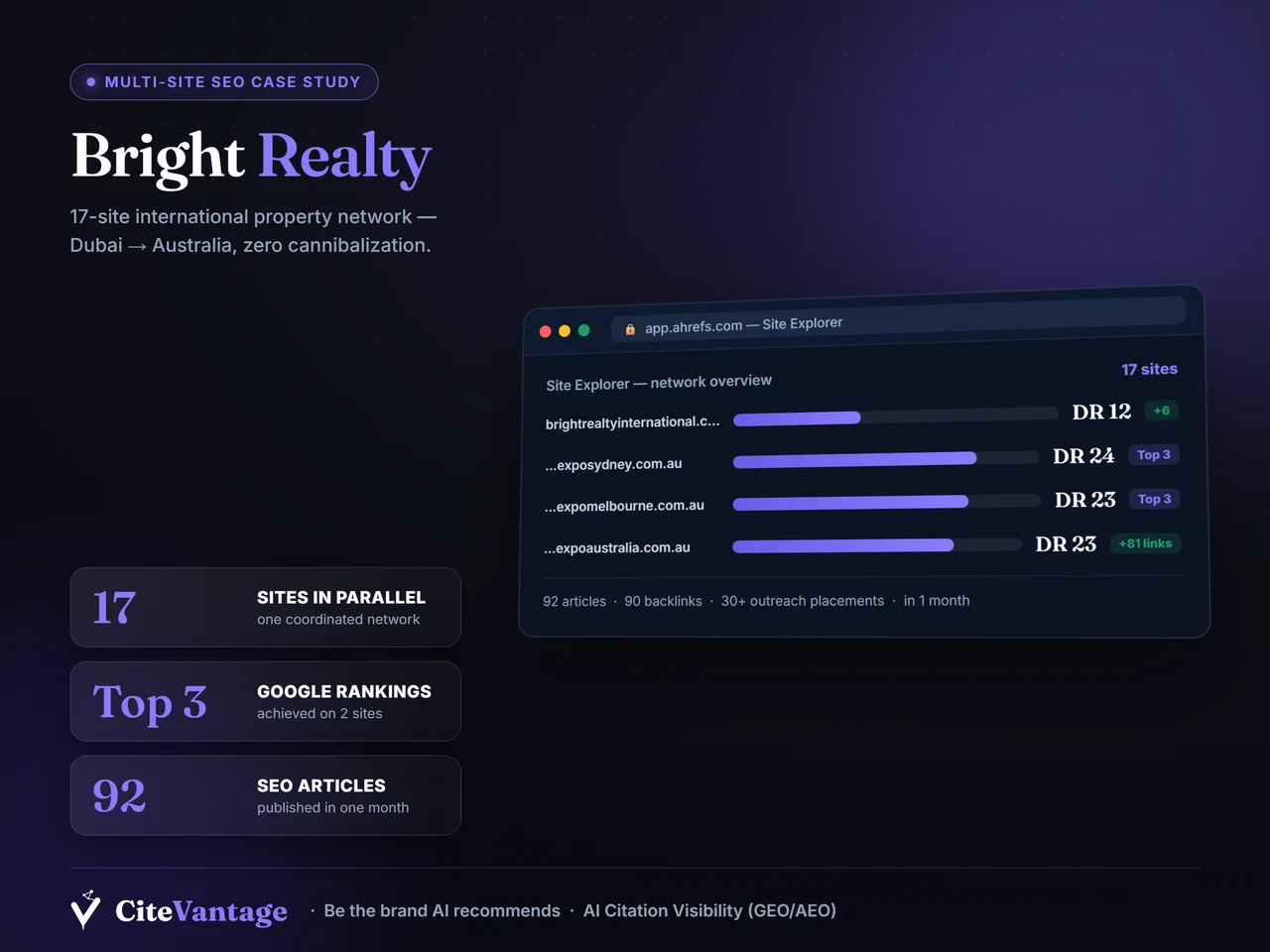
Multi-Site Real Estate SEO
Bright Realty International
Bright Realty wanted to own Australian search demand for Dubai property investment across a network of 17 sites, without the sites eating each other's rankings. In 30 days: 92 articles, 90 backlinks, a 6-point DR climb and two Top 3 Google rankings.
17 sites · Top 3 rankings
AI Visibility Sprint
one-time projectThe full foundation, built and proven in 14 days. Scoped to your niche, delivered like a team. Current pricing lives on the pricing page.
90-Day Cited Guarantee: newly cited by a major AI engine on your agreed buyer questions within 90 days, or we run a second sprint free.
real estate questions, answered
Do home buyers actually use ChatGPT to find agents?+
Yes, and at scale: ChatGPT passed 800 million weekly users in 2025 (OpenAI), and asking for local agent and builder recommendations is a natural use of it. The real question is whether AI can find you. In our audit of 181 brands, 87% were cited zero times across four engines.
What does AI visibility for real estate actually mean?+
AI visibility for real estate means your agency or building company gets named when buyers ask ChatGPT, Gemini, Perplexity or Google AI Overviews who to work with in your market. It is built from verifiable entity data, reviews, local citations and answer-shaped content, and measured by re-testing real buyer questions.
Is this different from normal local SEO?+
It builds on it. Local SEO gets you into map packs and rankings, and Google AI Overviews still lean on that work. AI visibility adds what answer engines need on top: a verifiable entity, structured data, review signals and third-party mentions they can quote with confidence when they name you.
Does one page cover agents and construction companies?+
The playbook is shared, the execution is specific. Agents need RealEstateAgent schema, neighborhood content and portal presence. Builders need LocalBusiness schema, project showcase pages and trade citations. We scope the audit and the build to which one you are, so nothing generic ships under your name.
I am one agent, not a brokerage. Can I compete?+
Yes, especially on specific questions. "Best agent in your city for first-time buyers" is far more winnable than "best agent in your city". Engines like naming well-corroborated specialists because a precise recommendation is safer than a generic one. Your specialty is the wedge; we build the proof around it.
Does this work in Australia as well as the US?+
Yes. Our Bright Realty engagement targeted Australian buyers across a 17-site real estate network: 92 articles and 90 backlinks in 30 days, with two city sites reaching Top 3 Google rankings and no keyword cannibalization. The same entity and citation playbook applies in both markets; only the portals change.
More questions? See the full FAQ or just ask us.
real estate guides and research, from this hub

Free, no call required
See where AI hides your real estate brand.
Two fields. We run your buyers' real questions across ChatGPT, Gemini, Perplexity and Google AI Overviews, screenshot every answer, and email the report inside 48 hours. If you are already in the answer, the report says so.
Prefer to talk first? 15 minutes with Abdul, not a sales rep.
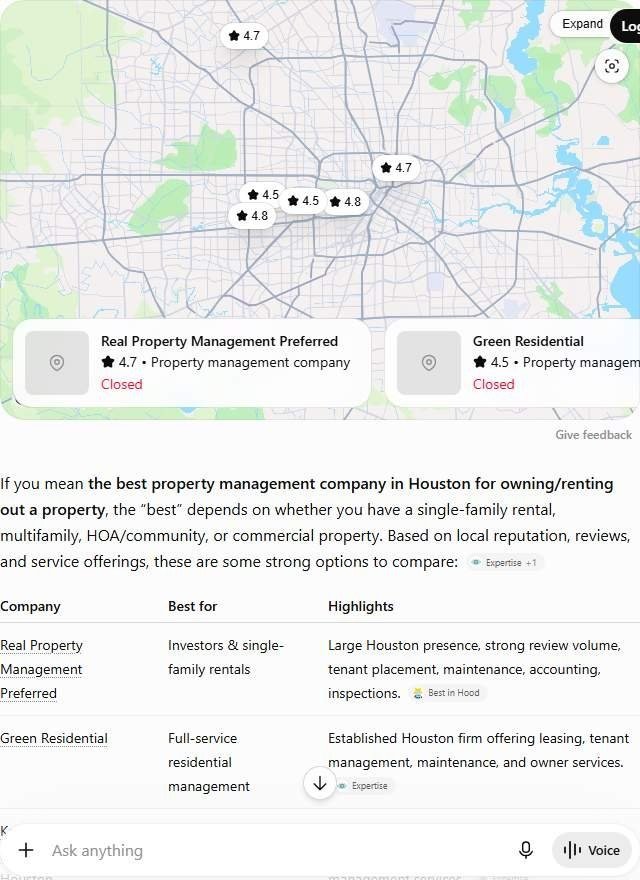
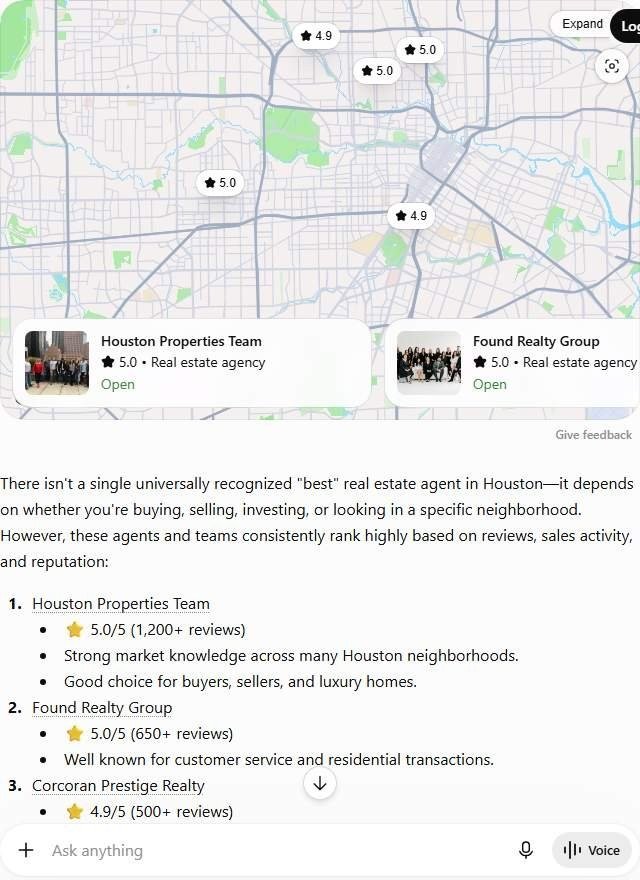 Three named. None of them you.