AI Search for Real Estate Agents: How to Get Recommended by ChatGPT in Your City
By Abdul Subkhan Published
Part of Real estate SEO
Images in this guide are free to reuse (CC BY 4.0). Credit CiteVantage with a link to this page.
A real estate agent gets recommended by ChatGPT by building the trust signals AI engines check: a complete Google Business Profile with steady reviews, a website with RealEstateAgent schema, consistent profiles on Zillow and Realtor.com, mentions in local press and best-agent lists, and neighborhood guides that answer buyer questions directly. That is what AI search for real estate agents comes down to, a short list of signals to complete rather than a new channel to buy.
None of those five things is exotic. Most agents already have pieces of them. The difference between agents who get named and agents who stay invisible is whether the pieces are complete, consistent, and easy for an AI engine to verify. Whether your market calls you a realtor, a real estate agent, or an estate agent, the engine runs the same check before it names you.
The short version: buyers now ask ChatGPT questions like “best realtor in Austin for first-time buyers” before they call anyone. The engine answers by checking your Google Business Profile, your website’s structured data, your portal profiles, and what independent local sources say about you. You can test your own visibility in five minutes, and you can meaningfully improve it in 30 days.
Why are home buyers asking ChatGPT before they call anyone?
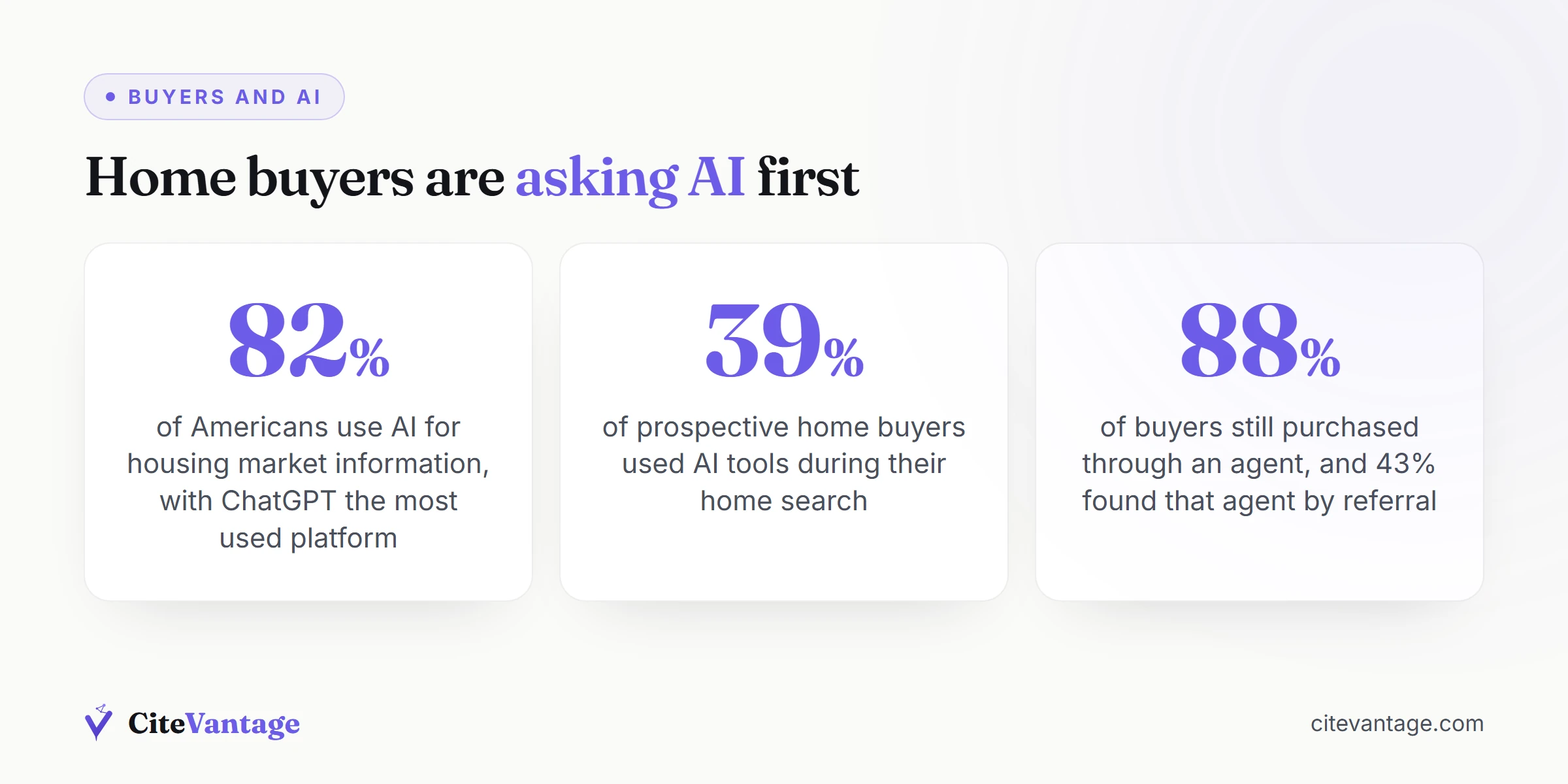
Because it feels like asking a knowledgeable friend rather than searching, and the behaviour is already mainstream. A 2025 Realtor.com survey found 82% of Americans use AI for housing market information, with ChatGPT the most used platform, and a separate Veterans United survey put 39% of prospective buyers using AI tools during their home search. The portals have noticed and are building for it.
A 2025 Realtor.com survey found that 82% of Americans use AI for housing market information, and ChatGPT was the most used platform, ahead of Gemini and Meta AI. A separate Veterans United survey found 39% of prospective home buyers used AI tools in their home search. And in March 2026, Realtor.com launched a home search app directly inside ChatGPT, which tells you where the portals think attention is going.
The questions buyers ask are not the old keyword searches. They are conversations with buyer intent baked in:
- “Who is the best real estate agent in Raleigh?”
- “Best Denver realtor for first-time buyers”
- “Should I buy in Oak Cliff or Bishop Arts?”
- “Is Ballard a good neighborhood for a family with young kids?”
- “What should I offer on a house that has been listed for 60 days?”
Notice what happened to “near me” searches. The buyer no longer types “realtor near me” into Google and scans a map pack. They describe their situation to an AI assistant and get back two or three names with reasons attached. If your name is in that answer, you start the relationship with borrowed trust. If it is not, you were never considered.
Here is the honest counterweight. The National Association of Realtors’ 2025 Profile of Home Buyers and Sellers found that 88% of buyers still purchased through an agent, and 43% found that agent through a referral from a friend, neighbor, or relative. Referrals are not dead. But NAR also found the search process almost always begins online, and “online” increasingly means an AI answer. AI is not replacing the referral. It is becoming the second opinion buyers run the referral through, and the first opinion for buyers who moved to a new city and know nobody.
That second case matters most. Relocating buyers have no referral network in your city. They are exactly the buyers asking ChatGPT who to call.
How do you test AI search for real estate agents in five minutes?
Ask the engines the questions your buyers ask, and write down whether they say your name. Open ChatGPT with web search on, ask for the best agent in your city, the best agent for first-time buyers, and who should sell a home in your neighbourhood. Repeat in Perplexity, Gemini and Google. Three outcomes are possible, and each one points at a different fix.
- Open ChatGPT and turn web search on (the browsing or search toggle).
- Ask: “best real estate agent in [your city]”.
- Ask: “best [your city] realtor for first-time buyers”.
- Ask: “who should I use to sell a home in [your neighborhood or suburb]?”
- Repeat the first question in Perplexity and in Google (to trigger AI Overviews), and in Gemini if you have it.
Then score what you see. Three outcomes are possible:
- You are named. Good. Note which sources the engine cited next to your name, because those sources are your moat. Protect them.
- Competitors are named and you are not. This is the visibility gap. Read the cited sources for the agents who did get named. Almost every time, they appear in a “best agents in [city]” roundup, a local news piece, or a portal profile with heavy reviews. That list of sources is literally your to-do list.
- The engine refuses to name anyone. Common in smaller markets. This is the open-net situation: the engine has no confident answer yet, so the first agent who builds a verifiable footprint tends to own the answer.
One warning about reading results: AI answers vary between sessions and change over time. One test is a snapshot, not a verdict. Run the same five queries monthly and log the results. Movement across months is the real signal.
If you want to see what these answers look like before you run your own, our Austin AI search results page and Brisbane page show real ChatGPT and Gemini answers naming real local businesses in those cities.
What five signals decide which agents get named?
AI engines do not pick names at random and there is no ad auction to enter. They aggregate trust signals from across the web and name whoever the most independent sources agree on, which is why how AI decides which brands to recommend matters more than anything on your own site. Mentions in AI answers come from third-party pages roughly 6.5 times more often than from a company’s own site.
Pro tip: Do the Google Business Profile first. It is the cheapest of the five, it is the one every engine cross-checks, and it is usually the one sitting half-finished. Complete categories, service areas, hours and a steady review flow beat another page on your own site.
For a local agent, the general signals translate into five specific things.
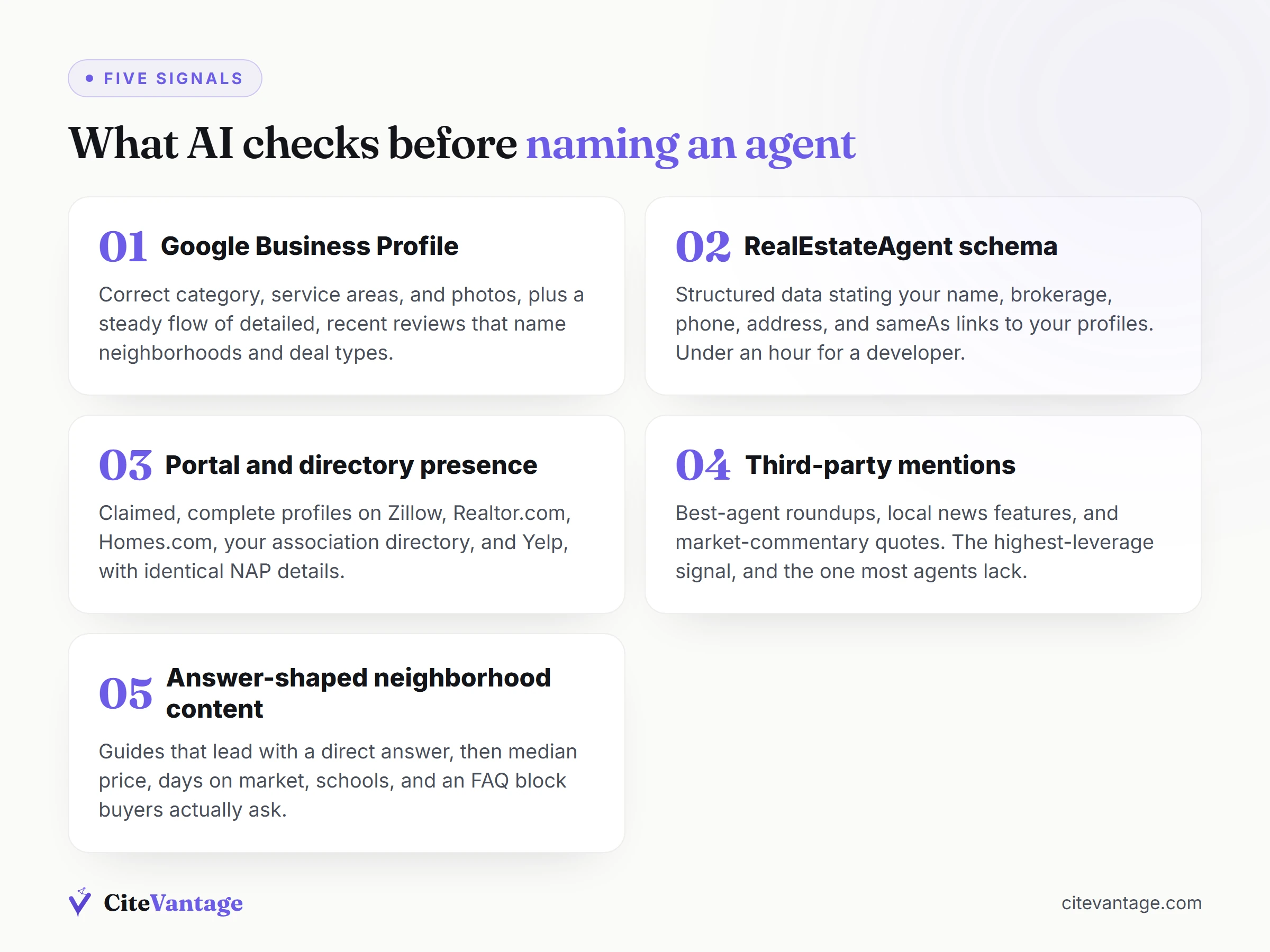
1. A complete Google Business Profile with real review signals
Your Google Business Profile is the closest thing to an identity card that AI engines have for a local business. Gemini and Google AI Overviews draw on it directly, and other engines read the local data that flows out of it.
Complete means: correct primary category (Real Estate Agent), accurate service areas, hours, photos of you and your listings, and a description written in plain language. Then reviews, which are the strongest part. Engines treat a steady flow of detailed, recent reviews as independent proof that you are active and that clients are happy. Fifty specific reviews that mention neighborhoods and transaction types beat two hundred one-liners. Ask every closed client to name the neighborhood and what you helped with. Those details become quotable evidence.
2. A real website with RealEstateAgent schema
Schema is structured data: a small block of code that tells machines, in a standard format, exactly who you are. Google publishes a RealEstateAgent type under its LocalBusiness documentation. It takes a developer under an hour to add.
Your schema should state your name, brokerage, phone, address, service areas and link to your profiles elsewhere (Zillow, Realtor.com, LinkedIn) using the sameAs property. This is entity building: making sure every machine that reads about you resolves to one consistent entity, one agent, one set of facts. And keep NAP consistency, meaning your name, address, and phone number written identically everywhere they appear. Small mismatches (“Jane Smith Realty” here, “Jane Smith Real Estate Group” there) make an engine less confident it is looking at one business, and less confident engines name someone else.
3. Presence on the big portals and local directories
When an engine checks whether you are a real, credible agent, it looks where the data is dense: Zillow, Realtor.com, Homes.com, your state license lookup, your local association directory, and general local citations like Yelp and the chamber of commerce. These listings are your citation layer, the same local citations that classic local SEO has always relied on. The difference now is that AI engines use them for verification, not just ranking.
Claim every profile. Fill each one out completely, with the same NAP details and the same headshot. An agent with a rich Zillow profile, 40 portal reviews, and matching directory listings gives an engine multiple independent confirmations. An agent with one claimed profile and three empty ones gives it doubt.
4. Third-party mentions in local press and best-agent roundups
This is the highest-leverage signal and the one most agents have none of. When ChatGPT answers “best realtor in [city]” with web search on, the pages it actually cites are usually roundup lists: “top 10 agents in [city]” articles, local news features, and market-commentary quotes. If you are in those pages, you get named. If you are not, you almost certainly do not.
How to get in them, in rough order of effort:
- Find every existing “best agents in [city]” list. Contact the publishers. Many have a submission process, and some are award programs you can enter.
- Answer journalist requests. Local reporters constantly need an agent to comment on the market. Sign up for source-request services and reply fast with a specific, quotable stat.
- Pitch one genuinely useful data story to your local paper, like what homes in a specific neighborhood actually sold for versus list price this quarter.
One caution: some roundup sites sell placement outright. A paid slot on a thin listicle nobody reads is worth little. A mention in a real local publication is worth a lot. Judge the page, not the label.
5. Answer-shaped neighborhood content on your site
Buyers ask AI engines about neighborhoods more often than they ask about agents. “Is [neighborhood] safe?” “Which [city] suburbs have the best schools?” “What does $450k buy in [neighborhood]?” Every one of those questions is a chance for your site to be the cited source, which puts your name inside the answer.
The format matters as much as the topic. Write neighborhood guides that lead with a direct answer in the first two sentences, then support it with specifics: median sale price this quarter, days on market, school names, commute times. Add FAQ blocks with the questions buyers actually ask. This is the AEO side of the work, answer engine optimization, and it is where a solo agent can beat the portals. Zillow has data on every neighborhood. It does not have your ground truth about which street floods, which block is walkable, and what buyers regret after a year. Specific, dated, first-hand detail is exactly what engines quote.
What should your 30-day real estate SEO strategy look like?
Work in the order the engines actually read you. Baseline yourself on day one with screenshots, fix the Google Business Profile in the first three days, complete every portal and directory profile by day seven with identical contact details, then add RealEstateAgent schema linking out to all of them. Content and reviews come after that foundation, not before it.
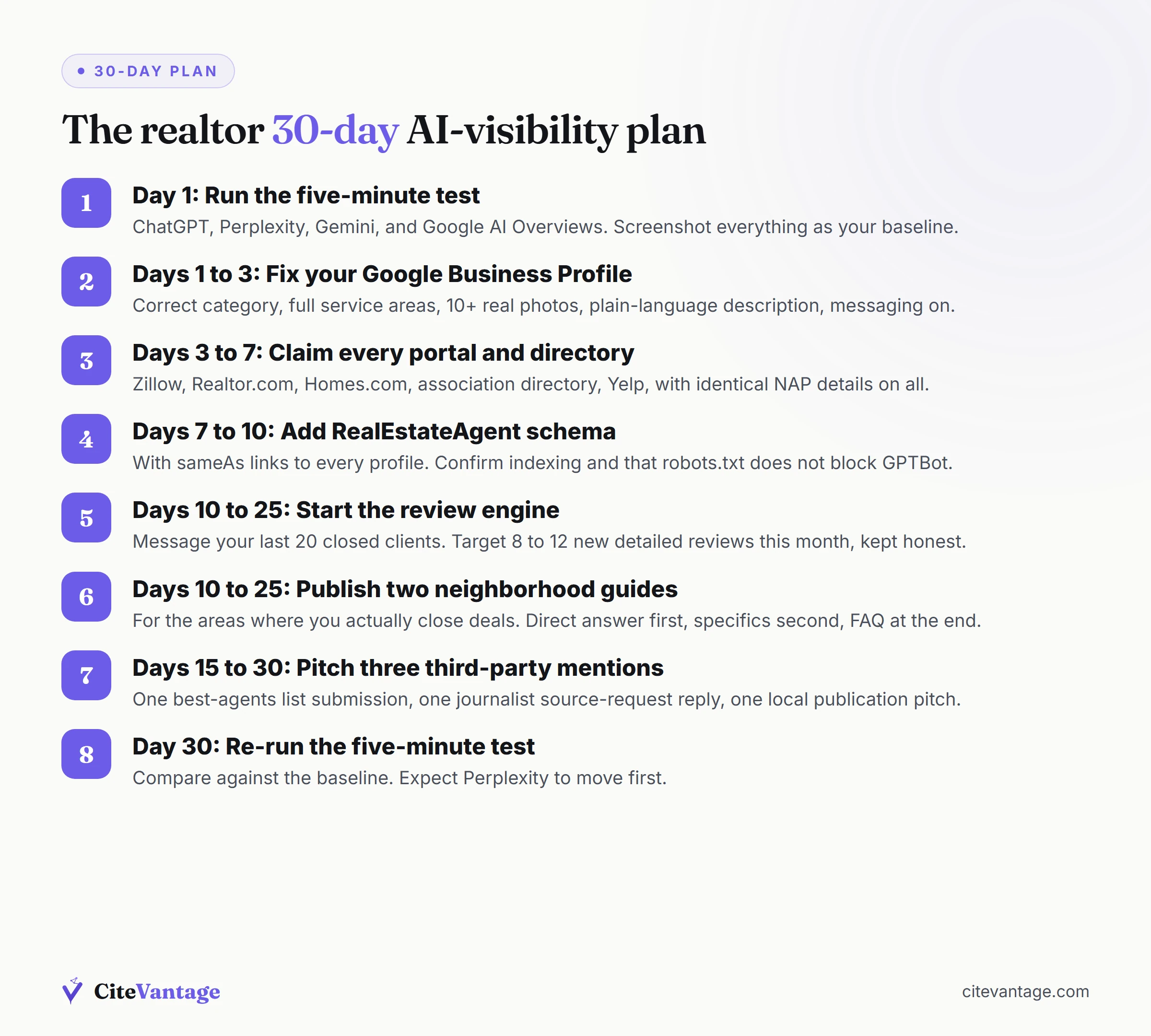
- Day 1: run the five-minute test in ChatGPT, Perplexity, Gemini and Google AI Overviews. Screenshot everything. This is your baseline.
- Days 1 to 3: fix your Google Business Profile. Correct category, full service areas, 10+ real photos, plain-language description. Turn on messaging.
- Days 3 to 7: claim and complete every portal and directory profile. Zillow, Realtor.com, Homes.com, your association directory, Yelp. Identical NAP details on all of them.
- Days 7 to 10: add RealEstateAgent schema to your website, with
sameAslinks to every profile from step 3. Confirm your site is indexed and that your robots.txt does not block AI crawlers like GPTBot. - Days 10 to 25: start the review engine. Message your last 20 closed clients personally. Ask for a Google review that mentions the neighborhood and what you helped with. Target 8 to 12 new detailed reviews this month, and keep it honest.
- Days 10 to 25: publish two answer-shaped neighborhood guides for the areas where you actually close deals. Direct answer first, specifics second, FAQ block at the end.
- Days 15 to 30: pitch three third-party mentions. One “best agents” list submission, one journalist source-request reply, one local publication pitch.
- Day 30: re-run the five-minute test and compare against the baseline. Expect Perplexity to move first.
That is one focused month. Steps 2 through 4 are one-time fixes. Steps 5 through 7 are the compounding habits that decide who owns the answer a year from now.
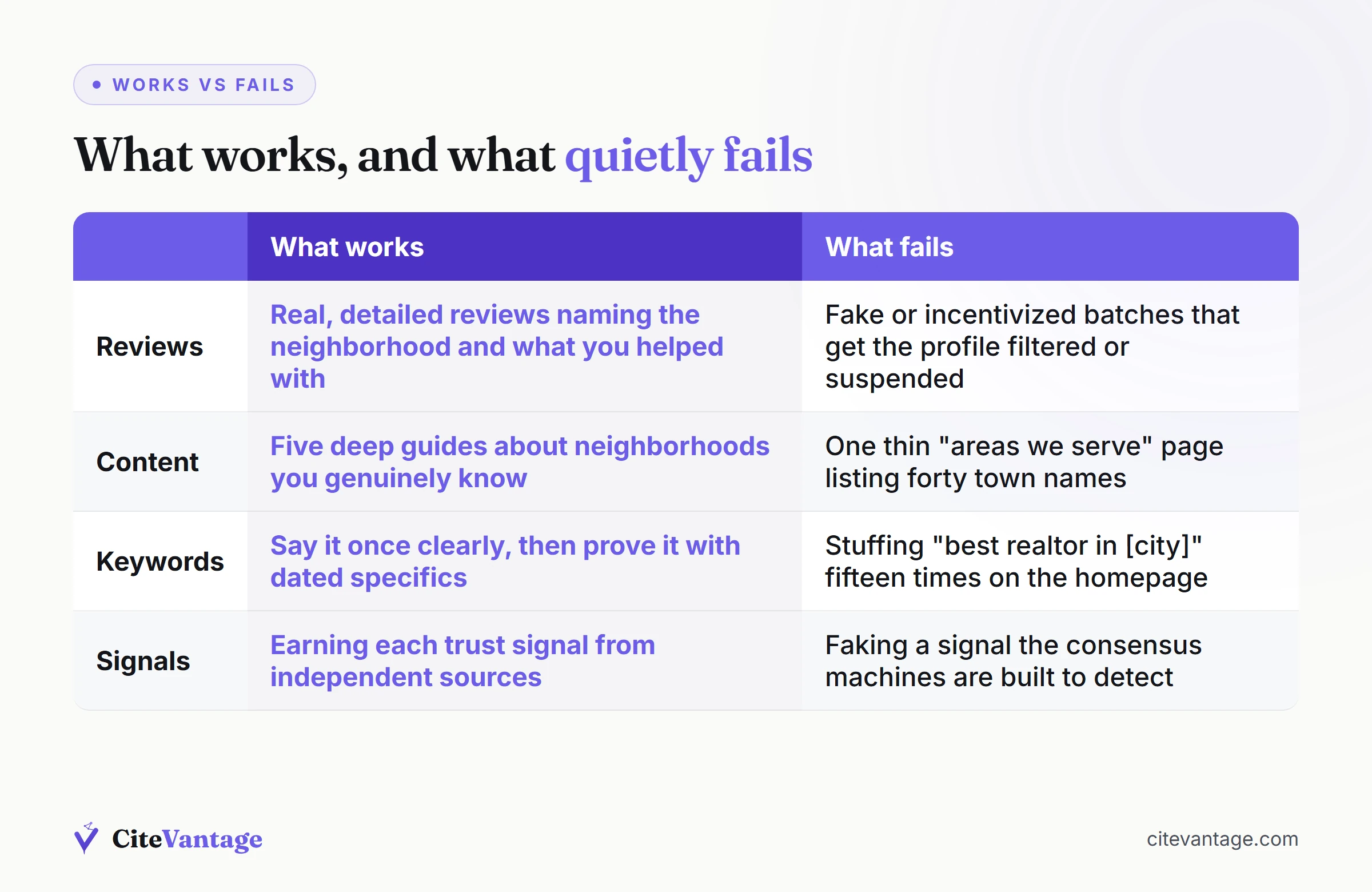
What does not work?
Three tactics agents keep trying that waste time or actively hurt: keyword stuffing, fake or incentivised reviews, and thin AI-generated area pages. The first reads as low quality to both the model and the reader. The second risks your profile being filtered or suspended, which deletes your strongest signal. The third gives an engine nothing specific enough to quote.
Keyword stuffing. Cramming “best realtor in [city]” into your homepage fifteen times worked on search engines in 2012. AI engines read for meaning, and a page that repeats a phrase unnaturally reads as low-quality to the models and to the human the model is writing for. Say it once, clearly, then prove it with specifics.
Fake or incentivized reviews. Engines lean on review signals precisely because they are hard to fake at scale, and the platforms have gotten aggressive about detection. A batch of vague five-star reviews from accounts with no history can get your profile filtered or suspended, which deletes the strongest signal you have. Real reviews, asked for honestly, are slower and worth infinitely more.
One thin “areas we serve” page. A single page listing forty town names with no real content about any of them gives an engine nothing to quote. It is the local-content equivalent of an empty profile. Five deep guides about neighborhoods you genuinely know beat forty name-drops every time.
The common thread: every shortcut tries to fake a signal instead of earning it, and AI engines are consensus machines built to detect exactly that.
Does the same playbook work for brokerages and construction companies?
Yes, with one swap. A brokerage, home builder, roofer or construction company runs the identical five signals but marks itself up with LocalBusiness schema, or a more specific type such as HomeAndConstructionBusiness, instead of RealEstateAgent. Everything else transfers: a complete Google Business Profile, consistent details across citations, directory presence where Houzz and Angi replace Zillow, mentions in local press, and answer-shaped pages about the areas you cover.
The opportunity is arguably bigger in construction, because so few contractors have done any of this. In most metros, the first roofing company with clean schema, 100 detailed reviews, and three genuinely useful cost guides becomes the default AI answer for years. Our AI visibility for real estate and construction service runs this playbook for agents and brokerages, and our AI search for home services businesses service covers roofers, remodelers, and the trades. Both sit on the same local AI visibility foundation, for agents and contractors alike.
Where does AI search for estate agents fit in the bigger picture?
Everything above is generative engine optimization applied to one local vertical. The principle holds: engines recommend whoever the most independent sources agree on, so the work is being easy to find, verify and quote. What changes by industry is which sources count. In real estate they are Google’s local data, the portals, local press and your neighbourhood content. UK surfaces differ, as covered in SEO for estate agents.
And a last dose of honesty: we audited 181 ecommerce brands last month and 87% were never mentioned when AI answered questions about their own category. We see the same pattern in local markets. Our Bright Realty multi-site real estate result shows what closing that gap looks like in real estate specifically. That is bad news if you wait and very good news if you move now, because in most cities the answer slot for “best real estate agent” is still winnable.
Want us to run the city-level test for you?
You can run the five-minute test yourself today, and you should. If you want the full picture, our free AI visibility audit runs your city’s buyer queries across ChatGPT, Gemini, Perplexity and Google AI Overviews, scores you against the agents currently being named, and identifies which of the five signals you are missing. Results come back within 48 hours, on the queries buyers in your market actually ask.
The agents getting named by ChatGPT this year did the boring work early. The window to be first in your city is still open. It will not stay that way.
Frequently asked questions
Do home buyers actually use ChatGPT to find real estate agents?
+
Yes, and the numbers are climbing fast. A 2025 Realtor.com survey found 82% of Americans use AI for housing market information, and ChatGPT was the most used platform. Buyers ask about neighborhoods, prices and agents before they call anyone. Referrals still close most deals, but AI now shapes the shortlist a buyer starts with.
How do I get ChatGPT to recommend me as a realtor in my city?
+
Build the five signals AI engines check: a complete Google Business Profile with steady recent reviews, a website with RealEstateAgent schema, matching profiles on Zillow and Realtor.com, mentions in local press and best-agent roundups, and neighborhood guides that answer real buyer questions. Then test monthly by asking ChatGPT for the best agent in your city.
What is GEO for real estate?
+
GEO stands for generative engine optimization. It is the work of making your business visible in AI-generated answers from ChatGPT, Gemini, Perplexity and Google AI Overviews. For real estate, it combines local SEO basics (profiles, citations, reviews) with structured data and answer-shaped content, so AI engines can find you, verify you, and name you.
Does my Google Business Profile matter for AI search?
+
Yes, a lot. AI engines lean on Google's local data to confirm you are a real business in a real place. A complete profile with the right category, service areas, photos and a steady flow of detailed reviews gives them concrete evidence. An empty or inconsistent profile gives them nothing to repeat, so they name someone else.
How long does it take to show up in AI answers?
+
Expect 30 to 90 days for early movement. Perplexity refreshes fastest because it searches the live web on every query, so new pages and mentions can surface within days. ChatGPT and Google AI Overviews move slower. Profile fixes and schema are quick wins. Press mentions and reviews compound over months. Test your city queries monthly and track changes.
Can I pay ChatGPT to recommend my real estate business?
+
No. There is no ad slot inside an organic ChatGPT recommendation and no one to pay for placement. The recommendation is earned through trust signals: reviews, consistent profiles, third-party mentions and useful content. You can pay for help building those signals faster. A free AI Visibility Audit shows which signals you are missing.
More in Real estate SEO
- 150-Query Real Estate AI Search Study
- AI Visibility Audit for Real Estate: What It Checks
- Best AI SEO Agencies for Real Estate Agents 2026
- Best SEO Agencies for Real Estate Brokerages 2026
Start from the hub: Real estate SEO
See where AI is hiding your brand
Free multi-engine audit across ChatGPT, Gemini, Google AI & Perplexity.
See who AI names instead of me