Perplexity
2.1x
clicks across Bright Realty International’s network, measured on the 15 sites with a full three-month history
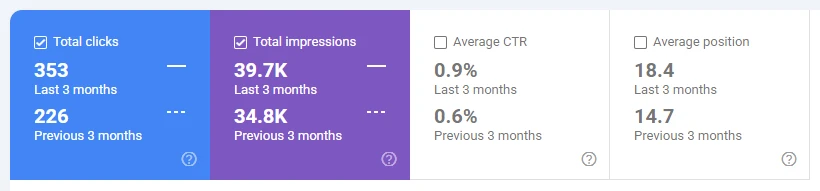
Real estate, 17 domains, Search Console 21 Sep 2026
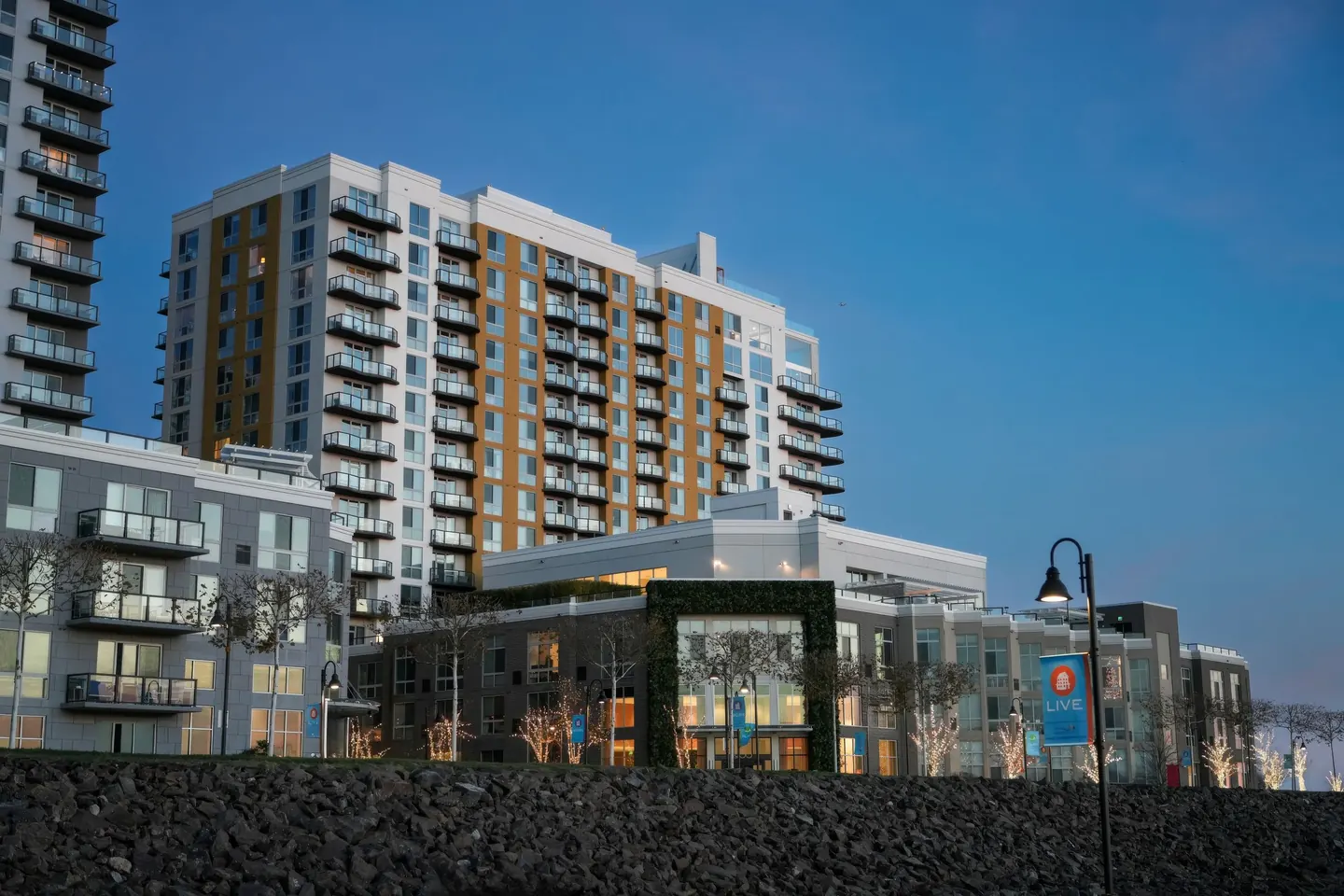
A multifamily SEO agency for communities renters ask AI about.
The free audit puts 50 renter and owner questions to each of ChatGPT, Gemini, Perplexity and Copilot and shows who gets named. No call and no card.
One question, two runs
Day 0ChatGPT, trimmed
best property management company in Denver
You: not named
Day 90IllustrationThe same question, asked again
best property management company in Denver
This question now counts toward your 25%.
Apartment communities get recommended when an engine can verify them from sources it trusts, and building that verification is the whole job of a multifamily SEO agency. It takes complete ApartmentComplex schema, floor plans and rents that are crawlable rather than locked inside an availability widget, recent reviews that mention resident experience, and presence on the listing services engines cross-check. A polished site alone will not get you named.
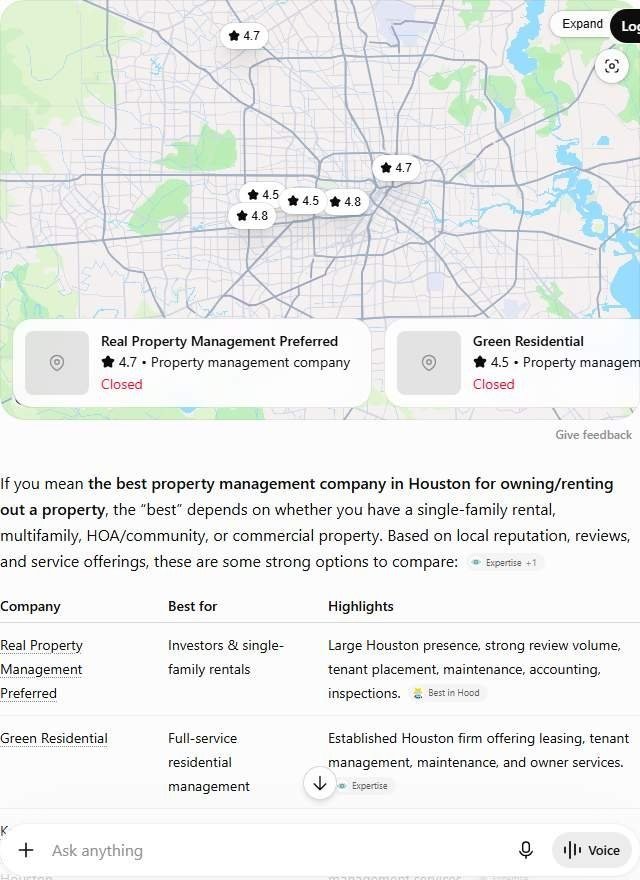
 Perplexity
The five engines every plan is measured on. The free audit runs the first four.
Renters ask assistants about neighbourhoods, price and pet policy before they book a single tour, and owners ask which manager to hand a building to. Both conversations end with named communities and named firms. These are the questions we run on live engines, and each one is a tour or a mandate going somewhere.
“Best SEO agency for multifamily apartment communities”
ChatGPT6 named
Perplexity5 named
2of 9
Two names both engines agreed on, out of 9 distinct names. The violet rows mark them.
CiteVantageon neither list
“Best apartments in my city under a set budget?”
“Which apartment communities allow large dogs?”
“Best luxury apartments near downtown with parking included?”
“Which new apartment buildings are offering move-in specials?”
“Best apartments for a short commute to a named employer?”
“Which communities have the fewest complaints about maintenance?”
“Best SEO agency for multifamily apartment communities?”
“Who markets lease-ups for new apartment communities?”
“Which marketing agency understands Entrata and Yardi feeds?”
Every question here is a shortlist your brand is either on or missing from.
Multifamily SEO services run on a 90-day clock. The first 30 days audit and fix, the next 30 build the review profiles and local coverage engines check a community against, and the last 30 close the gaps. Day 90 is the guarantee re-test on the renter and owner questions you approved in week one.
The 90 days start on the day you sign a monthly plan. A standalone Sprint bought earlier does not count toward them.
Perplexity01Days 0 to 30
Day 30
Early re-test
The same questions, free, so you see what moved before day 90.
02Days 31 to 60
03Days 61 to 90
Day 90
The guarantee re-test
Each question runs 3 times on each engine and counts when you appear in 2 of 3. Target: 25% of your list.
Target met. The plan carries on as normal.
We work two more months free, your billing pauses, and we re-test after each month.
04Day 91 onward
2.1x
clicks across Bright Realty International’s network, measured on the 15 sites with a full three-month history
Real estate, 17 domains, Search Console 21 Sep 2026
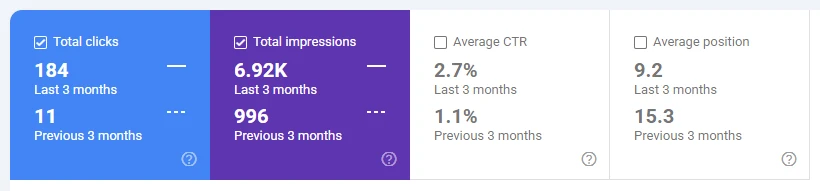
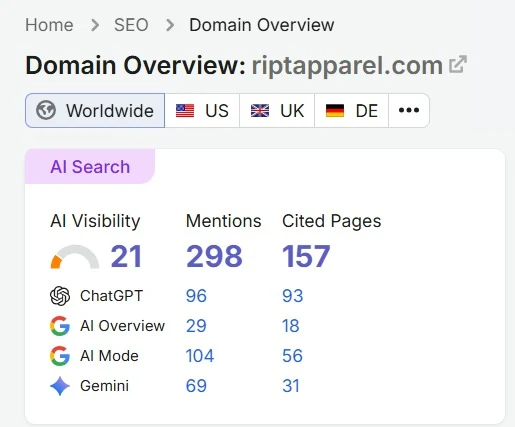
157
RIPT Apparel pages cited in AI answers, with 298 mentions across ChatGPT, Google AI Overviews, AI Mode and Gemini, per Semrush
Apparel store
1-in-4
Named on 25% of the questions you approve by day 90, or we work two more months free.
Read the guarantee termsEvery multifamily engagement starts with the free AI Visibility Audit, which puts 50 of your renter and owner questions to each of ChatGPT, Gemini, Perplexity and Copilot and shows who gets named instead of you. Every plan and price lives on the pricing page.
$0
48 hours
Who AI names instead of you: 50 questions on each of ChatGPT, Gemini, Perplexity and Copilot, 200 answers
$99
one-time
300 questions, 1,200 answers, and the fixes ranked by harm
$249
one-time
The fixes and up to 6 guides. Credited to month one if a plan starts within 30 days.
from $499/mo
3-month minimum
Agent $499, Brokerage $999, Multi-Market $1,899, each with the 1-in-4 Guarantee
Twelve questions multifamily operators and owners ask before they hire us, from how this differs from property management SEO to what each engine weighs. Each answer starts with the short version, then the detail and the numbers behind it. More questions? See the full FAQ or just ask us.

Abdul SubkhanFounder. Runs every audit himself.
abdul@citevantage.com
The buyer changes, so the questions change with it.
Property management SEO chases owners deciding who should manage their asset. Multifamily SEO chases renters deciding where to live, plus the operator questions behind a lease-up. Renter queries are driven by constraints, and they reward pages that state specifics an engine can quote directly. The constraints that show up in renter questions:
Yes, it is usually the biggest single problem we find on community sites.
When rents and floor plans render only after a script runs, an engine answering a budget question has nothing of yours to work with, so it quotes a listing service instead. Publishing the same information as crawlable text alongside the widget fixes it without changing how residents apply. At minimum the text version should carry unit types, square footage, current rent ranges and the date the figures were last updated.
Yes, and lease-up is where it matters most, because every week of vacancy carries a real cost.
With no residents there are no reviews, so the work shifts toward what exists before residents do. The goal is a community that already appears in AI answers while it is still being built, instead of arriving on move-in day with nothing for an engine to read. What we publish early:
Both, and portfolios usually move faster per property because template fixes apply everywhere at once.
The trap in a portfolio is near-identical community pages, which leave no single property reading as the right answer for any particular query. We treat the differences between submarkets as the asset instead of standardising them away: the commute, the pet policy, the price band and the renters each building actually attracts. Reporting runs per community, so you can see which properties get named and which still need work.
ChatGPT, Perplexity, Gemini, Copilot and Google AI Overviews, on your real renter questions, with dates and screenshots.
Each engine builds its shortlist from different sources, so a result on one tells you little about the others. When an engine returns nothing usable for a query we record that too, instead of dropping it from the report. The multifamily figures on this page came from a live run on 8 September 2026, when ChatGPT named six agencies and Perplexity built its answer from fifteen sources.
Technical and listing work lands within the first two weeks, and AI citations take longer.
Engines have to re-crawl both your community sites and the listing services they cross-check, and that happens on their schedule. Crawlable rents and clean entities tend to surface first on narrow renter questions for a single submarket. The 1-in-4 Guarantee on our monthly plans puts the timing in writing: named on at least 25% of your agreed questions within 90 days, or we work the next two months free.
6 agencies ChatGPT named in one answer when asked for the best SEO agency for multifamily apartment communities (CiteVantage engine run, ChatGPT, 8 September 2026).
A renter shortlisting apartments no longer opens ten tabs. They ask an assistant which communities fit their budget, their commute and their move-in date, and the answer comes back with a handful of names. Everything outside that answer is invisible, which is the same wall a lease-up hits on day one with no reviews and no history behind it. A multifamily SEO agency has to win the specific questions renters and owners type, not the generic occupancy keywords that fill a reporting dashboard. 15 sources Perplexity assembled its multifamily agency answer from, none of which were us at the time of the run (CiteVantage engine run, Perplexity, 8 September 2026). 94% of Houston's roughly 50,000 Realtors were never named across 2,000 AI answers in our own real estate study (CiteVantage 500-Query Houston study, September 2026).
Seven signals, and an engine that cannot confirm them tends to name someone else.
An engine checks each of them without taking your word for it. What it looks for, and where most communities fall short:
Traditional multifamily marketing buys visibility on the listing networks.
That still fills units, but it does nothing for an assistant that answers from review profiles, local coverage and its own reading of community websites. When the renter asks the assistant instead of browsing the network, the spend stops reaching the moment the decision is made. The patterns we see most often:
We work the community level and the firm level at once.
For communities that means review profiles, amenity and policy answers written plainly, and property entities that resolve. For the management firm it means the owner-facing questions and the sources that answer them. Then we re-run both sets of questions and report what changed. What we build:
Five steps, run in the same order on every multifamily engagement.
Each step depends on the one before it, so the order matters more than any single step. The steps, in order:
Each engine leans on different sources, which is why we test all of them instead of guessing at one.
Observed across our own dated engine runs during 2026, including the multifamily run on 8 September 2026. Engines change, so this is what we saw rather than a permanent ranking of factors. What each engine leans on for a rental question:

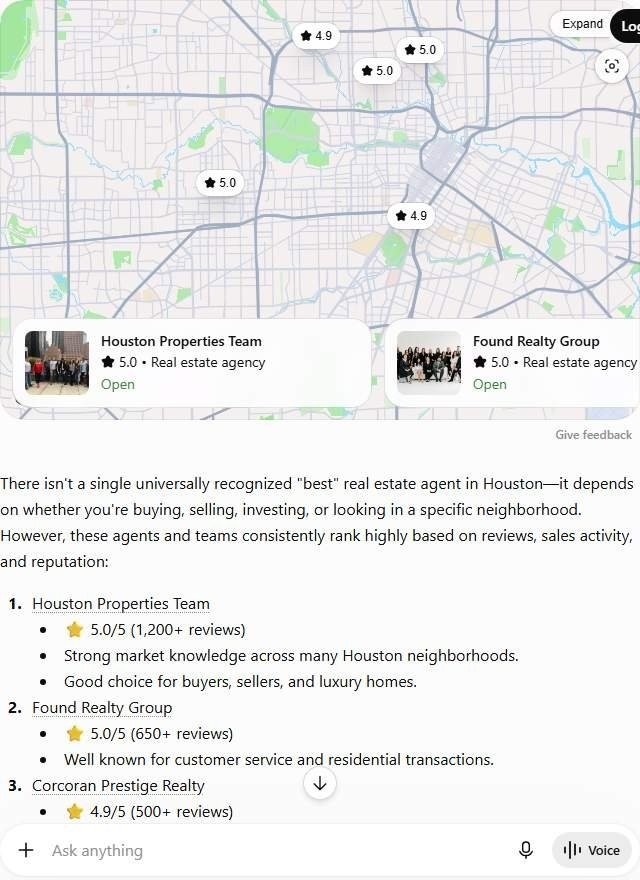 Nine named. None of them you.
CiteVantage Assistant
AI assistant. For anything serious: abdul@citevantage.com