Independent research
82.6% of the Houston real estate agents AI names appear in exactly one of 40 areas
By Abdul Subkhan Published 23 September 2026 Fieldwork 18 to 22 September 2026
Across 500 Houston real-estate queries put to four AI surfaces in September 2026, a hand-checked 82.6% of the real estate agents, teams and brokerages the engines named appeared in exactly one of 40 Houston areas. Only about 6% of HAR members were named at all, and 83.5% of the agents named appeared on a single surface.
appear in exactly one of 40 Houston areas
Hand-checked across roughly 3,000 agents, teams and brokerages named in 1,940 Houston answers; 95% interval 79.8 to 85.7. Katy is lit as one area of the 40.
82.6%
of the real agents named appear in exactly one area (hand-checked, 95% interval 79.8 to 85.7)
83.5%
of the real agents named appear on only one of the four surfaces (hand-checked, 95% interval 78.9 to 87.9)
~3,000
real agents, teams and brokerages named at all, about 6.1% of HAR's 50,000 members (hand-checked)
What we found
In 500 real-estate queries put to four AI surfaces about Houston in September 2026, a hand-checked 82.6% of the real estate agents, teams and brokerages named appeared in exactly one of 40 Houston areas (95% interval 79.8 to 85.7). 83.5% appeared on only one of the four surfaces, and 56.4% were named exactly once across the whole study.
The area lock is the finding. A firm the surfaces name for Sugar Land is, in almost every case, a firm no surface names for Spring or Kingwood.
Reach across surfaces is narrower still. Hand-checked, 74.3% of real agents were held to one area and one surface at the same time, which is one engine update away from zero visibility. 56.4% were named exactly once in 1,940 geo-clean answers.
The script extracted 4,841 distinct names, but a hand-labelled sample of 400 shows that about 29% of them are not businesses at all: evaluation criteria, query echoes, headings and neighbourhoods. The estimate for real agents, teams and brokerages named is roughly 3,000 (95% interval 2,800 to 3,267). Against the Houston Association of Realtors' own figure of more than 50,000 members, that is about 6% of HAR members named even once, closer to one in sixteen than one in ten.
Prior work points the same way. Our own 150-Query Real Estate AI Search Study found that 83.0% of 1,297 cited domains reached only one of five engines, and this study tests whether the same shape holds at business level. FlyDragon's report The 2026 State of AI SEO in Real Estate (April 2026, goflydragon.com) reported 91% of agents effectively invisible in AI answers, and their top-ranked Houston agent, James Krueger, is our top-ranked agent too.
How this Houston AI visibility study was run
CiteVantage put 500 real-estate queries covering 40 Houston areas to four AI surfaces between 18 and 22 September 2026, producing 2,000 answers, 1,940 of which passed the geo-clean filter. Every business named and every domain cited was recorded. The full row-level data, the query set and the analysis code are published under CC BY 4.0.
We put 500 queries about Houston real estate, covering 40 named Houston areas, to four AI surfaces in September 2026: ChatGPT, Gemini (API-based), the Gemini web app and Perplexity. That is 2,000 answers, of which 1,940 passed the geo-clean filter after 60 were excluded for answering about the wrong place. Fieldwork ran from 18 to 22 September 2026. For each answer we recorded every business or agent named and every domain cited. Names were extracted heuristically, and every structural percentage is published beside a strict-filter sensitivity check. The study is released under CC BY 4.0 with the row-level data, the query set and the analysis code published alongside it.
- Queries
- 500, across 40 Houston areas and 8 intent tiers, plus metro-wide questions
- Surfaces
- ChatGPT, Gemini (API-based), Gemini (web), Perplexity
- Answers
- 2,000; 1,940 counted
- Excluded
- 60 answers (3%) about the wrong place
- Recorded
- Firms named and domains cited, per answer
- Fieldwork
- 18 to 22 September 2026
- Validation
- 400 names hand-labelled, blind to outcome
- Extraction
- Heuristic; strict filter and a hand-labelled sample published
- Licence
- CC BY 4.0, reuse with attribution
- Prior work
- The 150-query study, on which domains engines cite
Your area is the whole market
Across 500 Houston AI queries in September 2026, 84.7% of the extracted names appeared in exactly one of 40 areas, 4,100 of 4,841, and a hand-labelled sample puts the figure for real agents, teams and brokerages at 82.6%. Only 741 names reached two or more areas and only 106 reached five or more.
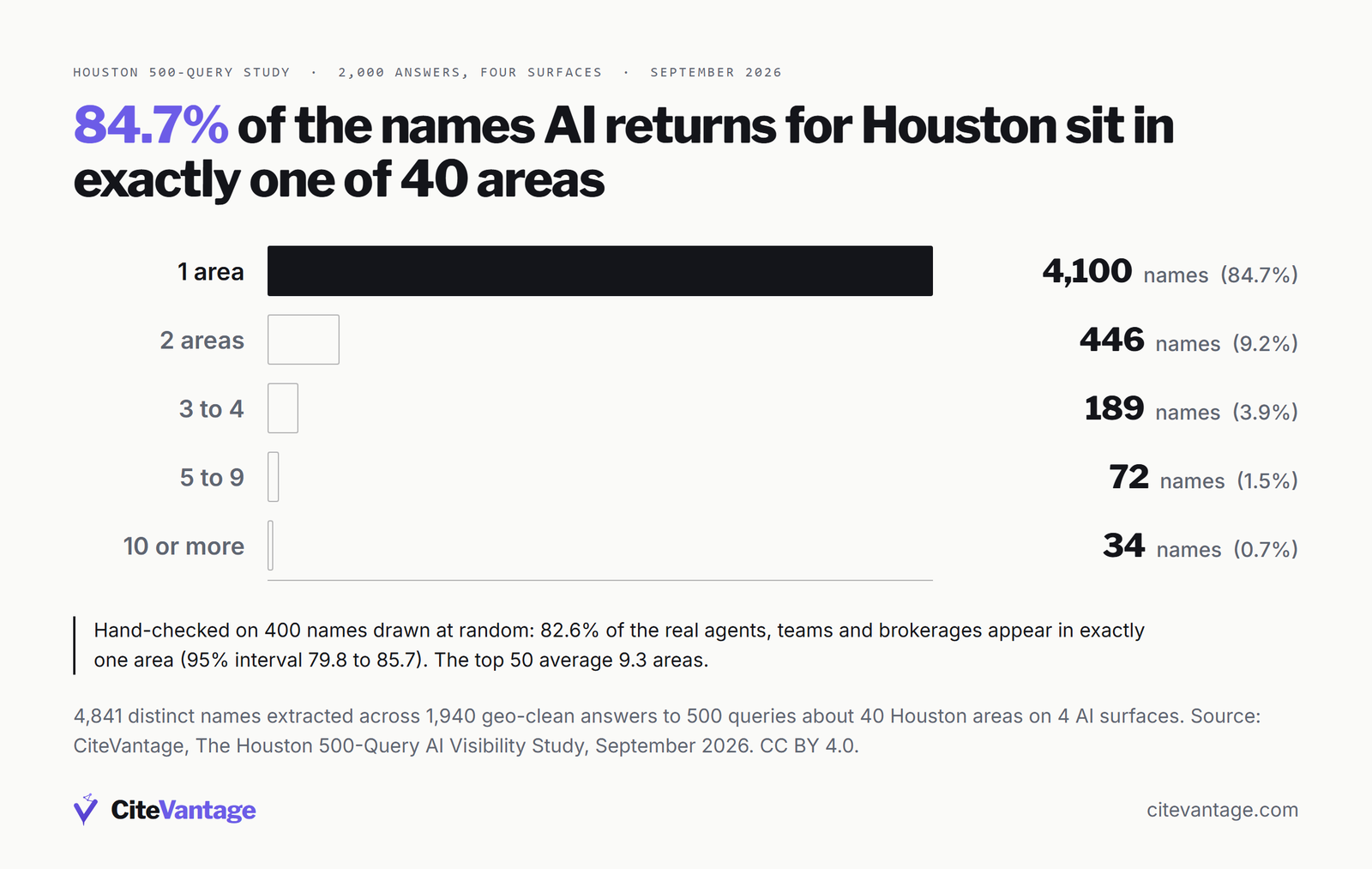
The firms with genuine breadth are countable. James Krueger appeared in 31 of the 40 areas, Sotheby's International in 22, Coldwell Banker in 22, Better Homes and Gardens Gary Greene in 18, Compass in 18, Alfonso Parodi in 18, Perry Homes in 17 and Jennifer Yoingco in 16. Below that list the field thins fast: only 106 names reached five areas, and 4,100 never left one.
The thinnest fields were League City with 110 distinct names ever returned, Atascocita with 119, Cinco Ranch with 131 and West University with 132, tied with River Oaks, which drew 46 answers. The most crowded were Spring with 327 names, the generic Houston queries with 233 and Alief with 191.
Read the crowded figures with the question count beside them. Spring drew 94 geo-clean answers and the generic Houston queries drew 77, against 48 for most areas, so part of what looks like a denser field is simply more questions asked about that area. The four thinnest fields all sit on the standard 48 answers, which makes them comparable to each other.
For a working agent the practical shape is this: the area you are named in is, in roughly eight cases out of ten, the only area you are named in, and the field you are competing against in a thin area is closer to 110 names than to 50,000.
All 40 areas, with their firm and answer counts, are in the data appendix.
Four surfaces, four markets
On the 442 Houston queries every surface answered in September 2026, 87.2% of the names returned came from only one of the four AI surfaces, 8.5% from two, 3.1% from three, and 51 names, 1.2%, from all four. Hand-checked across all queries, 83.5% of real agents appeared on a single surface.
The surfaces are not even working from lists of the same size. On that controlled subset, ChatGPT named 830 distinct firms, the Gemini web app 866, Gemini API-based 1,378 and Perplexity 1,983.
Overlap between any two of them is small. Gemini API-based and the Gemini web app shared the most, 268 firms, 13.6% of their combined list. ChatGPT and the Gemini web app shared 164, 10.7%. ChatGPT and Gemini API-based shared 182, 9.0%. Gemini API-based and Perplexity shared 197, 6.2%. ChatGPT and Perplexity shared 133, 5.0%. The Gemini web app and Perplexity shared 120, 4.4%, the lowest pair in the study.
The most-mentioned of the firms every surface named are James Krueger (153 mentions), Monica Foster (106), Jamie McMartin (78), Jay Thieme (62), Christy Buck (62), Jill Smith (55), Better Homes and Gardens Gary Greene (55), Cody Scurlock (54), Michele Harmon (50) and Houston Properties Team (48). That is the head of a list of 55 names returned by all four on the all-query basis, out of 4,841 extracted.
| Surface | Answers counted | Distinct firms named | Answers naming nobody |
|---|---|---|---|
| ChatGPT | 463 | 887 | 43 |
| Gemini (API-based) | 479 | 1,546 | 9 |
| Gemini (web) | 500 | 1,000 | 32 |
| Perplexity | 498 | 2,262 | 59 |
| Named by | Firms | Share |
|---|---|---|
| 1 of 4 surfaces | 3,730 | 87.2% |
| 2 of 4 surfaces | 365 | 8.5% |
| 3 of 4 surfaces | 131 | 3.1% |
| 4 of 4 surfaces | 51 | 1.2% |
Controlled subset: 442 queries answered by all four surfaces, 4,277 firms.
Most named firms are named once
A hand-labelled sample puts 56.4% of the real Houston agents, teams and brokerages that AI surfaces named across 500 queries in September 2026 at exactly one mention (95% interval 50.9 to 61.8). As extracted, including names that are not businesses, the figure is 68.0%, and the median name has one mention.
Concentration is real without being extreme. The Gini coefficient across 11,100 mentions is 0.491. The top 1% of firms, 48 of them, take 17.3% of all mentions, and the top 10%, 484 firms, take 47.4%.
What separates the head from the tail is breadth rather than volume. The top 50 firms average 9.3 areas, 3.42 surfaces and 7.02 intents. Everyone else averages 1.3 areas, 1.15 surfaces and 1.42 intents. A firm in the head is present in several different conversations at once, while a firm in the tail exists in one answer to one question.
National brands are a small share of the whole. 149 brand and franchise names took 728 mentions, 6.6% of the total, and the other 4,692 names took 10,372, 93.4%, most of them individual agents and local teams. The brands convert their mentions into breadth more often: 17 of 149 brands reached five or more areas, 11.4%, against 89 of the 4,692 other names, 1.9%.
| Most-named | Firms | Share of all mentions |
|---|---|---|
| Top 1% | 48 | 17.3% |
| Top 5% | 242 | 36.8% |
| Top 10% | 484 | 47.4% |
| Top 25% | 1,210 | 64.2% |
Extraction sensitivity: every headline figure checked by filter and by hand
Every structural figure in the 500-query Houston study of September 2026 is published three ways: as extracted, under a strict filter that deletes 24.2% of names, and as a hand-checked estimate from 400 names labelled blind. The one-area figure reads 84.7%, 82.6% and 82.6%: the strict filter and the hand check land on the same number.
| Metric | As extracted what the script returned | Strict filter built to break the finding | Hand‑checked real agents only, 95% interval |
|---|---|---|---|
| Distinct firms named | 4,841 | 3,671 fewer, by construction | 3,0332,800 to 3,267 |
| Mentions, total | 11,100 | 9,515 fewer, by construction | not estimated |
| Named exactly once across 500 queries | 68.0% | 62.7% −5.3 pts | 56.4%50.9 to 61.8 |
| Named in exactly one of 40 areas | 84.7% | 82.6% −2.1 pts | 82.6%79.8 to 85.7 |
| Named by one of four surfaces1 | 87.5% | 84.1% −3.4 pts | 83.5%78.9 to 87.9 |
| One area and one surface | 80.3% | 77.1% −3.2 pts | 74.3%69.9 to 78.5 |
| Gini coefficient of mentions | 0.491 | 0.524 stronger more concentrated | not estimated |
| Share of 50,000 HAR members ever named | 9.7% | 7.3% stronger fewer ever named | 6.1%5.6 to 6.5 |
1 87.5% is the uncontrolled figure over all 1,940 answers. The four-surfaces section uses 87.2%, the controlled subset of 442 queries every surface answered; the headline cards use the hand-checked 83.5%.
Every structural finding survives both checks, and three move enough to matter, so all three appear on this page in their hand-checked form: named exactly once falls from 68.0% to 56.4%, one area and one surface from 80.3% to 74.3%, and the share of HAR members named from 9.7% to 6.1%. The names the checks remove are overwhelmingly single-mention and single-area, which is the shape that inflated those three.
Same engine, two surfaces
On 479 Houston queries that both Gemini surfaces answered in September 2026, the API-based surface named 7.8 firms per answer and the Gemini web app named 3.9. They named 3,739 and 1,866 firms respectively, shared only 352, and on roughly 57% of queries they named nobody in common. Any claim about Gemini visibility has to say which surface.
Across the 479 Houston queries that Gemini API-based and the Gemini web app both answered in September 2026, the API-based surface named 7.8 firms per answer against 3.9 on the web app, and the two surfaces shared only 352 of the firms they named, 6.7% of their combined list. API-based named 3,739 firms in total, the web app 1,866.
Query by query the divergence is starker. The two surfaces shared at least one firm on 189 of 440 queries, 43.0%, which leaves roughly 57% of queries where the same engine, asked the same question through two surfaces, returned no firm in common at all. Both surfaces answered the same 479 queries in the same five-day window, so the gap is a property of the surfaces rather than of the sample.
The web app also behaves like a local search product in a way the API-based surface does not. Google Business Profile markers, star ratings and opening hours, appeared in 88 of 479 Gemini web answers against 27 of 479 API-based answers.
The consequence for anyone measuring is direct: a report saying an agent is visible in Gemini, or invisible in Gemini, is close to meaningless unless it names the surface it measured. Both are Gemini, and they return different Houston markets.
- Queries
- 479 answered by both Gemini surfaces
- Firms per answer
- 7.8 API-based, 3.9 web
- Firms named
- 3,739 API-based, 1,866 web
- Shared
- 352 firms, 6.7% of the union
- No firm in common
- 251 of 440 queries (57%)
- Business Profile markers
- 88 web, 27 API-based, of 479
Change the question, change the list
In 500 Houston queries across four AI surfaces in September 2026, 94.0% of the firms named in new-build answers were absent from the generic discovery answer for the same area. Investment queries displaced 76.1% of names, luxury 73.4%, condo 59.3%, sell 58.7%, first-time 56.9% and relocation 52.2%.
The new-build number is the one to look at twice. Almost the entire list of firms an AI surface names for a new-construction question in a Houston area is a list of firms it does not name when asked that same area's general question about the best agent. New-build answers also run long, naming 8.2 firms per answer against 5.6 for discovery, and 80.4% of the firms in them sit on a single surface.
Builders are visible in a way agents are not. Perry Homes reached 17 of 40 areas, placing it among the eight widest-reaching names in the study, without being a brokerage at all.
Sections 3 and 7 read together give the addressable unit of AI visibility in Houston: an area crossed with an intent, and this study covers 40 areas and eight intent tiers.
| Intent | Areas compared | Names | Absent from the generic answer |
|---|---|---|---|
| New build | 39 | 1,133 | 94% |
| Investor | 39 | 813 | 76.1% |
| Luxury | 39 | 832 | 73.4% |
| Condo | 39 | 627 | 59.3% |
| Selling | 39 | 1,362 | 58.7% |
| First-time buyer | 39 | 671 | 56.9% |
| Relocating | 39 | 801 | 52.2% |
| Intent | Answers | Distinct firms | Firms per answer | Named on one surface |
|---|---|---|---|---|
| Discovery | 621 | 1,846 | 5.6 | 78% |
| Selling | 313 | 1,085 | 5.1 | 74.6% |
| Condo | 157 | 519 | 4.2 | 64.2% |
| New build | 156 | 827 | 8.2 | 80.4% |
| First-time buyer | 155 | 576 | 4.6 | 66.7% |
| Investor | 154 | 713 | 5.5 | 77.8% |
| Luxury | 154 | 662 | 5.7 | 74.2% |
| Relocating | 153 | 674 | 5.7 | 67.1% |
| Metro-wide | 77 | 233 | 5.8 | 65.7% |
What did not separate the winners
Three common explanations for AI visibility were tested against the 500-query Houston data from September 2026 and none of them separated the named from the unnamed: presence in agent referral networks sits 2.5 points above a 42.4% base rate, a 17x spread in production produced a 1.17x spread in mentions, and website size ran in the wrong direction.
Three explanations for why the AI surfaces name one Houston firm and skip another were tested against the 500-query September 2026 data, and none of them separated the winners. Presence in agent referral networks came first: across the top 50 firms, 44.9% of the answers naming them also cited a referral network, against a base rate of 42.4%, a deviation of 2.5 points. Answers that cite a referral network name more firms, so any firm lands in one at close to the base rate by chance.
Production came second. Agent-level research collected alongside the study found a 17x spread in closings across four brands producing a 1.17x spread in mentions. Alfonso Parodi closed 10 transactions in the trailing 12 months according to his US News real estate agent profile, read 23 September 2026, and was named 48 times; Cody Scurlock closed 87 in the same period according to his US News profile, read the same day, with 390 lifetime sales according to his HAR bio, and was named 54 times. The closing counts are secondary sources rather than our measurement; the mention counts are ours.
Website size came third, and ran backwards. Jennifer Yoingco's site carries 244 blog posts according to its own post sitemap, counted 23 September 2026, and she was named 49 times; Jay Thieme had no site reachable at the time of research and was named 62 times.
What the answers do lean on is a thin band of intermediaries. Of 7,576 citations, 29.8% went to portals (Zillow 9.1%, HAR 8.6%, Realtor.com 6.3%) and 13.6% to agent referral networks (FastExpert 4.2%, HomeLight 3.4%, EffectiveAgents 3.3%, AgentPronto 1.3%), 43.4% to intermediaries in total. The mix moves by surface: ChatGPT cited portals in 47.8% of its citations and referral networks in 10.8%, Gemini API-based 27.1% and 17.4%, Perplexity 29.4% and 10.2%. Gemini web answers in this dataset do not carry cited URLs, so the split is reported for three surfaces.
| Cited source | Citations | Share of 7,576 |
|---|---|---|
| Property portals | 2,257 | 29.8% |
| Agent referral networks | 1,031 | 13.6% |
| Everything else | 4,288 | 56.6% |
Intermediaries in total: 43.4%. Most-cited: zillow.com 9.1%, har.com 8.6%, realtor.com 6.3%, fastexpert.com 4.2%, homes.com 3.6%, homelight.com 3.4%, effectiveagents.com 3.3%.
| Surface | Citations | Portals | Agent referral networks |
|---|---|---|---|
| ChatGPT | 611 | 47.8% | 10.8% |
| Gemini (API-based) | 3,544 | 27.1% | 17.4% |
| Perplexity | 3,421 | 29.4% | 10.2% |
Gemini (web) answers in this dataset carry no cited URLs, so the split is reported for 3 surfaces.
| Tier | Firms | Answers citing a referral network | vs 42.4% base | Answers citing a portal |
|---|---|---|---|---|
| Top 50 | 50 | 44.9% | +2.5 pts | 60.2% |
| Rank 51 to 500 | 450 | 44.6% | +2.3 pts | 68.5% |
| Named 2+ times | 1,550 | 42.6% | +0.2 pts | 73.2% |
| Named once | 3,291 | 37.2% | -5.2 pts | 71.6% |
The engines are mostly not reading the agent's own website
In the 500-query Houston study of four AI surfaces in September 2026, a firm's own domain appears in the citations of an answer naming it between 8.4% and 10.4% of the time, and the rate is flat from the 50 most-named firms down to the 3,291 named once. Portals and agent referral networks supply the answer, and the firm's own site is a minority of the mechanism.
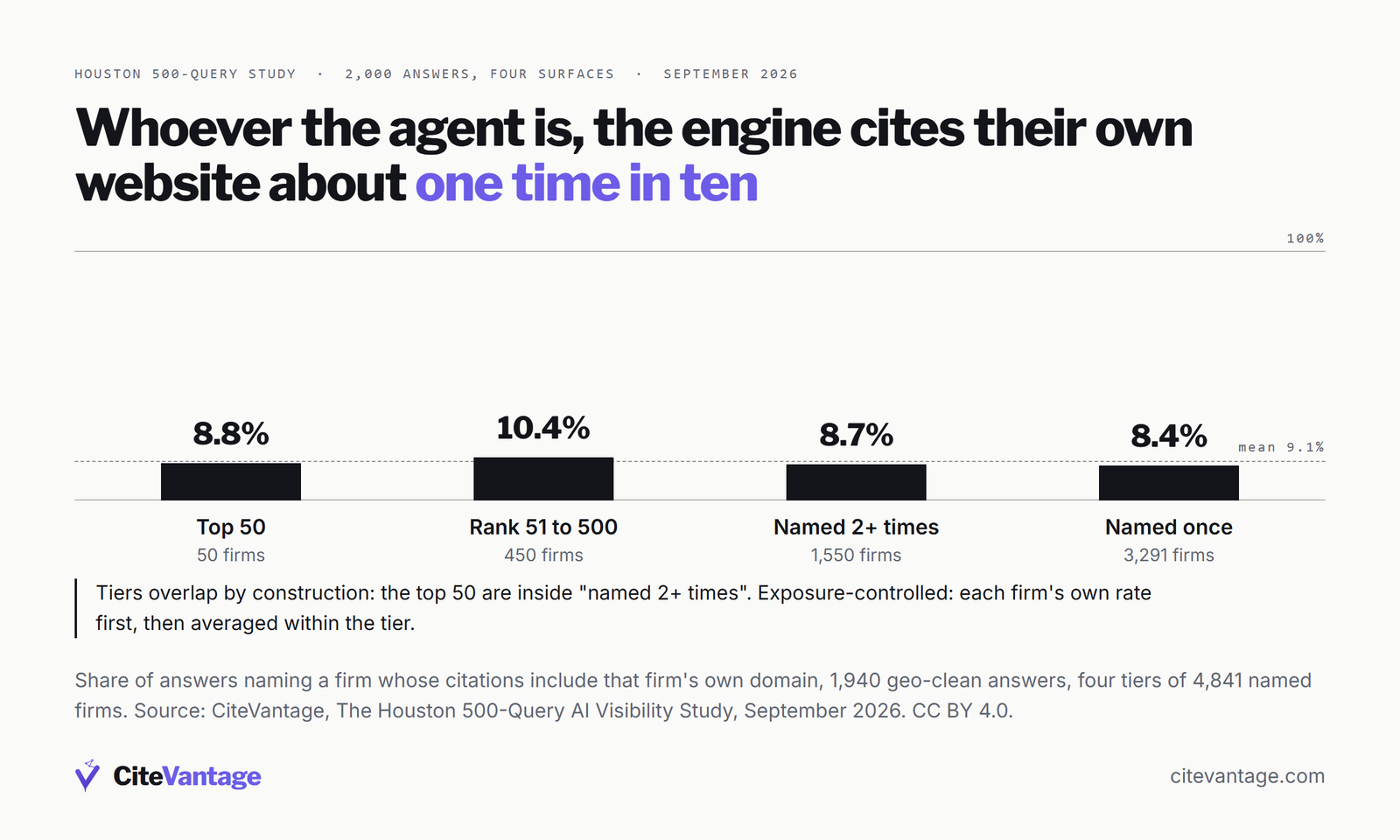
Across 1,940 geo-clean answers from four AI surfaces about Houston in September 2026, a firm's own domain appeared in the citations of an answer naming it between 8.4% and 10.4% of the time, depending on the tier, with no meaningful gradient between the head and the tail. The top 50 firms sit at 8.8% per answer and 34.0% ever. Firms ranked 51 to 500 sit at 10.4% per answer and 20.2% ever. Firms named twice or more sit at 8.7% and 14.5%. Firms named exactly once sit at 8.4% and 8.4%.
This is the finding that costs us money to publish. We sell AI visibility work, and a large part of what any agency in this category sells is work on the client's own website. The Houston data says the agent's own site is a minority of the mechanism behind an answer that names them, showing up in roughly one such answer in ten. We publish it anyway, at full strength, with the rows behind it.
Read it carefully in both directions. It says the surfaces assemble a Houston answer from portals and agent referral networks first, so being absent from those sources is expensive. It also has a real limit: the measurement records which domains an answer cited, and a surface can read a site during retrieval without citing it, so the 8.4% to 10.4% band measures citation and acts as a floor on influence. What it removes is the assumption that publishing more on your own domain is the lever that gets you named.
| Tier | Firms | Own domain cited, per answer | Own domain ever cited |
|---|---|---|---|
| Top 50 | 50 | 8.8% | 34% |
| Rank 51 to 500 | 450 | 10.4% | 20.2% |
| Named 2+ times | 1,550 | 8.7% | 14.5% |
| Named once | 3,291 | 8.4% | 8.4% |
The "ever" column rises with exposure because a firm with more answers has more chances; the per-answer column is the controlled one.
Nobody named, and the wrong place
7.4% of the 1,940 geo-clean Houston answers collected across four AI surfaces in September 2026 named no firm at all, ranging from 11.8% on Perplexity to 1.9% on Gemini API-based. Separately, 60 of 2,000 answers, 3.0%, answered about the wrong place and were excluded from every figure on this page.
Of the 1,940 geo-clean answers to 500 Houston queries across four AI surfaces in September 2026, 143 named no business or agent at all, 7.4%. The rate splits hard by surface: Perplexity returned no name on 11.8% of its answers, ChatGPT on 9.3%, the Gemini web app on 6.4% and Gemini API-based on 1.9%. By intent, the metro-wide questions were likeliest to return nobody at 13.0% and luxury questions least likely at 2.6%.
Geography failed separately and more interestingly. 60 of the 2,000 answers, 3.0%, answered about somewhere other than Houston and were dropped before any other figure was computed. Queries carrying a state marker such as "TX" or "Texas" failed at 1.1%, 10 of 880. Queries without one failed at 4.5%, 50 of 1,120.
On ChatGPT these failures were stable rather than random. Of 37 ChatGPT geo failures re-asked two days later, 29 were still wrong, and 27 of those landed in the same wrong city as the first time; 7 corrected themselves and 1 was unclear.
ChatGPT also answers in a different register from the others. It reasoned rather than simply handing over names in 97.6% of its answers, and across all surfaces the median reasoning answer ran 2,688 characters.
Answers naming nobody, by surface
- Perplexity: 59 of 498 (11.8%)
- ChatGPT: 43 of 463 (9.3%)
- Gemini (web): 32 of 500 (6.4%)
- Gemini (API-based): 9 of 479 (1.9%)
Wrong-place answers
- Query names Texas or Houston: 10 of 880 (1.1%)
- Query has no state marker: 50 of 1120 (4.5%)
How many Houston agents are ever named
Four AI surfaces answering 500 Houston real-estate queries in September 2026 returned 4,841 distinct names. A hand-labelled sample puts roughly 3,000 of them (95% interval 2,800 to 3,267) as real agents, teams and brokerages. Against the Houston Association of Realtors' own figure of more than 50,000 members, that is about 6.1% named at least once.
The denominator is HAR's own published figure, which is why we use it, and the point survives any plausible alternative. Whether the true count of active Houston agents is 30,000 or 50,000, the share of them that four AI surfaces will name across 500 questions stays small: about one in sixteen on HAR's figure, and about one in ten even on the lower one.
FlyDragon's national report reached a convergent number from a different method, finding 91% of agents effectively invisible in AI answers. Their cross-surface figure runs the same way: of the agents appearing on at least one AI surface, they report only 11% appearing on three or more. Our equivalent on the controlled subset is 4.3%, being 3.1% on three surfaces plus 1.2% on four. Same direction, same order of magnitude, ours stricter.
Does this hold in other metros?
This study measured one metro at depth: 500 queries, 40 Houston areas, four AI surfaces, September 2026. We have not measured any other metro, and we will not claim the Houston percentages hold elsewhere until we have. The shape it shares with a national study of cited domains is the part most likely to transfer.
Our 150-Query Real Estate AI Search Study found 83.0% of 1,297 cited domains reaching only one of five engines nationally, and this study finds the same pattern at business level in Houston. FlyDragon's market atlas covers many US metros, and we do not contradict their Houston head: their top-ranked Houston agent is also our top-ranked agent, and 20 of their 25 ranked Houston agents appear in our data, from a page stamped 23 July 2026, two months before our fieldwork.
On whether any of this reaches a buyer, the evidence cuts both ways. For: Pew Research Center (fieldwork March 2025, published July 2025, n=900, 68,879 searches) found users clicked a result on 8% of visits with an AI summary against 15% without one. Ahrefs measured a 34.5% lower click-through rate for the top result on keywords with an AI Overview in April 2025, and 58% lower when it repeated the measurement in February 2026. Bank of America's 2026 Homebuyer Insights Report (June 2026, n=2,000) found 20% of prospective buyers and homeowners had used AI tools for homebuying research in the past year.
Against, at full strength: Similarweb measured 1.13 billion AI referrals against 191 billion from Google in June 2025 across the top 1,000 websites, roughly 0.6%; the NAR 2025 Profile of Home Buyers and Sellers (4 November 2025, n=6,103) found 88% of buyers and 91% of sellers used an agent, and 91% of buyers would recommend theirs; and the portals now sit inside the surfaces themselves, Zillow in ChatGPT since October 2025 and Realtor.com since March 2026. No study anywhere isolates consumers using AI to choose an agent, so the stakes remain unmeasured.
What a Houston agent can do about this
The 500-query Houston data from September 2026 points to six moves: choose one area and one intent rather than the metro, measure each of the four AI surfaces separately, keep the Google Business Profile accurate for the Gemini web app, get present in the portals and agent referral networks the answers actually cite, write the state and metro into your copy, and remeasure.
Pick one area and one intent, and treat that as the whole target. A hand-checked 82.6% of named Houston agents hold exactly one area, and new-build answers exclude 94.0% of the names in the same area's generic answer, so "best realtor in Sugar Land" and "new construction in Sugar Land" are two separate contests. In a thin area such as League City the surfaces have named 110 distinct firms in total, which is a field you can picture.
Measure each surface on its own. 83.5% of real agents appear on one surface only, the widest overlap between any two surfaces is 13.6% of their combined list, and the two Gemini surfaces share nobody on roughly 57% of queries. A single screenshot from one surface tells you almost nothing about the other three.
Keep the Google Business Profile accurate and current, specifically for the Gemini web app, where star ratings and opening hours appeared in 88 of 479 answers against 27 on the API-based surface.
Be present where the answers are actually assembled. Portals and agent referral networks account for 43.4% of all citations, while a firm's own domain shows up in roughly one answer in ten that names it, so a complete and current presence on HAR, Zillow and Realtor.com is doing more of the visible work than another post on your own blog.
Write "Houston, TX" into the copy people quote you in. Queries carrying a state marker resolved to the wrong place 1.1% of the time against 4.5% without one.
Then remeasure. This is one run in one five-day window, and the answers move.
Method and limits
CiteVantage wrote 500 Houston real-estate queries across 40 areas and eight intent tiers, put each to four AI surfaces between 18 and 22 September 2026, and recorded every firm named and every domain cited in all 2,000 answers. 60 answers, 3.0%, were excluded for answering about the wrong place. Names were extracted heuristically and every figure is published with a strict-filter check.
Query design. The study covers 40 named Houston areas and eight intent tiers: discovery, sell, first-time, invest, relocate, luxury, new-build and condo, plus 20 metro-wide questions asked about Houston as a whole. 38 of the 40 areas carry 12 queries each, four discovery, two sell and one for each of the six remaining intents; Spring carries 24, and the generic Houston set is the 20 metro-wide questions. Queries were written in two shapes, 250 search-shaped and 250 conversational, so the same underlying question was asked both the way a person types it into a search box and the way a person asks a chatbot.
Surfaces. Four surfaces, each queried directly: ChatGPT through its web app, Perplexity through its web app, Gemini through its web app, and Gemini API-based. The two Gemini surfaces are reported separately throughout, because, as the Gemini section above shows, they return different Houston markets. Anywhere this page says "Gemini API-based" it means rows collected through the API, nothing more.
The geo-clean filter. Every answer was checked for whether it answered about Houston at all. 60 of 2,000 answers, 3.0%, did not, and those were removed before any other number was computed, so every percentage on this page runs off the 1,940 geo-clean answers. The failures are reported above, in the section on wrong-place answers.
Extraction is heuristic. Business and agent names were pulled from the answer text by a script. A script mistakes some phrases for names and misses some real ones, so every structural percentage is published three ways. The strict filter deletes 24.2% of names, real firms included, but still lets some non-businesses through, so it is a stress test rather than a floor. The headline figures come from a third method: 400 extracted names drawn at random and labelled by hand, blind to how often or where each was named, then re-weighted to the full list with bootstrapped 95% intervals. The labels are published so any of them can be disputed.
One run, one window. Fieldwork ran across five days, 18 to 22 September 2026. AI answers move between runs, so this is a snapshot rather than a ranking, though some of the movement is smaller than it looks: on ChatGPT, 29 of 37 retried geo failures were still wrong two days later. Anyone relying on these numbers for a decision about a specific firm should remeasure.
We sell this. CiteVantage sells AI visibility work to real-estate firms, so our commercial interest is direct and declared. The study was conducted independently, was not commissioned by anyone, has no vendor platform underneath it, and every row is published. The own-website finding above cuts against the easiest thing we could sell, and it is published at full strength.
Everything is published. The row-level data, the query set, the hand labels and the analysis, sensitivity and validation scripts all ship with the study, so every figure on this page can be recomputed rather than taken on trust.
Data appendix and the searchable list of every firm named
The 500-query Houston study of September 2026 ships its full row-level data: every query, area, intent, query shape and surface, with every firm named and every domain cited in each of the 2,000 answers, plus the query set, the analysis code, the sensitivity script and a searchable list of every firm named at least once. All of it is released under CC BY 4.0.
The row-level CSV carries one row per answer with the query text, the Houston area, the intent tier, the query shape, the surface, the geo-clean flag, every firm named and every domain cited. The query set ships as its own file so anyone can rerun all 500 questions. The analysis script and the sensitivity script are both published, which is what makes every percentage on this page recomputable.
The searchable list of named firms is published so a Houston agent can look themselves up. It lists every firm named at least once with its mention, area and surface counts. There is no list of firms that were never named, and we will not publish or imply one: absence from this data is not a finding about a business.
The row-level CSV is at /research/houston-real-estate-ai-visibility-2026.csv, one row per answer, 2,000 rows. The searchable firm list is at /research/houston-named-firms-2026.json, and the query set is published alongside it. The code is study500_findings.py, study500_market.py, study500_sensitivity.py and study500_validation.py, and the 400 hand labels are published as /research/houston-validation-sample-2026.csv. Everything here is free to republish under CC BY 4.0, with attribution and a link back.
Match on any part of a name, so krueg reaches james krueger.
No firm matching “” appears in the names extracted from the 1,940 Houston answers.
Name extraction is heuristic, and a firm is sometimes named inside a team or brokerage name rather than on its own.
| Firm, as the engines named it | Mentions | Areas | Surfaces |
|---|---|---|---|
| 01 James Krueger (Corcoran Prestige Realty) | 153 | 31 | 4 |
| 02 Monica Foster (Monica Foster Team - eXp Realty) | 106 | 13 | 4 |
| 03 Jamie McMartin (Compass) | 78 | 12 | 4 |
| 04 Jay Thieme (ReMax Cinco Ranch) | 62 | 4 | 4 |
| 05 Christy Buck Team (Infinity Real Estate Group) | 62 | 7 | 4 |
| 06 Jill Smith (eXp Realty) | 55 | 13 | 4 |
| 07 Better Homes and Gardens Real Estate Gary Greene | 55 | 18 | 4 |
| 08 Cody Scurlock (Keller Williams Summit) | 54 | 14 | 4 |
| 09 Greenwood King Properties | 52 | 12 | 3 |
| 10 Michele Harmon Team (RE/MAX Universal) | 50 | 5 | 4 |
| 11 Jennifer Yoingco (The Houston Suburb Group) | 49 | 16 | 3 |
| 12 Houston Properties Team | 48 | 16 | 4 |
| 13 Alfonso Parodi (Pak Home Realty) | 48 | 18 | 3 |
| 14 Compass Real Estate | 47 | 18 | 2 |
| 15 Cesar Espinoza (Equity Real Estate & Company) | 45 | 13 | 4 |
| 16 Martha Turner Sotheby's International Realty | 44 | 14 | 4 |
| 17 Coldwell Banker Realty | 43 | 22 | 4 |
| 18 Jill Wente, Realtor | 41 | 4 | 4 |
| 19 Corcoran Prestige Realty | 36 | 15 | 3 |
| 20 Shelley Stone | 35 | 3 | 4 |
| 21 Sotheby's International Realty | 34 | 22 | 2 |
| 22 Kimberly Harding (Call It Closed Realty) | 32 | 4 | 3 |
| 23 Kimberly Berger (JLA Realty) | 31 | 3 | 4 |
| 24 Jana Bruce (Compass RE Houston) | 31 | 7 | 4 |
| 25 Jay Thomas Real Estate Team | 30 | 8 | 3 |
| 26 Houston Properties | 30 | 11 | 2 |
| 27 Kevan Pewitt (Houston Prime Realty) | 29 | 9 | 4 |
| 28 Dena Day (Day Real Estate Group at RE/MAX Fine Properties) | 29 | 3 | 3 |
| 29 Energy Realty | 29 | 1 | 4 |
| 30 Perry Homes | 28 | 17 | 4 |
| 31 Jimmy Simien (Simien Properties) | 28 | 5 | 4 |
| 32 Compass RE Texas, LLC | 28 | 13 | 4 |
| 33 Chris Moore (The Moore Real Estate Group) | 28 | 3 | 4 |
| 34 Deborah Bly (eXp Realty - The Bly Team) | 27 | 4 | 3 |
| 35 Erica Stietenroth (Real Broker, LLC) | 26 | 3 | 3 |
| 36 Stacy Burgin (Terra Point Realty, LLC) | 26 | 5 | 4 |
| 37 Red Lion Realty Group | 25 | 2 | 3 |
| 38 Found Realty Group | 25 | 6 | 1 |
| 39 Brombacher & Co. | 25 | 3 | 3 |
| 40 Mark Dimas (Realty of America) | 25 | 8 | 4 |
| 41 Paige Martin | 25 | 10 | 3 |
| 42 Ryan Adams | 24 | 5 | 4 |
| 43 Kasteena Parikh | 24 | 5 | 4 |
| 44 Lisa Marie Sanders | 23 | 12 | 2 |
| 45 Kelly Polasek, REALTOR- RE/MAX | 23 | 2 | 3 |
| 46 Laura Sweeney (Compass) | 23 | 7 | 3 |
| 47 Mike Mahlstedt (Compass) | 23 | 9 | 3 |
| 48 Shawn Manderscheid Team | 23 | 5 | 4 |
| 49 Aqeel Virk (Keller Williams Southwest) | 22 | 5 | 2 |
| 50 Jo Anne Johnson Real Estate Group | 21 | 1 | 3 |
mentions
Downloads: data, queries and code
- Row-level data, CSV: all 2,000 answers, one row each, with the firms named and the domains cited.
- Named-firm appendix, JSON: every one of the 4,841 canonical names with mention count, areas, surfaces and intents.
- The query set, JSON: the 500 queries as asked, with area, intent and shape, published alongside so the wording is not taken on trust.
- Analysis code: study500_findings.py, study500_market.py, study500_sensitivity.py, study500_validation.py and a README that recomputes the headline from the CSV.
All 40 areas
| Area | Distinct firms named | Answers counted |
|---|---|---|
| League City | 110 | 48 |
| Atascocita | 119 | 48 |
| Cinco Ranch | 131 | 48 |
| River Oaks | 132 | 46 |
| West University | 132 | 48 |
| Conroe | 133 | 48 |
| Rosenberg | 136 | 48 |
| Midtown | 139 | 41 |
| Sienna | 142 | 45 |
| Kingwood | 143 | 48 |
| Clear Lake | 145 | 47 |
| Bellaire | 148 | 48 |
| Jersey Village | 150 | 48 |
| Energy Corridor | 152 | 48 |
| Fulshear | 152 | 48 |
| Katy | 153 | 48 |
| Tomball | 153 | 48 |
| Friendswood | 154 | 48 |
| Missouri City | 155 | 48 |
| Oak Forest | 156 | 48 |
| Garden Oaks | 157 | 48 |
| EaDo | 158 | 48 |
| Magnolia | 162 | 45 |
| Pearland | 162 | 47 |
| Stafford | 166 | 41 |
| The Heights | 166 | 46 |
| Braeswood | 168 | 48 |
| Cypress | 169 | 44 |
| Champions | 174 | 45 |
| Memorial | 174 | 47 |
| Sugar Land | 174 | 47 |
| The Woodlands | 184 | 47 |
| Copperfield | 184 | 48 |
| Richmond | 186 | 41 |
| Galleria | 186 | 46 |
| Montrose | 188 | 39 |
| Humble | 190 | 47 |
| Alief | 191 | 48 |
| Houston | 233 | 77 |
| Spring | 327 | 94 |
Press kit: cite, download and reuse this study
Everything here is free to republish under CC BY 4.0, including commercially, with attribution and a link back. The row-level data is published alongside the findings so any figure on this page can be recomputed rather than taken on trust. No permission request is needed and there is no embargo.
Full dataset, CSV
All 2,000 answers: query, area, intent, surface, whether it answered about Houston, every firm named and every domain cited
Named-firm appendix, JSON
Every one of the 4,841 canonical names with mention count, areas, surfaces and intents
Charts, PNG
Two 1200px charts, each with the source line and the licence inside the image.
Download the area distribution or the own-website chart.
Prior work
The 150-Query Real Estate AI Search Study: which domains five engines cite, nationally
How to cite it
Reference
CiteVantage (2026). The 500-Query Houston Real Estate AI Visibility Study. https://citevantage.com/research/houston-real-estate-ai-visibility-2026/
In a sentence
A 2,000-answer study by CiteVantage found that 82.6% of the Houston real estate agents AI surfaces name appear in exactly one of 40 areas, and that about 6% of HAR members are named at all (CiteVantage, 2026).
For journalists
Summary, free to quote: CiteVantage put 500 real-estate questions about 40 Houston areas to four AI surfaces, ChatGPT, Perplexity, the Gemini web app and Gemini API-based, between 18 and 22 September 2026, and recorded every business named and every source cited in all 2,000 answers. Across the 1,940 answers that resolved to Houston, a hand-labelled sample puts roughly 3,000 real agents, teams and brokerages among the names returned. Of those, 82.6% appeared in exactly one of the 40 areas, 83.5% on a single surface, and 56.4% were named exactly once. Set against the Houston Association of Realtors' own membership figure of more than 50,000, about 6% of HAR members were named even once. The practical implication is that AI visibility in Houston real estate is held one area and one surface at a time, so a firm measuring itself on a single engine in a single neighbourhood is measuring a fraction of the picture. Full row-level data, the query set and the analysis code are published under CC BY 4.0.
Author: Abdul Subkhan, founder of CiteVantage. Available for comment, data questions and methodology detail. Reach him at abdul@citevantage.com.
Published: 23 September 2026
Questions about this Houston AI visibility study
What exactly was measured?
Which Houston businesses and agents four AI surfaces name, and which domains they cite, when asked 500 real-estate questions about 40 Houston areas in September 2026. We recorded the names and the sources in each answer, not the wording of the answer. The study measures what the surfaces answer. It does not measure how often anyone asks.
CiteVantage sells this service. Is the study self-serving?
We ran it, so treat the bias as declared. CiteVantage sells AI visibility work to real-estate firms, and so does FlyDragon, whose comparable report published first, in April 2026. What we can offer instead of a claim to neutrality is reproducibility: the query set, every row, the analysis code, a sensitivity analysis and a hand-labelled validation sample are all published, so nothing here depends on trusting us. The clearest test of that is the own-website section, which reports that a firm's own website appears in roughly one answer in ten that names it, a finding that argues against the easiest thing we could sell.
How were these numbers verified?
Every figure was regenerated by script from the stored answers, and no number on this page was hand-edited. Each structural percentage is published beside a strict-filter version designed to break it, and every row is downloadable so anyone can recompute the lot. As a pre-publication check we ran FlyDragon's ranked Houston agent list against our data: their top-ranked Houston agent is also ours at number one, and 20 of their 25 ranked agents appear as named firms in our results.
Why do three different single-surface figures appear?
Because they measure different things. 87.5% covers every extracted name across all 500 queries. 87.2% is the same measure on the 442 queries every surface answered, which removes the chance that a name looks single-surface only because a surface was silent. 83.5% is the hand-checked estimate for real agents, teams and brokerages, and it is the figure the headline cards use.
How many real Houston agents did the AI surfaces name?
Roughly 3,000 real estate agents, teams and brokerages, with a 95% interval of 2,800 to 3,267. The script extracted 4,841 distinct names, but a hand-labelled sample of 400 found that about 29% of extracted names are not businesses at all, from evaluation criteria to neighbourhood names. The strict filter's 3,671 still includes some of those, so neither extracted count is the answer.
Does being named on one surface help on another?
The Houston data says barely. On the 442 queries all four surfaces answered, 87.2% of the names returned came from one surface, and only 51 names came from all four. The largest overlap between any two surfaces was 13.6% of their combined list, between Gemini API-based and the Gemini web app, and the smallest was 4.4%, between the Gemini web app and Perplexity.
Why are the two Gemini surfaces reported separately?
Because they return different Houston markets. On 479 queries both answered, the API-based surface named 7.8 firms per answer and the web app named 3.9, they shared 352 firms out of a combined list of thousands, and on roughly 57% of queries they named nobody in common. Google Business Profile markers appeared in 88 of 479 web answers against 27 API-based. Any claim about "Gemini visibility" has to say which surface produced it.
Free AI visibility audit
Want to know which surfaces name you, and in which areas?
This study measured who four AI surfaces name across 40 Houston areas. The free audit does the same thing for one firm: your real buyer questions, run across the surfaces by hand, with the answers and the names that came back instead of yours. 90-Day Cited Guarantee.
Prefer to talk first? 15 minutes with Abdul, not a sales rep.
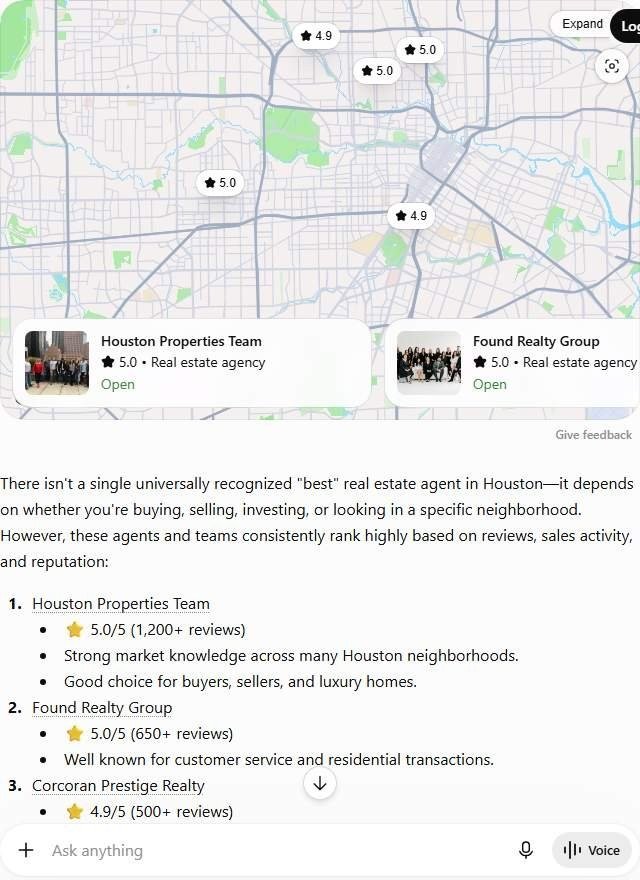 Three named. None of them you.
 The rest of our research
The 150-query study is the prior work this one builds on: which domains five engines cite on real estate questions, nationally. The open list is its raw result.
Research
The 150-Query Real Estate AI Search Study
150 real estate questions put to five AI engines, with every source each one cited.
Research
Which Domains AI Cites on Real Estate Questions
Every website five engines cited on real estate, with per-engine counts, as an open list.
Research
The 181-Brand AI Visibility Study
181 United States brands tested across four engines. Most were named by none of them.