Shopify Ecommerce SEO · Case study
Whats The Point case study: 15.3K organic clicks at a 24.8% click-through rate
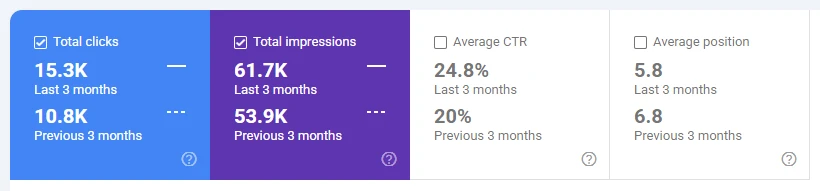
This Whats The Point case study covers a UK Shopify store selling its own modified dart points. Over the last three months it took 15.3K organic clicks against 10.8K in the previous three, at a 24.8% click-through rate and average position 5.8. The rate comes from collections named after point systems and titles written at spec level, not from star ratings.
Client
Whats The Point (whatsthepoint.shop), trading as Straight to the Point Ltd
Industry
Premium dart points and accessories, UK, on Shopify
Scope
Product titles and meta descriptions across the catalogue, and the collection architecture. Storefront: 57 products, 475 variants, 12 collections.
Timeline
Search Console pulled 21 September 2026. Storefront inspected 22 September 2026.
Led by
Abdul Subkhan, SEO lead on the engagement
Whats The Point case study: what was the challenge?
Whats The Point sells its own modified dart points out of the UK on Shopify. Fifty-seven products, 475 variants, twelve collections. Over the last three months the store took 15.3K organic clicks at a 24.8% click-through rate, which is the highest click-through rate of any property in this portfolio and roughly four times what a page at its average position would normally earn.
A store selling one narrow component into one sport has a small total addressable search market. There is no way to win it on breadth, because the number of people typing anything about dart points in a month is fixed and comparatively tiny. The only lever left is capturing a very high share of the searches that do happen.
That is what makes the click-through rate the number to watch here rather than the impression count. Impressions went 53.9K to 61.7K over three months, a modest rise, while clicks went 10.8K to 15.3K. The growth came from converting the same audience harder rather than from finding a bigger one.
The competition is also not what it looks like. The large UK dart retailers that occupy these result pages sell branded points from Winmau, Target and Unicorn, which is a different product from a modified grip point. Only one comparable specialist exists. A shopper who wants the exact item is looking at a result page mostly full of shops that do not stock it.
What is producing a 24.8% click-through rate?
A quarter of everyone who sees this store in a search result clicks it. The obvious explanation is star ratings in the snippet, and that explanation is wrong: the storefront was inspected on 22 September 2026 and carries no rating markup anywhere. The first two items below are ours. The three after them are conditions of the category that the first two take advantage of.
- 01
We built the collections around point systems
Not tops and bottoms. /collections/cp-points-m2-5, /collections/ezevo-points, /collections/qwik-point, /collections/switch-points. A darts player specifies a thread system when they buy, so the collection URL carries the same phrase they type into the search box. Twelve collections, each one a real buying decision.
- 02
We wrote the titles at spec level, on 51 of the 57 products
WTP BIGTOP SCREWED Steel Tip Darts 22-26g 95% Tungsten. Weight range, tungsten percentage and thread system in the title, against a Shopify default that prints the product name and truncates it at 70 characters. Every product page was re-checked on 22 September 2026: 51 of 57 carry an authored title, and the 5 that do not are the ones still cutting off mid-word.
- 03
78 indexable URLs and nothing wasted
Fifty-seven products, twelve collections, four pages and three blog URLs. Zero product tags across the whole catalogue, so the tag-page sprawl that usually buries a Shopify store does not exist here. Nothing on the domain competes with the page that should win the query.
- 04
Own-brand stock with one place to buy it
The brand in the schema is Whats The Point, the product handles carry a WTP prefix, and the range is designed in house with a sponsored player. Someone searching WTP BIGTOP or CP Points m2.5 has exactly one result that actually sells the item. Titles written to spec are worth far more when the spec is yours.
- 05
Almost nothing competes for the exact query
The large UK dart retailers that occupy these result pages sell branded points from Winmau, Target and Unicorn, which is a different product from a modified grip point. One comparable specialist exists. A shopper who wants this specific item is looking at a page mostly full of shops that do not stock it.
What results did Whats The Point get?
Two windows from the same property, both pulled on 21 September 2026. The three-month comparison shows the recent trend against the quarter before it. The 28-day comparison against the same 28 days a year earlier shows how far the store has come over a full year, which is the larger of the two moves.
| Metric | 3 months, previous | 3 months, now | 28 days, a year ago | 28 days, now |
|---|---|---|---|---|
| Clicks | 10.8K | 15.3K | 1.08K | 3.95K |
| Impressions | 53.9K | 61.7K | 9.2K | 19.1K |
| Click-through rate | 20.0% | 24.8% | 11.8% | 20.7% |
| Average position | 6.8 | 5.8 | 9.0 | 5.7 |
What Whats The Point looks like in Search Console
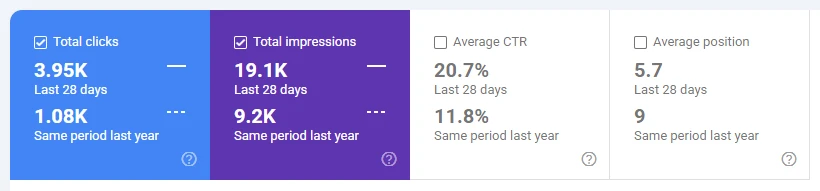
Both windows, straight out of the property. The three-month card is first: 15.3K clicks against 10.8K, 61.7K impressions against 53.9K, click-through rate 24.8% against 20%. The year-over-year card underneath is the bigger move, 3.95K clicks in 28 days against 1.08K in the same 28 days last year.
Why did it work for Whats The Point?
A 24.8% click-through rate at average position 5.8 means the store wins a quarter of everyone who sees it from roughly halfway down the first page. On a narrow catalogue that is the whole game, because the search volume is capped and the only remaining variable left to move is what share of it arrives on your site. Titles and taxonomy are how you move it.
The year-over-year window shows where that came from. Average position went 9.0 to 5.7 and click-through rate went 11.8% to 20.7% across the same 28 days, so the store moved up the page and got materially better at being clicked once it was there. Both effects compound, which is why clicks more than tripled while impressions only doubled.
It is worth saying plainly what is not causing this, because it is the first thing anyone assumes. Star ratings in the search snippet lift click-through rate dramatically, and this store has none. Every product page was checked on 22 September 2026: there is no aggregateRating in the markup, no review array, and no review app installed. The rate comes from matching the query, not from decorating the result.
One thing on the page does need fixing. The GTIN value in the product markup is eight digits, which is not a valid GTIN-12, 13 or 14, so it will fail validation wherever a shopping surface checks it. The price, currency and availability fields are all populated correctly, so this is a single field rather than a structural problem.
The buying guides are not part of this result and should not be credited with it. Both were published on 12 September 2026, inside the last ten days of a three-month window, and neither they nor the grip levels explainer is linked from the top-level navigation. Getting them into the nav is the next thing to do here, not something already done.
Tools and stack
Numbers verified in Google Search Console. See our verified reviews on Clutch.
AI visibility for ecommerce brandsQuestions about the Whats The Point case study
Short answers to what people ask about the Whats The Point case study: how a Shopify store reaches a 24.8% click-through rate, what the three-month and year-over-year windows each show, and how the figures were verified. Every number below was read off Google Search Console on 21 September 2026.
How much organic traffic does Whats The Point get?
15.3K organic clicks over the last three months, against 10.8K in the three months before, from 61.7K impressions. Click-through rate is 24.8% and average position is 5.8. All figures come from Google Search Console, pulled 21 September 2026.
Is a 24.8% click-through rate normal?
No, it is roughly four times what a page at position 5.8 usually earns. It reflects a 78-URL catalogue with no thin pages, collection URLs named after the point systems buyers actually search, and titles carrying weight, tungsten percentage and thread type where a Shopify default would print the product name alone.
What work was done on Whats The Point?
The collection architecture and the catalogue copy. Twelve collections were built around the point systems buyers search by rather than around generic categories, and the product titles were written at spec level, carrying weight range, tungsten percentage and thread system. A re-check on 22 September 2026 found 51 of the 57 products carrying an authored title.
Does Whats The Point have star ratings in Google?
No. Every product page was inspected on 22 September 2026 and there is no aggregateRating markup, no review array and no review app installed on the store. Star snippets are the usual explanation for a click-through rate this high and they are not the explanation here.
How many products does the store actually have?
Fifty-seven products carrying 475 variants, across twelve collections, four content pages and a two-post blog. That is 78 indexable URLs in total, with zero product tags, so none of the tag-page duplication that normally accumulates on a Shopify store exists on this domain.
What does the year-over-year comparison show?
Over the last 28 days the store took 3.95K clicks against 1.08K in the same 28 days a year earlier, from 19.1K impressions against 9.2K. Click-through rate went 11.8% to 20.7% and average position went 9.0 to 5.7.
How were these numbers verified?
Every traffic figure was read off a Google Search Console screenshot of the whatsthepoint.shop property taken on 21 September 2026, on two windows. Every catalogue and markup figure was fetched from the live storefront, its sitemaps and its product feed on 22 September 2026 and can be re-fetched by anyone.
Want numbers like these for your brand?
Start with the free AI Visibility Audit. We show you exactly where AI and Google are hiding you, in 48 hours, no strings.