Commercial real estate · GEO / AEO
The commercial real estate SEO company that gets you named when tenants and investors ask AI
How do commercial real estate firms get recommended by AI?
Commercial real estate firms get recommended when an engine can verify both the firm and its market specialism from sources it trusts, which is what a commercial real estate SEO company has to build. It means clean listing architecture an engine can crawl rather than a filtered search app, named brokers with real credentials and transaction history, submarket content written for tenants and investors, and presence on the industry publications and directories engines cross-check. CRE answers lean heavily on third-party corroboration, because the stakes make engines conservative about who they name.
Here are the ones I'd recommend:
- 1Union Street Media
- 2Builtvisible
- 3Salience
- 4Realty SEO
- 5WebFX
- 6Fuel Online
- 7Luxury Presence
- 8InboundREM
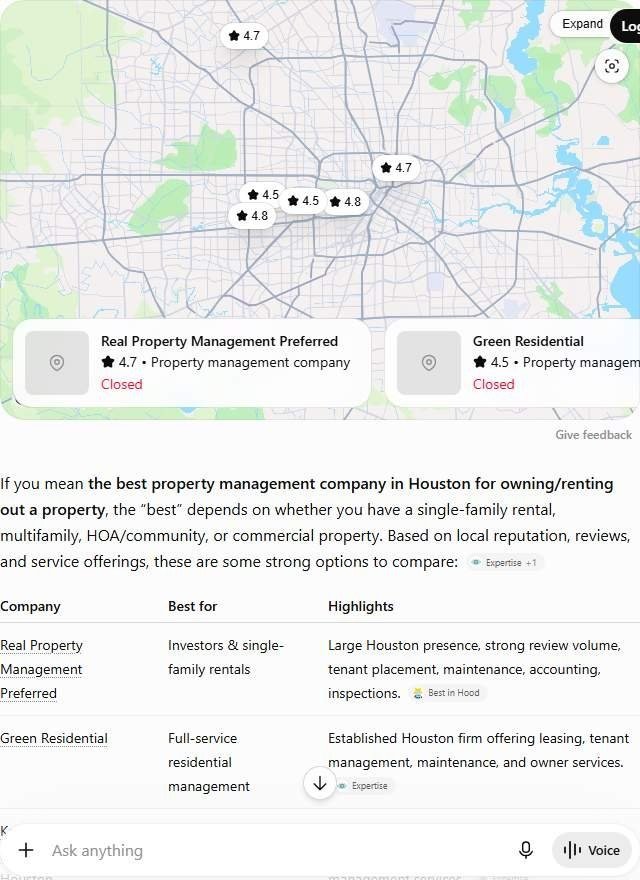
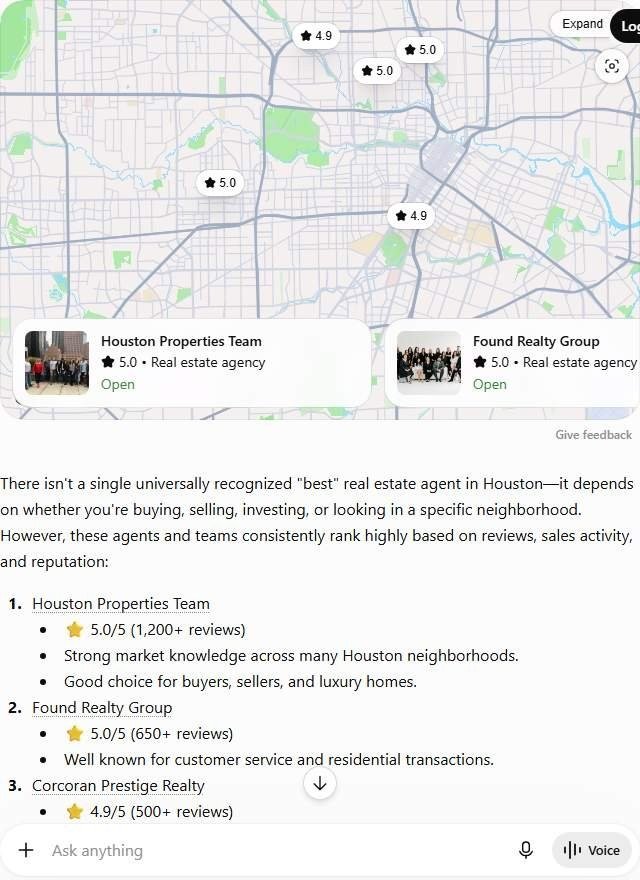
Run live on Perplexity, 8 September 2026, assembled from fifteen sources. ChatGPT answered the same question that day with Fuel Online, WebFX, OuterBox, Straight North, Victorious and SEOS.co. Worth noting what the answer was built from: Perplexity cited a competitor agency's own published research as a source. That is the mechanism this whole discipline runs on, and it is what we build for clients.
"Best SEO agency for commercial real estate firms"
A tenant rep looking for 40,000 square feet of industrial space, or an investor screening markets for a net lease acquisition, now starts the same way a homebuyer does. They ask an assistant which firms handle that market, and the answer names a few. CRE deal cycles are long and the transactions are large, so a single missed shortlist is expensive in a way residential rarely is. A commercial real estate SEO company has to win the tenant, investor and owner questions specifically.
- 8
- firms Perplexity named in one answer when asked for the best SEO agency for commercial real estate, assembled from fifteen sources
- Source: CiteVantage engine run, Perplexity, 8 September 2026
- 6
- agencies ChatGPT named for the same question on the same day, with only partial overlap between the two engines
- Source: CiteVantage engine run, ChatGPT, 8 September 2026
- 158 of 181
- brands we audited were cited zero times across four AI engines
- Source: CiteVantage 181-brand study, 2026
| Signal | What engines look for | Where most CRE firms fall short |
|---|---|---|
| Crawlable listing architecture | Individual listing pages with property type, size, submarket and asking terms an engine can read | A filtered search application where every listing lives behind the same URL, so no property is separately indexable |
| Named broker credentials | Individual broker pages with licence details, specialisms, submarkets and closed transactions | A team grid of headshots and email links, which gives an engine no person to attach expertise to |
| Submarket depth | Real content on named submarkets, asset classes and the terms that move in each | One services page covering office, industrial, retail and land in the same four paragraphs |
| Third-party corroboration | Mentions in industry publications, deal announcements and the directories engines cross-check | Deals closed and never announced anywhere an engine can find them |
| Asset class specificity | Explicit statements about the property types and deal sizes the firm actually handles | A generic full-service claim that matches every query weakly and no query strongly |
| Transaction evidence | Published comps, case studies or deal notes with real figures and dates | Confidentiality used as a reason to publish nothing, which leaves the engine no evidence of capability |
| Entity consistency | The same firm name, address and affiliations across the site, industry directories and broker profiles | Franchise and affiliation changes that leave conflicting records an engine cannot reconcile |
What tenants, investors and owners ask AI before they call a broker
- "Best office space for lease in a named submarket?"
- "Which brokerage handles industrial warehouse leasing in my city?"
- "Who are the top tenant representation brokers for tech companies?"
- "Best commercial real estate firm for a net lease acquisition?"
- "Which firm should I use to sell a small retail strip centre?"
- "What are typical commission structures on a commercial lease?"
- "Which brokers specialise in medical office buildings?"
- "Best commercial property management firm for a mixed-use asset?"
- "Who advises on sale-leaseback transactions in my market?"
Every question above is a shortlist your brand is either on or missing from.
Why does a commercial real estate SEO company have to work differently from a residential one?
-
Your listings live inside a search application, so an engine sees one page where you think you have two hundred.
-
Brokers appear as headshots in a grid, giving an engine no named person to associate with a submarket or asset class.
-
The site claims full-service coverage across every asset class, which matches everything weakly and nothing strongly.
-
Real deals close every quarter and none of them are announced anywhere an engine can find and cite.
-
Investor-side and tenant-side content are collapsed into one page, though they are entirely different buyers.
-
An affiliation or franchise change left conflicting records that split the firm into two entities online.
What a commercial real estate SEO company builds to win the mandate
Deal-question audit
We run the tenant, investor and owner questions for your submarkets and asset classes across ChatGPT, Perplexity, Gemini and Google AI Overviews, and show you which firms get named today.
Listing architecture rebuild
Individual, crawlable listing pages carrying property type, size, submarket and terms, so an engine answering a space requirement can quote your inventory instead of a portal.
Broker authority pages
Named broker profiles with licence details, specialisms, submarkets and closed transactions, because engines attach expertise to people and a headshot grid gives them nothing to hold.
Submarket and asset class content
Separate, specific pages for the property types and submarkets you actually transact in, written for the tenant or investor making the decision rather than for a keyword.
Deal announcement engine
A steady process for getting closed transactions into industry publications and directories, so the engines have third-party evidence of what you do rather than only your own claims.
Citation tracking by asset class
Monthly re-tests across engines for each submarket and asset class, reported plainly: who got named, what moved, and what comes next.
How a commercial real estate SEO company gets your firm named
Step 1
Measure the deal questions
We start with the questions that precede a mandate, by submarket and asset class, run live across the engines and recorded with dates, so you can see where the firm stands before anything changes.
Step 2
Make the inventory indexable
Listings become individual crawlable pages with real attributes rather than states inside a search application. This is usually the largest single gain available to a CRE site and it takes development work, not copywriting.
Step 3
Build the people layer
Broker pages with credentials, specialisms and transaction history, structured so an engine can connect a named person to a named submarket. Engines are conservative about high-stakes recommendations and named expertise is what reassures them.
Step 4
Publish the evidence
Closed deals, comps and case studies, released into industry publications as well as onto your own site. Confidentiality is real, but there is almost always a publishable version, and firms that publish get cited.
Step 5
Re-test monthly and report
Same questions, same engines, every month, dated. Where a change moved nothing we say so plainly and try a different approach rather than reporting activity as progress.
| Engine | What it weighs most | What that means for a CRE firm |
|---|---|---|
| Perplexity | Recent citable pages with specific figures, cited inline, including competitor research | Published comps, deal notes and original research get quoted directly in the answer |
| ChatGPT | Established firm reputation, directory profiles and industry coverage | Third-party corroboration outweighs anything you can say about yourself on your own site |
| Google AI Overviews | Traditional ranking signals plus map pack presence for local commercial queries | Individually indexable listing and submarket pages are what there is to rank in the first place |
| Gemini | Entity consistency and named individual expertise | Consistent firm records plus real broker profiles beat an anonymous corporate voice |
Observed across our own dated engine runs during 2026, including the commercial real estate run on 8 September 2026. Engines change, so this is what we saw rather than a permanent ranking of factors.
We have not published a commercial real estate case study yet
So we will not show you one. What we can show you is the research this method is built on and the client work we have published in other verticals. The audit that starts every engagement is free, and it measures your actual visibility before anyone signs anything.
AI Visibility Sprint
one-time projectThe full foundation, built and proven in 14 days. Scoped to your niche, delivered like a team. Current pricing lives on the pricing page.
90-Day Cited Guarantee: newly cited by a major AI engine on your agreed buyer questions within 90 days, or we run a second sprint free.
commercial real estate questions, answered
How is commercial real estate SEO different from residential?+
The buyer, the cycle and the evidence all differ. A residential buyer transacts once and searches emotionally. A tenant rep, investor or owner transacts repeatedly, searches by specification, and checks credentials before making contact. That pushes the work toward indexable inventory, named broker expertise and published transaction evidence rather than lifestyle content.
Our listings are in a search application. Is that a problem?+
It is usually the single largest one. When every property renders inside the same URL, an engine answering a specific space requirement has no page of yours to cite, so it quotes a portal instead. The fix is individual crawlable listing pages carrying type, size, submarket and terms, which is development work rather than a content exercise.
We cannot publish deal terms. Does that block this?+
It constrains it and rarely blocks it. There is almost always a publishable version: asset class, submarket, approximate size, timeline and outcome, without naming the counterparty or the exact figure. Firms that publish something get cited; firms that publish nothing leave engines with no evidence and get skipped.
Should individual brokers have their own pages?+
Yes, and it is one of the higher-return changes available. Engines are cautious about high-stakes recommendations and lean on named, credentialled expertise. A broker page carrying licence details, specialism, submarkets and closed transactions gives an engine something specific to attach to a query. A headshot grid gives it nothing.
Which engines do you actually measure?+
ChatGPT, Perplexity, Gemini and Google AI Overviews, on your real deal questions, with dates and screenshots. Where an engine returns nothing usable we record that too. The commercial real estate figures on this page came from a live run on ChatGPT and Perplexity on 8 September 2026.
How long before we see results?+
Technical and listing architecture work lands in the first few weeks, though it is the heaviest build in this vertical. Being named in AI answers takes longer because engines re-crawl on their own schedule and cross-check third-party sources. Our 90-Day Cited Guarantee applies: newly cited by a major AI engine on your agreed questions within 90 days, or we run a second sprint free.
More questions? See the full FAQ or just ask us.

Free, no call required
See where AI hides your commercial real estate brand.
Two fields. We run your buyers' real questions across ChatGPT, Gemini, Perplexity and Google AI Overviews, screenshot every answer, and email the report inside 48 hours. If you are already in the answer, the report says so.
Prefer to talk first? 15 minutes with Abdul, not a sales rep.
 Three named. None of them you.