Original research
The 181-Brand AI Visibility Study
By Abdul Subkhan Published Fieldwork June 2026
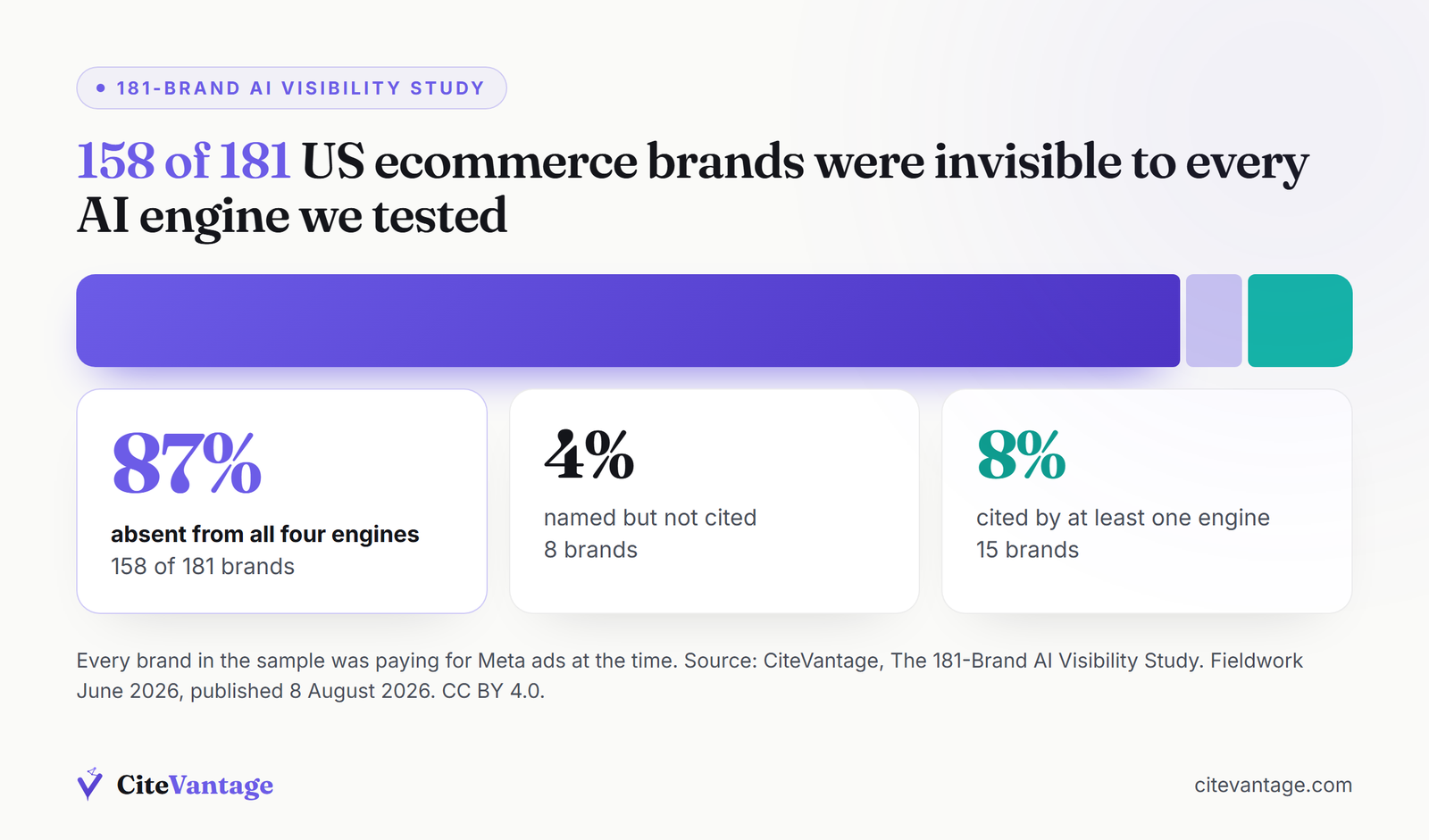
87% of the brands we tested were invisible to AI: 158 of 181 United States ecommerce brands were neither named nor cited by ChatGPT, Perplexity, Gemini or Google AI Overviews when each engine was asked a buying question in that brand's own product category.
Every brand in the sample was spending money on Meta ads at the time, so this is not a set of dormant stores. Only 15 brands (8%) were cited by even one engine, and 8 more (4%) were named in an answer without their site being cited as a source.
The short version: these brands were buying traffic to a storefront that the AI answer layer could not see, and paying for Meta reach did not put them in front of it.
- 181 brands measured across 4 engines
- Download the data, CSV
Four engines, one question each
87%
of 181 brands were invisible to AI
- All four engines 158 of 181
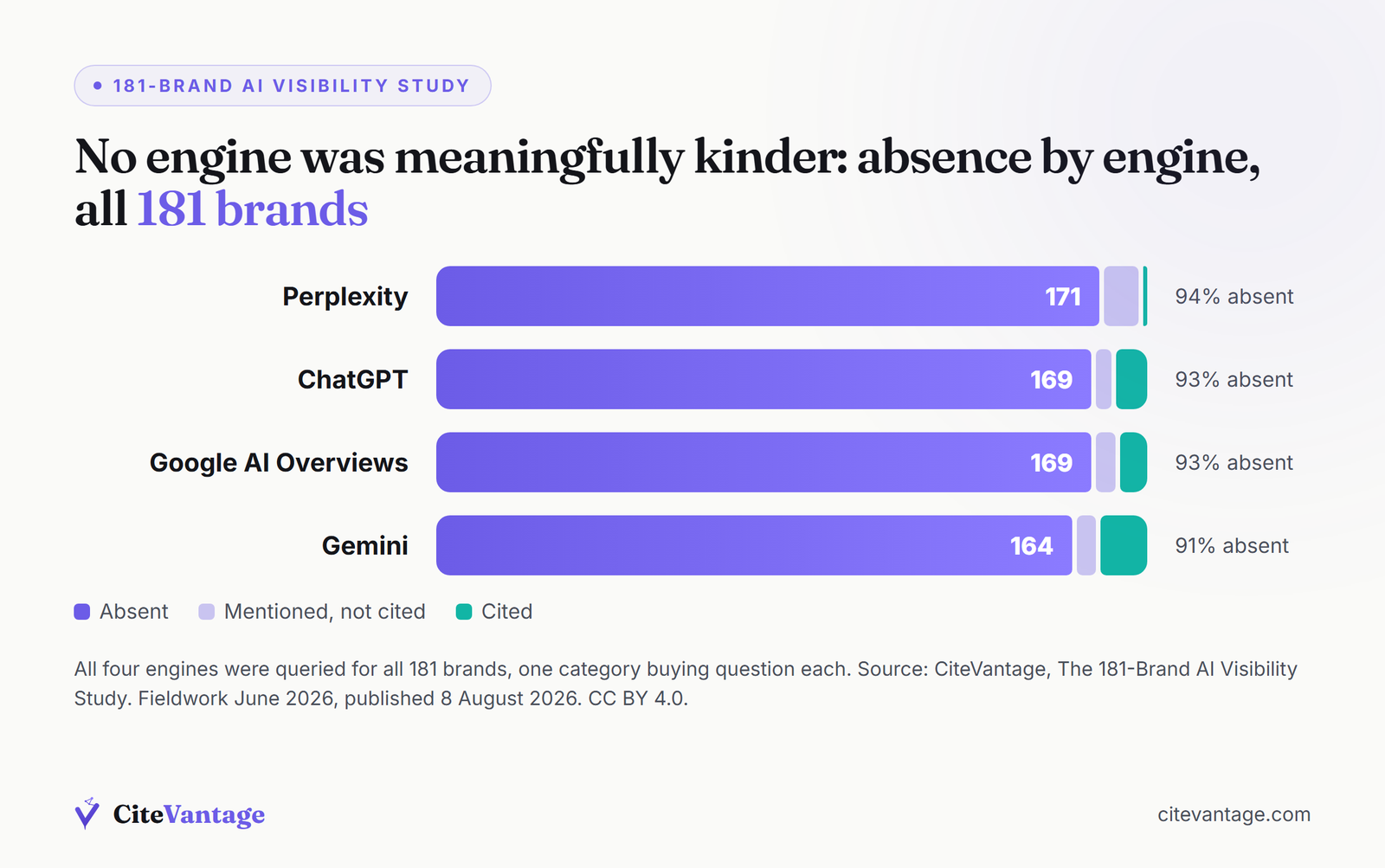
- Perplexity 171 of 181
- ChatGPT 169 of 181
- Google AI Overviews 169 of 181
- Gemini 164 of 181
-
87%
absent from all four engines (158 of 181)
-
4%
named in an answer but not cited (8 brands)
-
8%
cited by at least one engine (15 brands)
What the 181-Brand AI Visibility Study found, engine by engine
No engine was meaningfully kinder than another. Perplexity left 171 of 181 brands absent and Gemini, the most generous, still left 164. That is a spread of three percentage points across four engines built by different companies on different indexes, which means a brand missing from one is almost always missing from all of them rather than losing a single platform.
- Absent
- Mentioned
- Cited
| Engine | Absent | Mentioned | Cited |
|---|---|---|---|
| Perplexity | 171 (94%) | 9 | 1 |
| ChatGPT | 169 (93%) | 4 | 8 |
| Google AI Overviews | 169 (93%) | 5 | 7 |
| Gemini | 164 (91%) | 5 | 12 |
| Absent on all four | 158 (87%) | 8 | 15 |
How invisible, exactly?
The first pass also scored each brand from 0 to 100 on how strongly it surfaced. The mean was 18.4 out of 100, and 61 brands (34%) scored a flat zero. Only three brands in the entire sample scored above 50.
Methodology
We built a sample of 181 United States ecommerce brands that were actively paying for Meta ads, wrote one buying question per brand in that brand's own product category, and put the same question to four AI engines. An answer counted as a hit only when the engine named the brand or cited its domain. A brand counts as absent only when all four engines returned nothing.
- Sample
- 181 US ecommerce and DTC brands
- Selection
- Active Meta advertisers running their own storefront
- Engines
- ChatGPT, Perplexity, Gemini, Google AI Overviews
- Coverage
- All four engines queried for all 181 brands
- Query
- One unbranded "best [category]" buying question per brand
- Classification
- Cited, mentioned or absent, per engine
- Sample built
- 2026-06-15 to 2026-06-17
- Engines queried
- 2026-06-18 to 2026-06-25
- Published
- 8 August 2026
- Licence
- CC BY 4.0, reuse with attribution
How the sample was built
We pulled advertisers from the Meta Ad Library between 2026-06-15 to 2026-06-17, looping a list of consumer product keywords and keeping brands that ran their own online store. We removed tracking domains, duplicates and large-retailer subdomains. That left 181 clean United States ecommerce and DTC brands. Advertising was the qualifying signal, because a brand paying for traffic has already decided that being findable is worth money.
What the sample looked like
Storefront platform
- Not detectable from the outside: 143
- Shopify: 25
- WooCommerce: 5
- Wix: 2
- WordPress: 1
- Squarespace: 1
- BigCommerce: 1
- Unreachable at audit time: 3
Largest categories
- Jewelry and watches: 24
- Gifts: 18
- Clothing and apparel: 18
- Children's and baby goods: 8
- Printing and custom print: 4
- Art and crafts: 4
- Health and beauty: 3
Category is the brand's own Facebook page label across 69 distinct values, and it is weak data: 46 of the 181 brands used a label that describes nothing, such as "Brand", "Website" or "Product/service". We report it for shape only and drew no conclusions from it.
What we asked the engines
For each brand we wrote one buying question in that brand's own category, phrased the way a shopper would type it, in the shape of "best [category]". We did not use the brand's name. The point was to see whether an engine reaches for the brand unprompted when a customer is choosing what to buy, which is the moment the sale is decided.
How each answer was classified
- Cited: the brand's own domain appeared as a source behind the answer.
- Mentioned: the brand was named in the answer text but its site was not cited.
- Absent: neither. The engine answered the question and the brand did not exist in it.
Four engines were queried for every brand between 2026-06-18 to 2026-06-25: ChatGPT, Perplexity, Google AI Overviews and Gemini. A brand counts as absent overall only when all four returned absent.
Why some of our older material says 72%
The first pass, run 2026-06-15 to 2026-06-17, used a single engine and found 131 of 181 brands absent, which is where the 72% figure came from. Going back over the same 181 brands with all four engines moved the number up to 158 (87%). Two brands that looked absent turned out to be visible; twenty-two that looked visible turned out to be absent once we checked properly. We now lead with the four-engine number and keep 72% on record as the conservative first-pass floor, which is the figure our earlier videos quote.
Limitations
This study measures one specific thing: whether four AI engines named or cited 181 advertising US ecommerce brands on one unbranded category question, during one week in June 2026. It is not a random sample of ecommerce, not a longitudinal study, and not a measure of what those engines would say today. The limits below are stated so nothing here reads as more certain than it is.
- This is not a random sample of ecommerce. Every brand was advertising on Meta, in the United States, in June 2026. That selects for businesses with a budget. Do not read 87% as a fact about all online stores. It is a fact about these 181.
- One question per brand per engine. Visibility is query-specific. Several brands that were absent for the broad category question turned out to be cited for a narrower one when we followed up. A different question would produce a different number.
- One run per question. AI answers are not deterministic, and we did not sample the same question repeatedly to measure variance, so treat individual brand verdicts as a snapshot rather than a settled fact.
- June 2026, and engines change fast. Any of these results could move within weeks of publication.
- Gemini is the weakest leg. It was queried on a free tier subject to rate limiting, and a rate-limited response can come back empty. An empty response misread as silence would inflate the absent count, so the collector was changed to stop rather than record a false absent. It is still the engine we would trust least here.
- Category labels are self-reported and messy, as described above. Eight of the 181 were also later found not to be genuine online sellers.
- We are not neutral. We sell the fix for this problem. That is exactly why the method is written out in full: so you can disagree with it, or run it yourself.
What we take from this AI visibility study
Every brand in this sample was paying for Meta advertising when we built it, and 158 of 181 were still absent from all four engines. Paid reach on social did not carry these brands into AI answers about their own category. Only 15 had their own site cited by even one engine. The study recorded whether each brand was named or cited and did not measure why, so we draw no conclusion here about what those 15 have in common.
If you want to check your own brand against this, the Free AI Visibility Audit runs a similar check on your category across ChatGPT, Perplexity, Gemini and Copilot, or you can follow the steps in how to run an AI visibility audit yourself and do it by hand. The mechanics of getting cited are covered in how to get cited by ChatGPT.
This study covers ecommerce brands. Our real estate research puts the same kind of question to the engines about agents and brokerages: start with the 500-query Houston study and the 150-query real estate study, or use the real estate SEO statistics list, which sets those findings beside third-party figures.
Press kit: cite, download and reuse this study
Everything here is free to republish under CC BY 4.0, including commercially, with attribution and a link back. The underlying row-level data is published alongside the charts so anyone can check the figures rather than take them on trust. No permission request is needed and there is no embargo.
Download
- CSV
Full dataset, CSV
All 181 rows, anonymised: category, platform, each engine's verdict, visibility score. 13 KB
- PNG
Headline chart, PNG
The 87% finding. 1200px wide, source line and licence in the image
- PNG
By-engine chart, PNG
Absence across all four engines. 1200px wide, source line and licence in the image
Brand names and domains are withheld from the dataset. The brands did not consent to being named and naming them would publish a commercial weakness they were never asked about. Every aggregate on this page recomputes exactly from the rows provided.
How to cite it
Reference
CiteVantage (2026). The 181-Brand AI Visibility Study. https://citevantage.com/research/181-brand-ai-visibility-study/
In a sentence
A 181-brand audit by CiteVantage found 87% of US ecommerce brands were absent from all four major AI engines (CiteVantage, 2026).
For journalists
Summary, free to quote: CiteVantage asked ChatGPT, Perplexity, Gemini and Google AI Overviews an unbranded buying question about each of 181 United States ecommerce brands, in the brand's own product category. 158 of them (87%) were neither named nor cited by any of the four. Every brand in the sample was paying for Meta advertising at the time of the audit, which makes the finding a gap between paid reach and AI visibility rather than a story about inactive stores.
Author: Abdul Subkhan, founder of CiteVantage, an AI search visibility agency. Available for comment, data questions and methodology detail at abdul@citevantage.com.
Questions about this study
The questions below are the ones we are asked most often about the sample, the engines and the 87% figure itself, including why some of our earlier material quotes 72% instead. If something is not answered here, the raw dataset is downloadable above and we answer methodology questions directly.
How many brands were in the study?
181 United States ecommerce and DTC brands.
Every one was actively running paid ads on Meta when we built the sample in June 2026, which is how a brand qualified. All four AI engines, ChatGPT, Perplexity, Google AI Overviews and Gemini, were queried for all 181 brands, each with one unbranded buying question in that brand's own category. 158 of them (87%) were named by none of the four, and the row-level results for every brand are in the CSV.
What does "invisible" mean here?
Absent: the engine answered a buying question about the brand's own product category and neither named the brand nor cited its site.
Each engine's answer is classified separately. A brand named in the answer text counts as mentioned, and a brand whose own domain appears as a linked source counts as cited. When neither happens, the brand is absent for that engine. It only counts toward the headline figure when all four engines return absent, which is why the study calls those brands invisible rather than merely missing from one engine.
Why does this study say 87% when some of our older material says 72%?
Because 87% is the four-engine result, and 72% came from an earlier first pass on a single engine.
158 of 181 brands were absent across all four engines, and that is the figure we lead with. The first pass found 131 absent. Rechecking the same 181 brands on all four engines moved the number up, because twenty-two brands that had looked visible turned out to be absent, against two that went the other way. The earlier videos and posts quote the first pass, which we keep on record as the conservative floor.
Is this a representative sample of ecommerce?
No, and it should not be read as one.
Every brand in it was advertising on Meta in June 2026, which selects for businesses with a marketing budget, and all of them are based in the United States. The result is a real measurement of that specific population, and projecting it onto all ecommerce would overreach. Category data is weak too: labels came from each brand's own Facebook page, many of them describe nothing, and we drew no conclusions from them.
Can I cite or reuse this data?
Yes, under CC BY 4.0, with attribution and a link to this page.
Cite it as: CiteVantage (2026), The 181-Brand AI Visibility Study. The row-level CSV and both charts can be downloaded from this page, and the licence allows commercial reuse as long as the attribution stays with it. If you replicate the study and get a different result, we would genuinely like to hear about it, because a second sample is the best test this one could get.