+128%
organic clicks, six months
Search figures verified in Google Search Console. Shopping figures from Google Merchant Center.
All case studiesEcommerce SEO
By Abdul Subkhan Published Updated
Search Console, riptapparel.com
2.3x
organic clicks, six months against the six before
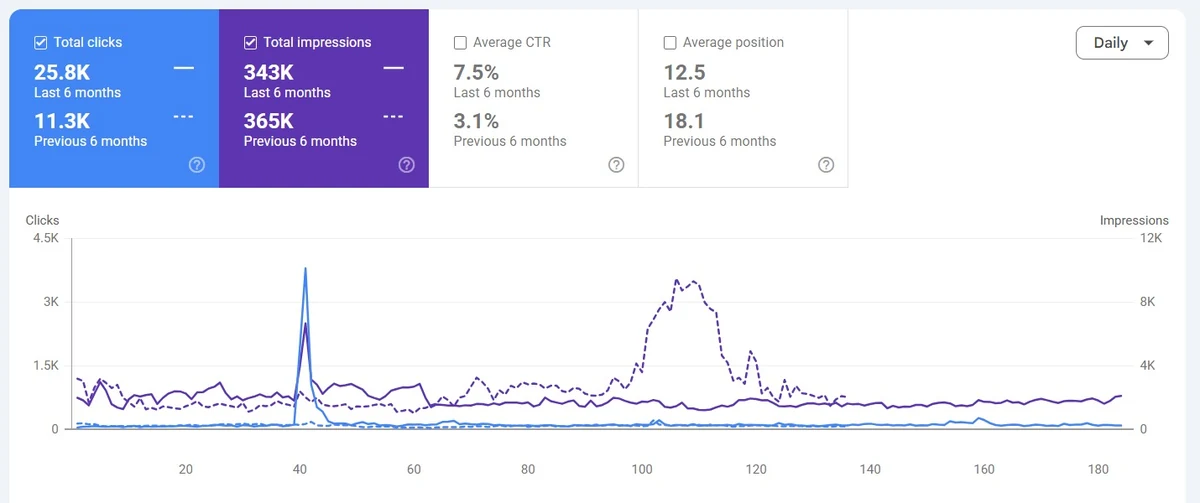
This RIPT Apparel case study covers a pop-culture T-shirt store built from one template. Over six months organic clicks went from 11.3K to 25.8K, which is 2.3x, click-through rate from 3.1% to 7.5% and average position from 18.1 to 12.5. Merchant Center clicks are up 317.8% year on year. Every number is read from Google Search Console or Merchant Center.
Across the 30 pages we rewrote in the 18-day sprint, monthly organic clicks went from 2,170 to 8,450 and click-through rate went from 3.3% to 18.3%. Site-wide across the six months since, clicks are up 128% and the store now converts impressions at more than twice the rate it used to. Both views are below.
See our verified reviews on Clutch+128%
organic clicks, six months
Search figures verified in Google Search Console. Shopping figures from Google Merchant Center.
+142%
click-through rate, site-wide
53%
fewer crawled-not-indexed URLs
| Metric | Before | After | Change |
|---|---|---|---|
| Total clicks / month | 2,170 | 8,450 | +290% |
| Average CTR | 3.3% | 18.3% | +455% |
| Average position | 19.0 | 15.5 | +3.5 positions |
| Pages with improved CTR | n/a | 22 of 30 | 73% hit rate |
| Newly indexed pages | 0 impressions | 33+ live | from invisible to found |
RIPT Apparel had five thousand products and one page template. We started with an 18-day meta title sprint, then spent six months rebuilding the product pages themselves and clearing out an index full of variant URLs. Six months on, organic clicks are 2.3x what they were. Every number below is read from Google Search Console or Merchant Center.
RIPT Apparel sells pop-culture and fandom T-shirts, and the whole catalog was built from one template. Every product page carried the same heading pattern with a word or two swapped for the product name, the same description as the rest of the store, and the same five reviews, while the client actually had more than a thousand reviews sitting unused.
Underneath that the index was inside out. Thousands of real product pages were not indexed at all, while tens of thousands of variant URLs were, so Google was spending its crawl on size and colour permutations instead of the products people search for.
The result: across the 30 pages with the most upside, click-through rate sat at 3.3% and organic clicks at about 2,170 a month, while purchase-ready shoppers landed on competitors instead.
The RIPT Apparel work ran in two phases. An 18-day sprint in April rewrote the 30 meta titles with the most upside and pushed the unindexed part of the catalog into Google. The six months after it rebuilt the product pages themselves, put the real reviews on them and cleared out the variant URLs crowding the index.
Tools and stack
Homepage, category pages, evergreen collections (Daily Deals, Trending Designs, Last Chance, New Designs) and key product pages, ranked by upside.
A click-optimization framework: match the search intent, add an emotional trigger, keep the brand consistent. No guesswork, each title tested against what already wins that SERP.
Submitted missing pages, fixed crawl errors and pushed 33+ previously invisible pages into Google's index.
Watched which titles compounded fastest and doubled down on the winners while the campaign was still running.
Every product got its own H1 and its own description instead of a pattern with the name swapped in, so each page finally said something the other five thousand did not.
The store held over a thousand reviews and was showing the same five everywhere. We mapped them back to the products they belonged to, so each page carries its own proof.
Questions specific to that product, answered on the page, which is what gives a search engine or an AI engine something worth quoting.
Tens of thousands of variant URLs were competing with the products they belonged to. Trimming them moved crawl budget back onto pages that can actually rank.
01Search performance
Google Search Console, the last six months against the six before them. Clicks went from 11.3K to 25.8K while impressions actually fell, from 365K to 343K. That gap is the whole point, because we traded generic reach for buying intent, and click-through rate more than doubled from 3.1% to 7.5% while average position improved from 18.1 to 12.5.
02Indexing
The store had the wrong pages in Google. Between the end of June and mid September, indexed pages rose from 3,668 to about 5,000 while the not-indexed pile collapsed from 102,935 to 36,400. The crawled-but-not-indexed bucket more than halved too, from 13,510 URLs down to 6,410, as duplicate templates turned into real pages.


03Shopping
Product titles that describe the actual product do not only help organic search. Merchant Center now shows 4,640 approved products out of 5,100, and clicks across the last 28 days are up 317.8% against the same window a year earlier. The product feed carries the same rewritten titles, so one piece of work moved both surfaces.


A template tells Google the same thing five thousand times. Once every product page had its own heading, its own description, its own reviews and its own answers, each page had a reason to exist, and Google could tell them apart well enough to rank them. That is the whole mechanism.
It is also why impressions fell while clicks rose on both the 18-day sprint and the six-month view. The store stopped turning up for searches it was never going to win, and started turning up for the ones it could.
AI visibility for real estate agents and brokeragesShort answers to what people ask about the RIPT Apparel case study: how a template-built store reached 2.3x organic clicks in six months, why impressions fell while clicks rose, and what the April title sprint contributed. Every number below is read from Google Search Console or Merchant Center.

Abdul SubkhanFounder. Runs every audit himself.
abdul@citevantage.com
Organic clicks reached 2.3x over six months, from 11.3K to 25.8K in Google Search Console.
That compares the last six months against the six before them. Click-through rate rose from 3.1% to 7.5% and average position improved from 18.1 to 12.5, while impressions actually fell from 365K to 343K. The shopping side moved too, with Merchant Center clicks over the last 28 days up 317.8% on the same window a year earlier. Across the 30 pages rewritten in the April sprint, monthly clicks went from 2,170 to 8,450.
Six months so far, starting with an 18-day title and indexing sprint in April 2026.
The sprint ran from 9 to 27 April, rewrote the 30 meta titles with the most upside and pushed 33 previously invisible pages into Google. The bigger job came after it, with tracking running through September 2026. What the six months added on top of the sprint:
Product pages that finally differ from one another, plus an index cleared of the wrong URLs.
The whole catalog had been built from one template, so Google was reading the same page five thousand times while spending its crawl on size and colour variants. Once each product carried its own heading, description, reviews and answers, Google could tell the pages apart well enough to rank them. Between late June and mid September, indexed pages rose from 3,668 to about 5,000 and the not-indexed pile fell from 102,935 to 36,400. Impressions dipped as generic reach gave way to buying intent, which is why click-through rate more than doubled.
No, and the sprint data shows which ones moved: 22 of the 30 pages rewritten in April improved their click-through rate, a 73% hit rate.
The other eight did not, and they stay in the count. Site-wide, the six-month view is the fairer test, with clicks at 2.3x and the crawled-but-not-indexed bucket down from 13,510 URLs to 6,410. The biggest page-level moves from the sprint:

 Nine named. None of them you.
CiteVantage Assistant
AI assistant. For anything serious: abdul@citevantage.com