How to Get Cited by ChatGPT: The 2026 Citation Playbook
By Abdul Subkhan Published Updated
Part of AI SEO, GEO and AEO
Images in this guide are free to reuse (CC BY 4.0). Credit CiteVantage with a link to this page.
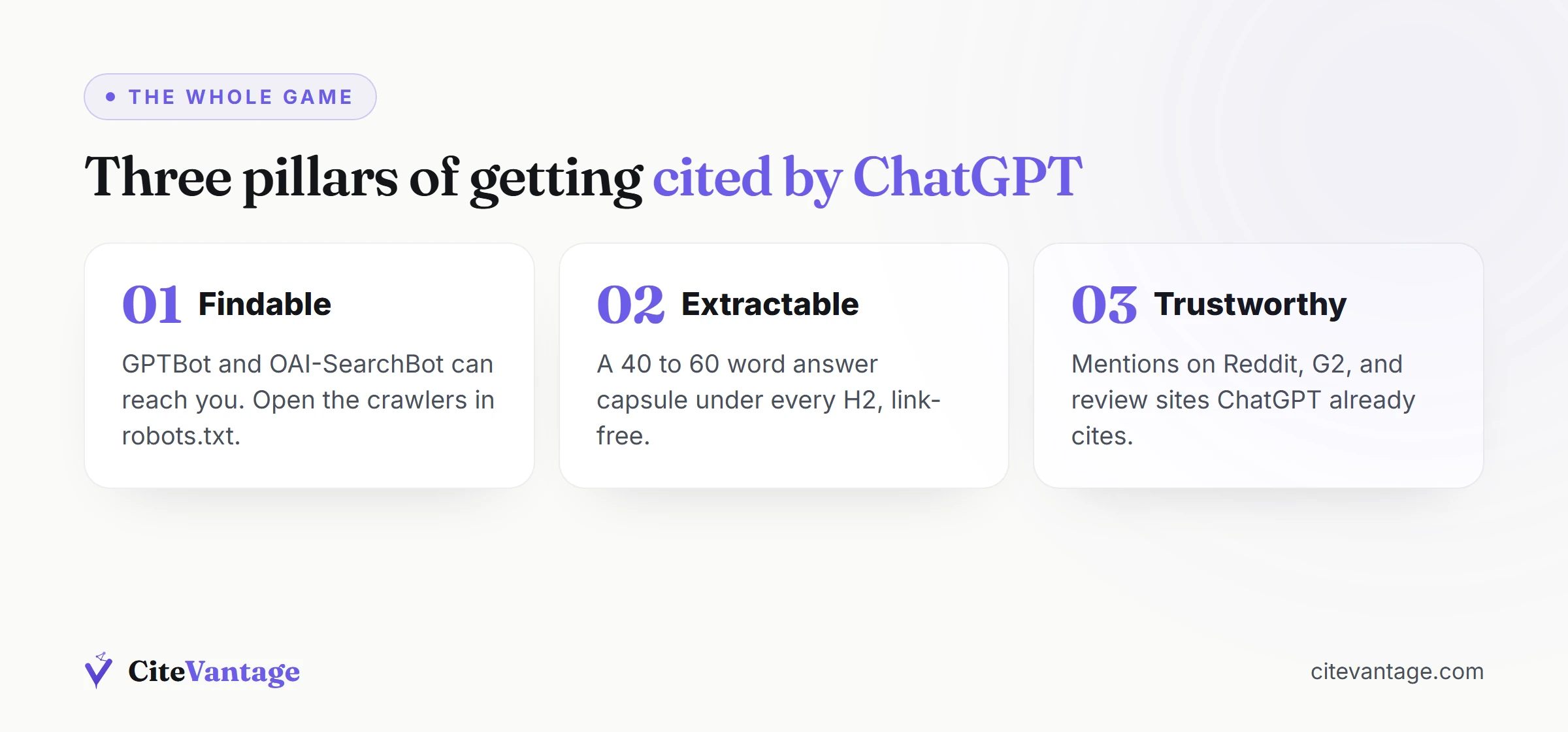
How to get cited by ChatGPT comes down to three things being true at once: your content is reachable by its crawlers, easy to quote, and backed by sources ChatGPT already trusts. That is the whole game. Domain authority barely matters. A clean answer capsule, an open robots.txt and a handful of third-party mentions will beat a high Domain Rating almost every time.
The short version: ChatGPT cites pages it can find, extract, and trust. Open GPTBot in robots.txt. Lead every section with a 40 to 60 word answer capsule. Publish original data with specific numbers. Add Article and FAQ schema. Then earn mentions on Reddit, G2, and review sites. Extractability and social proof beat domain authority.
ChatGPT crossed 1 billion monthly active users in June 2026 and processes around 2.5 billion queries a day, per OpenAI and DemandSage. A growing share of those queries return a synthesized answer with a short list of cited brands. If you are not on that list, you are invisible at the exact moment someone is deciding what to buy.
This is generative engine optimization in practice, and it does not work like the SEO you already know.
Why ranking on Google does not get you cited by ChatGPT
Ranking and citation are not the same signal, and a strong Google position does not carry over. ChatGPT runs its own retrieval and its own selection over what it retrieves, so a page can hold the top organic slot and never be named in the answer. In our 181-brand study many of the invisible brands ranked perfectly well and were still cited zero times.
Ahrefs analyzed 15,000 queries and found only about 12% of URLs cited by AI tools overlap with Google’s top 10 organic results. Flip that around. Roughly 88% of AI citations come from pages ranking outside Google’s first page. You can sit at position two for your money keyword and still never appear inside a ChatGPT answer about your own category.
The gap opens because Google ranks whole pages while ChatGPT quotes passages. When ChatGPT answers a question, it runs a query fan-out, issuing several related searches across subtopics, then retrieves candidate chunks and stitches together a response. Google’s own documentation describes the same fan-out behavior for AI Overviews and AI Mode. The model is not picking the best page. It is picking the most quotable, most trustworthy sentences.
So the unit of optimization changes. Not the page. The block.
| Signal | Traditional SEO (Google) | Getting cited by ChatGPT |
|---|---|---|
| Unit that wins | The page | A 40 to 60 word block |
| Authority signal | Backlinks, Domain Rating | Entity trust, third-party mentions |
| Domain authority weight | High | Near zero (r=0.18) |
| Content shape | Long, comprehensive | Answer-first, scannable |
| Crawler | Googlebot | GPTBot, OAI-SearchBot, ChatGPT-User |
| Freshness need | Moderate | High for live-search queries |
We ran the numbers ourselves. In our audit of 181 ecommerce brands across ChatGPT, Gemini, Perplexity and Google AI Overviews, 87% were never cited once when AI answered questions about their own product category. Most of them had perfectly fine SEO. Decent rankings, clean tech, real backlinks. They just were not built to be quoted.
What makes content more likely to be cited by ChatGPT?
Quotability decides it. ChatGPT cites passages that stand on their own once they are lifted out of the page: a direct answer to the heading above them, roughly 40 to 70 words, carrying its own context so it still makes sense with nothing around it. Passages that depend on the previous paragraph, or that bury the answer after a wind-up, get read and passed over.
Pro tip: Write the answer capsule so it survives being lifted out of the page with no surrounding context. If the sentence needs the heading above it to make sense, an engine quoting it produces something that reads like a fragment, and fragments get dropped in favour of a competitor who wrote a whole thought.
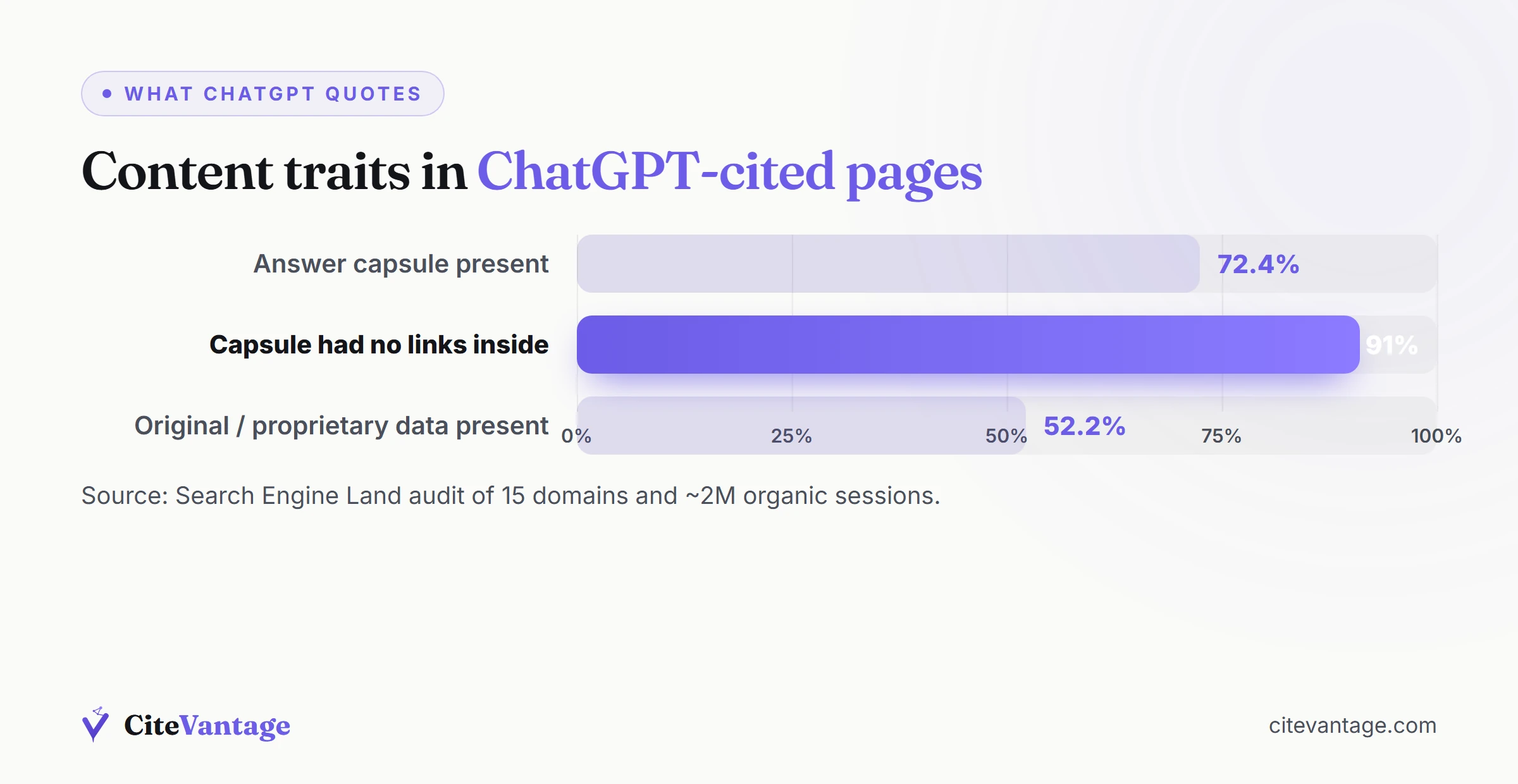
Search Engine Land audited 15 domains and nearly 2 million organic sessions to find which content traits actually correlate with ChatGPT citations. The standout: 72.4% of cited pages contained an identifiable answer capsule, a short block that answers the question completely on its own. Original or proprietary data showed up in 52.2% of cited pages. And the link-density finding was blunt: more than nine in ten cited capsules had no links inside them at all.
Read that last one twice. Links inside an answer block appear to drag down citation odds.
Here is what consistently earns citations, in rough order of leverage:
- A 40 to 60 word answer capsule directly under each H2, written so it stands alone
- Original data with a real number (“we audited 181 brands and 87% were invisible”)
- Clean tables and comparison lists, which AI extracts far more readily than prose
- Question-shaped H2s that mirror what people actually type
- No hyperlinks inside the capsule itself
- A clear author or brand entity the model can attribute the claim to
There is also placement. ALM Corp’s analysis found 44.2% of all LLM citations come from the first 30% of a page, and pages with an answer-first structure showed roughly 4x higher citation probability than pages that buried the answer halfway down. Lead with the answer. Always.
How does ChatGPT decide which brands to recommend?
Two paths, and most brands work on the slower one. The first is the training corpus, which fixes what the model knows without searching and cannot be edited after the fact. The second is live retrieval, where ChatGPT searches at the moment of the question and reads what it finds. The second path is open to a page published this week, and it is the one worth optimising.
ChatGPT surfaces brands from its training knowledge, meaning whatever it learned about established names during training, and from live web search, meaning what it retrieves and cites in real time through Bing’s index. For an established brand, the training path matters. For everyone else, live search is the lever you can actually pull this quarter.
Live search rewards a different mix of signals than people expect. Domain authority barely registers. Discovered Labs found Domain Rating and Domain Authority carry “weak or negative correlations” with LLM visibility, and a separate Clairon analysis put the correlation at r=0.18, explaining about 3% of citation variation. We have watched a six-month-old domain with sharp entity definitions get cited over a competitor sitting at DA 90.
What does move it:
- Crawler access. If GPTBot or OAI-SearchBot can’t reach you, none of the rest matters.
- Extractable structure. Answer capsules, tables, clear definitions.
- Entity clarity. Consistent name, Organization schema, sameAs links.
- Third-party consensus. Mentions on sites ChatGPT already trusts.
- Freshness. Recently updated pages for queries that need current data.
That fourth one deserves its own section, because it is where most brands lose.
Why third-party mentions matter more than your own website
Because ChatGPT trusts agreement rather than assertion. Your own website is a single source making claims about itself, which the model discounts accordingly. Independent sites describing you the same way are corroboration, and corroboration is what moves a brand from known to quotable. This is why a comprehensive website with no outside mentions produces a confident brand that nothing ever cites.
Note: Allowing GPTBot in robots.txt is a precondition, not a cause. It gets you considered. Plenty of sites with wide-open crawler access are still never named, because nothing off their own domain corroborates what they say about themselves.
Roughly 85% of AI-trusted brand citations originate from external sources, not the brand’s own pages. The 5W Public Relations AI Platform Citation Source Index 2026 found Reddit is the number one cited source across every major engine, hovering near 40% citation frequency. Wikipedia accounts for 26 to 48% of ChatGPT’s top-10 citation share. Your homepage is not on that list. Reddit is.
This is the uncomfortable truth for content teams. You can write the best guide on the internet and still lose to a Reddit thread that mentions you twice. ChatGPT is built to repeat consensus, and consensus lives off your domain.
So the work splits in two:
- On your site: answer capsules, schema, original data, clean entity
- Off your site: get named in the places ChatGPT already pulls from
For the off-site half, the highest-value targets are review platforms (G2, Trustpilot, Capterra), the subreddits where your buyers ask questions, and the editorial roundups and “best X” articles ChatGPT cites for your category. One mention in a list ChatGPT already trusts can outperform a month of blogging.
A warning on volatility. This consensus shifts fast. The 5W index documented ChatGPT’s Reddit citation share dropping from roughly 60% to 10% in six weeks during late 2025. Whole strategies went stale overnight. We treat third-party mentions as an ongoing program, not a one-time push, for exactly this reason.
How to get cited by ChatGPT: the 7-step framework
Run these in order, because each step is a prerequisite for the next one paying off. Access first, since a page the crawler cannot fetch cannot be chosen no matter how well it is written. Then structure, so the answer survives extraction. Then corroboration, which is slowest and decides the outcome. Reversing the order is the most common way to spend a quarter and move nothing.
| Step | What you do | Why it matters |
|---|---|---|
| 1. Open the crawlers | Allow GPTBot, OAI-SearchBot, ChatGPT-User in robots.txt | ChatGPT can’t cite what it can’t fetch |
| 2. Get indexed | Verify in Search Console, submit sitemap, render real HTML | Live search pulls from the indexed web |
| 3. Ship a clean entity | Organization schema, consistent name, sameAs links | The model attributes facts to a clear entity |
| 4. Write answer capsules | 40 to 60 word direct answer under each H2, no links inside | The single biggest citation driver |
| 5. Publish original data | One proprietary stat makes you the primary source | Forces ChatGPT to credit you by name |
| 6. Add schema | Article, FAQPage, HowTo where relevant | Easier parsing, clearer trust signals |
| 7. Earn third-party mentions | Reviews, Reddit, editorial roundups | 85% of AI-trusted citations come from here |
1. Open the AI crawlers
In robots.txt, explicitly allow GPTBot, OAI-SearchBot and ChatGPT-User. Add PerplexityBot and Google-Extended while you are in there. Plenty of sites block these by accident through a security plugin or a CDN default, and that one line guarantees invisibility. Check it first.
2. Get indexed
ChatGPT’s live search reaches into Bing’s index, but the discipline is the same as Google. Verify the site, submit an XML sitemap, confirm nothing critical is set to noindex, and make sure pages render real HTML rather than client-side-only content a crawler might miss.
3. Ship a clean entity
Add Organization schema with your name, logo, sameAs links to LinkedIn and Crunchbase and a ContactPoint. Keep the name and description identical across every profile. When the model can resolve “who is this,” it can attribute claims to you with confidence. Fuzzy entities get skipped.
4. Write answer capsules
Open each key section with a 40 to 60 word block that answers the section’s question completely, with no hyperlinks inside it. This is the move that shows up in 72.4% of cited pages. If a reader could screenshot that block and have the full answer, ChatGPT can quote it.
5. Publish original, quotable data
A single proprietary number makes you the source ChatGPT has to credit. “We audited 181 brands and found 87% are invisible to AI” is a sentence the model can lift and attribute. Surveys, internal benchmarks, before-and-after results, anything no one else can claim. This is the highest-leverage authority move on the list.
6. Add schema markup
Mark up articles with Article schema, FAQ blocks with FAQPage and step content with HowTo. Schema does not force a citation. It makes your content easier to parse and your entity easier to trust, which raises the floor on everything else.
7. Earn third-party mentions
The off-site work from the section above. Reviews on G2 and Trustpilot, genuine presence in relevant subreddits, inclusion in the roundups ChatGPT already cites for your category. This is slow and it compounds. It is also where most of the citation weight actually sits.
How often does ChatGPT actually cite a brand? 169 of 181 were absent
In June 2026 we asked ChatGPT a category question for each of 181 United States ecommerce brands. It cited 8 of them, mentioned 4 without a citation, and left 169 out entirely. That is 93 percent absent from one engine, in categories those brands were actively buying paid social to compete in. The method, limitations and row-level results are in the 181-brand AI visibility study.
What ChatGPT cited across 147 real estate answers
In September 2026 we ran 150 real estate queries across five engines and logged every source. ChatGPT returned 147 answers, and only 135 carried sources at all. Those answers cited 305 distinct domains at 4.1 per answer. Perplexity, on the same queries, cited 618 at 7.7. ChatGPT is the more selective engine, which cuts both ways: harder to enter, worth more once you are in.
The full matrix, including the per-engine breakdown and the query list, is published in the 150-query real estate AI search study.
Can ChatGPT even reach your site?
Before any of this matters, check that OpenAI’s crawlers can fetch your pages, because a host or CDN can refuse them without telling you and nothing in your own logs will show it. Testing our own site, the full versioned GPTBot user agent was refused on 8 of 8 cache-busted requests while OAI-SearchBot and ChatGPT-User passed on 8 of 8 each, from the same machine in the same minutes.
That split matters. OpenAI runs three crawlers and they do different jobs: GPTBot builds the training corpus, OAI-SearchBot builds the index behind ChatGPT search, and ChatGPT-User fetches live when someone’s question triggers browsing. Losing the first costs you the model’s background knowledge over years. Losing the other two costs you today. Our host confirmed the block was deliberate and platform-wide, and the evidence is in the GPTBot case study.
Do not optimize for ChatGPT alone
One platform is a fraction of the picture, and optimising for it alone hides where you are actually losing. Across 747 measurements in our real estate study, 1,077 of the 1,297 cited domains were cited by exactly one engine out of five. Being quoted by ChatGPT tells you almost nothing about Perplexity, Gemini, Copilot or Google AI Overviews, so measure each one separately.
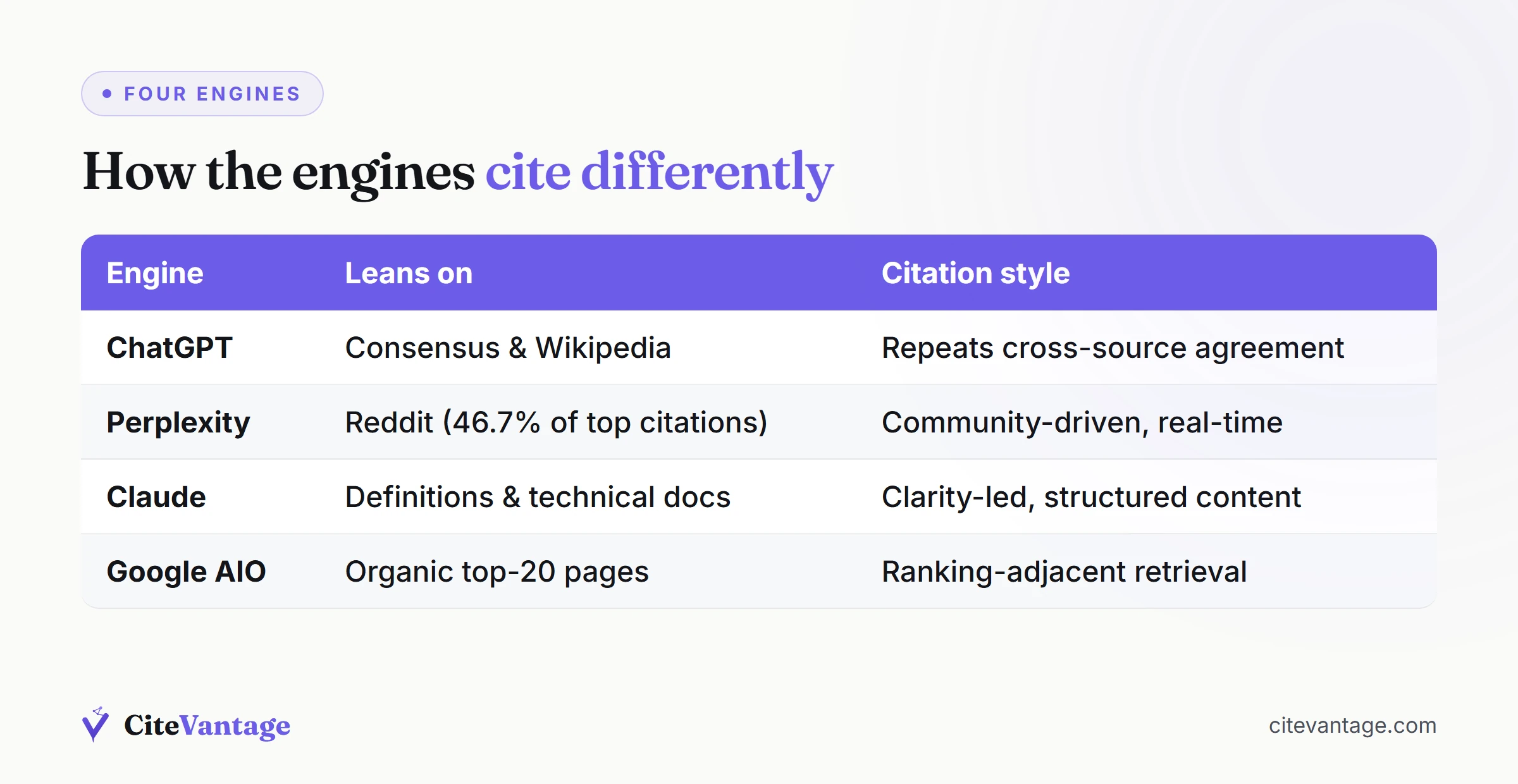
Engines cite differently and they barely overlap. Perplexity pulls 46.7% of its top citations from Reddit. Claude rewards clear definitions and bullet points, up to 30% more likely to select cleanly structured content. ChatGPT leans on consensus and Wikipedia. Optimizing only for ChatGPT can leave you invisible on the engines your buyers actually use, and ChatGPT’s own market share slid from 77.6% to 53.7% between May 2025 and April 2026 as Claude, Gemini, and Grok fragmented the field.
So measure across all four. We tell clients the same thing every time: monitoring one engine misses most of your real AI visibility. That is the whole reason our free AI Visibility Audit checks ChatGPT, Gemini, Google AI Overviews and Perplexity together rather than one in isolation.
For the deeper mechanics, our guides on what generative engine optimization actually is and how AI decides which brands to recommend go further than we can here. If Perplexity is your priority, getting cited by Perplexity covers its Reddit-heavy quirks. And because Gemini leans on brand-owned pages far more than ChatGPT does, our guide to getting cited by Google Gemini shows where that engine rewards a different kind of work.
What ChatGPT citations are worth to your brand
ChatGPT citations are the moments the model names your brand inside an answer, and they land right where the buying decision happens. To get cited on ChatGPT you need reachable pages, quotable capsules, and third-party trust. To get cited in ChatGPT repeatedly, you keep that program running, because the answers reshuffle constantly. The work above is how you earn both.
How long does it take to get cited by ChatGPT?
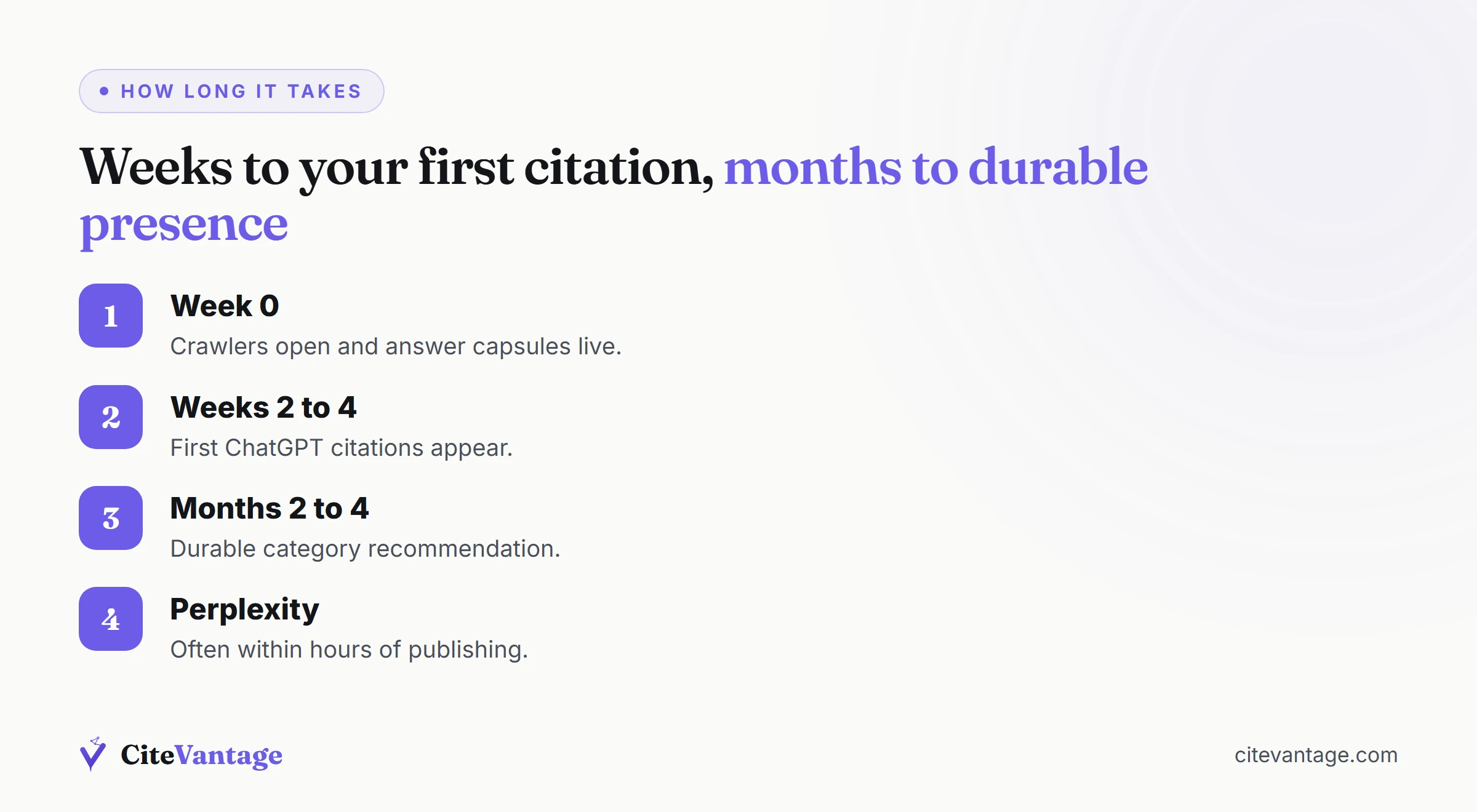
Weeks for the first citations, months for durable presence, and the two halves move on different clocks. Structural changes can alter an answer as soon as the page is recrawled, because live retrieval reads the page as it stands today. Corroboration depends on other people publishing, which you can prompt but not schedule. Anyone quoting a fixed timeline is guessing.
Once crawlers can reach you and your top pages lead with answer capsules, first citations can show up in a few weeks. Repeated, reliable recommendation across your category usually takes a few months of sustained content and mention-building. Perplexity tends to move faster because it retrieves in real time, sometimes within hours of publishing.
It is a program, not a fix. AI answers reshuffle constantly, so the brands that stay cited are the ones that keep publishing and keep earning mentions.
Where to start this week
Three moves, in order, before anything more ambitious. Confirm ChatGPT’s crawlers can actually reach your pages, because a host can refuse them silently. Rewrite the opening paragraph under each heading into a self-contained answer of roughly 40 to 70 words. Then pick the three independent sites your buyers already read and work out what would make them mention you.
- Open robots.txt and confirm GPTBot, OAI-SearchBot and ChatGPT-User are allowed. This takes five minutes and it is the most common reason brands are invisible.
- Rewrite the opening of your three most important pages into 40 to 60 word answer capsules, link-free, leading with the direct answer.
- Run a baseline check across all four engines so you know where you actually stand before you start. Our AI Visibility Sprint does this and gets you newly cited in agreed buyer questions within 90 days, or we run a second sprint free.
That is the foundation. Crawlers, capsules, then the patient off-site work that turns a few citations into a category default. And if you want proof the foundation piece pays for itself, our RIPT Apparel case study covers a store that gained 290% more organic clicks in 18 days from exactly that groundwork.
Frequently asked questions
What makes content more likely to be cited by ChatGPT?
+
Self-contained answer capsules, first. 72.4% of ChatGPT-cited pages open a section with a 40 to 60 word direct answer, per a Search Engine Land audit. Pair that with original data, clean formatting, and link-free capsules. ChatGPT lifts text it can quote without editing, so the easier a block is to extract, the more often it gets pulled into an answer.
Does domain authority affect ChatGPT citations?
+
Barely. Domain authority correlates with AI citation probability at about r=0.18, which explains roughly 3% of why a brand gets cited. We have watched DA-10 sites outrank DA-90 sites inside ChatGPT answers. Extractable structure, a clear entity and third-party mentions move the needle far more than a high Domain Rating ever will.
Why is my website not cited by AI search engines?
+
Usually one of three reasons. Your robots.txt blocks GPTBot or OAI-SearchBot, your content buries the answer instead of leading with it, or no trusted third party mentions you. In our audit of 181 ecommerce brands, 87% were cited zero times across four engines. Most had decent SEO. They just were not built to be quoted.
How long does it take to get cited by ChatGPT?
+
First citations can land in weeks once the foundations are set. Durable, repeated recommendation in your category takes a few months of sustained content and mention-building. ChatGPT's live search refreshes constantly, so this is a program you maintain, not a switch you flip. Perplexity often moves faster, sometimes within hours of publishing.
Do I need an llms.txt file to be cited by ChatGPT?
+
No. No major AI engine has confirmed it reads llms.txt, and Google has said it does not use it. It is cheap to publish and harmless, so add one if you like, but treat it as optional. Allowing GPTBot in robots.txt and shipping answer-shaped content matter far more for getting cited.
How do ChatGPT, Claude, and Perplexity cite sources differently?
+
Each picks sources its own way. ChatGPT leans on consensus and Wikipedia. Perplexity pulls heavily from Reddit, which makes up about 46.7% of its top citations. Claude favors clear definitions, bullet points and technical docs. Engine citation overlap is low, so optimizing for one platform misses most of your visibility on the others.
Is schema markup important for AI citations?
+
It helps, indirectly. Schema like Article, FAQPage and Organization does not force a citation, but it clarifies your entity and makes content easier to parse and trust. We treat it as table stakes, not a silver bullet. The bigger levers are answer capsules and third-party mentions. Schema supports them rather than replacing them.
How do third-party mentions affect AI visibility?
+
They carry most of the weight. Roughly 85% of AI-trusted brand citations come from external sources like Reddit, G2, and review sites, not a brand's own pages. ChatGPT trusts cross-source agreement. If five sites it already cites mention you, you become part of the consensus it repeats. Owned content alone rarely gets you there.
What is the difference between ranking in Google and being cited by ChatGPT?
+
Different games. Only about 12% of URLs cited by AI overlap with Google's top 10 organic results. Google rewards pages; ChatGPT rewards quotable passages and entity trust. You can rank page one and still be invisible inside AI answers, which is exactly what we see in most audits.
Can I pay ChatGPT to include my brand?
+
No. There is no paid-inclusion or submission mechanism for organic ChatGPT answers. You earn citations through crawler access, extractable content, a clean entity and third-party trust signals. Anyone selling guaranteed placement inside ChatGPT answers is selling something that does not exist.
More in AI SEO, GEO and AEO
- Domains AI Cites on Real Estate: The Open List
- Hostinger CDN Blocks GPTBot: HTTP 429 Case Study
- AI Search Statistics 2026: Sourced and Dated
- AI Tools for SEO and AEO: Track ChatGPT Mentions
- Best AI Mode SEO Analysis Tools for 2026
- Best AI SEO Agencies 2026: 15 Firms Ranked
- Can AI Crawlers Reach Your Site? How to Check
- GEO Case Studies: Successful Campaigns
- GEO vs SEO vs AEO: The Real Difference in 2026
- Generative Engine Optimization: GEO and AEO Guide
- Google Preferred Sources: Myths, Broken
- How to Check if ChatGPT Recommends Your Brand
- How to Get Cited by Google Gemini
- How to Get Cited by Perplexity: 9 Source Signals
- How to Rank in Google AI Overviews: 2026 Guide
- How to Run an AI Visibility Audit Step by Step
- How to Track Competitors in AI Search Results
- Most Popular AI Visibility Tools for SEO
- SEO and GEO Strategy: Make Them Work Together
- Schema Markup for AI Search: Types That Matter
- What Is llms.txt? Complete Setup Guide
Start from the hub: AI SEO, GEO and AEO
See where AI is hiding your brand
Free multi-engine audit across ChatGPT, Gemini, Google AI & Perplexity.
See who AI names instead of me