How to rank in Google AI Overviews comes down to three things: hold a top 10 position for the query, answer that query in your first 40 to 70 words, and structure the page so a model can lift a clean fact. Google AI Overviews optimization adds extractability to your existing SEO rather than opening a separate channel: hierarchical headings that mirror real questions, FAQ and Article schema, current data with sources and visible author expertise. Google says no special AI tactics are needed. The work is making your answer the easiest one to quote.
TL;DR: Google AI Overviews favour pages that rank well and read as clean, liftable answers, though Ahrefs found about 62% of cited pages sit outside the top 10. To get cited: hold strong classic rankings, lead each section with a 40 to 60 word answer capsule, add FAQPage and Article schema, keep facts current with sources and prove real author expertise. Rank improves your odds, and extractability earns the citation.
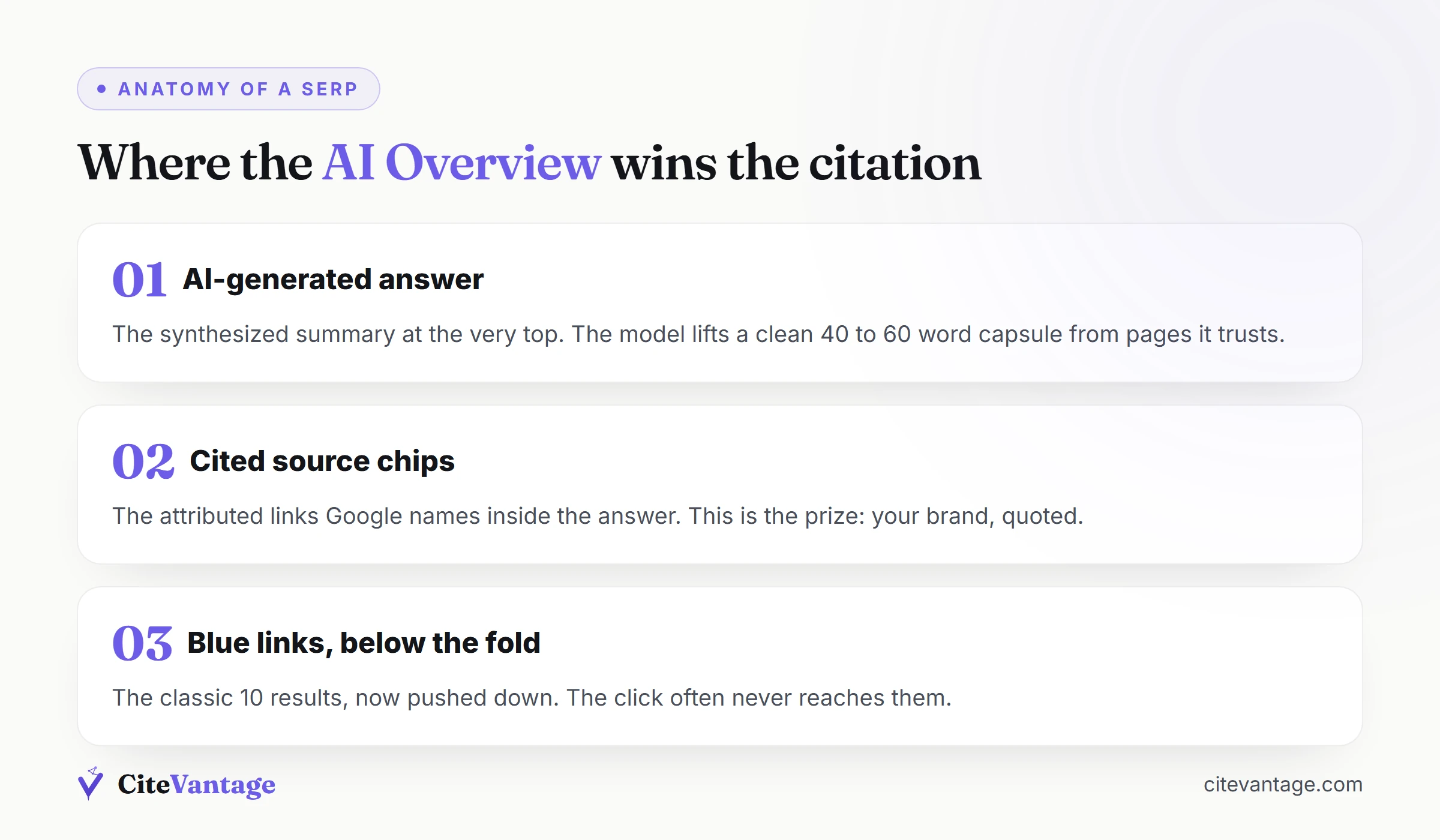
Here is the uncomfortable part. Ranking number one used to be the finish line. Now it is a head start.
AI Overviews appear on a large and growing share of searches overall, though far fewer in real estate, as the section below shows, and when they show up, the click often doesn’t follow. Pew Research found people clicked a regular search link in only 8% of searches that displayed an AI summary, compared with 15% when no summary appeared. Ahrefs put a number on the damage for top pages: a 58% drop in clicks on AI Overview keywords. So the page that “wins” by ranking can still lose the visit. The only durable win left is being the source the Overview quotes, with your brand named at the very top.
That is the whole game now: ranking improves your odds, and structure decides whether you get selected.
What is a Google AI Overview, and how does it actually pick sources?
A Google AI Overview is the AI-generated summary above the blue links, assembled by a language model from pages Google already trusts and shown with citations. Selection runs in two stages: Google retrieves a candidate set, then the model decides which candidates to quote. Ranking feeds the first stage without deciding the second, which is why strong organic pages are so often missing from the summary above them.
The selection is less mysterious than it looks. Google has been blunt about it. Optimizing for generative AI search “is optimizing for the search experience, and thus still SEO,” and you “don’t need to create new machine readable files, AI text files, markup, or Markdown to appear in Google Search.” Strip away the noise and the model is doing three things when it builds an Overview:
- It starts from a candidate set that includes pages ranking well for the query, though most of what it cites comes from outside the top 10.
- It scans those pages for a self-contained, factual answer it can lift without rewriting much.
- It weighs trust signals (author, freshness, accuracy) before it commits your sentence to the answer.
That third step is where a lot of strong pages quietly fail, because they rank without ever handing the model a clean sentence to lift.
How much a top 10 ranking actually buys you
Ahrefs studied 863,000 SERPs and 4 million AI Overview URLs in March 2026 and found 37.9% of cited pages also rank in Google’s top 10. The other 62% were split almost evenly between positions 11 to 100 and pages beyond the top 100. A first-page ranking raises your odds without deciding the outcome, and among the pages a model considers, one that answers the question in its opening line hands it an easier sentence to quote than one that buries the answer under a 200-word intro.
How is Google AI Overviews optimization different from ChatGPT or Perplexity?
Google AI Overviews lean harder on existing Google rankings than the chat engines do. ChatGPT and Perplexity pull from a wider, messier mix of sources and care less about where you sit in Google’s index, which means a well-structured page can get cited by them without ranking at all. Overviews are stricter: classic SEO is load-bearing here in a way it isn’t for pure chat.
That difference matters for where you spend effort.
| Factor | Google AI Overviews | ChatGPT | Perplexity |
|---|---|---|---|
| Needs you to rank in Google | Helps, though 62% of citations sit outside the top 10 (Ahrefs) | No, uses Bing index + browsing | No, ranks its own retrieval |
| Primary trust signal | Google’s existing quality + E-E-A-T | Brand mentions, training data, citations | Live citations, freshness |
| Schema influence | Helps clarify facts | Minor | Minor |
| Answer-first structure | Critical | Critical | Critical |
| Best content type | Ranking page with liftable capsule | Authoritative, widely-cited page | Fresh, well-sourced page |
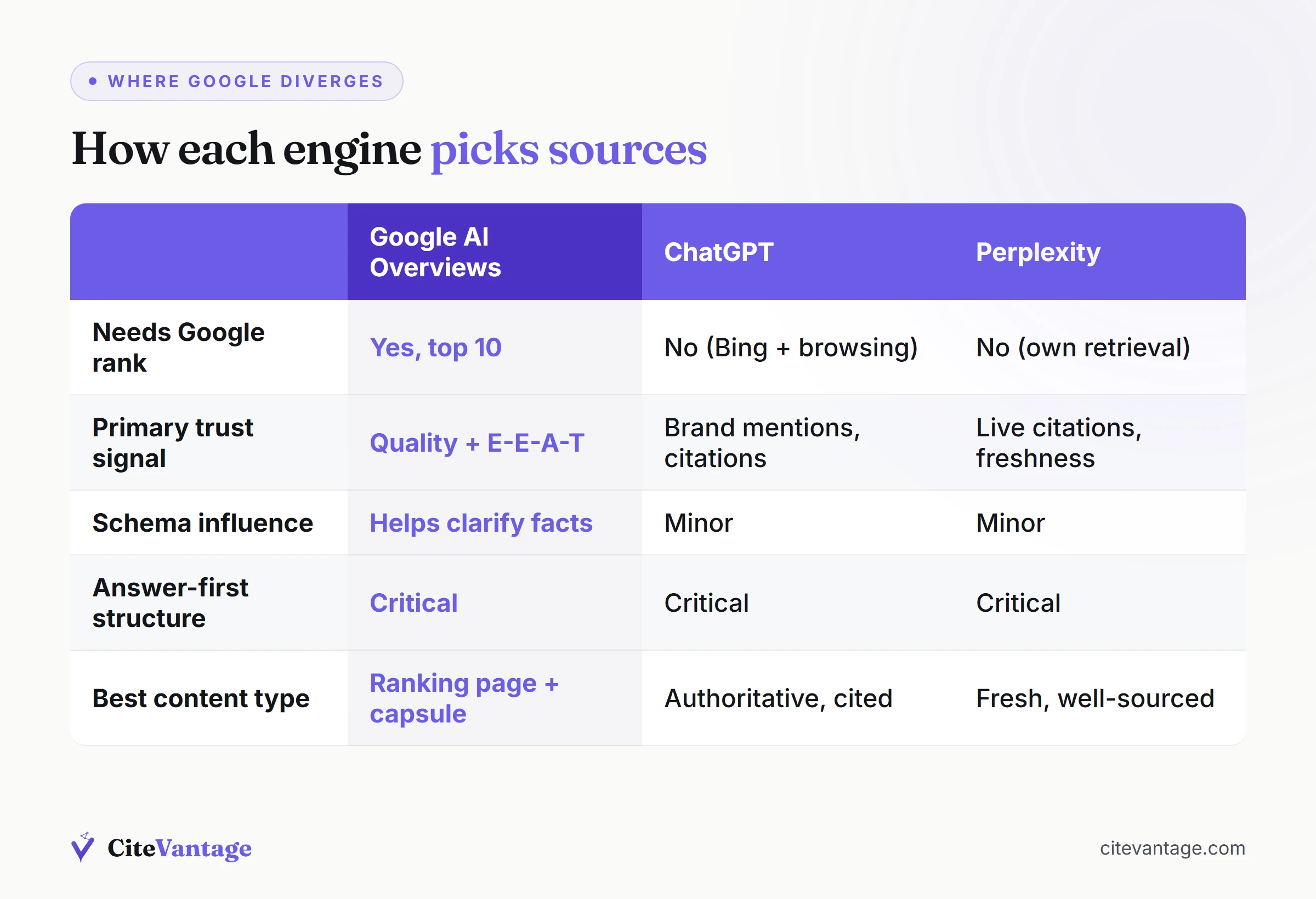
Notice the bottom three rows. Answer-first structure matters everywhere. That overlap is why a single page, built right, can earn citations across all four engines at once. The schema and rank dependencies are where Google diverges. We cover the chat side in detail in how to get cited by ChatGPT and how to get cited by Perplexity, and the bigger frame in generative engine optimization.
What are the moves that actually win AI Overview citations?
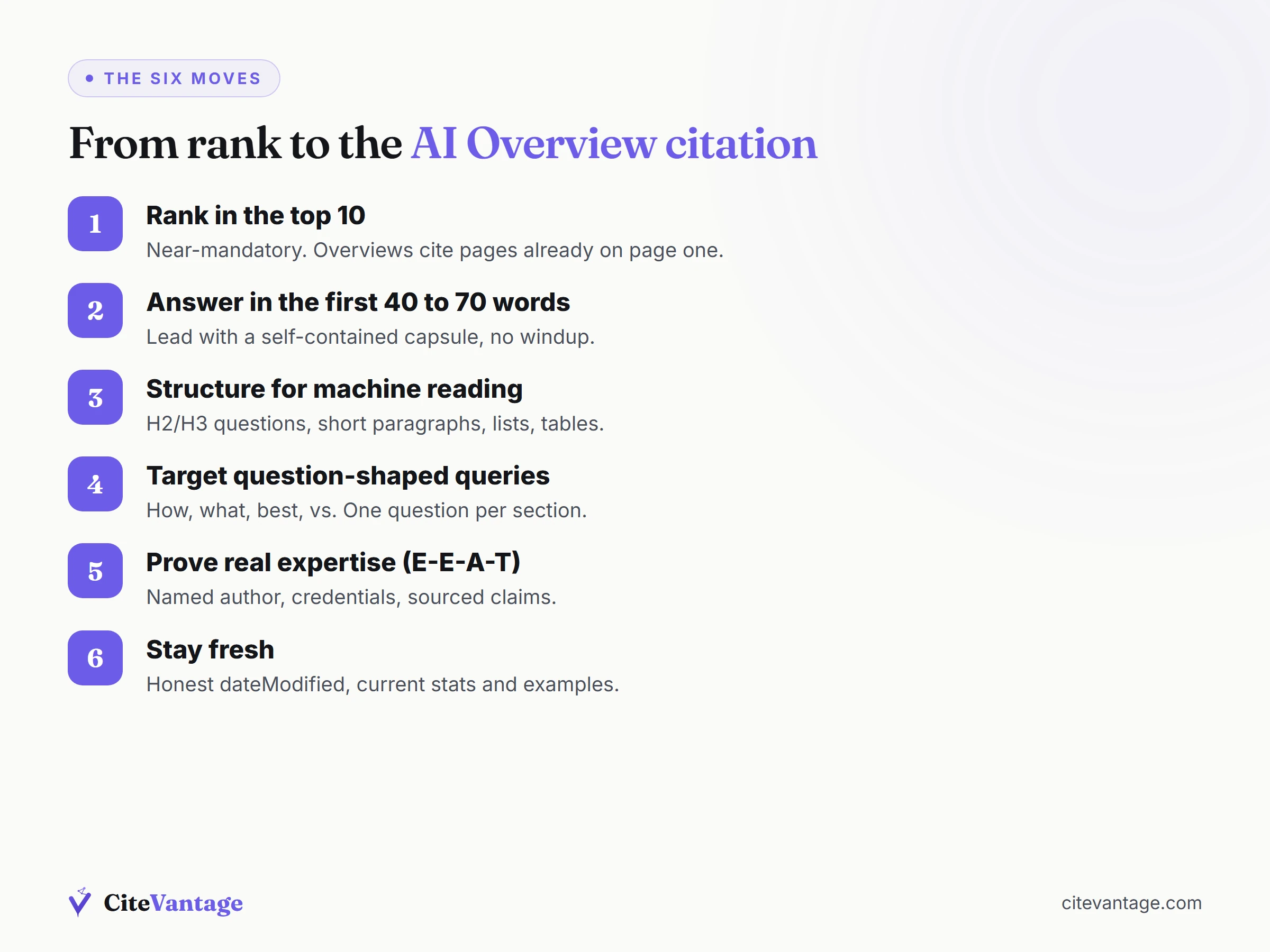
The moves that win AI Overview citations are: rank top 10, lead with a direct answer, structure for machine reading, target question-shaped queries, prove expertise and stay fresh. Each one is an SEO fundamental pointed at extractability, with no AI hack among them.
1. Rank in the top 10
Ranking still moves the odds. Ahrefs found 37.9% of AI Overview citations go to pages that also rank in the top 10, a heavy share for ten slots, even though most citations come from further down. So the boring SEO work still pays: relevance, internal links, technical health, mobile speed, indexability. It also pays in plain clicks, as the structural rebuild of a multi-site property network in our Bright Realty International case study shows, and as an index cleanup did in our retail work, taking RIPT Apparel to 2.3x organic clicks over six months. Work on the ranking and the extraction together, because a page further down can still be quoted if it answers the question best.
2. Answer the question in the first 40 to 70 words
Lead the page, and each major section, with a tight, self-contained answer to the exact query. This is the single highest-leverage move, and it’s the one most pages skip. A marketer on r/digital_marketing put it plainly: “I’ve had better AIO pickup when I rewrote intros to answer in 2-3 lines, added a FAQ.” Move the answer up, drop the windup.
A good answer capsule:
- States the answer in the first sentence, no preamble.
- Runs 40 to 60 words, long enough to be complete, short enough to lift whole.
- Uses the query’s own words so the match is obvious.
- Stands alone without needing the paragraph before it.
- Bolds the core claim once so it’s visually the answer.
3. Structure the page for machine reading
Below the capsule, format so a model can parse you fast. Use H2s and H3s phrased as the real questions people search. Keep paragraphs short. Break steps into numbered lists and facts into tables, because tables get extracted far more often than prose. As one r/growmybusiness commenter said, “AI overviews love content that’s easy to parse.” Hierarchy, lists, and tables are what “easy to parse” means in practice.
4. Target the queries that actually trigger Overviews
Overviews show up most on informational, comparison, and “how / what / best / vs” queries. Build pages around the precise questions your buyers type, worded naturally, one clear question per section. For an agent that means questions like “what is it like to live in [neighbourhood]” or “how long do homes take to sell in [city]”, the informational searches a buyer runs months before calling anyone. This is also where query fan-out lives: a single Overview often answers a cluster of related sub-questions, so a page that covers the main question plus its neighbors gives the model more to pull from. Map the question cluster, then answer each node.
5. Prove real expertise (E-E-A-T)
Google weighs trust heavily before it puts your words in an Overview. That means named authors with real credentials, accurate claims, links to reputable sources and clear authorship markup. On a real estate site, the strongest version is the licensed agent who actually works the area, named on the page with a license number and a link to their profile. A named author with real credentials gives the engine a person it can check against other sources. A byline with a real person behind it works as a ranking and citation input here, not as decoration.
6. Keep the page fresh
Update the content and stamp dateModified honestly. Overviews favor current information for anything time-sensitive, and stale stats are a fast way to get dropped. Refresh the numbers, refresh the date, refresh the examples. This article kept its slug and original date precisely because the URL already earned trust; we updated the body rather than starting over. Do the same with your winners.
Does schema markup matter for AI Overviews, or not?
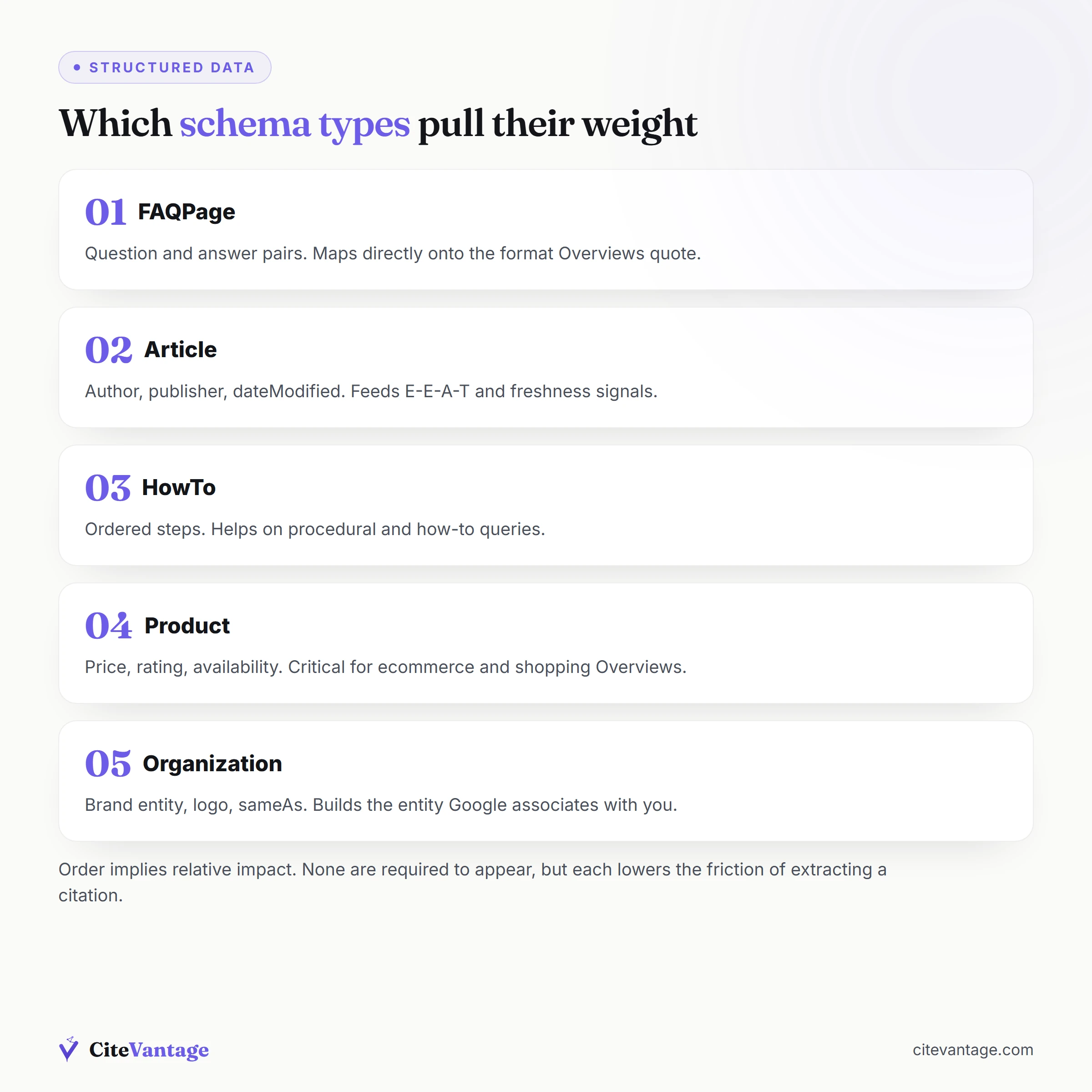
Schema markup isn’t required for AI Overviews, but it earns its place by making your facts unambiguous to a machine. Google explicitly says you don’t need new markup to appear in AI features. At the same time, structured data clarifies your Q&A, your authorship, and your update date, which are exactly the signals an Overview leans on. So: not mandatory, still worth it.
Here is which types pull their weight, and why.
| Schema type | What it clarifies | Why it helps AI Overviews |
|---|---|---|
| FAQPage | Question and answer pairs | Maps directly onto the format Overviews quote |
| Article | Author, publisher, dateModified | Feeds E-E-A-T and freshness signals |
| HowTo | Ordered steps | Helps on procedural and “how to” queries |
| Product | Price, rating, availability | Fits priced offers; most agent and brokerage pages are better described by RealEstateAgent |
| Organization | Brand entity, logo, sameAs | Builds the entity Google associates with you |
| RealEstateAgent | Agent or office, address, service area | Ties the page to the local entity Google already knows from your Business Profile |
Schema will not force a citation on its own. Its job is to lower the friction of extracting one, so a short question-and-answer block with clean FAQPage schema is easier for the model to lift. The arXiv “GEO: Generative Engine Optimization” paper found structured, source-cited content can boost visibility in generative engines by up to 40%.
Why your top-ranking page still doesn’t appear in Google AI Overviews
The usual reason a top-10 page misses the Overview is a buried answer. The page is eligible. The model just can’t find a clean, liftable sentence near the top, so it quotes a lower-ranked page that made the answer obvious.
Run this checklist against any page that ranks but doesn’t get cited:
- A direct 40 to 60 word answer in the first paragraph, not paragraph four
- H2s and H3s phrased as the actual questions searched
- At least one table or numbered list of extractable facts
- FAQPage schema on the Q&A, Article schema with
dateModified - A named author with visible credentials
- Current statistics, each with a real source link
- No fluff intro standing between the reader and the answer
Most “why am I invisible” cases are three or four of those boxes unchecked. We break the full diagnosis down in why your brand is invisible to AI. The fix is usually tighter, answer-first content rather than more of it.
How do you measure AI Overview visibility?
Measure AI Overview visibility by tracking citation share, whether your domain is named or linked in the Overview for your priority queries, rather than rank alone. Standard analytics won’t show it cleanly, because clicks from AI surfaces often arrive as direct or dark traffic with no referral tag. So rank can hold steady while your real visibility quietly erodes. Search Console’s Generative AI performance report, open to all sites since August 31, 2026, now shows your impressions in AI Overviews and AI Mode by page, country and device. It reports only your own site, not who else was cited, so you still have to check the Overview itself.
A workable measurement loop:
- List the 10 to 20 buyer questions that matter most to your revenue.
- For each, record whether an AI Overview shows and whether you’re cited in it.
- Track that citation share over time, the same way you’d track keyword rankings.
- Repeat across ChatGPT, Gemini and Perplexity, since each cites differently.
- Watch direct-traffic shifts on pages that lost Overview citations.
The Gemini app is its own surface with its own citation habits, and it favors brand-owned pages more than ChatGPT or Perplexity do. Our playbook on how to get cited by Google Gemini covers that side in full.
This is exactly the gap most teams have no tooling for. Our free AI Visibility Audit runs this check on ChatGPT, Perplexity, Gemini and Copilot, scores you 0 to 100, and returns it inside 48 hours, so you can see citation share instead of guessing from rank.
How do Google AI Overviews treat real estate searches?
Google AI Overviews show up on only a small share of real estate searches, and Google’s local surfaces carry more of the load when someone is looking for an agent. Conductor, measuring enterprise real estate domains, found Overviews on only 4.5% of page-one queries, and Local Falcon found they returned nothing at all seven times out of ten when asked to find an agent.
That shifts where an agent or brokerage should spend effort. The same Local Falcon index, a vendor measurement of “best realtor near me” questions in the 100 largest US cities, found Google Business Profile supplied 36.6% of all AI citations and 72.5% of the sources in Google AI Mode. Our own 500-query Houston study saw the same pull on a different Google surface, with Business Profile details such as ratings and opening hours appearing in 82 of 473 Gemini web app answers. The Conductor and Local Falcon figures are listed with their publishers and dates on our real estate SEO statistics page.
For a real estate firm the practical order runs like this. Keep the Business Profile accurate and current, because it feeds the local answers that agent-finding questions trigger. Then build answer-first area and market pages for the informational questions buyers research, such as schools, commute times or how fast homes sell in a neighbourhood, so you are the page an Overview can lift when one does appear. That page-level work is what our AEO for real estate service covers.
The bigger picture: rank is now a false summit
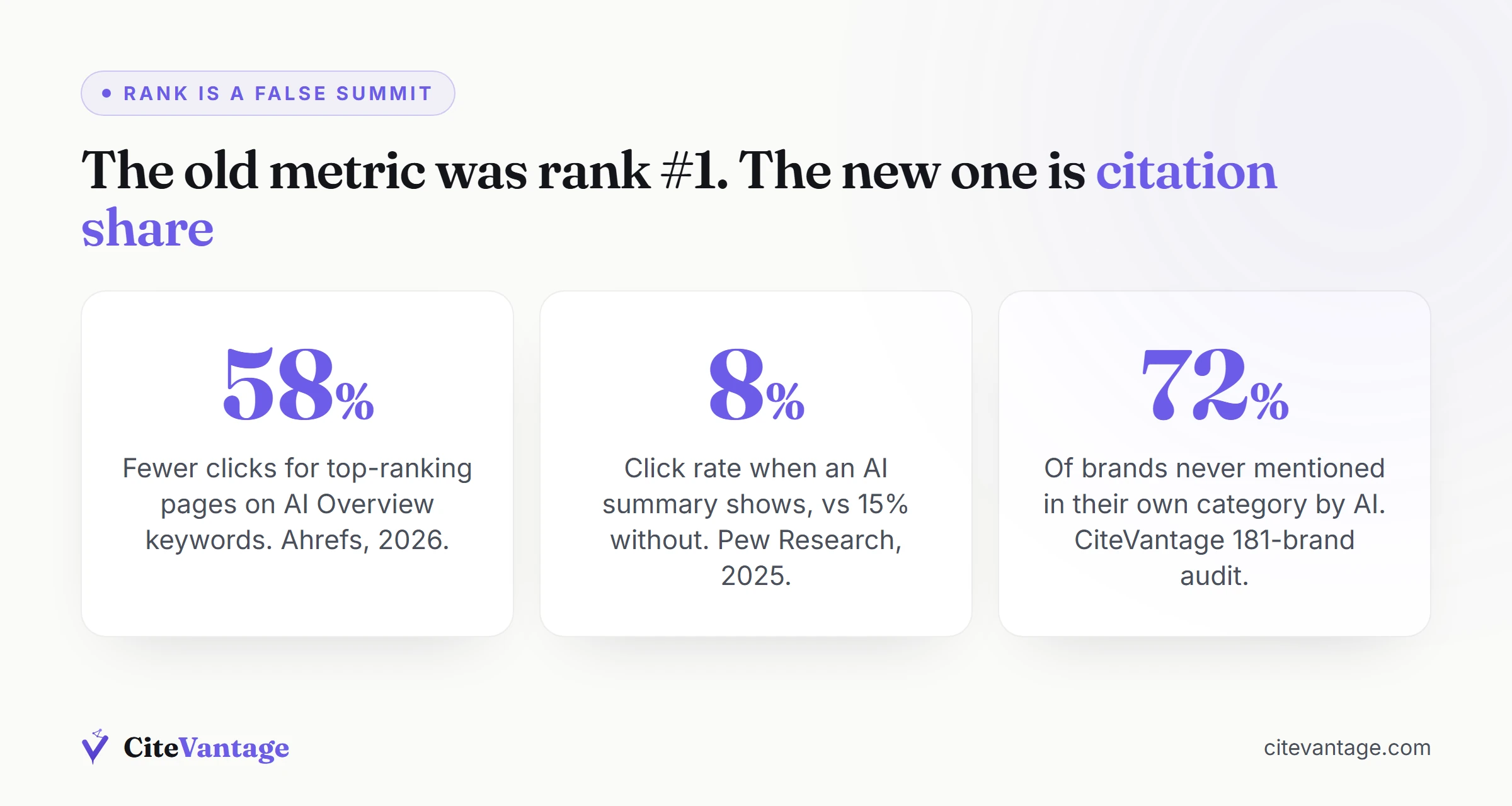
Gartner projects search engine volume will fall 25% by 2026 as AI assistants absorb queries. Pew shows the click vanishing when an Overview appears. Ahrefs shows 58% fewer clicks for top pages on Overview keywords. Put those together and the conclusion is hard to dodge: ranking number one and earning the click are no longer the same thing.
In our 181-brand audit of online retailers, 87% were never mentioned when AI answered questions about their own category, and in real estate a hand-checked 94.0% of Houston’s 50,000-plus Realtors went unnamed in 2,000 AI answers. The new summit is citation share across Google AI Overviews, ChatGPT, Gemini and Perplexity. That’s a different scoreboard, and most brands aren’t keeping it yet.
How to rank in Google AI Overviews: where to start this week
Three concrete moves, in order, and the order is the point. Rewrite the opening paragraph under each heading into a self-contained answer of roughly 40 to 70 words, because that is the unit the model lifts. Check that your pages carry valid schema for what they actually are. Then find the three independent sources Google already cites for your category and work out what would make them mention you.
- Pick your five highest-value ranking pages and rewrite the opening into a 40 to 60 word direct answer. This is the fastest pickup.
- Add FAQPage and Article schema to those pages, with an honest
dateModifiedand a named author. - Check whether you’re cited in the Overview for those queries today, so you have a baseline to beat.
Do those three and you’ve covered the moves that decide most citations. For the strategy behind the tactics, see GEO vs SEO vs AEO. Then watch the Overview, not just the ranking. That’s where the visibility actually lives now.
Frequently asked questions
What are Google AI Overviews and how do they work?
They are the AI-written answers that appear above the blue links on many Google searches, with the pages they drew on cited alongside.
Google retrieves a candidate set of pages, and a language model reads them, pulls the most extractable facts and stitches them into a summary. Ranking feeds the retrieval stage without deciding the selection: Ahrefs found 37.9% of pages cited in AI Overviews also rank in Google's top 10, and about 62% come from further down. Strong pages that bury the answer are often missing from the summary above them.
Do I need to optimize separately for AI Overviews, or is normal SEO enough?
Mostly normal SEO, with one shift in how you structure the page.
Google says no special AI tactics, files or markup are needed to appear in AI features. What changes is extractability: the page has to answer the question in its first 40 to 70 words and present facts so a model can lift them cleanly. Treat it as your existing SEO plus a structure a model can quote, run as one channel.
Why isn't my website appearing in AI Overviews even though it ranks in the top 10?
Ranking makes you eligible, and extractability decides whether you get quoted.
If your answer sits three paragraphs down or is split across sections, the model cannot lift a clean capsule and quotes a lower-ranked page that made the answer obvious instead. The fixes to try first:
- Move a direct 40 to 60 word answer to the top of the page.
- Phrase H2s as the questions people actually search.
- Add FAQPage schema to the question-and-answer block.
- Put at least one table or numbered list of facts on the page.
Is schema markup required for AI Overviews?
No, Google says schema is not required, though it still helps.
Google's guidance says you need no new markup to appear in AI features. Structured data still makes your facts, authorship and question-and-answer pairs unambiguous to a machine. FAQPage and Article schema will not force a citation, so treat schema as a clarity layer that lowers the friction of extraction, and keep the same facts in the visible text.
Do AI Overviews hurt my organic traffic?
Yes, on informational queries the click often disappears.
Ahrefs measured a 58% drop in clicks for top-ranking pages on AI Overview keywords. Pew Research found people clicked a traditional link in only 8% of searches that showed an AI summary, against 15% when none appeared. Being cited inside the Overview is now the win that matters, because the click is increasingly gone either way.
How long does it take to appear in Google AI Overviews after optimizing?
Usually a few weeks, if the page already ranks.
Google has to recrawl the page and re-evaluate it, and the query has to keep triggering an Overview at all. A rewrite on a page already in the top 10 is the fastest case. Brand-new pages take longer because Google has not yet crawled and evaluated them, so start with pages that already sit on page one.
What's the difference between AI Overviews and People Also Ask?
People Also Ask is a list of related questions that each expand to one source, while an AI Overview is a single answer synthesised from several pages at once.
The Overview sits above everything else on the results page. PAA points you at sources to visit, and an Overview tries to make the visit unnecessary. On many queries the Overview now shows instead of the old PAA box, so question-shaped content is what both reward.
How do I measure my visibility in AI Overviews and AI search?
Track citation share, meaning whether your domain is named or linked in the answer for your priority queries.
Standard analytics will not show it cleanly, because AI traffic often lands as direct with no referral tag. Google's Search Console now has a Generative AI performance report with your impressions in AI Overviews and AI Mode, but it does not show who else is cited. A free AI Visibility Audit checks ChatGPT, Perplexity, Gemini and Copilot in one pass, or you can run the loop yourself:
- List the 10 to 20 buyer questions that matter most to revenue.
- Record whether an Overview shows and whether you are cited in it.
- Ask ChatGPT, Gemini and Perplexity the same questions.
- Re-run the set every few weeks and track the share over time.
Which schema types matter most for AI Overview citations?
FAQPage and Article do the most work, with HowTo, RealEstateAgent and Organization useful where they match the page.
Pick the types that describe what the page actually is, instead of adding all of them. What each one contributes:
- FAQPage maps question-and-answer pairs onto the format Overviews quote.
- Article carries author, publisher and dateModified, which feed trust and freshness.
- HowTo helps on procedural queries, such as the steps to sell a home.
- RealEstateAgent describes an agent or office as a local business with an address and service area.
- Organization defines the brand entity Google associates with you.
Can I stop my content from appearing in Google AI Overviews?
Yes. Since August 31, 2026, a Search Console setting lets any site exclude itself from AI Overviews and AI Mode without changing how it ranks in regular search.
Google says the control is not used as a ranking or inclusion signal in other parts of Search. The older route, the nosnippet tag and data-nosnippet attribute, also keeps your text out of AI summaries but removes you from featured snippets too. Most brands gain more from being the cited source than from disappearing from the answer.
How do I get my real estate business into Google AI Overviews?
Hold a top 10 ranking for the area question, then make the answer on that page easy to lift.
Expect an Overview on only a small share of real estate searches. Conductor, measuring enterprise real estate domains, found AI Overviews on only 4.5% of page-one queries, and Local Falcon found they returned nothing at all seven times out of ten on agent-finding questions. Where one does appear, the page-level work is the same:
- Lead each area page with a 40 to 60 word answer to the buyer's question.
- Add RealEstateAgent schema that matches your Google Business Profile.
- Answer real buyer and seller questions in an FAQ marked up with FAQPage.
- Earn reviews on your Business Profile and the portals as well as your own site.