AI Tools for SEO and AEO That Show Your Brand Mentions in ChatGPT
By Abdul Subkhan Published Updated
Part of AI SEO, GEO and AEO
Images in this guide are free to reuse (CC BY 4.0). Credit CiteVantage with a link to this page.
As of July 2026, the AEO tools that track brand mentions in ChatGPT fall into three tiers: free one-time checkers (HubSpot’s AEO Grader, the Ahrefs AI Visibility Checker), affordable trackers (Otterly.AI from $29/mo), and suite tools (HubSpot AEO from $50/mo, Semrush from $99/mo). All of them work the same way: simulated prompts, logged answers. Across the category, AI tools for SEO and AEO differ mostly in prompt budget and schedule, not in what they can actually see.
The stakes are simple. ChatGPT has 800 million weekly active users, a figure Sam Altman announced at OpenAI Dev Day in October 2025, per TechCrunch. Those users send about 2.5 billion prompts a day, per OpenAI figures reported in July 2025. And ChatGPT hands brands exactly zero native analytics about any of it.
One thing before we start. Every article currently ranking for this question is written by a tool vendor, and each one ranks itself. We run AI visibility audits for real estate agents and brokerages and we sell none of these tools. That is the lens for this guide: which tools are worth your money, how they actually work, and what the vendor lists will not tell you.
What are the best AI tools for SEO and AEO in 2026?
There is no single best. The right pick depends on whether you need a one-time snapshot or ongoing tracking, and on how many prompts you need watched. Free checkers answer “where do I stand today.” Paid trackers, from $29/mo to $99/mo as of July 2026, answer “is this changing.”
Here is the field, priced from the vendors’ own pages:
| Tool | Best for | Engines covered | Starting price (July 2026) |
|---|---|---|---|
| HubSpot AEO Grader | Free one-time brand check, no account | Single AEO score across 5 weighted dimensions | Free |
| Ahrefs AI Visibility Checker | Free multi-engine snapshot, no signup | 6 platforms: ChatGPT, Gemini, Perplexity, Copilot, AI Overviews, AI Mode | Free |
| Otterly.AI (Lite) | Cheapest ongoing tracking | ChatGPT, Google AI Overviews, Perplexity, MS Copilot; Claude, AI Mode and Gemini are add-ons from $9-$29/mo | $29/mo, 15 prompts |
| HubSpot AEO | Tracking inside an existing HubSpot stack | ChatGPT, Gemini, Perplexity | $50/mo ($45/mo annual), 25 prompts |
| Semrush AI Visibility Toolkit | Teams already paying for Semrush | ChatGPT, Google AI, Gemini, Perplexity | $99/mo per domain billed annually, 25 prompts |
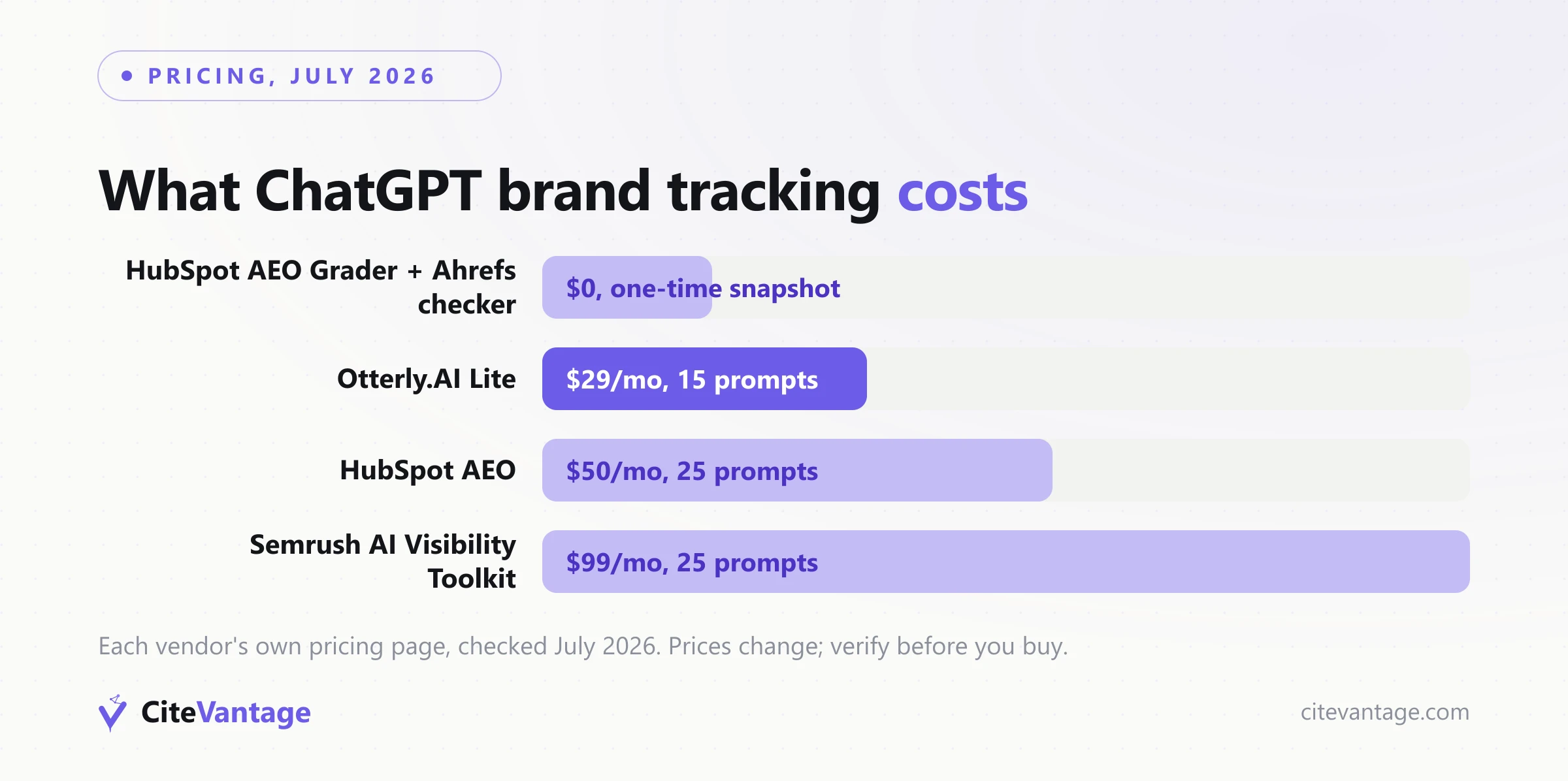
Every price above comes from the named vendor’s pricing page, checked July 2026. They change. Verify before you buy.
The free snapshot tier
A free scan tells you where you stand on the day you run it. HubSpot’s AEO Grader scores your brand out of 100 across 5 weighted dimensions, per its own tool page. The Ahrefs checker shows whether six different AI platforms name you at all. Useful. But a snapshot cannot tell you whether last month’s work moved anything, which is the question that actually matters. More on that gap below.
The paid tracking tier
Between $29 and $99 a month, what you are really buying is a prompt budget and a schedule. Otterly’s Lite plan runs 15 prompts. HubSpot AEO and Semrush each run 25, per their pricing pages as of July 2026. Feature lists differ. Dashboards differ. The prompt count is the constraint that decides what your money is worth, and we will show you why in the section on sample size.
Pick by budget and prompt count, and hold the receipt.
Are there free tools to check AI brand mentions?
Yes, two worth your time. HubSpot’s AEO Grader is a free one-time check with no account required; it scores 5 weighted dimensions out of 100, and Sentiment Results alone carries 40 of those points, per the tool’s page. The Ahrefs AI Visibility Checker is free with no signup and covers 6 platforms.
What each one gives you:
- HubSpot AEO Grader: a weighted score out of 100 plus a read on how AI describes your brand, sentiment included.
- Ahrefs answers a blunter question: do ChatGPT, Gemini, Perplexity, Copilot, AI Overviews or AI Mode name you at all? Ahrefs says the checker is built on a corpus of 401M+ organic prompts monthly, per its tool page.
- Run both. Ten minutes, no card, two independent reads on the same brand.
Now the honest caveat. A free scan is one day’s photo. AI answers move around constantly, so the score you get on Tuesday is not a trend, a baseline, or proof of anything except Tuesday. Treat it as a starting point.
There is also a $0 route that needs no tool at all: asking ChatGPT your own buyer questions and logging what comes back. We wrote the full walkthrough in our guide to checking if ChatGPT recommends your brand, so we will not repeat it here.
How does brand mention tracking in ChatGPT actually work?
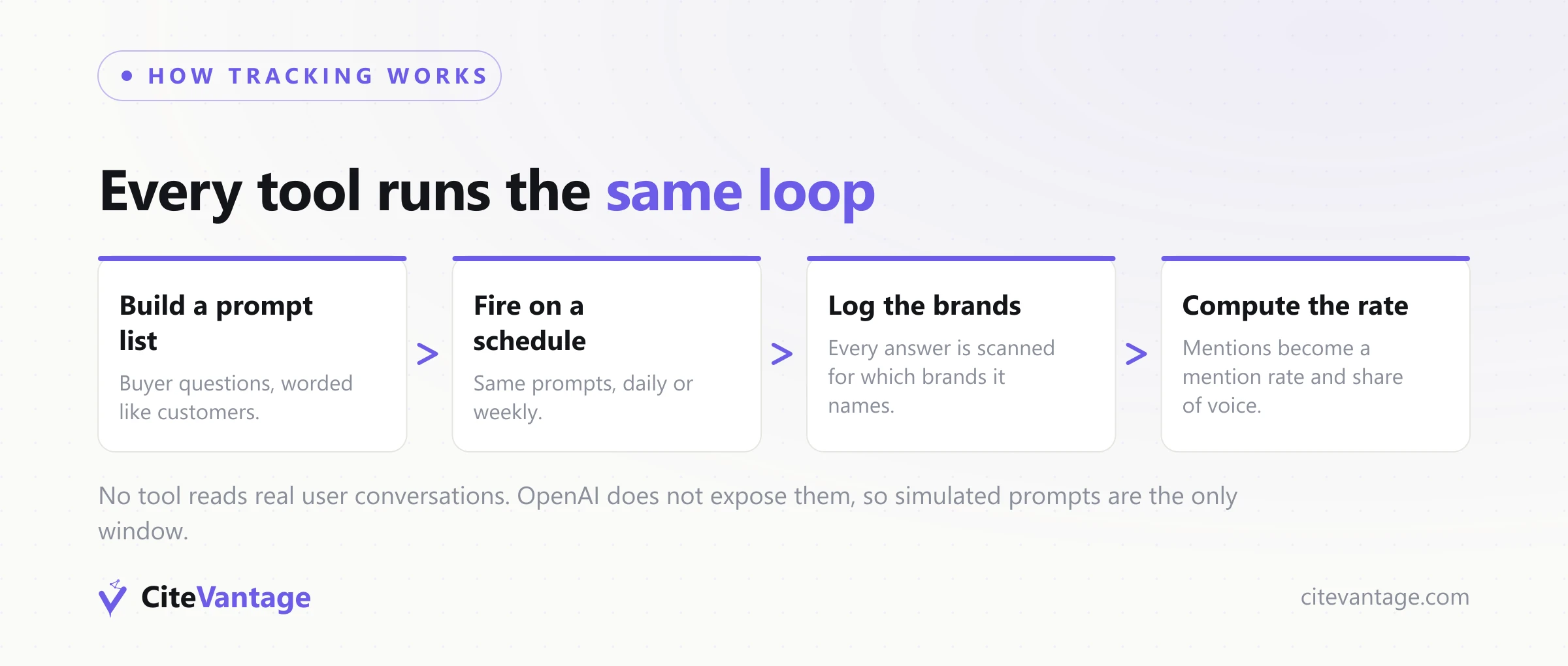
Prompt simulation. Every tool on the market fires a set of buyer-style prompts at ChatGPT and other engines on a schedule, logs which brands each answer names, and turns that log into a mention rate. No tool reads real user conversations, because OpenAI does not expose them. Simulated prompts are the only window that exists.
What the tools measure
Four metrics show up everywhere, and each one feeds a different decision. Mention rate is the share of tracked prompts that name you; it tells you whether to invest in visibility at all. Share of voice compares your mentions against competitors on the same prompts; it tells you who AI treats as the category default. Citation frequency counts how often your pages get linked as sources; it tells you which content earns trust. Sentiment reads how AI describes you; it flags a messaging problem, not a visibility one.
What no tool can see
Real conversations, for a start. Tools also cannot see how ChatGPT’s memory personalizes answers for a logged-in user, and they cannot see the variation between what a fresh account gets and what a long-time user gets. Every dashboard number is an estimate built from the outside.
If you want the mechanics underneath the metric, our breakdown of how AI decides which brands to recommend covers what actually drives those answers.
Can ChatGPT monitor brand mentions for you?
No. ChatGPT ships no brand analytics, no alerts, no dashboard, nothing. The scale makes that absence expensive: 800 million weekly users sending 2.5 billion prompts a day, per TechCrunch, and not one report about how any of those answers treat your brand. Your options are asking it manually or paying a tool to ask it for you.
That is the entire section, because that is the entire answer. The manual route is the DIY guide linked above. The paid route is the table in the first section.
Before you pick from that table, though, one question is worth sixty seconds: who wrote the reviews you are about to read?
Who actually writes the lists ranking AI tools for SEO and AEO?
Tool vendors. When we reviewed the pages ranking for this exact question in July 2026, every one of the ten was published by an AEO tool, and each ranked itself favorably. None disclosed how tools were selected or scored. That does not make the tools bad. It makes the lists sales pages, and it means the criteria you need will not come from the lists themselves.
The pattern repeats page after page. A comparison table where the author’s product sits in the most flattering row. A “best for” column that happens to describe the author’s ideal customer. Pricing framed around the author’s cheapest plan. No methodology section anywhere.
We tell clients the same thing every time: a vendor ranking itself first is not lying to you, but it is not reviewing either. Read those lists for the pricing tables and skip the rankings.
We ran the same count across the wider category and published it, page by page, in our guide to the most popular AI visibility products for SEO, where six of the ten ranking pages sell one of the products they rank.
Five things to demand before paying
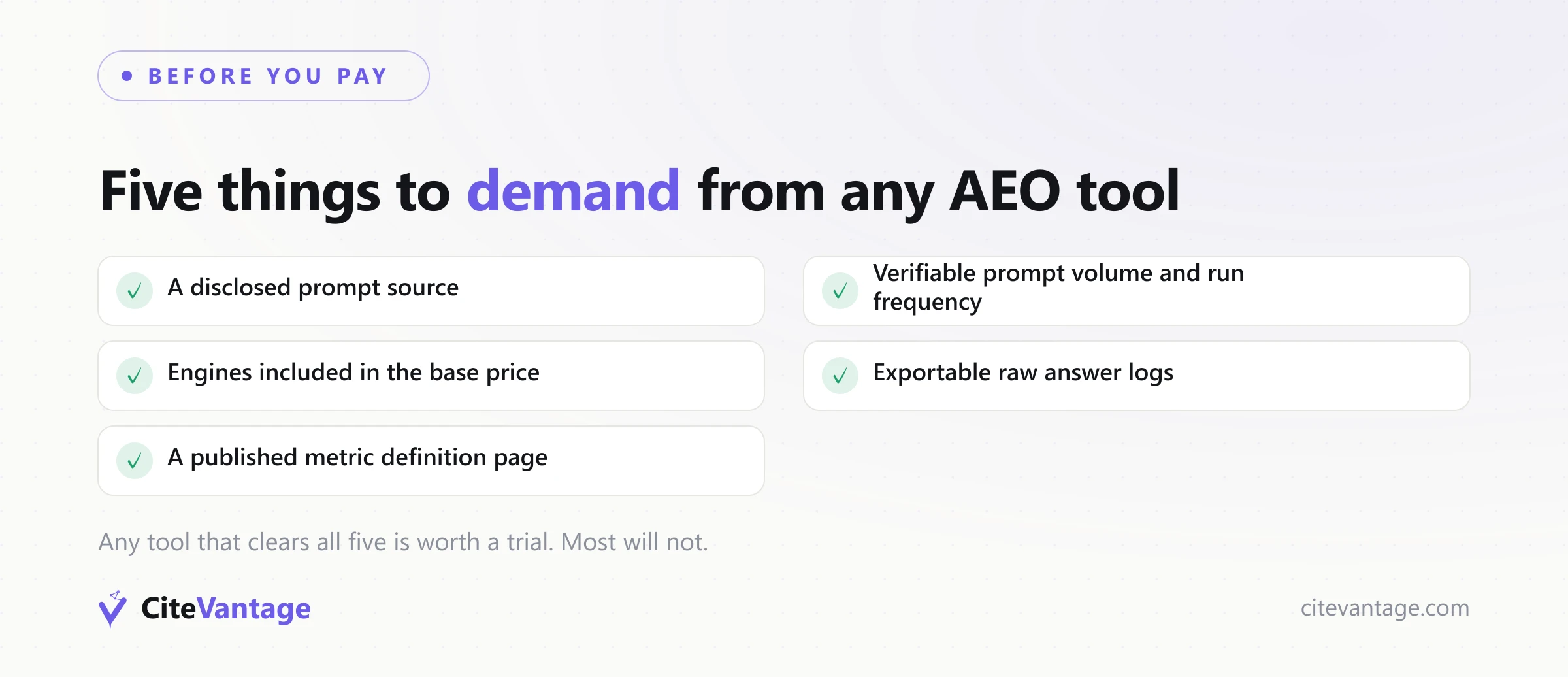
- A disclosed prompt source. Are the prompts derived from real search behavior or invented by the tool? Only Ahrefs even raises this question in public, and only while selling its own prompt corpus.
- Prompt volume and run frequency you can verify inside the product, not just in marketing copy.
- Engines covered in the base price. Otterly’s Lite plan, for example, covers four engines and sells Claude, AI Mode and Gemini as add-ons from $9-$29/mo, per its pricing page.
- Raw answer logs you can export and spot-check yourself. If you cannot see the answers behind the score, the score is a black box.
- A metric definition page. How does this vendor compute “mention rate”? If they will not write it down, walk.
Any tool that clears all five is worth a trial. Most will not.
Google AI Mode is the engine these tools handle least consistently, so if that surface matters to you, our review of the best AI Mode SEO tracking tools shows which plans include it and which sell it as an add-on.
How many prompts make a mention rate trustworthy?
More than most starter plans run. ChatGPT returns different answers to the same prompt run to run, by design, so a mention rate built on 15 prompts checked weekly is mostly noise. Treat any score from a small sample as a direction, and never compare two snapshots taken days apart as if they were a trend.
The variance is not a flaw you can buy your way around. Ask ChatGPT the same buyer question five times and you can get five different brand lists, with real overlap but real churn. A tool sampling 15 prompts is photographing a moving target 15 times and averaging. The average moves even when your visibility has not.
Practical rules we use on our own tracking:
- Repeat runs before trusting a change. One week’s jump from 20% to 33% on a 15-prompt plan can be pure churn.
- Watch the trend over weeks. Six weekly readings pointing the same way mean something. One reading means Tuesday.
- Treat a free one-time scan as a photo, never as a film.
This is also why the prompt counts in the comparison table matter more than the feature columns. A $29/mo plan running 15 prompts and a $99/mo plan running 25 are both small samples. The extra spend buys engines and dashboards, not certainty.
One first-party observation on how noisy single readings can be. In our ongoing multi-engine citation audits we have watched DA-10 sites beat DA-90 sites inside ChatGPT answers. Single-run scores swing while the pattern underneath them holds, so judge the pattern.
What should you do when the tool says nobody mentions you?
First, know that zero is normal. In our audit of 181 ecommerce brands, 87% were cited zero times across four AI engines. A dashboard tells you the score. It does not tell you what to change, and buying a bigger dashboard does not change the score. The fix path starts with why AI skips you, not with more tracking.
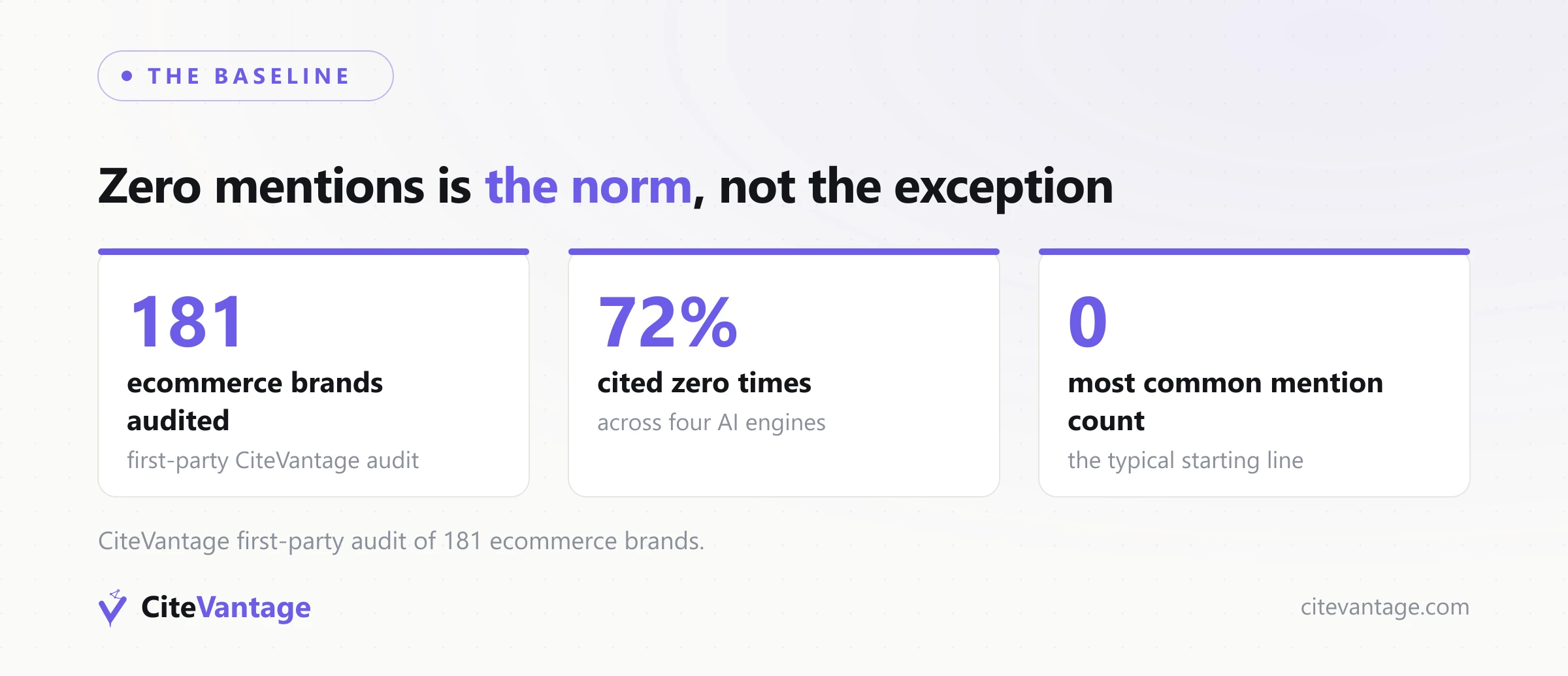
That 181-brand number is the baseline no vendor list can give you, because none of the ranking lists publishes one. So when your first scan comes back empty, you have not discovered a crisis. You have discovered the starting line most brands share.
The fix order we use
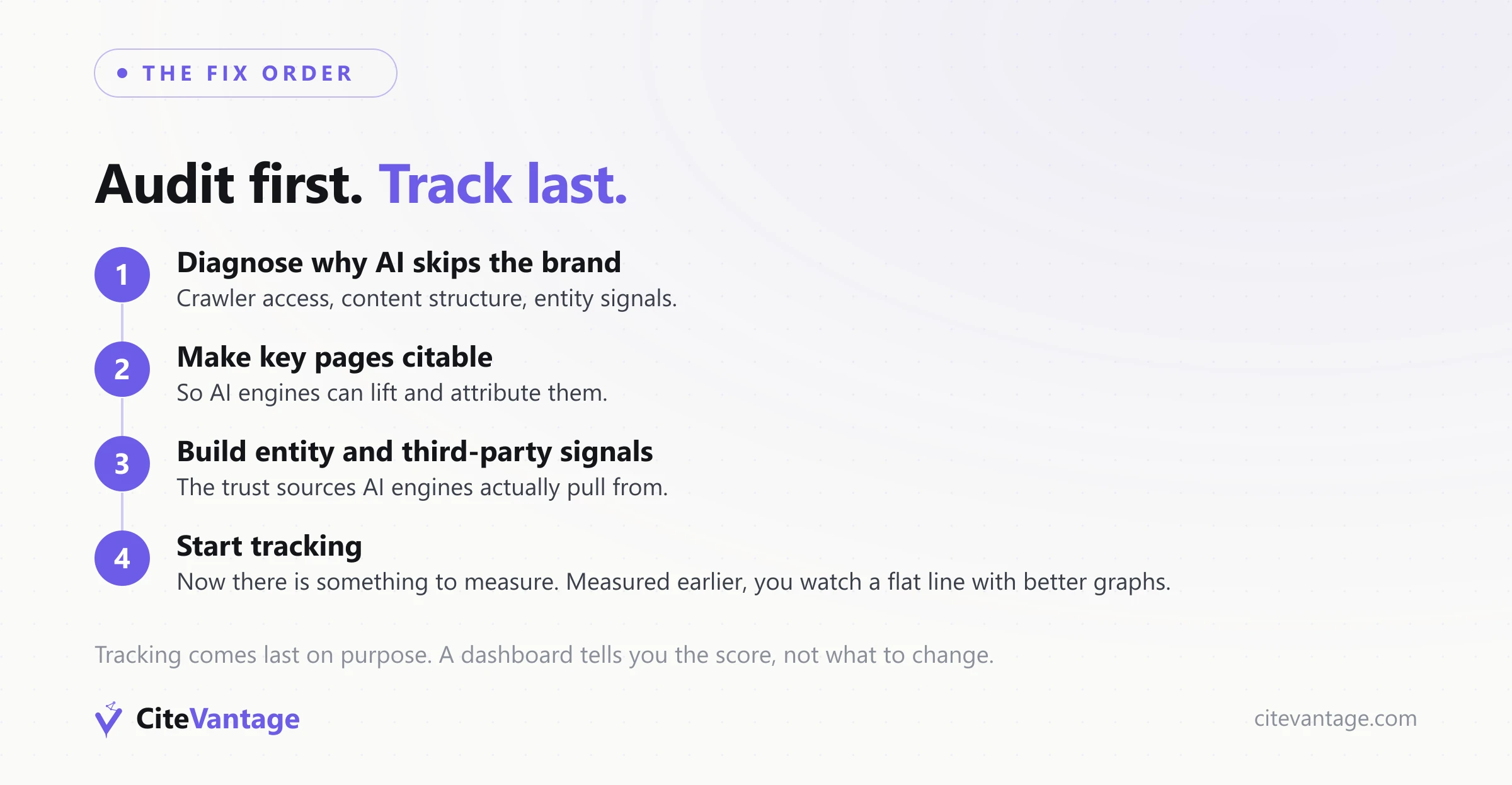
Our approach is audit-first, not dashboard-first, and the order matters because each step feeds the next. Tracking comes last on purpose: measured earlier, you are just watching a flat line with better graphs.
- Diagnose why the brand is invisible: crawler access, content structure, entity signals.
- Make your key pages citable, so AI can lift and attribute them.
- Build the third-party and entity signals AI engines actually trust.
- Then track, because now there is something to measure.
For the diagnosis itself, our guide to why AI skips some brands entirely walks the common causes, and the DIY AI visibility audit shows you how to run the check yourself before spending anything. The full picture of how measurement fits into the work sits on our services page.
The tools in this guide tell you your score. Our free AI Visibility Snapshot tells you your score and the first three things to fix, checked by a person rather than a prompt loop. No call required, no card, no drip sequence. Get your free snapshot here and skip straight to the part the dashboards leave out.
Frequently asked questions
What are the best AEO tools for brand mentions in ChatGPT?
+
Depends on budget. For a free snapshot, HubSpot's AEO Grader and the Ahrefs AI Visibility Checker both work with no account. For ongoing tracking, Otterly.AI starts at $29/mo for 15 prompts, HubSpot AEO at $50/mo and Semrush at $99/mo, all as of July 2026.
Can I track ChatGPT brand mentions for free?
+
At snapshot level, yes. HubSpot's AEO Grader scores your brand across 5 weighted dimensions with no account, and the Ahrefs AI Visibility Checker covers 6 AI platforms with no signup. For ongoing $0 tracking, the manual route is asking ChatGPT your buyer questions yourself on a schedule and logging the answers.
How do AEO tools track ChatGPT answers?
+
Prompt simulation. Each tool fires a set of buyer-style prompts at ChatGPT on a schedule, logs which brands every answer names, and turns that log into a mention rate. No tool reads real user conversations. OpenAI does not expose them, so simulated prompts are the only window anyone has.
How accurate are ChatGPT brand mention trackers?
+
Directionally useful, noisy at small samples. The same prompt returns different answers run to run, so a mention rate built on 15 prompts checked weekly moves around on its own. Trust trends over several weeks, not a single score, and never compare two one-day snapshots as if they were a trend.
What is a normal AI mention rate for an ecommerce brand?
+
Zero. In our audit of 181 ecommerce brands, 87% were cited zero times across four AI engines. If a tool tells you no one mentions you, you are in the majority, and the useful next question is why AI skips you, not which dashboard to buy next.
More in AI SEO, GEO and AEO
- Domains AI Cites on Real Estate: The Open List
- Hostinger CDN Blocks GPTBot: HTTP 429 Case Study
- AI Search Statistics 2026: Sourced and Dated
- Best AI Mode SEO Analysis Tools for 2026
- Best AI SEO Agencies 2026: 15 Firms Ranked
- Can AI Crawlers Reach Your Site? How to Check
- GEO Case Studies: Successful Campaigns
- GEO vs SEO vs AEO: The Real Difference in 2026
- Generative Engine Optimization: GEO and AEO Guide
- Google Preferred Sources: Myths, Broken
- How to Check if ChatGPT Recommends Your Brand
- How to Get Cited by ChatGPT: 2026 Playbook
- How to Get Cited by Google Gemini
- How to Get Cited by Perplexity: 9 Source Signals
- How to Rank in Google AI Overviews: 2026 Guide
- How to Run an AI Visibility Audit Step by Step
- How to Track Competitors in AI Search Results
- Most Popular AI Visibility Tools for SEO
- SEO and GEO Strategy: Make Them Work Together
- Schema Markup for AI Search: Types That Matter
- What Is llms.txt? Complete Setup Guide
Start from the hub: AI SEO, GEO and AEO
See where AI is hiding your brand
Free multi-engine audit across ChatGPT, Gemini, Google AI & Perplexity.
See who AI names instead of me