GEO vs SEO vs AEO: the real difference in 2026 and which one your site needs first
By Abdul Subkhan Published Updated
Part of AI SEO, GEO and AEO
Images in this guide are free to reuse (CC BY 4.0). Credit CiteVantage with a link to this page.
GEO vs SEO vs AEO is not a choice between three tools. It is three different finish lines on the same web. GEO gets your brand cited inside an AI answer. SEO gets your page ranked in a list of links. AEO gets your content lifted as the direct response. In 2026 you need all three working together rather than picking one.
The 40-word answer: SEO earns rankings, AEO earns the direct answer slot, GEO earns the citation inside AI-generated responses from ChatGPT, Gemini, Perplexity and Google AI Overviews. SEO is the foundation, AEO is the extraction layer, GEO is the authority layer that decides which brand the model actually names.
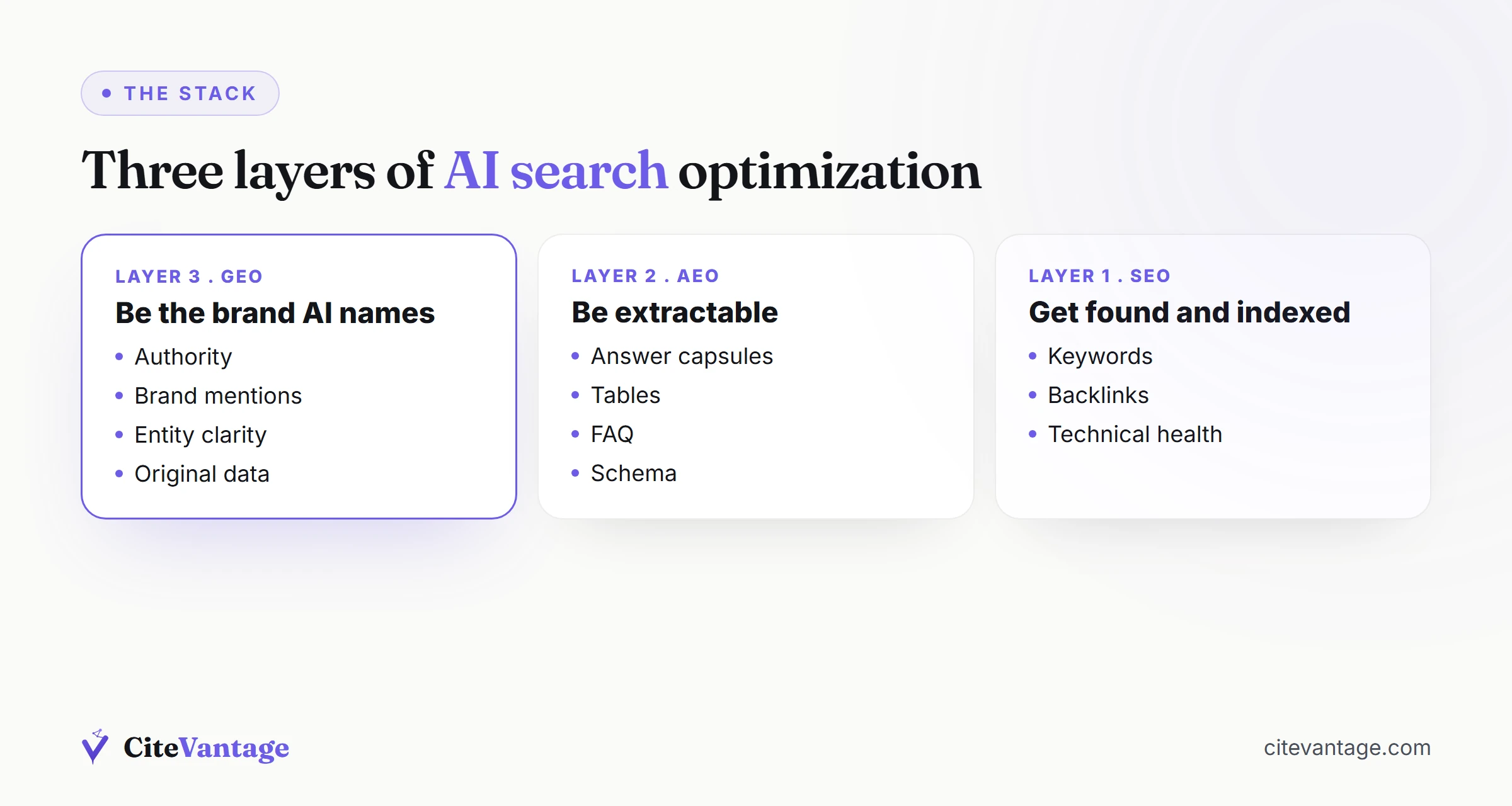
Here is the part most comparison guides skip. These three are not competitors fighting for your budget. They stack. Skip the bottom layer and the top one has nothing to stand on. We have watched this play out across 181 ecommerce audits, and the pattern is brutally consistent: strong SEO, invisible in AI.
GEO vs SEO vs AEO: the difference in one table
| SEO | AEO | GEO | |
|---|---|---|---|
| Full name | Search Engine Optimization | Answer Engine Optimization | Generative Engine Optimization |
| Goal | Rank in a list of links | Be the source of the direct answer | Be named and recommended across AI |
| Where it shows | Google and Bing results pages | Featured snippets, AI Overview answer box | ChatGPT, Gemini, Perplexity, AI Overviews |
| Primary lever | Keywords, backlinks, technical health | Answer capsules, tables, FAQ, schema | Authority, brand mentions, entity clarity, original data |
| Measured by | Rankings and organic clicks | Whether your content is cited as the source | Brand mentions and citations in AI answers |
| Who reads it | Google’s ranking algorithm | Answer engines and snippet systems | Large language models and generative engines |
| Still relevant in 2026? | Yes, the foundation | Yes, the extraction layer | Yes, the visibility layer |
That table is the whole article in one screen: GEO optimises to be named inside a generated answer, AEO optimises to answer one question cleanly enough to be lifted, and SEO optimises to rank a link somebody clicks. The rest of this page is why it works that way, and what to do about it.
What is the difference between GEO and SEO?
Two decades of digital marketers optimized for one thing: position in the search results pages. Rank higher, earn more clicks. That is traditional SEO, and it still runs on keywords, backlinks and technical soundness. SEO metrics like position, impressions and organic click-through have not gone anywhere.
GEO changes the target. Instead of optimizing to rank in blue links, you optimize to be cited and trusted when generative engines like ChatGPT or Gemini synthesize an answer. The user never sees a list. They see one paragraph, and either your brand is in it or it is not.
The mechanics diverge in three places that matter:
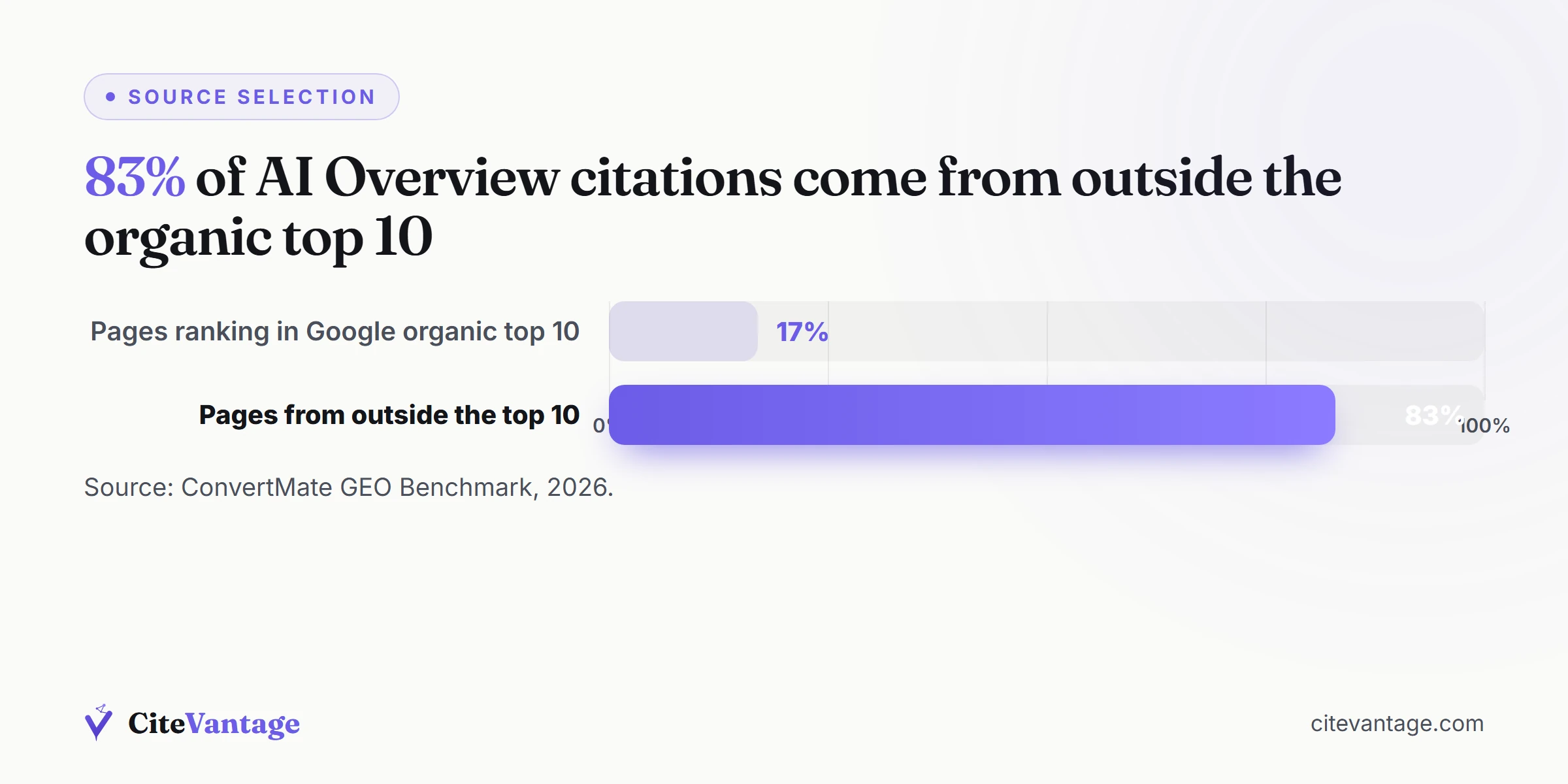
- Source selection. Google’s algorithm ranks pages. AI systems retrieve and synthesize, weighing brand mentions and corroboration. Ahrefs found 62% of AI Overview citations come from pages outside the organic top 10.
- The unit of victory. SEO wins a position. GEO wins a sentence inside an answer, often with no click attached.
- What gets rewarded. The KDD 2024 GEO study found the biggest levers in AI answers were citing sources, adding direct quotations and including original statistics. Backlink-heavy thin content did not move the needle.
One Reddit thread in r/content_marketing put it cleaner than any vendor blog: “SEO optimized for algorithms. GEO optimizes for intelligence.” That is the shift in one line. The reader is no longer a ranking system. It is a language model deciding who to quote.
How is AEO different from GEO?
This is where the labels blur, so be precise. AEO, answer engine optimization, is about being the direct answer. It predates the LLM era, going back to featured snippets and “position zero.” You shape one page so an engine can lift a clean, attributable response: a tight answer capsule, an FAQ, a table, the right schema.
GEO sits above that. AEO makes your content liftable. GEO makes your brand the one the model actually selects out of a dozen liftable options. The difference is authority. You can have the cleanest FAQ on the internet and still lose the citation to a competitor with more brand mentions and original data behind them.
Think of it as a sequence rather than a rivalry:
- SEO gets you found and indexed. No retrieval without it.
- AEO gets your answer extractable, so an engine can quote you cleanly.
- GEO gets your brand chosen, because authority signals tip the model toward you over rivals.
Do only SEO and you rank but never get quoted. Do only AEO and your content is liftable but lacks the weight to be picked. Do only GEO without clean pages and the engine has nothing tidy to extract. Three layers. One pyramid.
Why do 87% of brands stay invisible to AI despite ranking?
Here is the number that started CiteVantage. I audited 181 ecommerce brands across the four engines myself, and 87% were never mentioned when AI answered questions about their own category. Not buried on page two of an AI answer. Absent. These were brands with solid SEO, real rankings, healthy organic traffic.
The reason is structural, not a fluke. AI search and traditional search run on different source-selection logic.
| Signal | Weighs heavily in SEO | Weighs heavily in GEO |
|---|---|---|
| Backlink profile | Yes, primary | Indirectly, via authority |
| Keyword optimization | Yes | Less so, semantic clarity matters more |
| Brand mentions across the web | Minor | Major |
| Original data and statistics | Helpful | Strong citation driver |
| Clean, extractable answer format | Minor | Major |
| Position in organic top 10 | The whole point | Often irrelevant |
Two failure modes show up again and again in our audits. The first is the format gap: a brand has the authority but buries its answer 1,400 words deep, so the engine cannot extract anything clean. The second is the ghost citation, where an AI answer borrows your facts and framing but never prints your brand name. Reports put ghost citations at a large share of all brand citations, which means a lot of “invisible influence” you cannot see in standard analytics.
And it decays. Brands routinely lose AI visibility from one month to the next even while ranking stays flat, because models re-weight sources and refresh what they retrieve. GEO is not set-and-forget the way an old backlink was.
Why does this matter more in 2026?
Because the audience moved. About half of US adults now use AI chatbots, and 60% say they read the AI-generated summary at the top of search results, per Pew Research. ChatGPT alone reached roughly 900 million weekly users by early 2026. When the answer arrives before the click, ranking #1 on a page nobody scrolls to is a hollow win.
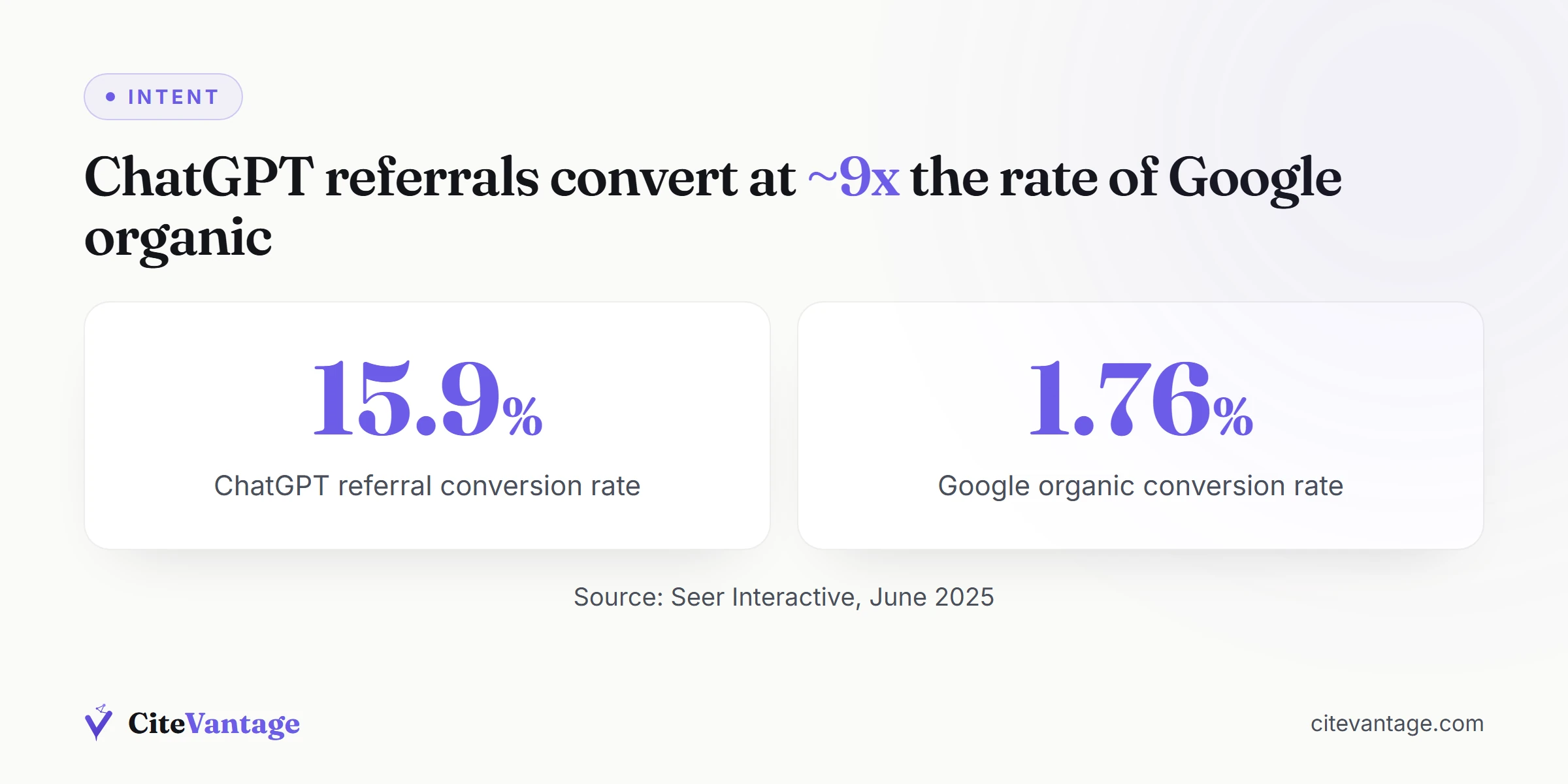
The traffic that does come through converts harder. Seer Interactive measured a 15.9% conversion rate from ChatGPT referrals against 1.76% from Google organic. Fewer visits, far higher intent, because the model already pre-qualified the user by naming you as the recommendation.
Gartner projected traditional search volume dropping 25% by 2026 as people shift to AI answers and virtual agents. You can argue the exact figure. You cannot argue the direction. Google’s own AI optimization guide now states plainly that its generative AI features are “rooted in our core Search ranking and quality systems,” which is Google confirming the foundation is shared even as the surface changes.
Is traditional SEO still important after AI Mode, or should GEO come first?
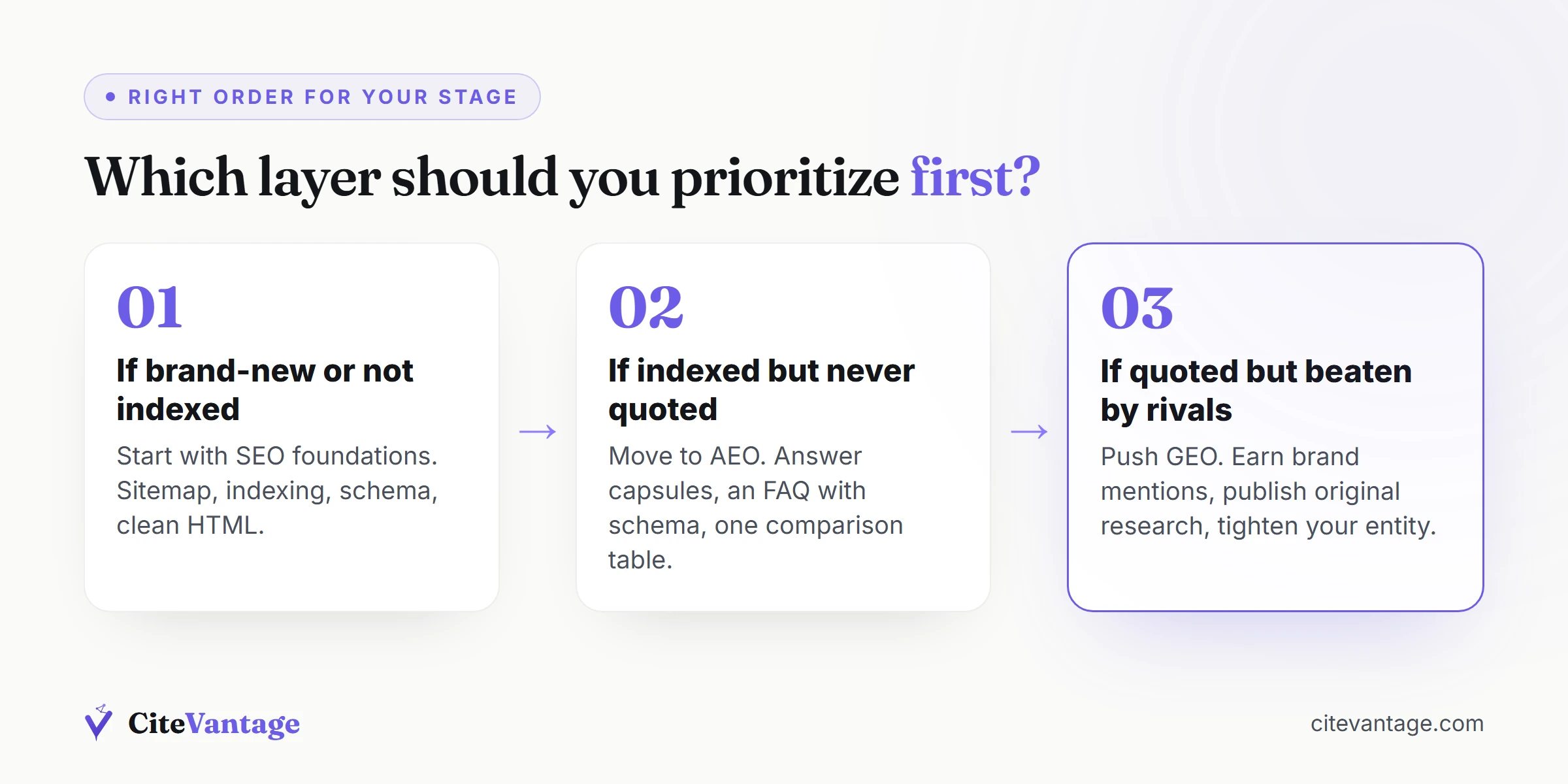
Traditional SEO is still important, because it is the layer that gets you indexed in the first place. Which layer you push hardest depends entirely on where you are starting. There is no universal order, but there is a right order for your situation.
- Brand-new or not indexed: start with SEO foundations. Sitemap, indexing, schema, clean HTML. Engines cannot cite what they cannot crawl, and generative engines retrieve from the indexed web. That layer alone moves real numbers: our RIPT Apparel case study covers a store that gained 290% more organic clicks in 18 days from foundation work.
- Indexed but never quoted: focus on AEO. Reshape your top pages into answer capsules, add an FAQ with schema, drop in one comparison table. This is usually the fastest measurable win.
- Quoted sometimes, beaten by rivals: push GEO. Earn brand mentions, publish original research, tighten your entity, get into the third-party roundups and community threads that models lean on. Note that a meaningful slice of AI citations trace to platforms like Reddit and YouTube, not your own domain.
A practical move that serves all three at once: build one page with a 40 to 60 word answer up top, a table, an FAQ and a stat you own. Google ranks it for depth. AI engines lift it because it extracts cleanly. We have watched a single well-structured 200-word FAQ get cited by Perplexity over a competitor’s 2,000-word guide more than once.
What content strategies work for all three?
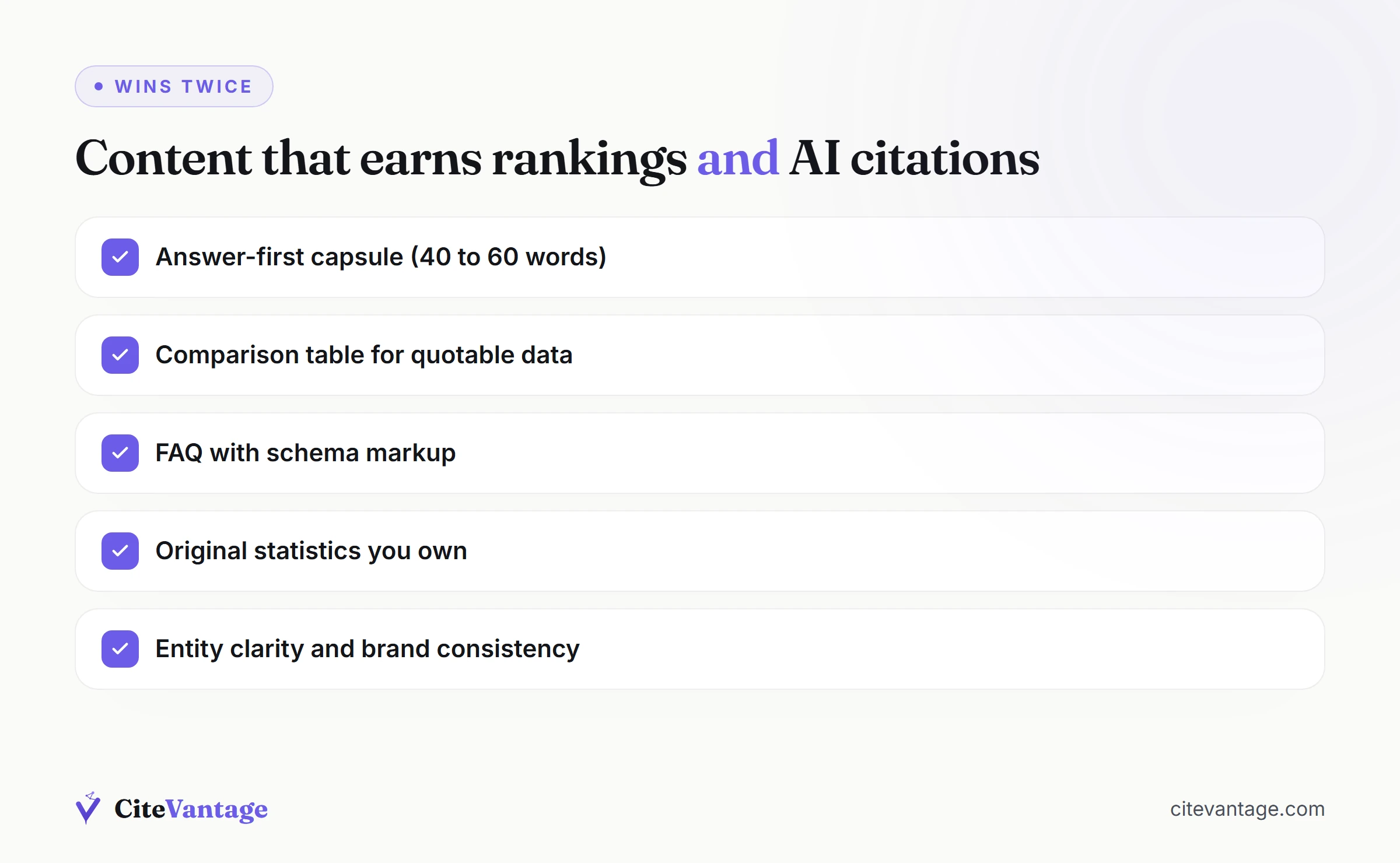
The content that wins across GEO, SEO and AEO shares a shape. It answers first and explains second, carries structure a machine can parse underneath, and is backed by something only you have: your own data, your own client results, your own measurement. A copy of a copy ranks nowhere and gets cited nowhere.
- Lead with the answer. A boldable 40 to 60 word capsule an engine can lift wholesale, then expand below it.
- Use tables for your most quotable data. AI extracts structured data far more readily than prose.
- Add an FAQ with schema. It feeds featured snippets, AEO answer boxes and your own crawlability at once.
- Publish original numbers. Our 181-brand audit, your own customer data, anything with a real figure. Statistics are a documented citation lever.
- Build entity clarity. Consistent brand naming, an about page, third-party corroboration, so models know who you are.
Notice what is not on that list: keyword stuffing, thin AI-generated filler, chasing exact-match phrases. Those were never great SEO. They are actively useless for GEO, where semantic clarity and authority do the work language models care about.
GEO vs SEO vs AEO: your three next steps
Three next steps, in order, and the order matters more than the steps themselves. Find out what the engines say about you today, fix the pages and sources those answers depend on, then re-run the same questions so you can tell whether anything moved. Everything else in GEO vs SEO is detail on top of that loop:
- Audit your AI visibility. Ask ChatGPT, Gemini, Perplexity and Google AI Overviews the questions your buyers actually ask, and log how often you are named. Our free AI Visibility Audit scores this across all four engines.
- Fix the format on your top five pages. Add answer capsules, an FAQ with schema and one table each. That is the AEO layer, and it is the fastest lever.
- Build the authority that earns citations. Original data, brand mentions, entity clarity. If you want this done in two weeks against your real buyer questions, that is what our 14-Day AI Visibility Sprint is for.
For the deeper mechanics on each layer, see what generative engine optimization actually is, how answer engine optimization works, and why your brand may be invisible to AI even with strong rankings. And if you would rather not build all three layers in-house, here is how to compare the best GEO and AEO agencies for 2026.
GEO, SEO and AEO are not a choice. They are a stack. Build the bottom, shape the middle, earn the top.
Frequently asked questions
What is the main difference between GEO and SEO?
+
SEO gets your page to rank in a list of blue links. GEO gets your brand cited inside an AI-generated answer from ChatGPT, Gemini or Google AI Overviews. SEO is measured by position and clicks. GEO is measured by whether the model names you when it synthesizes a response, which often has nothing to do with where you rank.
How does GEO differ from answer engine optimization (AEO)?
+
AEO shapes a single page so an engine can lift one clean, attributable answer, think capsules, FAQs, tables and schema. GEO is broader. It builds the authority, entity clarity and citations that decide whether the model selects your brand at all. AEO makes you liftable. GEO makes you the one it actually picks. You usually want both.
Do I need to choose between GEO and SEO, or do both?
+
Both, in that order. SEO is the foundation that lets a model find and crawl you in the first place. GEO is the layer that gets you named once it does. In our audit of 181 ecommerce brands, 87% earned zero AI citations, and plenty of them ranked fine in Google, so SEO alone clearly was not enough.
Why do brands that rank well in Google get zero AI citations?
+
Because AI engines pick sources by different rules than Google's ranking algorithm. Ahrefs found 62% of AI Overview citations come from pages outside the organic top 10. Models weigh brand mentions, third-party corroboration and clean extractable answers more than backlink-driven rank. A page can sit at position one and still never be the source the model quotes.
What are ghost citations and why do they matter?
+
A ghost citation is when an AI answer pulls facts or framing from your content but never shows your brand name in the response text. Reports put these at a large share of all brand citations. They matter because they create real influence you cannot see in standard analytics, and they reward authority and original data over keyword-matched copy.
Is GEO just SEO with a new name?
+
No, though they share plumbing. Google's own guidance says AI features run on its core ranking systems, so technical SEO still feeds GEO. But the optimization targets diverge. SEO chases position; GEO chases citation. The KDD 2024 GEO study found that adding sources, quotations and original statistics lifted visibility in AI answers, levers that classic SEO never optimized for.
Which content works best for both SEO and GEO?
+
Content with a clear answer up top, supported by structure underneath. A 40 to 60 word answer capsule, a comparison table, an FAQ and original data tend to win twice. Google ranks them for depth, and AI engines lift them because they are easy to extract and attribute. One well-built page can serve both jobs without being rewritten.
How do I measure brand visibility in AI search?
+
Track citation share, not just rank. Ask the four engines, ChatGPT, Gemini, Perplexity and Google AI Overviews, the real questions your buyers ask, then log how often your brand is named and against which competitors. Our free AI Visibility Audit scores this across all four engines so you can see exactly where you are invisible.
Will AI search replace traditional SEO by 2027?
+
Unlikely to replace it, but it is reshaping it. Gartner projected a 25% drop in traditional search volume by 2026 as people shift to AI answers. SEO stops being the whole game and becomes the foundation layer. The brands that win run SEO, AEO and GEO together rather than betting everything on rankings.
What role do brand mentions play in AI citations?
+
A large one. AI models lean on how often and how credibly your brand is referenced across the open web, reviews, forums, press and third-party roundups, not just links to your domain. Notably, a meaningful share of AI citations trace back to community platforms like Reddit and YouTube rather than owned corporate sites.
More in AI SEO, GEO and AEO
- Domains AI Cites on Real Estate: The Open List
- Hostinger CDN Blocks GPTBot: HTTP 429 Case Study
- AI Search Statistics 2026: Sourced and Dated
- AI Tools for SEO and AEO: Track ChatGPT Mentions
- Best AI Mode SEO Analysis Tools for 2026
- Best AI SEO Agencies 2026: 15 Firms Ranked
- Can AI Crawlers Reach Your Site? How to Check
- GEO Case Studies: Successful Campaigns
- Generative Engine Optimization: GEO and AEO Guide
- Google Preferred Sources: Myths, Broken
- How to Check if ChatGPT Recommends Your Brand
- How to Get Cited by ChatGPT: 2026 Playbook
- How to Get Cited by Google Gemini
- How to Get Cited by Perplexity: 9 Source Signals
- How to Rank in Google AI Overviews: 2026 Guide
- How to Run an AI Visibility Audit Step by Step
- How to Track Competitors in AI Search Results
- Most Popular AI Visibility Tools for SEO
- SEO and GEO Strategy: Make Them Work Together
- Schema Markup for AI Search: Types That Matter
- What Is llms.txt? Complete Setup Guide
Start from the hub: AI SEO, GEO and AEO
See where AI is hiding your brand
Free multi-engine audit across ChatGPT, Gemini, Google AI & Perplexity.
See who AI names instead of me