Estate Agent SEO: The UK Guide to Ranking and Getting Named by AI Search
By Abdul SubkhanPublished Updated
Part of UK estate agent SEO
Images in this guide are free to reuse (CC BY 4.0). Credit CiteVantage with a link to this page.
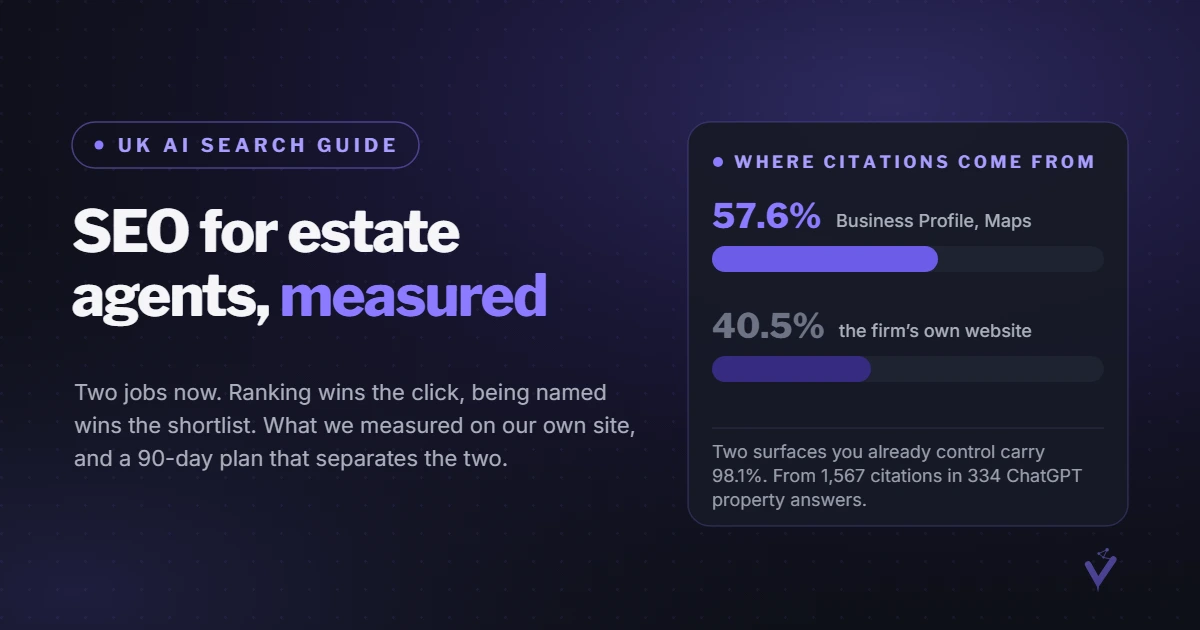
Estate agent SEO is now two jobs, not one. Ranking on Google wins the click. Being named inside an AI answer wins a place on a shortlist of about six firms. Most UK agency sites are only doing the first job, and their reporting hides the second one entirely.
GetAgent surveyed 622 UK estate agents in February 2026. 22% had already seen a buyer reference AI when explaining how they found a property. 84% expect AI search to become a primary route. Click economics are moving the same way. Pew Research Center, on a US panel of 900 adults and 68,879 searches, found a traditional result clicked on 8% of visits with an AI summary, against 15% without.
Some of the numbers below are ours. A few make us look bad. That is deliberate. Nothing else ranking for SEO for estate agents has measured anything, and borrowed statistics are how this topic got so vague.
What actually earns AI citations in UK estate agent SEO?
Not much of what agencies sell. In our own testing, crawler directives, schema depth and page length moved nothing. What separates a cited estate agency from an invisible one is off-site authority: referring domains, branded mentions, being named where an engine already looks. Not the site itself.
| What we did | What we expected | What we measured |
|---|---|---|
| Named 16 AI crawlers in robots.txt | Crawler access would help | 0 of 5 engines cite us on category prompts |
| Added deep schema across the site | Rich results plus a citation lift | No citation change observed |
| Published long, polished pages | A quality and authority signal | The cited competitor won on 1,187 words |
| Nothing off-site, 0 referring domains | Not applicable | The cited competitor holds 95 at DA 47 |
Our real estate pillar covers the shortcuts that backfire: keyword stuffing, bought reviews, thin area pages. This is a different list. It is work already sold to you as SEO for estate agents that our own measurements say does nothing here. We name 16 AI crawlers in our robots file, and we are cited on 0 of 5 engines for category prompts. In our tracking run on 17 August 2026, 40 category prompts returned zero citations across ChatGPT, Perplexity and Google AI Overviews. That is 120 measurements, all of them zero. In the same week, brand-name prompts returned seven citations in ChatGPT, the best result we have recorded. Ranking and being named are two separate problems. The general version of that argument, with the page-level test, sits in our guide to how the ranking job and the citation job fit into one workflow.
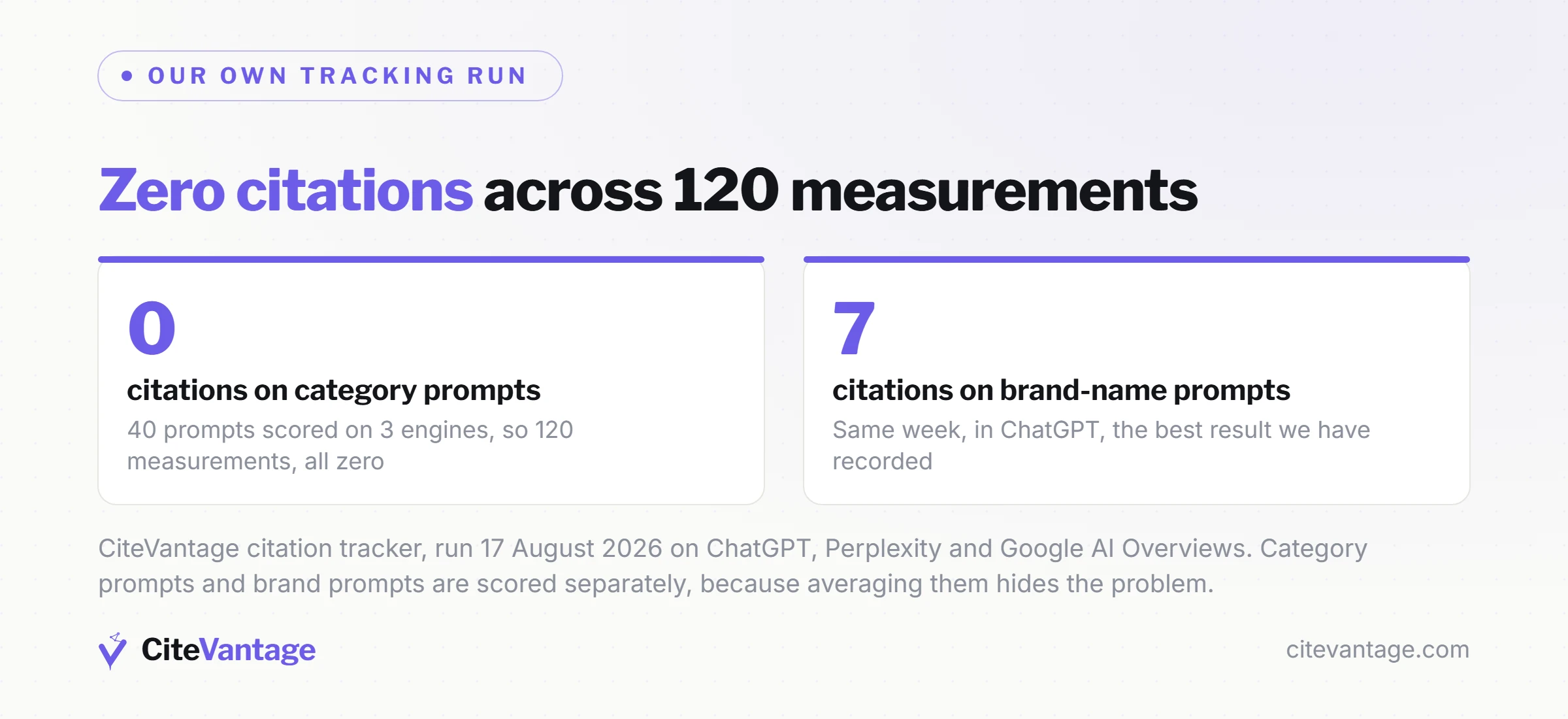
So what is the gate? Authority, and it is not close. We hold zero backlinks and zero referring domains at DA 1, on a site we have worked on harder than most agencies work on a client’s. A competitor cited on three of five engines holds 95 referring domains at DA 47. Ahrefs measured branded web mentions at 0.664 correlation with AI Overview brand visibility across 75,000 brands, against 0.218 for backlinks. Their own caveat is worth repeating: correlation is not causation, and every factor they tested was moderate to weak. The scale of it shows up in our own work too. 87% of the 181 brands we audited, 158 of 181, were cited zero times across four AI engines. That sample was ecommerce brands, not estate agents, so read it as a scale figure rather than a UK property measurement.
“We name 16 AI crawlers in our robots file and hold zero referring domains. Only one of those two numbers explains why no engine cites us, and it is not the crawler list.” Abdul Subkhan, Founder of CiteVantage
Does being on Rightmove and Zoopla help your AI visibility?
Yes, for verification. No, for citation. Rightmove and Zoopla profiles help an engine confirm the firm is real and that your details match. They are not where AI answers get their sources. In the largest study so far, the four US portals it tracked supplied zero of 1,567 citations.
Note: Portal authority does not transfer to you. When an engine cites Rightmove it is citing Rightmove, and the buyer reads a portal recommendation rather than your name. Being listed is table stakes for enquiries; it does nothing on its own for whether an AI names your firm.
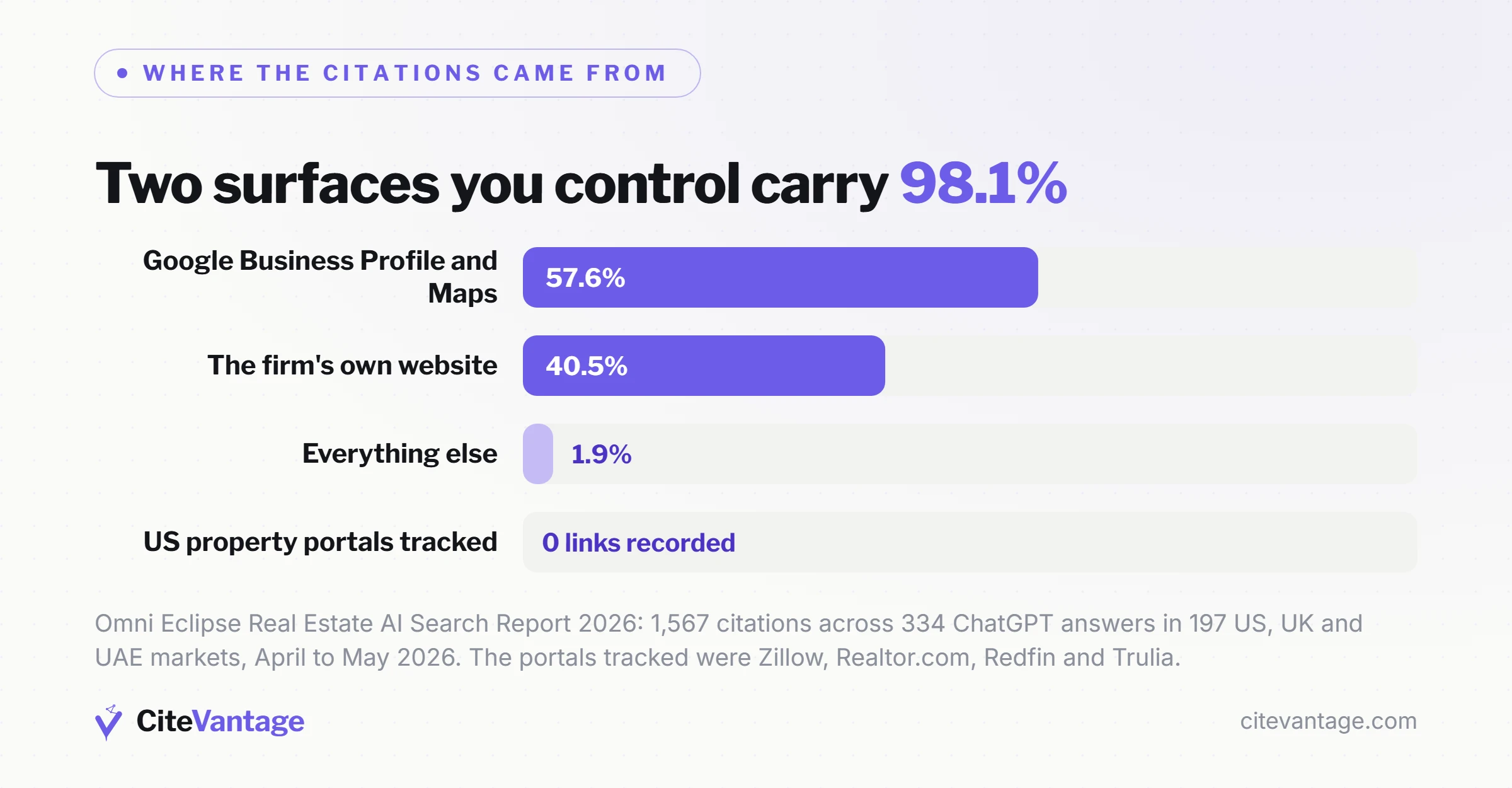
Two facts, rarely put next to each other. Rightmove took over 80% of all time spent on UK property portals in 2025, 16.8 billion minutes, on revenue of £425.1m, per its FY2025 results. Human attention is concentrated there. Against that, the Omni Eclipse Real Estate AI Search Report 2026, a vendor study of 334 ChatGPT answers across 197 markets in the US, UK and UAE, April to May 2026, recorded zero links to Zillow, Realtor.com, Redfin or Trulia across 1,567 citations. The shortlist those answers produce is short. A median of six businesses per city, mean 6.1, range three to ten, with 34.6% of answers naming five or fewer. In UK answers, 97.9% of the businesses named were firms rather than individual agents, against 73.9% individuals or teams in US markets. That last number decides whether you build the branch brand or the negotiator’s.
| Source type | Share of 1,567 citations | Who controls it |
|---|---|---|
| Google Business Profile and Maps | 57.6% | You |
| The firm’s own website | 40.5% | You |
| Everything else | 1.9% | Mixed |
| US property portals tracked in the study (Zillow, Realtor.com, Redfin, Trulia) | 0 links recorded | The portal |
Portals and directories are a verification layer. An engine checks them to confirm the firm exists, that name, address and phone agree across sources, and that you are what you claim to be. You fail that check silently. Nobody tells you. That is a different thing from being the source a model quotes. The honest caveat belongs here rather than in a footnote: the zero-citation finding names US portals, because those are the portals the study tracked. What transfers to the UK is the mechanism, not a measurement we have. So the instruction is both things at once. Claim and complete every Rightmove, Zoopla, Propertymark and Property Ombudsman profile, because verification matters and it is cheap. Then put your build effort into the two surfaces that actually get cited, the two you already own.
What are the local basics of SEO for estate agents?
SEO for estate agents starts where it always did. A complete Google Business Profile, matching details everywhere, a page per branch, area pages that say something local, fast pages on a phone, honest review requests, and Search Console wired up. Table stakes, and every competitor guide covers them.
Detail matters more than the list. A Google Business Profile counts as complete when the primary category is right, the hours are right, and there are recent photos of the actual office plus recent posts. NAP consistency means the exact same trading name, address format and phone number on every directory, including the ones you forgot you created in 2019. A page per branch, not one contact page with three addresses on it. Area pages that carry local specifics, transport, schools, price movement, the streets people actually name, rather than portal boilerplate reworded or the same 300 words with the town swapped out. Listing pages with titles a human would write, linked from the relevant area page. Core Web Vitals passing on mobile, where most property browsing happens. Reviews asked for by a person, not automated at scale.
| Basic | What it buys on Google | What it buys in AI answers |
|---|---|---|
| Complete Google Business Profile | Map pack eligibility | The single largest citation source at 57.6% |
| Consistent NAP across directories | A local ranking signal | Verification that the firm is real |
| A page per branch | Query coverage | An entity an engine can resolve |
| Real area pages | Long-tail rankings | Quotable local passages |
| Reviews | Ranking and click-through | A trust signal, not a citation source |
| Search Console and GA4 | The Google scoreboard | Nothing. You need a second scoreboard |
Worth pausing on the first row. Because Google Business Profile and Maps supplied 57.6% of citations in the Omni Eclipse set, the least interesting item on the list is the one doing double duty. Filling in that profile properly is the one place where the Google job and the AI job are genuinely the same job. It is also close to the only place, which is why the rest of this guide looks different from every other guide to SEO for estate agents on this page. Below the profile, the work splits. Rankings go one way, citations go another, and a report built only on Search Console will show you a flat line on the half that is actually moving. The vertical version of how we run this sits on our AI visibility work for UK estate agents page, the wider version on our real estate work, and the market-by-market version on our city pages.
How do you write pages an AI will quote?
AI does not quote pages. It quotes blocks. A block that gets cited answers one question completely, names the place it is talking about, carries a number, and survives being lifted out with nothing above it. On our own site, only 2.9% of blocks were the right length to do that.
We audited our own content at block level and the result was worse than we expected. Only 2.9% of our content blocks, 41 of 1,421, landed in the 134 to 167 word band that correlates with citation. The median block was 51 words. Short, tidy, scannable, and close to useless to a model that wants a passage it can quote whole. A cited competitor’s article in this space averages roughly 219 words per block, and it is not a better-written article. It is a more extractable one. We are the ones who wrote the guide about answer capsules, so finding this in our own audit was uncomfortable. It is also the most checkable instruction in this article, because you can count it yourself in an afternoon. No guide to SEO for estate agents that we could find discusses block length at all.
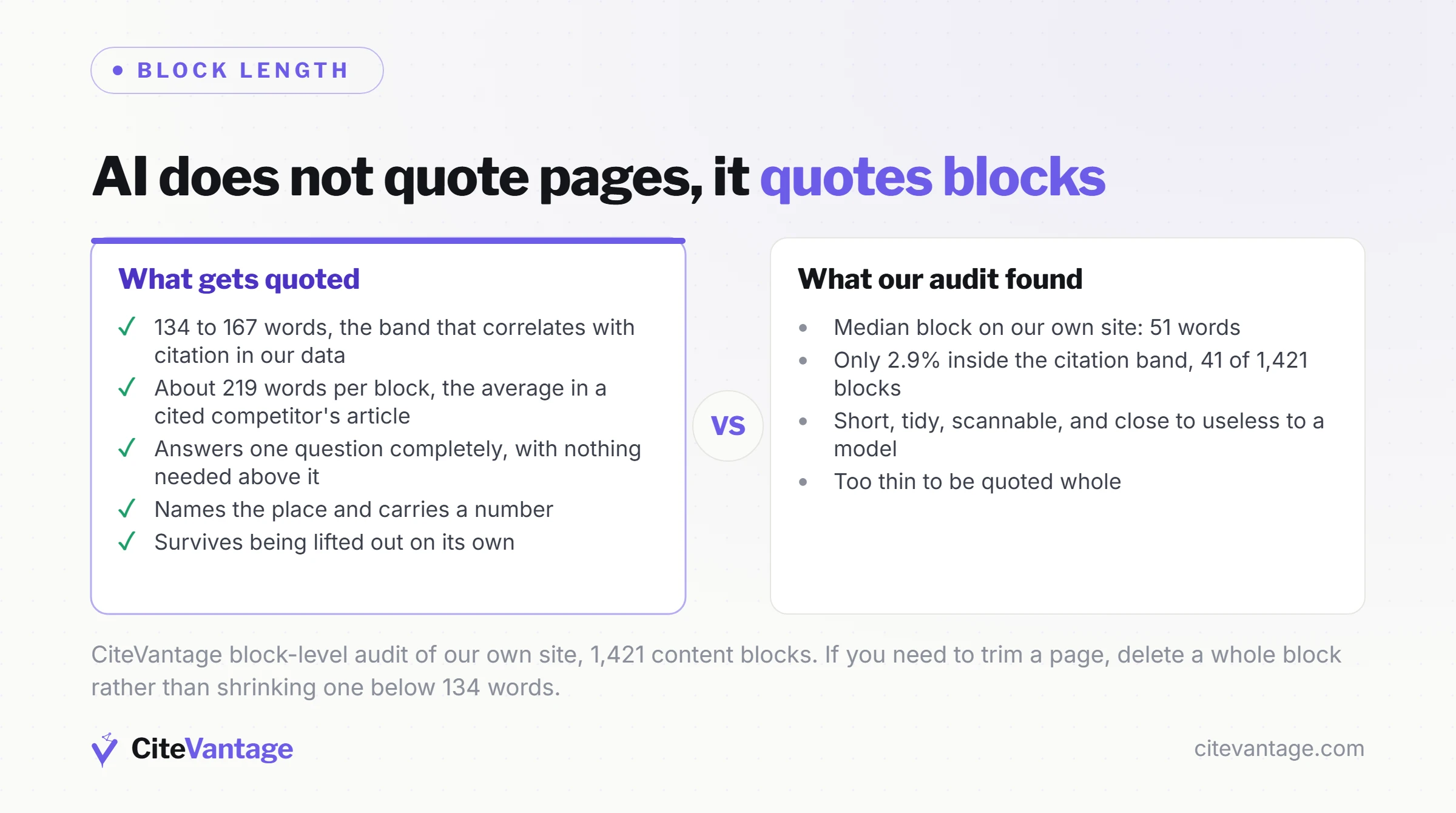
The problem shows up plainly in a branch sidebar. Here is the shape of it at about 40 words, composed from the pattern rather than lifted from any real firm’s page: “Why choose us in Sevenoaks. Local knowledge, decades of experience, and a friendly team who will guide you through every step of your move.” Nothing there can be quoted, because nothing there is a fact. Rebuilt at around 150 words, the same claim says something a model can attribute: how many properties the branch sold in Sevenoaks last year, the average time from instruction to offer accepted, which postcodes the branch covers, the two schools most buyers ask about, and the current asking-to-achieved gap locally. Same claim. Made checkable. The rule is fewer blocks, longer blocks, each one able to stand alone with no paragraph above it. If you need to trim, delete a whole block rather than shrinking one below 134 words.
Where should material information go on a listing page?
On the page, as text, under real headings. The Parts A, B and C structure most UK agents work to came from guidance withdrawn in May 2025, but the duty to disclose did not go with it. Most agencies still bury Parts B and C in a tab or a PDF. That satisfies a compliance check and loses the machine.
UK agents have worked to a three-part structure since 2022. Part A is price, tenure and council tax band. Part B is what should be established for every property: construction materials, room measurements, utilities and parking. Part C is what applies only when the property is affected: building safety, restrictive covenants, rights of way, flood risk. The National Trading Standards guidance that set those parts out was withdrawn in May 2025, when Part 4 of the Digital Markets, Competition and Consumers Act 2024 came into force and enforcement moved to the Competition and Markets Authority. The duty did not go with it. Omitting material information is now automatically an unfair commercial practice, whether or not the omission changed what the buyer decided, and the CMA can act without going through a court. Enforcement got sharper, not softer.
The A, B and C labels survive because portals and agency software are built around them, and the original guidance expected Part A on the listing itself with Parts B and C no more than one click away. That is why most UK listings put Parts B and C in an accordion, a tab, or a linked PDF. All three are common. All three are the worst available container. Anything that loads only after a click is the one place an AI answer will not reach. A PDF is barely better, because even when a model can read it, it is a separate document rather than part of the page the answer is about. So compliance and visibility point in opposite directions unless you make one small decision: put the material information into the page as plain text under real headings, and keep the PDF as a download alongside it.
| Part | What it covers | Where most agents put it | Where it should be |
|---|---|---|---|
| Part A | Price, tenure, council tax band | First page of the listing, usually fine | Same place, as text |
| Part B | Established for every property: construction materials, rooms, utilities, parking | Accordion or tab that loads on click | Visible text under a real heading |
| Part C | Only where the property is affected: building safety, flood risk, covenants, rights of way | Linked PDF | Visible text under a real heading |
Beyond compliance, this is the best quotable asset a UK agency already owns and has already paid to produce. Look at what the three parts actually contain. Tenure. Council tax band. Construction materials. Parking. Flood risk. Covenants and rights of way. Facts, structured, uniquely British, and covered by a legal duty to disclose. That is the exact profile of content a model lifts and attributes, and on almost every UK agency website it is sitting behind a click. Nobody on this search result has said so. The competitor guides that mention material information at all treat it as a compliance table, tick it off, and move on. None of them ask where it should physically live on the page. You are already producing the material. The only thing between it and an AI answer is the accordion you put it in.
Which off-site mentions actually move AI visibility?
Mentions, not only links. Ahrefs found branded web mentions correlate with AI Overview visibility at 0.664, against 0.218 for backlinks. For a branch, that means local press, sponsorships, trade directories, awards, and being the named expert in somebody else’s article. Unlinked mentions still count.
The 0.664 number gets quoted often and translated into action almost never. Translated for a two-branch agency on a Monday morning, it looks like this. The property pages of the regional paper, which still run comment from local agents and still get read by models. Sponsorships that produce a page with your name on it: a school, a football club, a village event. Propertymark and Property Ombudsman entries filled in properly. Chamber of commerce listings. Local radio, which produces a show page and often a transcript. Awards entries, which produce shortlist pages that rank. Being the source somebody quotes about the local market, not the agency that bought the ad next to it. None of that needs a link to work, which is the entire point of the Ahrefs finding, and the reason this is not a link-building list.
Then there is the layer most UK agents have never considered. Perplexity draws roughly 46.7% of its sources from Reddit in our tracking. That is a source mix, not an opinion about Reddit, and it is the mechanical reason a firm with good local press can still be invisible on that one engine. UK property conversation is not hard to find either. r/HousingUK, MoneySavingExpert and HousePriceCrash carry the exact questions your sellers ask before they ring anybody, often with a named agent recommended two replies down. Not one competitor page on this topic mentions forum presence as a visibility lever. The method is slow and unglamorous. Answer questions as a named professional, no links, no pitch, over months, in threads where the answer is genuinely useful. Our guide to how Perplexity picks its sources covers the mechanics.
What does a 90-day plan for SEO for estate agents look like?
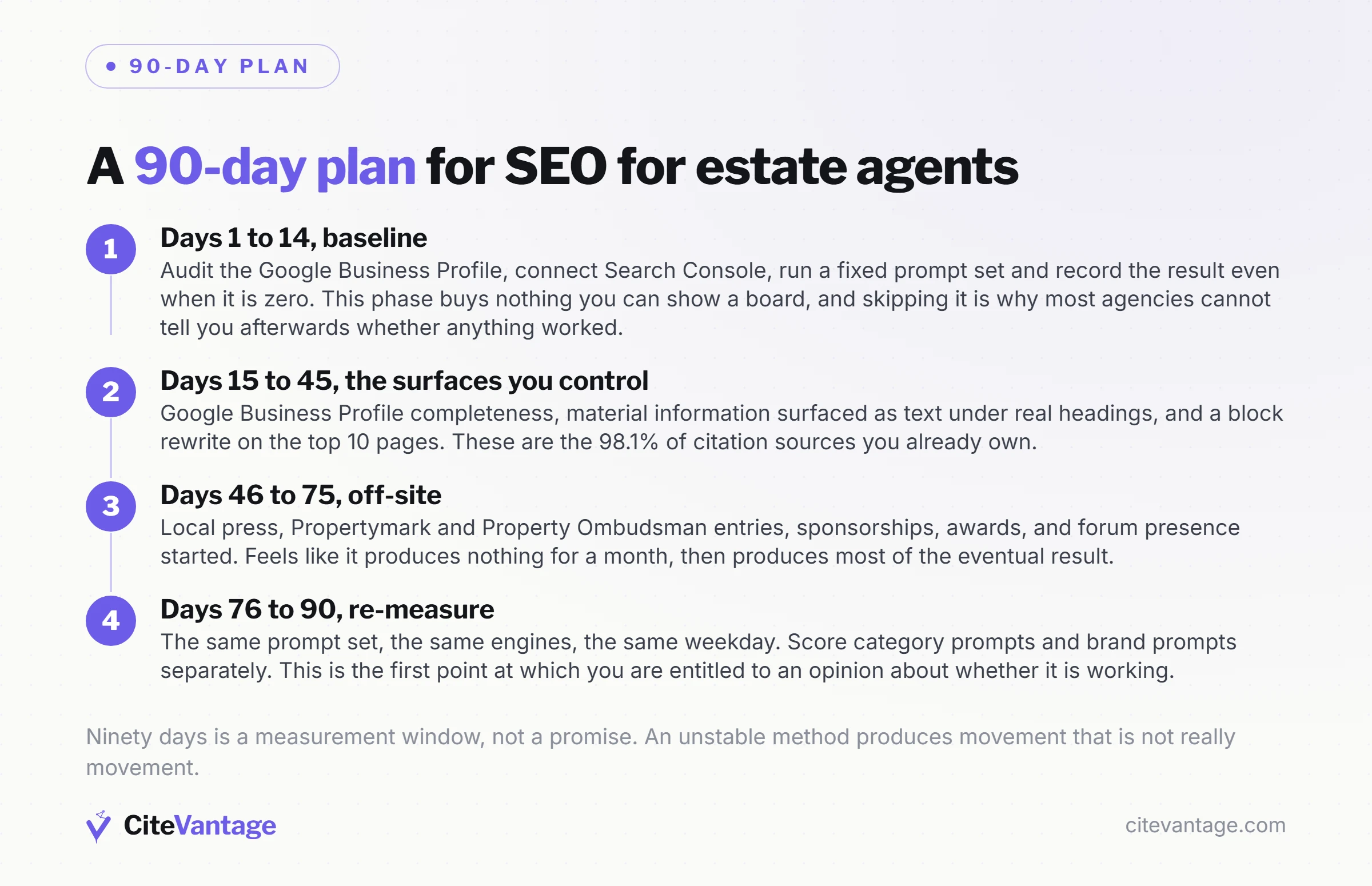
A 90-day plan for SEO for estate agents runs in four phases. Two weeks to baseline and record the zero. Thirty days on the two surfaces you control. Thirty days off-site. Then two weeks to re-measure, using the same prompts, the same engines and the same weekday.
| Phase | What you do | What it buys on Google | What it buys in AI answers | What you give up |
|---|---|---|---|---|
| Days 1 to 14, baseline | GBP audit, Search Console connected, run a fixed prompt set, record the result even when it is zero | Nothing yet | Nothing yet | Two weeks of visible progress |
| Days 15 to 45, the surfaces you control | GBP completeness, material information surfaced as text, block rewrite on the top 10 pages | Local ranking and long-tail lift | The 98.1% of citation sources you own | New content production |
| Days 46 to 75, off-site | Local press, directory entries, sponsorships, forum presence started | Slow authority gain | Branded mentions, the 0.664 signal | Fast, reportable wins |
| Days 76 to 90, re-measure | Same prompt set, same engines, same weekday, category and brand prompts scored separately | A clean before and after | The only honest read you will get | The urge to judge it early |
Every competitor gives you an SEO plan or an AI-visibility pep talk. This sequences both, and the column that matters most is the last one. Phase one buys nothing you can show a board. It is two weeks of measuring a number that will probably be zero, and skipping it is the reason most agencies cannot tell you afterwards whether anything worked. Phase two is where the double-duty work sits, because Google Business Profile and Maps plus your own site cover 98.1% of the citations in the Omni Eclipse set. Phase three feels like it produces nothing for a month, then produces most of the eventual result. Phase four is the first point at which you are entitled to an opinion about whether it is working. Ninety days is not a promise. It is a measurement window.
The stop-doing list deserves as much room as the start-doing list. Stop buying more schema. Stop adding crawler directives. Stop chasing word count. Our own measurements above say none of those moved citations in this niche, and we ran them on ourselves before saying it about anybody else. Score category prompts and brand prompts separately, always. Averaging them hides the problem, which is exactly what our own split showed: zero across 40 category prompts, seven citations on brand prompts, in the same week. Two handoffs, so you are not reading the same thing twice. The shorter 30-day version, the five-minute self-test and the reasons buyers now ask AI first are in our guide to how buyers now use AI to find an agent. The full measurement method, seven steps, is in run the audit yourself.
By Abdul Subkhan, Founder of CiteVantage. We run multi-engine citation tracking on our own site every week, including the weeks the number stays at zero. That is the whole method behind every number in this guide to SEO for estate agents, and it is the same method we would hand you.
Send us your town and the questions your buyers ask, and our free AI Visibility Snapshot returns what ChatGPT, Perplexity, Gemini and Google AI Overviews say today when somebody asks for an estate agent there. Phase one, run for you, before you spend anything.
Frequently asked questions
How much does SEO for estate agents cost?
+
It depends on four things: how many branches you have, how many area pages you need, whether off-site mention work is included, and whether it is a one-off project or a retainer. Current figures sit on our pricing page rather than in an article, because they change.
How long does SEO take for an estate agency?
+
Local ranking movement on branch and area pages usually shows inside one to three months. Authority takes longer and depends on referring domains, which nobody can shortcut. Our own count is zero, so we are not going to be vague about anyone else's timeline either.
How long does it take to get AI-recommended?
+
Different scoreboard, different clock. Tie it to a re-measure date rather than a promised one. Run a fixed prompt set on day one, work for 75 days, run the same set on day 90. If a supplier offers a date instead of a measurement plan, that answers the question.
Should estate agents add schema markup for AI search?
+
Yes for eligibility, no as a citation strategy. Schema helps an engine parse your pages and resolve your entity, so add Organization, LocalBusiness and FAQPage. We ran deep schema across our own site and observed no citation change. Table stakes, then spend the rest off-site.
Will AI replace property portals?
+
No. Rightmove alone took over 80% of all time spent on UK property portals in 2025. The zero-citation finding is a separate measurement, made on the US portals that study tracked, not a UK share figure. Two different behaviours in two different datasets, both real.
How often should we review AI visibility?
+
Weekly while you are actively working on it. Monthly at minimum after that. Same weekday, same prompt set, same engines, recorded the same way every time. Consistency beats frequency, because an unstable method produces movement that is not really movement.
See where AI is hiding your brand
Free multi-engine audit across ChatGPT, Gemini, Google AI & Perplexity.
Get your free audit