Can SEO and GEO Strategies Work Together? One Plan for Rankings and AI Citations
By Abdul SubkhanPublished Updated
Part of AI SEO, GEO and AEO
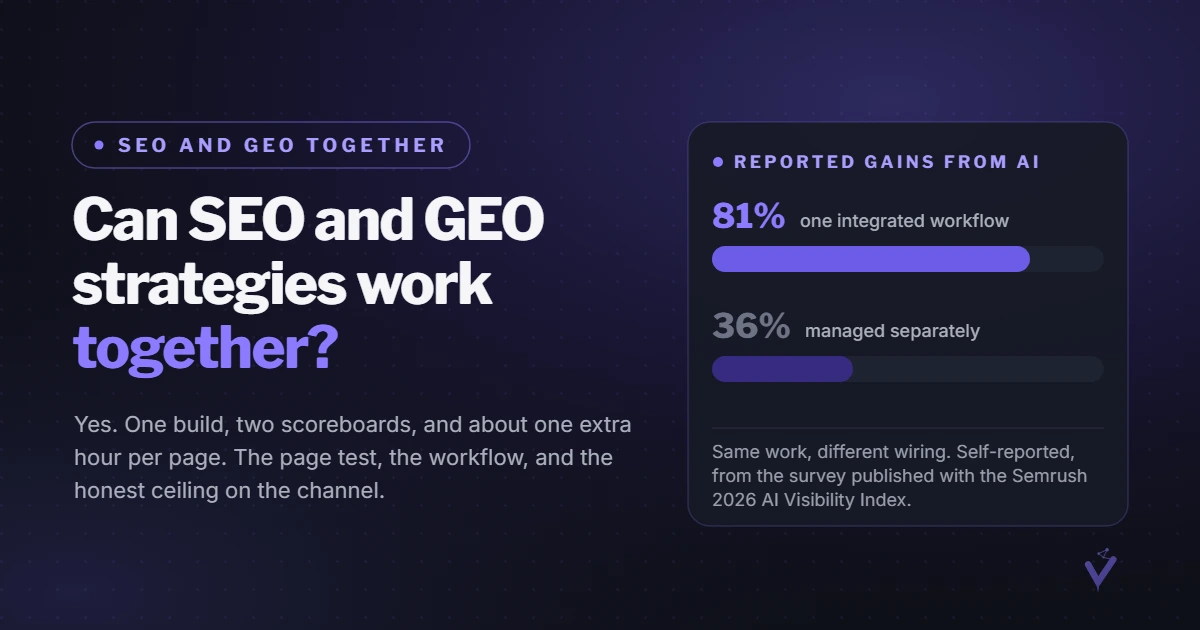
Images in this guide are free to reuse (CC BY 4.0). Credit CiteVantage with a link to this page.
Yes. SEO and GEO strategies work together for better results, and the honest version is one SEO and GEO strategy rather than two separate programs. The split is measurable. Teams that run them as one workflow report gains from AI platforms far more often than teams that keep them apart. But they do not share an outcome. Ranking on page one does not earn you an AI citation.
One thing first, because the term is muddy. GEO here means generative engine optimization, which is getting named and cited inside ChatGPT, Perplexity, Google AI Overviews and Gemini. It does not mean geographic or local targeting, though some articles published under this exact question answer the local version instead. If you want the definitions side by side, how GEO, SEO and AEO differ covers that ground.
You probably rank fine. And AI still names somebody else when a buyer asks about your category. The distance between those two facts is now measurable page by page.
That is what this article is about. The test, the workflow, the honest ceiling.
Can SEO and GEO work together for better results?
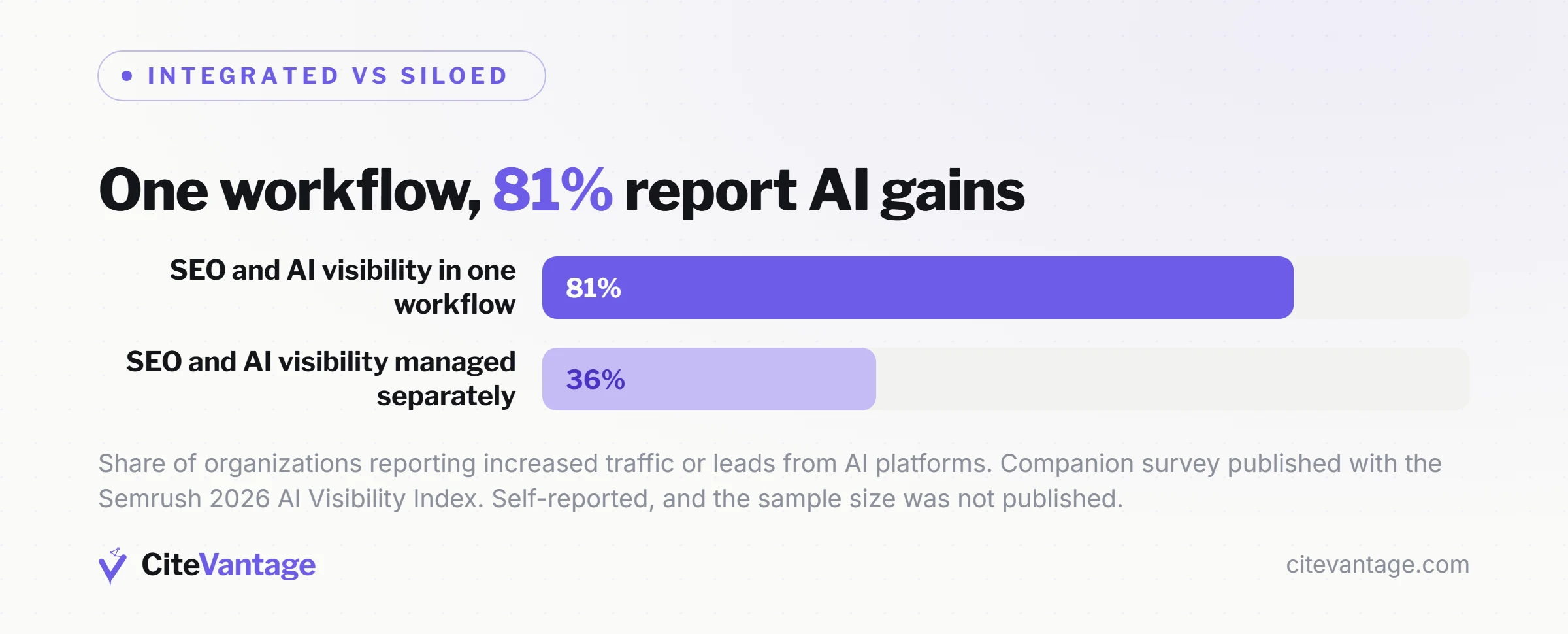
Yes, and it is measured. Organizations that fully integrate SEO and AI visibility into one workflow report increased traffic or leads from AI platforms 81% of the time. Organizations managing them separately report it 36% of the time. Same work, different wiring, and the wiring is worth more than most teams expect.
That split comes from the survey published alongside the Semrush 2026 AI Visibility Index. The index itself is built on 126 million US AI search prompts collected between January and April 2026. The 81 to 36 split comes from the survey run next to it.
Worth saying what that number is and is not. It is self-reported, and Semrush did not publish the sample size. It tells you which operating model correlates with results across a large sample of teams. It does not tell you which specific tactic did the work.
The common answer stops well short of that anyway. You will read, in a lot of places, that roughly 80% of GEO is just good SEO, so do the SEO and the citations follow. uSERP CEO Jeremy Moser put the number in print, telling Digiday that success in AI visibility is “80 percent good fundamental SEO”.
It is a widely held position. It is also asserted far more often than it is measured. The rest of this page tests it.
They share a foundation. They do not share an outcome.
Is optimizing content for AI search different from SEO?
Most of the build is one job. When SEO and GEO strategies work together, crawlable pages, site architecture, internal links, schema and page speed serve rankings and citations at the same time. What is genuinely new is a second pass over the same page, plus a set of off-site signals. Not a second website, and not a second content team.
| Work item | Shared or new | Who owns it | Effort |
|---|---|---|---|
| Crawlable, fast, indexable pages | Shared | Engineering | Already funded |
| Site architecture and internal links | Shared | SEO | Already funded |
| Schema and structured data | Shared | SEO or engineering | Already funded |
| Search intent and topic selection | Shared | Content | Already funded |
| Answer-first structure, one claim per passage | New pass | Content | Low, on pages you have |
| Named, dated, sourced statistics in the body | New pass | Content | Low to medium |
| Consistent off-site description across mentions, listings and reviews | New | PR or founder | Medium, ongoing |
| Citation tracking across four engines | New | SEO or ops | New tooling |
Look at the top half of that table and the “GEO is just SEO with a new name” argument feels obviously true. Four of the eight rows are work you finished years ago.
The bottom three rows are why the argument falls apart. None of them are things a ranking program produces as a side effect. Nobody earns a consistent third-party description by fixing crawl depth. Different work entirely.
Which is why brands with every shared row finished still go unmentioned. We have already published the diagnosis for that, in detail, in why a brand that ranks still goes unmentioned by AI.
How do you test one page for both rankings and citations?
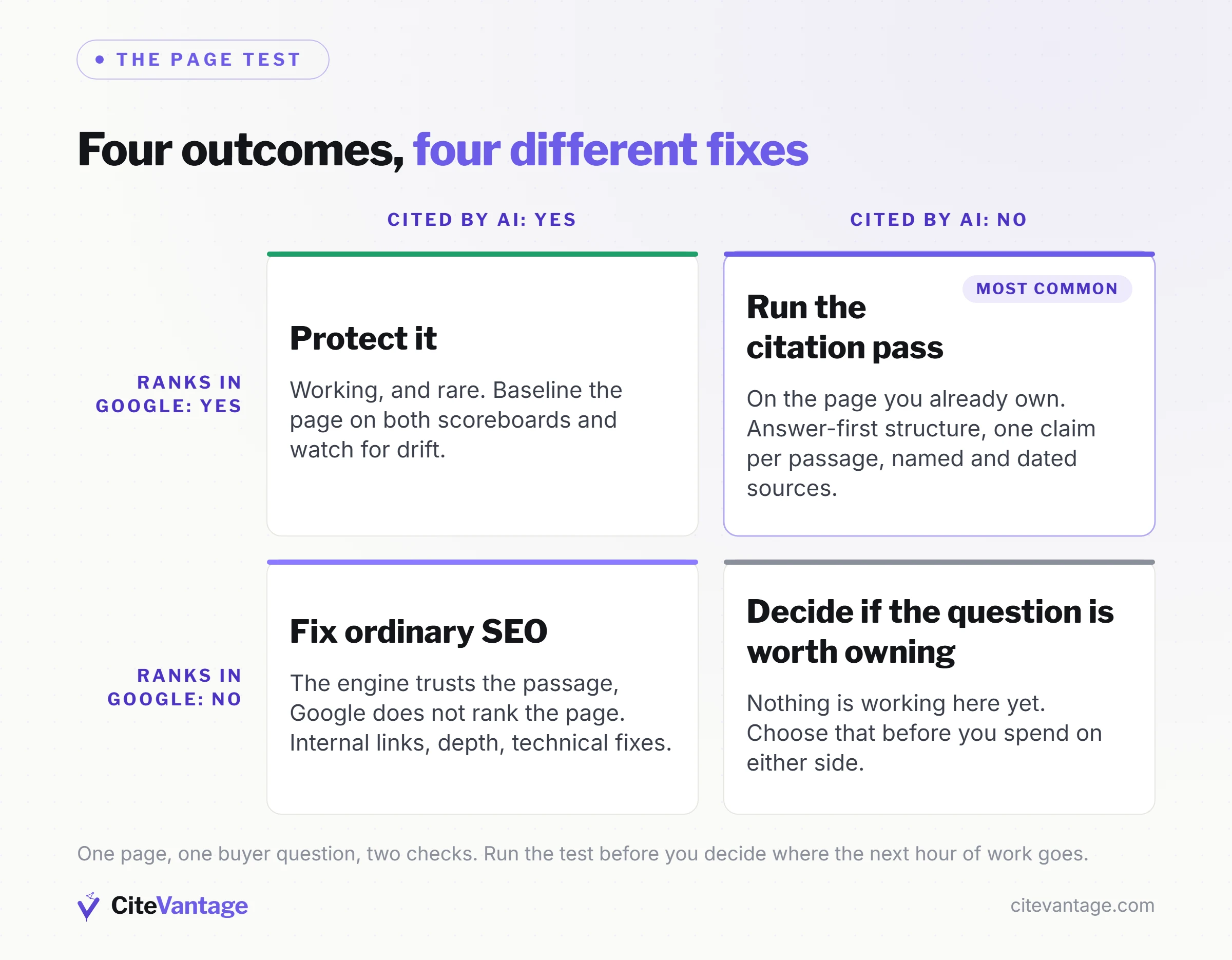
Take one page and one buyer question. Ask two things: does the page rank, and does any engine cite it. There are four possible answers, and each one points at a different fix. Most teams never run this test, because they only ever look at one of the two.
Four lines.
- Pick a buyer question a real customer would type. Not a keyword.
- Check where your page sits in Google for it.
- Run the same question through ChatGPT, Perplexity, Google AI Overviews and Gemini.
- Record two things separately: whether the brand gets named, and whether the page gets linked.
| Ranks? | Cited? | What it means | What to fix first |
|---|---|---|---|
| Yes | Yes | Working. Rare. | Protect it. Baseline it and watch for drift. |
| Yes | No | The most common case, and the reason this page exists. | Run the citation pass on the page you already have: answer-first structure, named and dated sources, one claim per passage. |
| No | Yes | The engine trusts the passage. Google does not rank the page. | Ordinary SEO work: internal links, depth, technical fixes. The content is already citable. |
| No | No | Nothing is working on this question yet. | Decide whether the question is worth owning before you spend on either side. |
Rows two and three are not hypothetical. Search Engine Land’s SEO and GEO gap analysis is Adam Gnuse’s read of GA4 data from 10 websites, covering 150,000 indexed pages over a one-month window in March 2026.
It found that top 10 organic pages produced 55% of organic sessions but only 29% of LLM sessions. Of the top 100 organic pages on those sites, 49 had zero LLM traffic. And 14% of the pages that did receive LLM traffic had zero organic clicks.
The 55 to 29 drop is row two at scale. The 49 pages are row two with names attached.
The 14% is row three, and it matters more than it looks, because it shows the citation lever moves on its own. You can earn a citation on a page Google has not decided to rank. Rare. Still real.
Which row you are mostly in decides where the next hour of work goes. Per page, not site-wide. If you want the mechanics of running the check across engines and keeping the numbers somewhere useful, how to baseline citations across the engines walks through it step by step.
Row two is the fixable row.
Will optimizing for AI hurt my Google rankings?
No. Nothing in the citation pass fights ranking work. Answer-first openings, clean headings, named and dated sources, a consistent description of who you are: Google already rewards all of it. The real risk sits somewhere else, and it is worth naming plainly before you commit any hours.
GEO does not replace SEO either. It is a second outcome measured on the same build, which is exactly why the budget question further down is not a split.
The risk is opportunity cost. Treat AI visibility as a new content stream and every hour goes to pages with no ranking history, no internal links and no traffic. Meanwhile the pages that already earn sit untouched.
That is a real way to lose money here. It has nothing to do with Google penalizing you.
Which is the whole argument for one build.
Which content types actually get cited by AI?
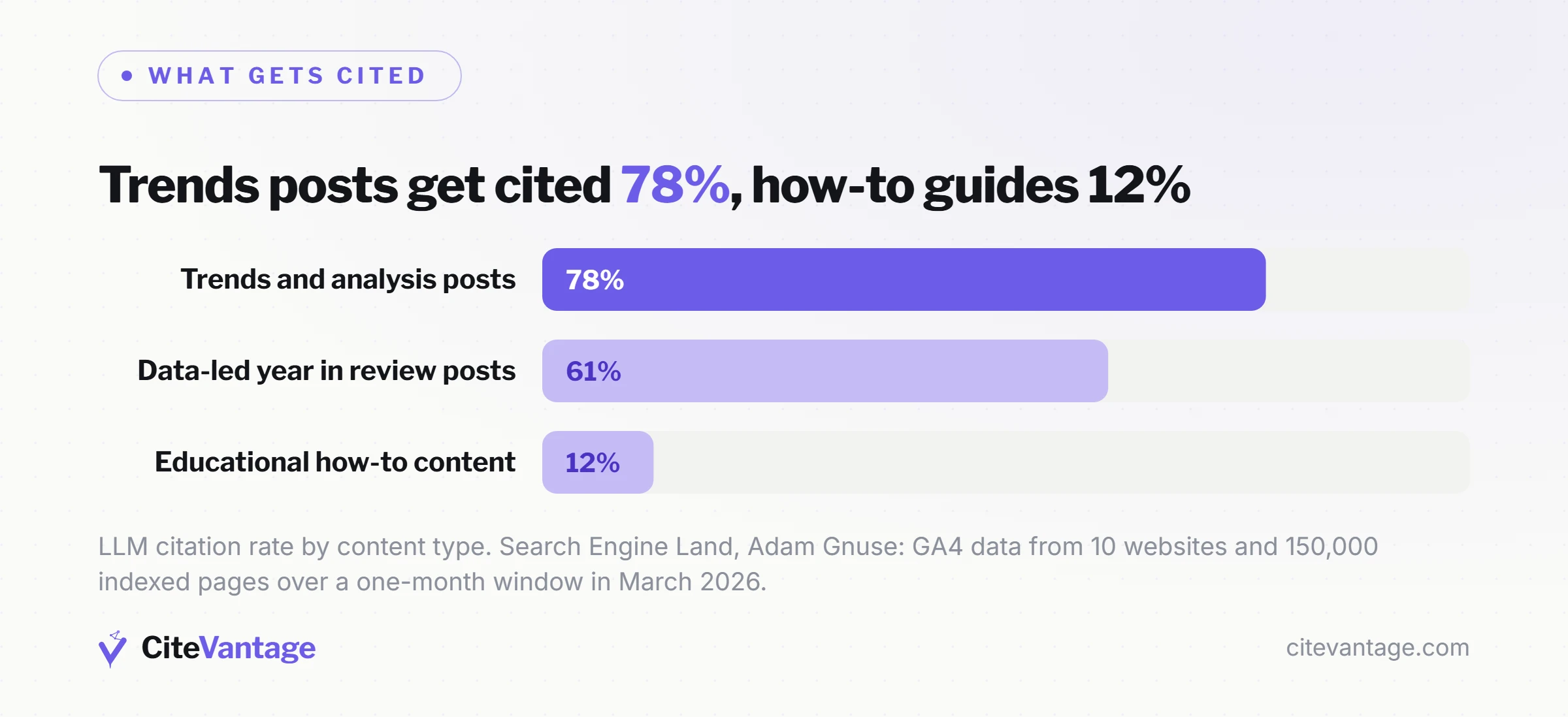
The content your SEO calendar produces most is the content AI cites least. In the Search Engine Land page-level data, educational how-to content was cited at a 12% rate. Trends and analysis posts were cited at 78%, and data-led year-in-review posts landed at 61%. That gap is about format, not quality.
Same source as the figures above: Adam Gnuse, the same 10 sites, the same March 2026 window.
A how-to page is built to walk somebody through steps. That shape is hard for a model to lift, because the value is spread across twelve paragraphs and none of them stands alone as a claim. A trends piece opens with a position and a number. That lifts clean.
Format, not depth. Which is why a genuinely good how-to guide can sit at position two and never get quoted anywhere.
That is row two of the table above with a cause attached.
The fix is smaller than it sounds. You do not stop publishing how-to content, because that content is what earns the rankings and the traffic in the first place. You add a liftable opening to it. Then you put one trends or data piece on the calendar each quarter, so the citation side of the scoreboard has something built for it rather than borrowed.
Is any AI engine easier to get cited by than the others?
No. We audited 181 United States ecommerce and DTC brands, every one running paid ads on Meta at the time, across four engines. The count of brands absent from a given engine ran from 164 to 171 out of 181. There is no soft target in that set.
| AI engine | Brands absent | Out of |
|---|---|---|
| Perplexity | 171 | 181 |
| ChatGPT | 169 | 181 |
| Google AI Overviews | 169 | 181 |
| Gemini | 164 | 181 |
Absent means neither named nor cited. Only 15 of the 181, about 8%, were cited by even one engine. Another 8 got named in an answer without a link.
I ran that per-engine cut expecting to find one weak spot worth targeting first. There was not one. Seven brands separate the best engine from the worst.
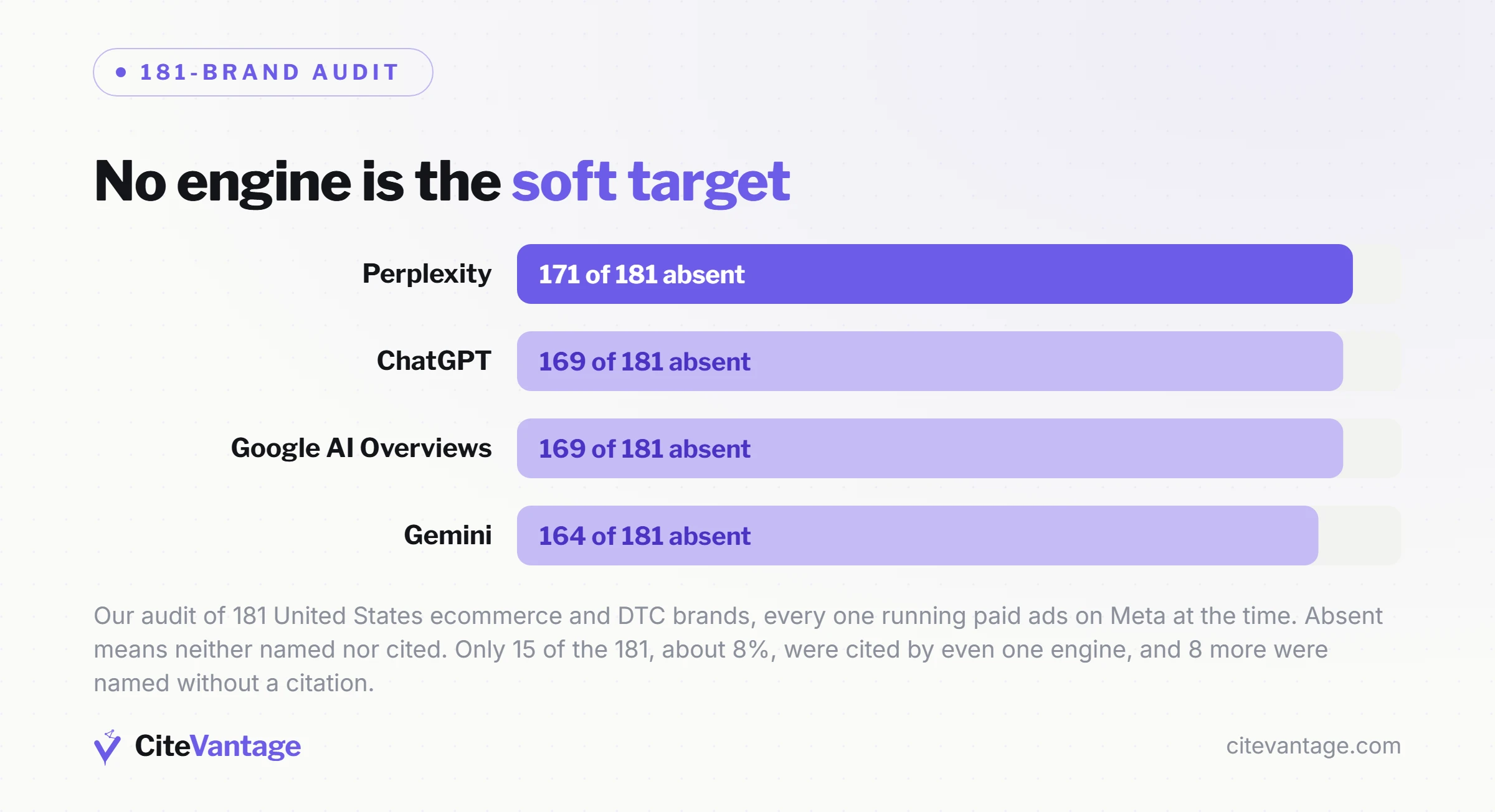
The headline number is already published with its full read-out: 158 of 181, or 87% of the 181 brands, absent from all four engines at once. That sits alongside the rank-to-citation evidence, and the method, sample and collection dates are in the 181-brand AI visibility study.
How do you make SEO and GEO strategies work together in one workflow?
One build, two scoreboards. The same page, the same brief, one extra pass before it goes live, then two separate measurement systems. The second scoreboard is the part almost nobody sets up, and it is the only thing that tells you whether the citation work did anything at all.
The build order, with owners:
- Pick the buyer question, not the keyword. Content, at brief stage.
- Build the page to your normal SEO standard. Content and engineering, unchanged.
- Run the citation pass before publish. Answer-first opening under each heading, one claim per passage, named and dated sources, a plain description of who you are. Content, roughly an extra hour per page.
- Log the page in both scoreboards on day one. Ranking position, and a citation baseline across the four engines. SEO or ops.
- Review at 30 and 90 days on each scoreboard separately. Never blend them.
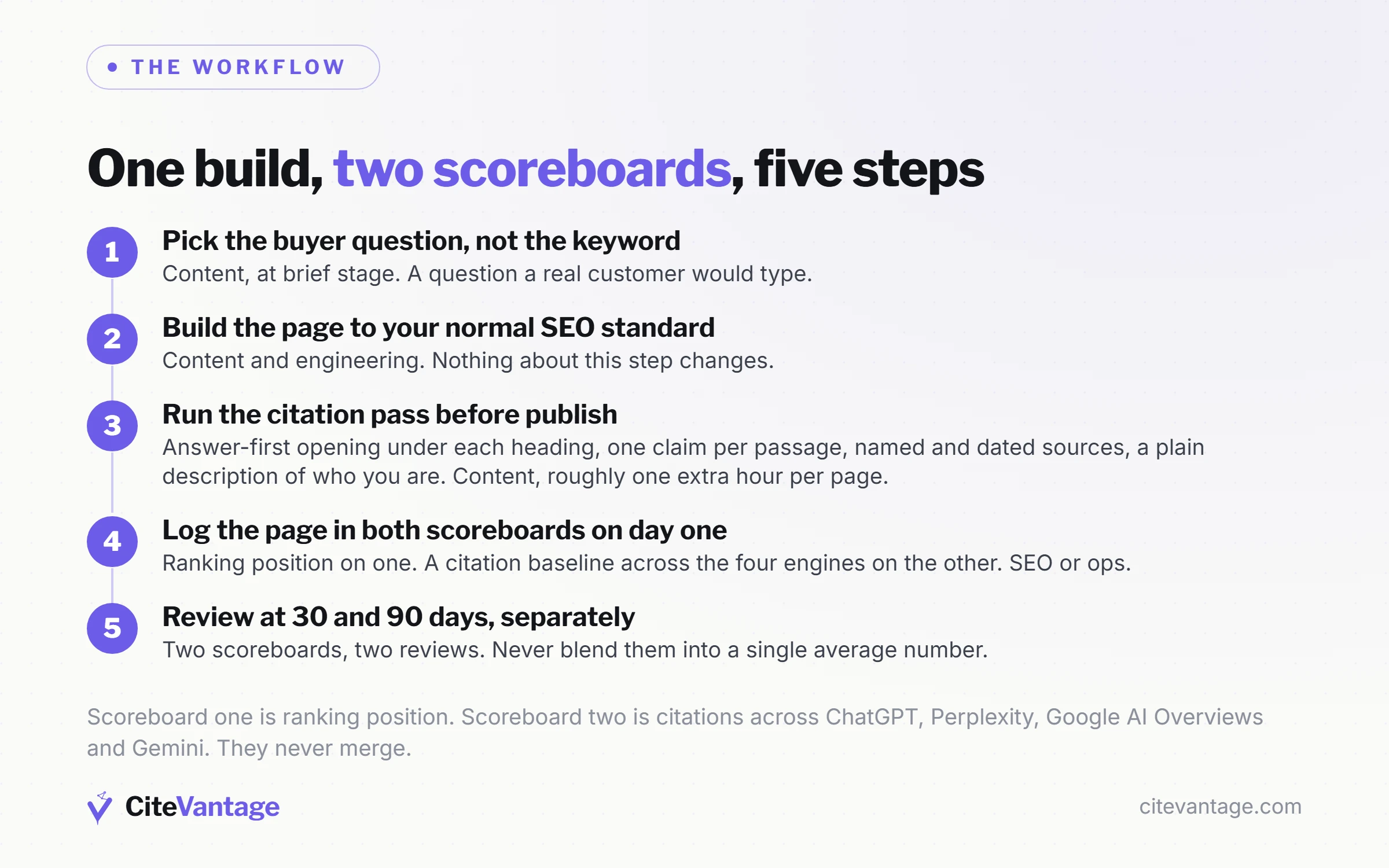
One rule holds the whole thing up. Never merge the two scoreboards into a single number.
A blended AI visibility score averages the page that ranks well and is cited nowhere against the page doing fine. The average hides the exact case this article exists to expose. That is row two of the diagnostic table. It disappears the moment you take a mean.
Ownership is simpler than most teams assume. The citation pass sits with whoever already writes and owns the page, because it is an edit to a brief they were producing anyway.
The off-site work does not sit there. Nobody on a content team controls how a review site describes you. That is the one place a genuine handoff is needed, usually to PR or to the founder.
How do you budget for one SEO and GEO strategy?
GEO is not a second invoice. It is a tax on the content, engineering and PR budget you already run. So the honest answer to “what percentage should go to GEO” is that the question is built wrong. A percentage chosen in advance will be wrong for most of your pages.
Published answers on the GEO share of budget run from 5% to 70%. Flatline Agency put five of them side by side and got 70/30, 65/35, 25/75, 15/85 and 5/95 for the same question. A spread that wide is a tell. The right number depends on which of the four page-level outcomes your money pages are actually sitting in.
So use a rule instead of a percentage.
- Mostly ranks, not cited: the money is a citation pass on pages you already own. Close to zero new spend, real time cost.
- If most money pages neither rank nor get cited, you have an SEO problem first. Fix that. The citation work has nothing to attach to.
- Everything baselined and holding: the next dollar goes off-site, to third-party mentions and consistent descriptions. That is the one genuinely new line item.
Notice that in two of the three cases the answer is not “spend more”. It is “spend the same hours differently”. That is what it looks like in practice when SEO and GEO strategies work together inside one budget.
If you want the shape of what that work covers end to end, what AI visibility work actually includes lays it out.
How do you measure GEO when half of it is invisible?
Start with the honest ceiling. AI referrals were 1.08% of all web traffic across 13,770 domains and more than 3.3 billion sessions measured between May and September 2025. That is a small channel. It is also the wrong number to plan against, because the money you are losing is not landing on the AI side of the ledger.
Those figures come from Conductor’s 2026 AEO and GEO benchmarks, reported by Search Engine Land in November 2025.
Measurement is genuinely hard. Semrush found that 45% of marketing leaders cannot accurately measure their brand visibility inside AI-generated answers. Only 9% hold tools that track all the relevant metrics across platforms.
A tooling gap. It is closing.
The reframe matters more. Planning against 1.08% assumes the prize is the AI referral click. It is not. The click a search engine used to send you is the thing being quietly removed, from a channel you have already paid years to build.
So the number that should worry you is not how small AI referrals are. It is how much of your existing organic click volume now ends inside an answer somebody else is named in. In the same Conductor report, 25.11% of 21.9 million Google searches triggered an AI Overview.
The audit walkthrough linked earlier covers how to keep that second scoreboard without buying anything.
The AI referral channel is small. The share of searches answered on the results page is not. You are not choosing between them.
Get your starting numbers
You can run the four-outcome test by hand this week. If you would rather have the baseline done for you, our free AI Visibility Snapshot puts your brand through all four engines. It sends back which ones name you, which name a competitor instead, and which of the four page-level outcomes your money pages are sitting in.
You give us a domain and a few buyer questions. That is the starting line for making SEO and GEO strategies work together on the pages you already own. Request the snapshot.
Frequently asked questions
Do SEO and GEO actually compete for the same budget?
+
No. They compete for the same hours. SEO and GEO strategies work together on one build, so there is no second invoice for the page itself. The one genuinely new line item is the off-site work: getting described consistently by people who are not you.
Who owns GEO internally: SEO, content, or PR?
+
Split it. The citation pass sits with whoever already owns the page, because it is one extra hour on a brief they were writing anyway. The off-site work is the real handoff, and it lands with PR or with the founder. That is the only new headcount question.
Do I need a second content stream for AI, or can I reuse the pages I have?
+
Reuse them. The second pass is a structure and sourcing edit on pages that already exist, not a parallel calendar. You change how the page opens, where the claims sit, and which sources you name. The page keeps doing its original job.
Is GEO worth it if AI referrals are only about 1% of my traffic?
+
Usually yes, because channel size is the wrong input. AI referrals sat at 1.08% of web traffic in Conductor's benchmarks. But the decision in front of you costs one extra pass on a page you were publishing anyway. You are pricing an hour, not a channel.
Does GEO replace SEO?
+
No. AI answers are assembled from pages an engine already crawled and indexed, so the ranking work still has to happen underneath. GEO is a second outcome measured on the same build, not a replacement for it. Drop the SEO and there is nothing left for a model to cite.
What does AI citation tracking involve if I have no budget for tools?
+
Run the same buyer questions through ChatGPT, Perplexity, Google AI Overviews and Gemini on a fixed schedule, and log two things per page: whether the brand gets named, and whether the page gets linked. Keep that scoreboard separate from your ranking report. Never average the two.
More in AI SEO, GEO and AEO
- Hostinger CDN Blocks GPTBot: HTTP 429 Case Study
- AI SEO Impact Ranking Statistics US 2026
- AI Tools for SEO and AEO: Track ChatGPT Mentions
- Best AI Mode SEO Analysis Tools for 2026
- Best AI SEO Agencies 2026: 15 Firms Ranked
- Brand Invisible to AI? How to Appear in AI Search
- Can AI Crawlers Reach Your Site? How to Check
- GEO Case Studies: Successful Campaigns
- GEO vs SEO vs AEO: The Real Difference in 2026
- How AI Decides Which Brands to Recommend
- How to Check if ChatGPT Recommends Your Brand
- How to Get Cited by ChatGPT: 2026 Playbook
- How to Get Cited by Google Gemini
- How to Get Cited by Perplexity: 9 Source Signals
- How to Rank in Google AI Overviews: 2026 Guide
- How to Run an AI Visibility Audit Step by Step
- How to Track Competitors in AI Search Results
- Most Popular AI Visibility Tools for SEO
- Schema Markup for AI Search: Types That Matter
- What Is Answer Engine Optimization (AEO)?
- What Is Generative Engine Optimization (GEO)?
- What Is llms.txt? Complete Setup Guide
Start from the hub: AI SEO, GEO and AEO
See where AI is hiding your brand
Free multi-engine audit across ChatGPT, Gemini, Google AI & Perplexity.
Get your free audit