Breaking the Myths of Google Preferred Sources
By Abdul Subkhan Published
Part of AI SEO, GEO and AEO
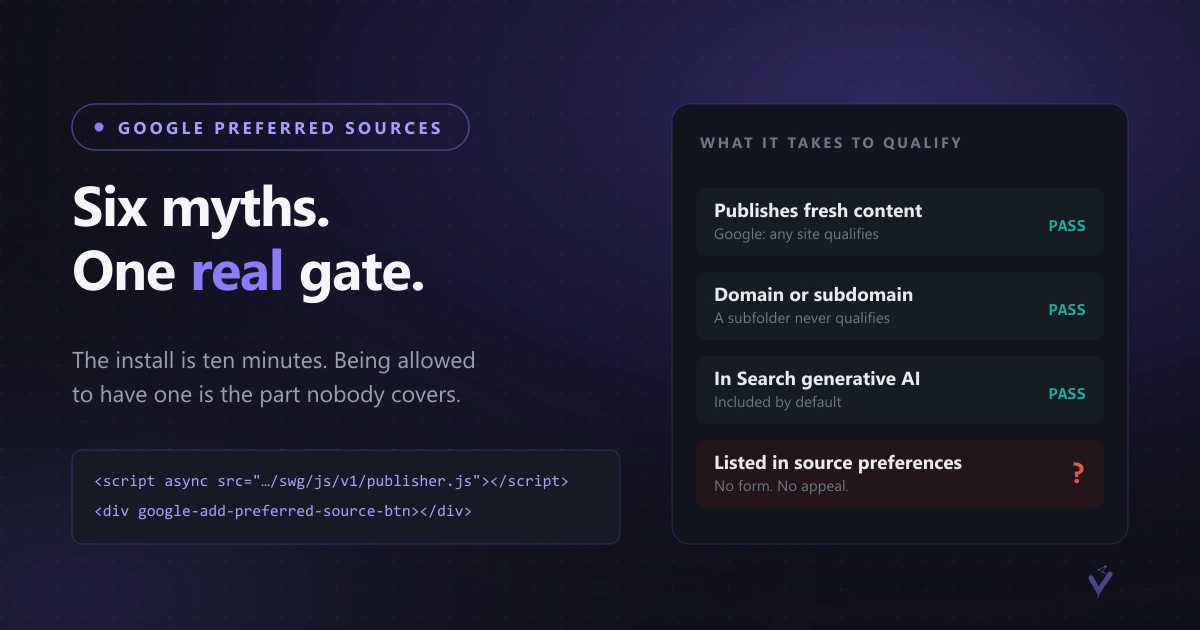
Images in this guide are free to reuse (CC BY 4.0). Credit CiteVantage with a link to this page.
Google Preferred Sources got its own embeddable button on 20 August 2026, and the SEO industry wrote it up within the fortnight. Most of that coverage is fine. Some of it quietly promises things Google has never said, and one of those promises is about AI Overviews, which is the part people are buying.
This is the feature first, honestly and in its best light, then six claims worth checking against Google’s own words. We installed it on this site while writing, got one of the six wrong ourselves, and that mistake turned out to be the most useful finding here.
What the Google Preferred Sources button actually is
It is a button you embed on your pages that lets a reader add your site to their preferred sources in Google with one click. From then on, Google shows your content more often in that reader’s Top Stories and marks it with a “preferred” badge where it appears in AI Mode and AI Overviews. The reader lands back on the page they were on.
The install really is two lines. A script from news.google.com, and a div Google paints into.
<script async src="https://news.google.com/swg/js/v1/publisher.js"></script>
<div google-add-preferred-source-btn></div>
Optional data-theme and data-lang attributes override the defaults. Google also ships downloadable badge assets and documents a plain link as an alternative for sites that cannot run the script.
What genuinely changed in August 2026
The button is new. The feature is not. Google tested Preferred Sources in Search Labs from 26 June 2025, launched it in the US and India on 12 August 2025, took it global in English on 16 December 2025, extended it to all languages on 30 April 2026, and brought it to AI Overviews and AI Mode on 27 May 2026. August 2026 added the embeddable button.
Before that, a publisher who wanted readers to opt in had to build the prompt themselves and hand-roll the link. What changed is cost, and cost matters: this went from a small front-end project to a copy and paste.
There are real reasons to like it. It is the rare Google feature that gives a publisher something to ask their audience for directly, rather than something to optimise and hope about. Readers have selected more than 600,000 unique sources. Google says people are twice as likely to click through to a preferred source. It costs ten minutes, it carries no policy risk that Google has published, and unlike almost everything else in search right now it rewards having an actual audience.
So install it. Then be careful about what you tell a client it does.
Myth 1: Preferred Sources gets you cited in AI Overviews
Google has never claimed this. Its publisher documentation makes two different promises for two different surfaces. For Top Stories your content is “more likely to appear”. For AI Mode and AI Overviews, it “can be highlighted with a ‘preferred’ badge for users who have selected your site”.
One of those is a selection claim. The other is a decoration on content that already got selected some other way. Every verb Google uses about the AI surfaces is a labelling verb: in the May 2026 announcement readers will “easily spot links in AI responses from the sources you’ve already selected”, and preferred sources “will be clearly labeled to stand out”.
Nowhere has Google said preferred status changes which sources an AI Overview retrieves, cites or grounds on. Headlines have said it anyway. If you take one thing from this page, take the distinction: being badged inside an answer and being chosen for an answer are different products, and only one of them has been promised.
Myth 2: Preferred Sources is a ranking signal
It is usually described as personalisation rather than ranking, and that is a reasonable reading. It is also not something Google has confirmed. Google has never stated, in either direction, whether a preferred-source selection influences results for anyone other than the person who made it.
That gap has not stopped the claim. Search Engine Journal published “Google’s Preferred Sources Is Now A Global SEO Signal” on 1 May 2026, and the body of the article produces no Google quote supporting the headline.
The closest thing to a constraint from Google is John Mueller, asked whether preferred status overrides low-quality signals: “I don’t think it makes sense to show spam to users just because of that, but it does help a user to see their preferred sources more.” That describes Google’s ranking behaviour, and it still says nothing about spillover to other users.
So the honest position is narrower than either camp wants. You can say Google has not documented a cross-user effect. You cannot say there is none.
Myth 3: It is only for news publishers
Google’s wording from 27 May 2026 is direct: “Any website that publishes fresh content is eligible.” There is no requirement to be in Google News, and no requirement to be a news organisation at all.
We can confirm it first hand. This site is an agency blog. It has never been in Google News. It appears in Google’s source preferences tool, listed with our own favicon, and the button renders on our pages.
The confusion is understandable, because the feature’s main surface is Top Stories and news publishers dominate that. Two limits are real: it works at domain and subdomain level only, so example.com and blog.example.com qualify while example.com/blog never can, and Google has never defined what “fresh” means. The user help page says only that “sources that aren’t updated regularly may not be available”. No frequency, no window, no threshold.
Myth 4: You have to switch something on in Search Console first
Google’s docs say that for the AI Mode and AI Overviews badge your site must be “included in Search generative AI features in Search Console”, and a lot of coverage has turned that into a box you must go and tick. It is the opposite. That control defaults to included for every property, and it finished rolling out worldwide on 31 August 2026.
Unless you deliberately excluded yourself from generative AI features, you already pass this condition and there is nothing to do. The only people who need to touch that setting are publishers who opted out and now want back in.
Myth 5: Installing the button is the hard part
The install is ten minutes. The gate is whether Google already lists your domain in its source preferences tool, and that is where this feature quietly stops for most sites. There is no application form, no Search Console control, no appeal and no documented signal that gets a domain added.
The public record is in Google’s own Publisher Center community, and it is bleak. A publisher with 70 million monthly users across their network reported not one of their sites appearing. A Malayalam publisher found their Telugu and English sites listed while the Malayalam one was not. A Marathi publisher was told the feature was English-only, produced screenshots of Marathi publishers who were listed, and got the concession that “it’s a limited rollout right now and still in beta probably”. A small business owner named the trap: sites need visibility before readers can pick them, so the businesses that would benefit most are the least likely to qualify. Every one of those threads is locked, and every one was answered by a volunteer rather than by Google.
There is also a live bug. An open issue on Google’s own Reader Revenue demo repository, filed 31 August 2026, reports the embedded button declaring domains ineligible that can be added successfully through the manual preferences page. It reproduces on Google’s own demo site. So a button that fails to render is not proof you were refused, either.
Check google.com/preferences/source signed in and search your domain. Note that the URL returns HTTP 200 for any domain you put in the query string, so the status code proves nothing and you have to look at the result.
Myth 6: You can tell who has installed it
You cannot, and neither can we, because Google paints the button into a shadow root attached to your div and leaves the div empty in the normal DOM. The button is plainly visible to a reader while the page source shows nothing, div.children.length returns zero, and any crawler, CSS :has() rule or fetch-and-grep audit concludes the site never installed it.
This cost us an hour and a wrong answer. We added Google’s snippet to every article here, checked the div for child elements, found none, and decided our domain had been refused. We ran the same check against the live site and got the same empty result. Only on inspecting element.shadowRoot did a fully rendered 218 by 40 pixel button appear, reading “Add to Preferred Sources”.
The consequence is larger than our afternoon. We swept 55 domains across three groups, looking for the button or the documented deeplink in served HTML: sites that had published about the feature, major news publishers, and twenty of the largest US real estate brokerages and portals. We found it live on five of the sites that wrote about it, and on none of the news publishers or brokerages. Every one of those zeros is a floor rather than a rate.
The Guardian proves the point from the other direction. Its stylesheet ships dedicated --preferred-source-button-border, --preferred-source-button-hover and --preferred-source-button-text custom properties, which nobody authors by accident, and yet no button markup and no deeplink appears anywhere in the HTML its servers return. It has the feature. A crawler cannot see it.
There is a second measurement problem underneath the first. Search Console has no preferred-sources dimension, no report and no filter. You can count clicks on your own button, but a click only starts the flow on Google’s side and never confirms the reader finished it. A publisher asked Google’s VP of engineering for Search in August 2025 whether the numbers would appear in Search Console and got “We’re looking into this”. Thirteen months later there is nothing.
Publishers have been blunt about what they read into that. A Guardian SEO strategist, on the record in February 2026: “When Google doesn’t make it easy to track something, it’s probably because it’s not necessarily a positive for publishers.”
Read the adoption figures with the same caution. The “more than 600,000 unique sources” counts distinct domains picked by at least one person each. It is a count of domains, so a source chosen by one reader and a source chosen by a million each contribute one. And the “twice as likely to click” line is a single Google sentence published with no baseline, sample or methodology.
What to actually do about Preferred Sources
Install it if your domain is listed, put it where someone has just finished reading something, and move on. Ten minutes, no ongoing cost and a small real benefit for readers who already like you. Do not budget for it, build a campaign around it, or let anyone sell you a preferred sources strategy, because the mechanism converts existing loyalty and cannot create discovery.
Two implementation notes worth having. Check element.shadowRoot rather than the div, or you will draw the same wrong conclusion we did. And keep a plain link to google.com/preferences/source?q=yourdomain.com alongside the embed, hidden only once you have confirmed Google’s button actually painted, so a reader behind an ad blocker or a stripped script still has a route. That is what the card at the bottom of this page does, and it is what the Guardian and the Daily Mail both chose over Google’s embed.
For a real estate brokerage specifically, the honest read is that this is a nice-to-have. A button only works on someone already on your page, already reading you, already willing to press it. If a buyer does not know your name, nothing here helps, and not knowing your name is the actual problem for almost every brokerage we audit. The narrow reason to do it anyway is that we found no US brokerage or portal using it at all, and being early in an empty category costs you ten minutes.
Frequently asked questions
What is the Google Preferred Sources button?
+
It is an embeddable button, launched 20 August 2026, that lets a reader add your site to their preferred sources in one click. After that, Google shows your content more often in that reader's Top Stories and marks it with a preferred badge where it appears in AI Mode and AI Overviews. It affects that reader's results, and Google has never said whether it affects anyone else's.
Is Google Preferred Sources a ranking factor?
+
Google has never said so, in either direction. It is widely described as personalisation rather than ranking, and that is a reasonable inference from the wording, but Google has never confirmed whether a selection influences results for anyone other than the person who made it. Treat the common line as an inference rather than a documented fact.
Does being a preferred source get you cited in AI Overviews?
+
Google does not claim that. Its documentation says your content can be highlighted with a preferred badge in AI Mode and AI Overviews for users who selected you. Every verb Google uses about the AI surfaces is a labelling verb: spot, label, highlight. It has never said preferred status changes which sources an AI answer pulls in or grounds on.
Can a non-news website be a Google preferred source?
+
Yes. Google's own wording, from the announcement of 27 May 2026, is that any website that publishes fresh content is eligible. We verified it on this site, which is an agency blog with no Google News presence and which appears in the source preferences tool. There is no stated requirement to be a news publisher.
Why is my site not in Google's source preferences tool?
+
Google has not said, and there is no way to ask. Publishers who are live in Google News, Search and Discover have posted repeatedly since August 2025 that their domains do not appear, and the answer each time is that no submission path exists. The threads are locked and answered by volunteer product experts rather than Google staff.
Can you track how many people added you as a preferred source?
+
No. Search Console exposes no preferred-sources dimension. You can count clicks on your own button in your analytics, but the click only starts the flow in Google and never confirms the reader completed it. Google's VP of engineering for Search said in August 2025 that they were looking into reporting. Thirteen months later nothing has shipped.
More in AI SEO, GEO and AEO
- Domains AI Cites on Real Estate: The Open List
- Hostinger CDN Blocks GPTBot: HTTP 429 Case Study
- AI Search Statistics 2026: Sourced and Dated
- AI Tools for SEO and AEO: Track ChatGPT Mentions
- Best AI Mode SEO Analysis Tools for 2026
- Best AI SEO Agencies 2026: 15 Firms Ranked
- Can AI Crawlers Reach Your Site? How to Check
- GEO Case Studies: Successful Campaigns
- GEO vs SEO vs AEO: The Real Difference in 2026
- Generative Engine Optimization: GEO and AEO Guide
- How to Check if ChatGPT Recommends Your Brand
- How to Get Cited by ChatGPT: 2026 Playbook
- How to Get Cited by Google Gemini
- How to Get Cited by Perplexity: 9 Source Signals
- How to Rank in Google AI Overviews: 2026 Guide
- How to Run an AI Visibility Audit Step by Step
- How to Track Competitors in AI Search Results
- Most Popular AI Visibility Tools for SEO
- SEO and GEO Strategy: Make Them Work Together
- Schema Markup for AI Search: Types That Matter
- What Is llms.txt? Complete Setup Guide
Start from the hub: AI SEO, GEO and AEO
See where AI is hiding your brand
Free multi-engine audit across ChatGPT, Gemini, Google AI & Perplexity.
See who AI names instead of me