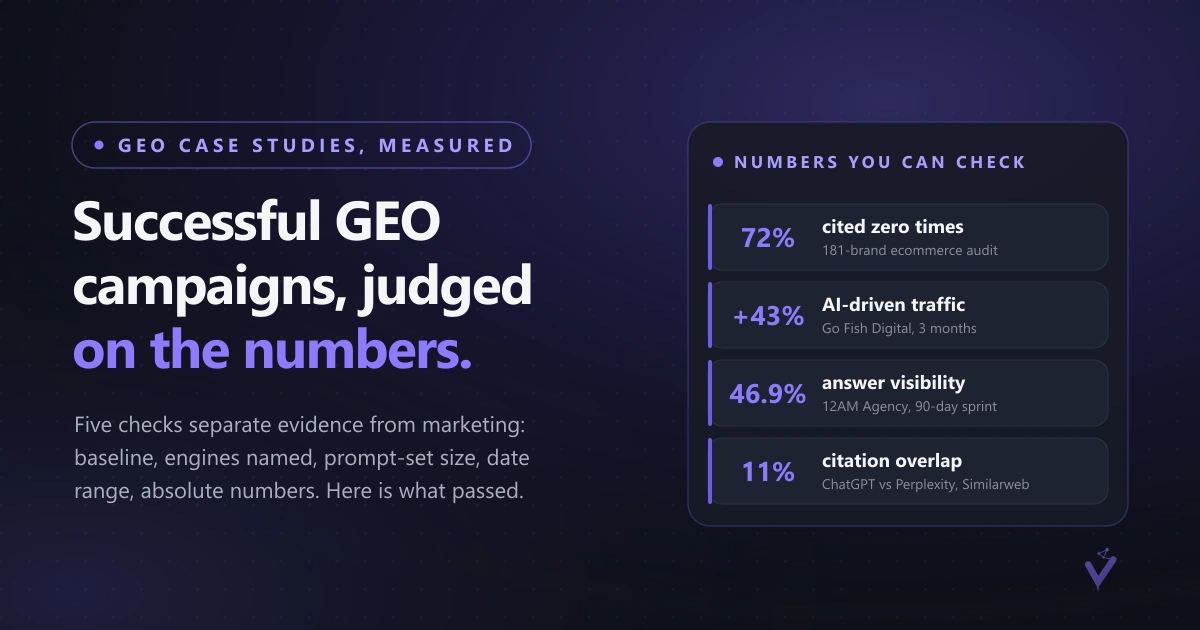
The GEO case studies worth trusting share four things: a stated baseline, a fixed prompt set, per-engine reporting and a dated window. Take any of those away and the headline percentage stops meaning anything. The results that survive scrutiny move AI referral traffic and conversions, not keyword rankings.
The short version: Judge a GEO case study on five things: whether a baseline was recorded before the work started, whether the engines are named, whether the prompt-set size and the date range are given, and whether it shows absolute numbers or only percentages. Across the case studies ranking for this search, almost none show a baseline, a prompt set, or a measurement method.
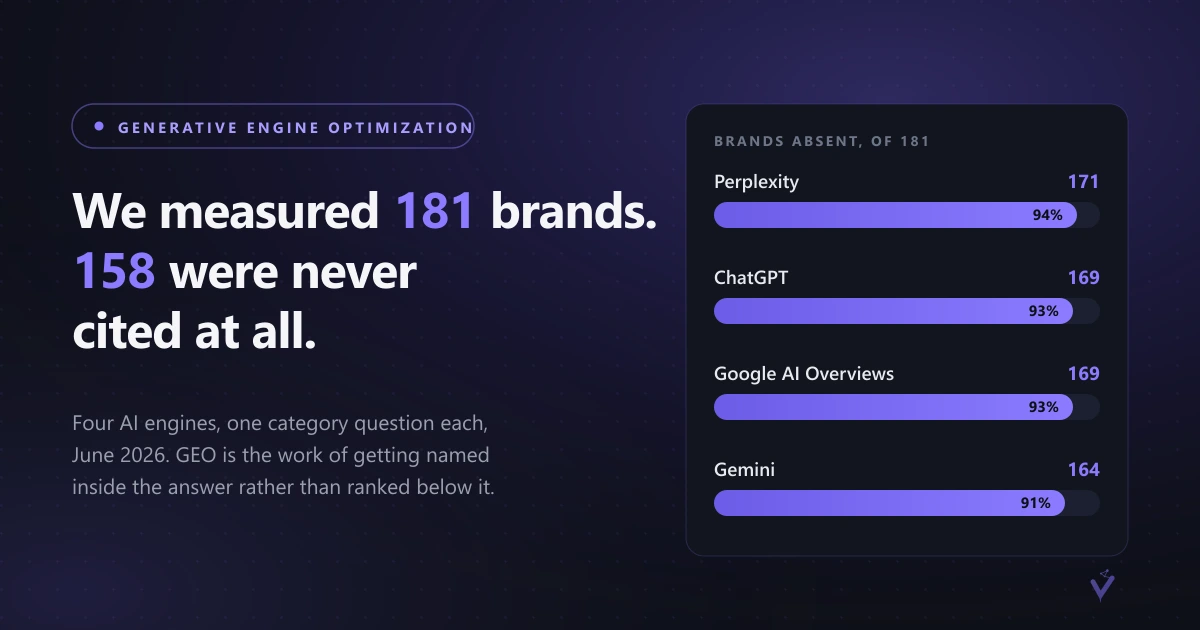
In our audit of 181 ecommerce brands, 87% were cited zero times across four AI engines. That is the starting line. Almost no published case study shows it, which is why a jump from one citation to four can be printed as “+300%” and nobody blinks.
So the buyer is stuck. You cannot tell a real result from a decorated one, and if you cannot tell, you cannot decide whether to spend. Below are the campaigns with numbers that hold up, the arithmetic behind each metric, and a checklist for reading any case study you did not run yourself.
What do successful GEO campaigns case studies actually show?
They show movement in two places: how often AI answers name you, and what the traffic those answers send actually does. Named engines, a dated window and a number you can check. Everything else in a case study is decoration, including the design of the slide it sits on.
Here are the campaigns with published, checkable numbers, and what each one leaves out.
| Campaign | Result | Engines / scope | Window | Source |
|---|---|---|---|---|
| Agency’s own site, lead gen | +43% monthly AI-driven traffic; +83.33% monthly conversions from AI referrals | AI referral traffic in GA4 | 3 months | Go Fish Digital |
| Agency client, brand visibility | AI answer visibility 46.9% on its best prompt (31.1% and 25.5% on two others); 521 referring domains; Austin cluster average position 62.9 to 6.4 | Critical prompt set | 90-day sprint | 12AM Agency |
| 181-brand ecommerce audit | 87% cited zero times, the pre-campaign state | 4 AI engines | Audit snapshot | CiteVantage, first-party |
| Chewy (observation, not a campaign) | 641,000 visits from ChatGPT, 7% of all referral traffic | ChatGPT | 6 months | Similarweb |
That last row is not a case study and we are not going to pretend it is. Nobody published what Chewy did to earn it. It sits in the table because it shows the size of the prize when AI referral traffic compounds at a large retailer, and because AI SEO results in the US are usually reported this way, as an observed number with no method attached.
Look at what the first two rows have that the SERP roundups do not: a window, a scope, and a source you can open for yourself.
The rest is percentages floating in air.
How do you measure GEO success? The metrics to track
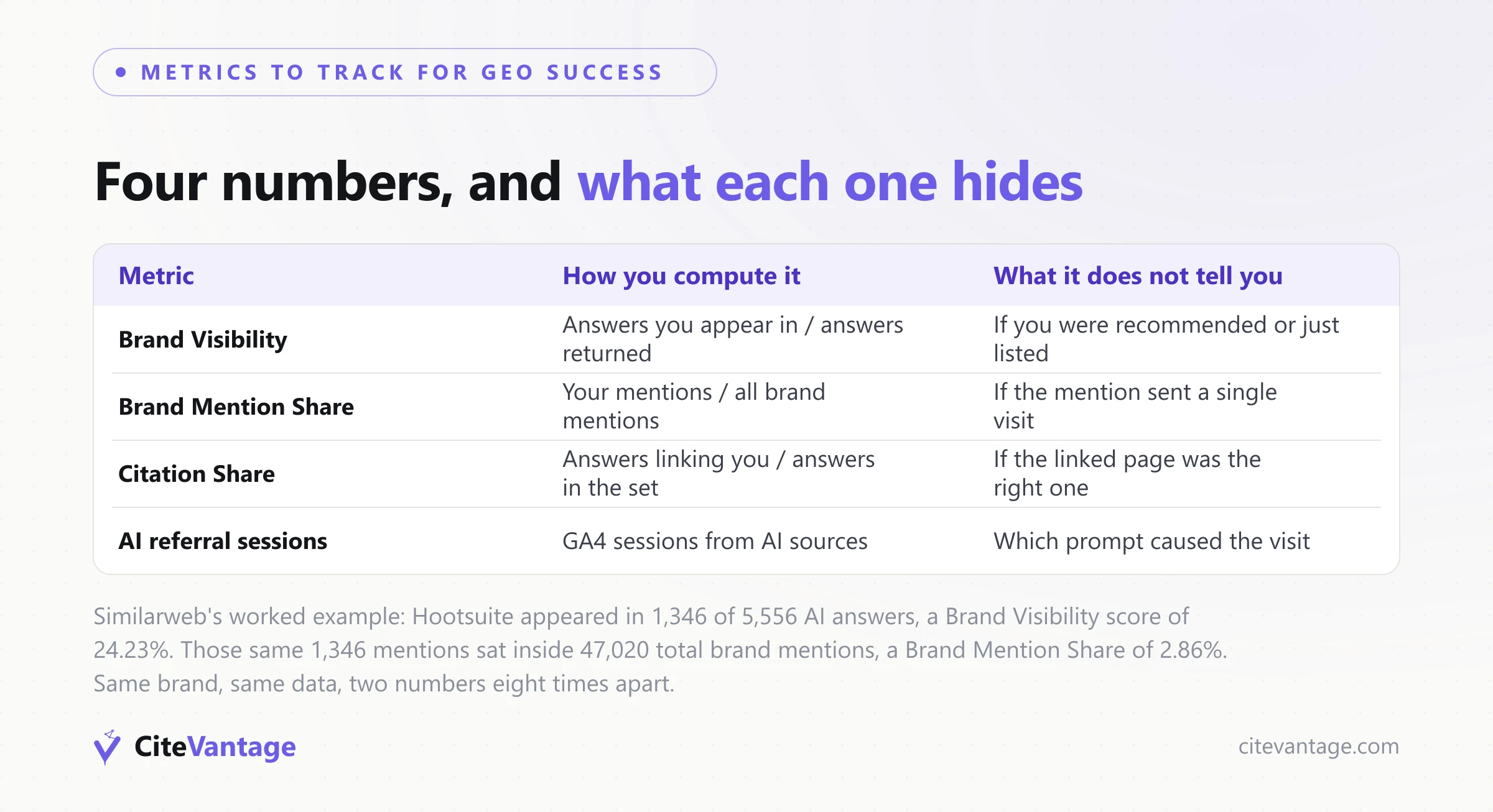
Four numbers carry the weight. Brand Visibility, Brand Mention Share, Citation Share and AI referral sessions with their conversion rate. Everything else is a slice of those four. The trick is not picking the metrics. It is doing the division honestly and saying what each number cannot tell you.
| Metric | How you compute it | What it does not tell you |
|---|---|---|
| Brand Visibility | Answers you appear in, divided by answers returned for your prompt set | Whether you were recommended or just listed |
| Brand Mention Share | Your mentions divided by all brand mentions across those answers | Whether the mention sent a single visit |
| Citation Share | Answers that link your domain, divided by answers in the set | Whether the linked page was the one you wanted cited |
| AI referral sessions | GA4 sessions from AI sources, and their conversion rate | Which prompt or citation caused the visit |
Similarweb publishes a worked example that makes the arithmetic concrete. Hootsuite appeared in 1,346 of 5,556 AI answers, a Brand Visibility score of 24.23%. Those same 1,346 mentions sat inside 47,020 total brand mentions, giving a Brand Mention Share of 2.86%. Same brand. Same data. Two numbers eight times apart, depending on which denominator you use.
Now imagine a vendor picks whichever one flatters the report. That is most of the industry.
If you want to run this yourself before hiring anyone, our walkthrough on how to run an AI visibility audit covers the prompt set, the logging sheet, and the schedule.
Why successful GEO campaigns case studies start with a baseline
Without a documented zero state, a result is a claim. The baseline is the only thing that gives the after number a meaning. It is also the cheapest part of the whole campaign, which makes its absence from most published cases a choice rather than an oversight.
What a baseline actually is
A fixed set of buyer prompts, run on named engines, on a dated day, recorded before any work starts. Fifty to a hundred prompts is the working range. You log whether the answer names you, whether it links you, and which competitors it names instead.
Freeze that set. If the prompts change mid-campaign, the comparison is dead and every chart built on it is decoration.
The industry baseline nobody publishes
We audited 181 ecommerce brands across four AI engines. 87% were cited zero times when AI answered questions about their own product category.
That number explains something uncomfortable about how successful GEO campaigns case studies get written. When the starting point is zero, almost any movement produces a huge percentage. One citation to four reads as +300%. Both numbers are true. Only one is useful.
“I stopped asking agencies what their case study result was. I ask what the number was the week before they started. Most of the time nobody wrote it down.” Abdul Subkhan, Founder of CiteVantage
We publish our own before-and-after work on the CiteVantage case studies hub, and the same rule applies to us. If a page there does not show you the starting state, hold it to the same standard as everyone else’s.
Do all AI engines report the same result?
No. A win in Perplexity is not a win in ChatGPT, and a blended “AI visibility” score is how that gets hidden. One study, cited by Similarweb, found only 11% overlap in citations between ChatGPT and Perplexity. The engines are reading different parts of the web and reaching different conclusions about who to name.
So successful GEO campaigns case studies carry a per-engine scorecard, not a headline. Four columns, one row per engine:
- Engine name, and the date the run happened
- Prompts the brand appeared in, as a count and as a percentage of the set
- Prompts where the brand was cited with a live link
- Competitors named more often than you in that same run
Blend those four engines into one average and a campaign that only moved Perplexity looks like a campaign that moved everything. That is the most common flattering trick in the category, and it is invisible unless you ask for the split.
The fix is boring. Report each engine separately, every time. Our playbooks on getting cited by ChatGPT and getting cited by Perplexity go into why the two engines reward such different work.
One number for four engines is not a measurement. It is an average of four arguments.
How long does GEO take to show results?
The honest answer is a sequence, not a number. Something moves in weeks. The thing you actually want, being named as a default in your category, moves later. Both dated agency campaigns above landed their headline results in roughly three months, which is the realistic end of the range for a focused effort.
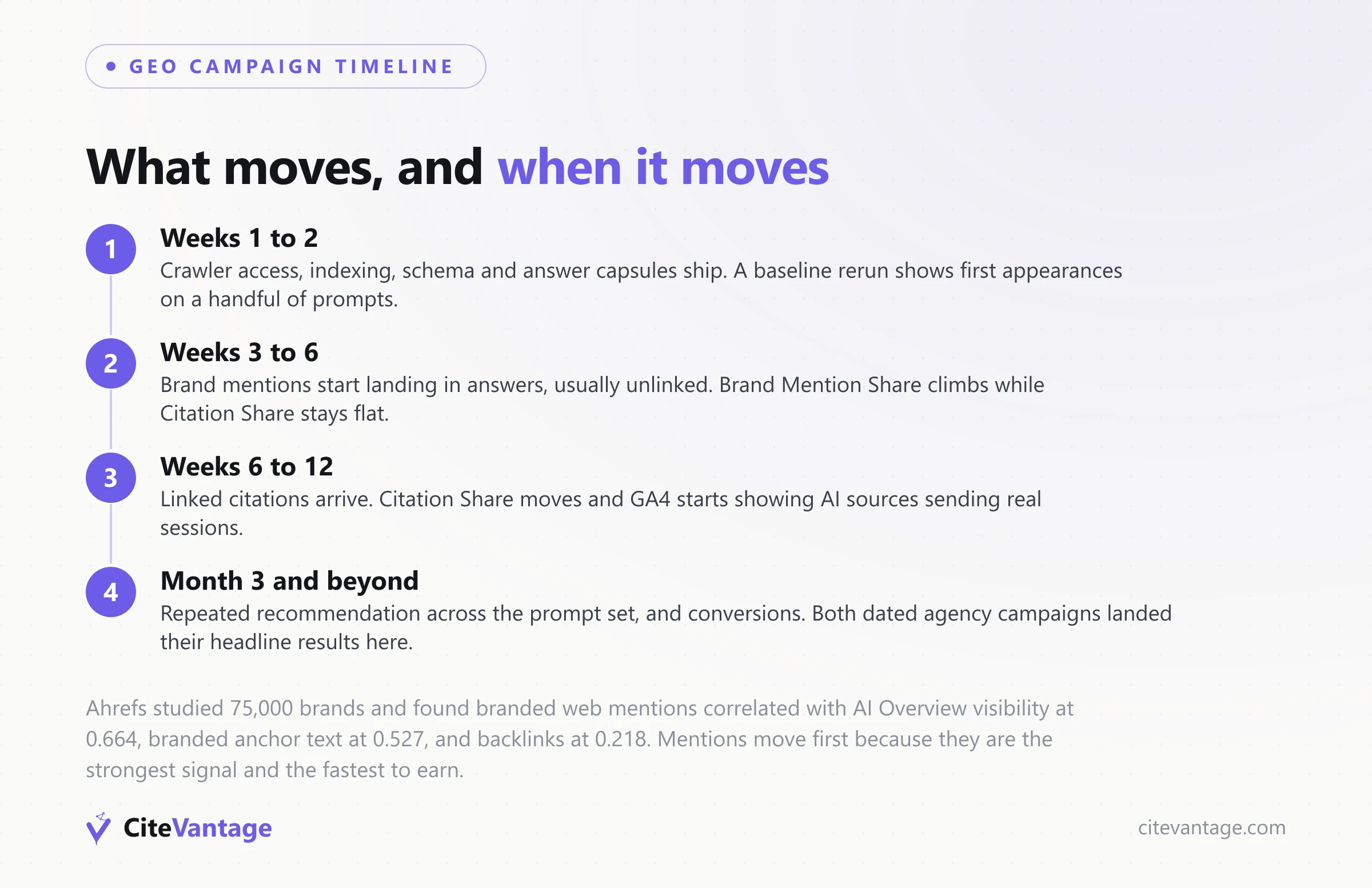
Ahrefs studied 75,000 brands and found branded web mentions correlated with AI Overview visibility at 0.664, branded anchor text at 0.527, and backlinks at 0.218. That ordering explains the sequence below. Mentions move first because they are the strongest signal and the fastest to earn. Link-driven effects trail.
| Window | What typically moves | How you would see it |
|---|---|---|
| Weeks 1 to 2 | Crawler access, indexing, schema, answer capsules shipped | Baseline rerun shows first appearances on a handful of prompts |
| Weeks 3 to 6 | Brand mentions in answers, usually unlinked | Brand Mention Share climbs while Citation Share stays flat |
| Weeks 6 to 12 | Linked citations, AI referral sessions in GA4 | Citation Share moves, GA4 shows AI sources sending real traffic |
| Month 3 and beyond | Repeated recommendation across the prompt set, conversions | Both agency campaigns above reported here, at 3 months and 90 days |
Will anything actually change? That is the fair question, and reassurance is not an answer to it. The two dated windows are. Three months, +43% AI-driven traffic. Ninety days, 46.9% visibility on its best prompt. Those are the numbers to hold a vendor to, with the baseline attached.
Anything faster than that grid is a claim without a window.
How to read GEO case studies you did not run
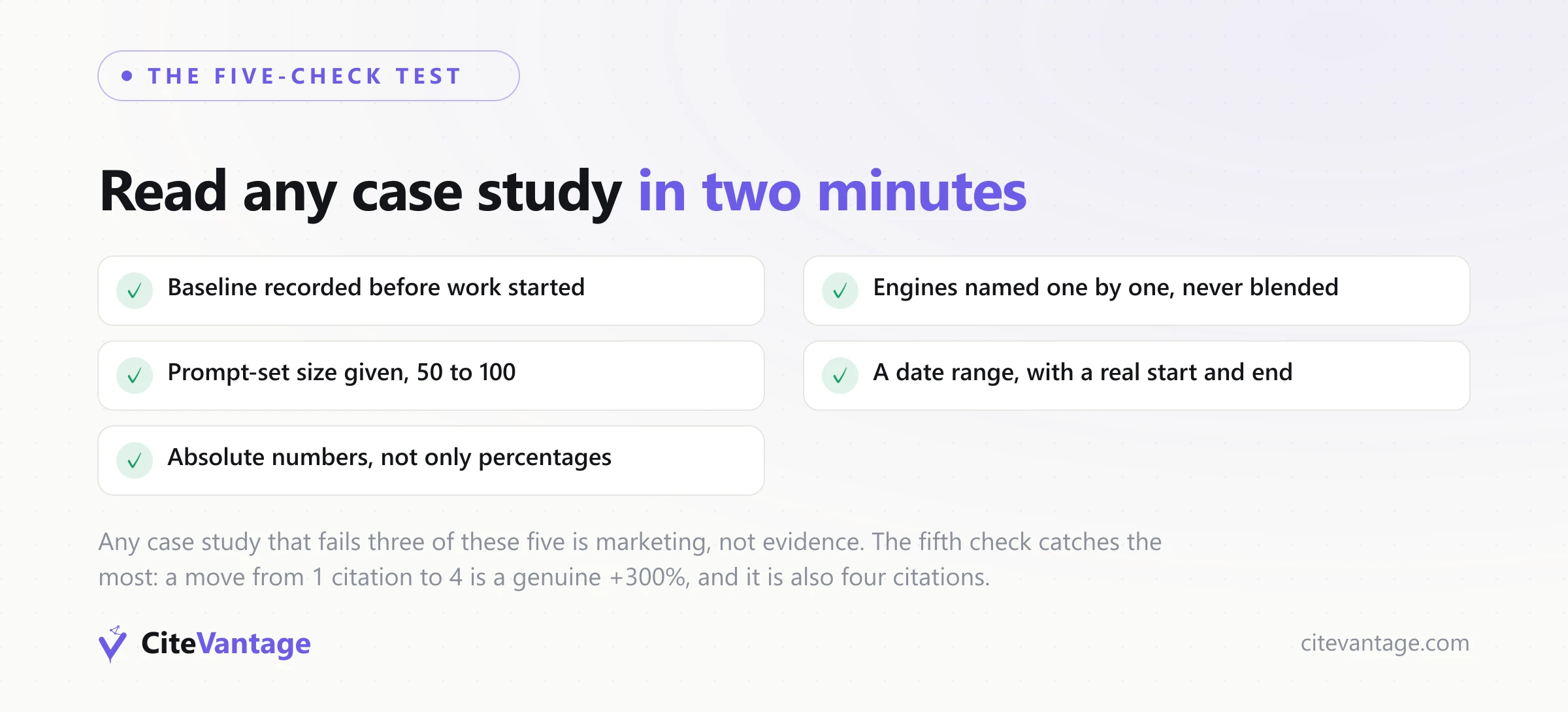
Five checks. Any case study that fails three of them is marketing, not evidence. The checks work on agency decks, vendor docs and the roundup listicles that dominate this search. Two minutes per case, and you do not need access to the underlying data.
- Baseline stated? Look for the number from before the work started, on the same prompt set.
- Engines named? “AI visibility” with no engine list means somebody blended the split.
- Prompt-set size. Fifty prompts and five prompts produce very different percentages.
- A date range, with a start and an end. “Recently” is not a window.
- Absolute numbers, not only percentages. Ask for the counts underneath.
That fifth one catches the most. A move from 1 citation to 4 is a genuine +300%, and it is also four citations. Both facts belong in the report. Only one usually shows up.
This is also where the real objection lives. Are these successful GEO campaigns case studies real, or is generative engine optimization just SEO with a new label? The academic answer came before the agencies did. Aggarwal, Murahari, Rajpurohit, Kalyan, Narasimhan and Deshpande measured the effect directly in “GEO: Generative Engine Optimization” and found the methods can boost visibility by up to 40% in generative engine responses. The mechanism is real. Plenty of the marketing built on top of it is not.
Run the five checks on our table above too. Two rows pass on all five. One row is honestly labeled as an observation. That is the standard we want held against us.
What is a good AI Share of Voice?
There is no universal good number. The same percentage is excellent in one category and mediocre in another, because AI answers surface brands at wildly different rates depending on what is being asked. Any case study quoting a visibility percentage without naming the category is quoting a number you cannot judge.
Promodo’s GEO Benchmarks 2026, published 16 July 2026 on GELIOS data, put hard numbers on the spread.
| Category signal | Figure | What it means for a case study |
|---|---|---|
| Jewelry AI visibility | 79.9% | A 46.9% result here would be below average |
| Logistics and postal services AI visibility | 2.5% | The same 46.9% would be extraordinary |
| Category leaders, share of mentions | 5.1% to 23.2% | Even winners rarely dominate the answer set |
That last row is the one to sit with. Across categories, the leading brand captures somewhere between 5.1% and 23.2% of mentions. So a vendor promising you most of the answer space is promising something the benchmark data says does not happen.
Which brings the 12AM figure back into focus. 46.9% visibility on its best prompt is a strong number, and it stays strong only once you know the category and the size of that prompt set. Ask for both. This is the check almost no roundup of successful GEO campaigns case studies applies, which is why the same percentage gets reused across industries where it means opposite things.
Does GEO traffic convert better than organic?
The evidence says yes, and the gap is wide enough that a small citation win can pay for the work. AI-referred visitors arrive later in the decision, having already been given a shortlist. That changes what the session is worth before anyone lands on your site.
The chain runs in four steps, and this is the part most case studies never connect.
First, you earn a citation on a buyer prompt. Second, a share of the people reading that answer click through, which shows up in GA4 as an AI referral session. Third, those sessions convert at a different rate than organic. Fourth, that rate is what turns a visibility percentage into money.
The numbers on step three and four:
- 4.4x. Semrush research, reported by MarTech, puts the average AI search visitor at 4.4 times the value of an average traditional organic visit.
- 54% better conversion. Adobe Analytics data, via Digital Commerce 360, across more than 1 trillion visits to US retail sites.
- 138% year over year. The growth in AI-referred retail traffic in May 2026, and 1,324% since October 2024, from the same Adobe dataset.
- 25X. In the Go Fish Digital campaign, leads from AI referrals converted at 25 times the rate of leads from traditional search.
Read the fourth bullet with the checklist in mind. It is one site, one category, one window. It is also the most specific conversion figure any agency has published on this, with the traffic numbers next to it.
For real estate agents and brokerages, the practical version of this work sits in our real estate AI visibility service, where the prompt set is built from actual buyer, seller and comparison queries rather than head terms.
Small citation counts producing revenue out of all proportion to them is the whole economic case. For the market-level numbers behind it, our roundup of AI SEO impact ranking statistics for US search dates and sources every figure and names the ones that have already expired.
Get your own baseline before you buy anyone’s case study
Every number above means nothing until you know where you stand. Successful GEO campaigns case studies are somebody else’s baseline. Yours is the Free AI Visibility Audit. We run a fixed prompt set for your category across ChatGPT, Perplexity, Gemini and Copilot, then send the per-engine split: who names you, who links you, who shows up instead.
It is a baseline, not a campaign. It will not fix anything on its own, and it takes a few days because the runs are real. But it gives you the one number every case study you read is missing. Run your Free AI Visibility Audit and start from a documented zero.
Frequently asked questions
How do you track AI citations?
With a frozen set of buyer prompts that you run on each engine on a fixed schedule.
Write 50 to 100 buyer questions and keep them unchanged for the whole campaign, because two runs are only comparable when the prompts match. Tools can automate the running, but the log is what makes the numbers usable later. Record these on every run:
- Whether the answer names you.
- A yes or no on whether it links your domain.
- Competitors it names instead of you.
- The date and the engine.
How many prompts should you track to measure AI visibility?
50 to 100 buyer prompts is the working range for most brands.
Fewer than 50 and one lucky answer swings your whole percentage, while more than 100 gets expensive to rerun every week. The exact number matters less than keeping the set frozen: change the prompts mid-campaign and every before-and-after comparison you publish loses its meaning. Category matters too, since Promodo's GEO Benchmarks 2026 put jewelry at 79.9% AI visibility and logistics at 2.5%, so compare your score only with brands asked the same kind of question.
What is the difference between AI mentions and AI citations?
A mention is your brand name inside the answer text, while a citation is a linked source the engine credits.
Similarweb reports them separately as Brand Mention Share and Citation Share, and the two move independently. You can be named often and linked rarely, which looks like a win in a visibility report and a flat line in analytics. In a typical campaign, unlinked mentions climb first and linked citations with AI referral sessions in GA4 follow weeks later, so report each one on its own line.
Are successful GEO campaigns case studies real, or just SEO rebranded?
Some are real, and a two-minute test separates them from the decorated ones.
The mechanism itself is documented: the arXiv GEO paper by Aggarwal and colleagues measured GEO methods lifting visibility by up to 40% in generative engine responses. Plenty of the marketing built on top of it fails basic checks, so run these five on any published case study:
- A baseline, recorded on the same prompt set before work began.
- Engines named one by one, never blended into a single score.
- Check that the prompt-set size is given.
- A date range with a real start and end.
- Absolute counts should sit next to every percentage.
Can a small brand beat a big one in AI answers?
It can, because in Ahrefs' study of 75,000 brands, mentions tracked AI visibility far more closely than backlinks did.
Branded web mentions correlated with AI Overview visibility at 0.664, against 0.218 for backlinks. A correlation does not prove cause, but it points the work at earning mentions on third-party sites and publishing answer-ready pages, and a smaller brand can do both. That is why a focused GEO campaign built on mentions and answer-ready pages can move faster than the same spend on traditional link building.