The Best AI Mode SEO Analysis Tools, and Which Ones to Skip
By Abdul Subkhan Published Updated
Part of AI SEO, GEO and AEO
Images in this guide are free to reuse (CC BY 4.0). Credit CiteVantage with a link to this page.
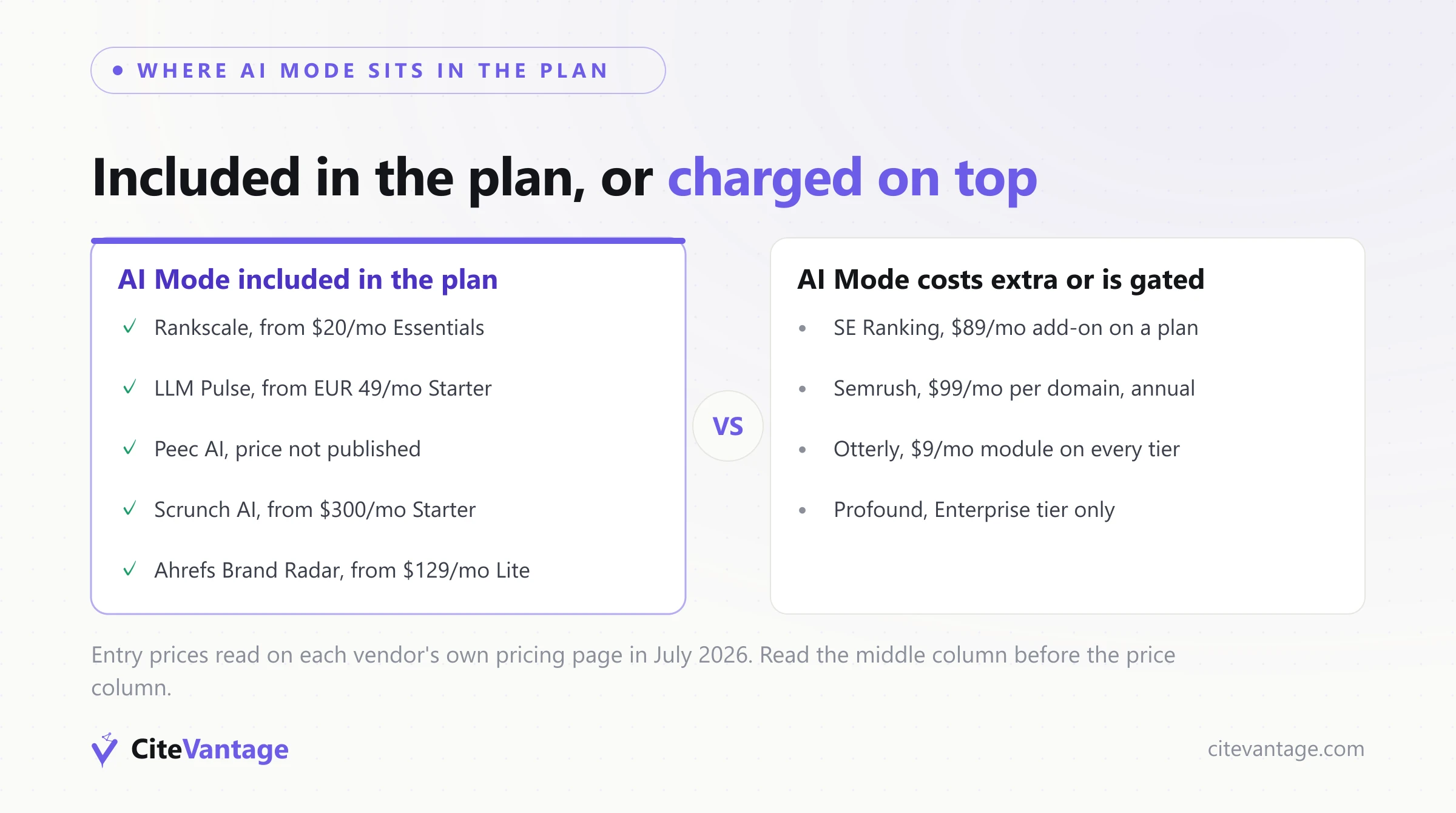
The best AI Mode SEO analysis tools are the ones that query Google AI Mode as its own surface instead of relabeling AI Overviews data. Rankscale, LLM Pulse and Peec AI include it in every paid tier. Semrush, SE Ranking and Otterly sell it as an add-on. Profound keeps it on Enterprise.
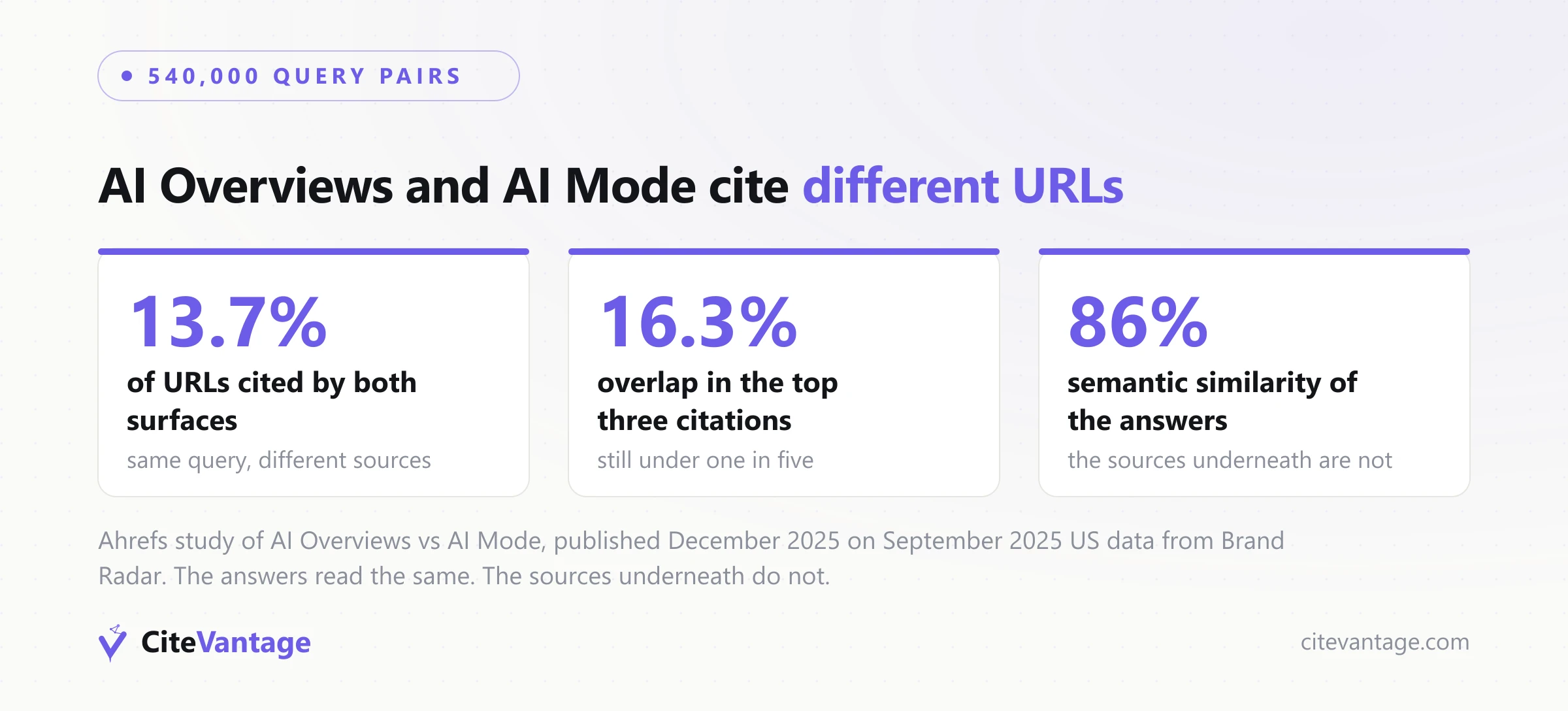
That distinction is the whole budget question, and here is the number that settles it. Ahrefs compared 540,000 AI Overviews and AI Mode query pairs and found the two surfaces cited the same URLs only 13.7% of the time. Narrow it to the top three citations and overlap rises to 16.3%. So if you track AI Overviews and assume AI Mode is covered, you are covered for about one URL in seven.
We buy these tools to run client audits and we sell none of them. Below: the comparison table with prices checked in July 2026, and which tools to skip. Then the free Search Console route with the date corrected, a check that proves a tool is really reading AI Mode, and what to actually spend.
Why do the best AI Mode SEO tracking tools have to be separate from AI Overviews tracking?
Because the two surfaces cite different pages. Ahrefs ran 730,000 query pairs for the content-similarity work and 540,000 for the citation analysis, and found the same URLs cited only 13.7% of the time. Same query. Different sources. An AI Overviews report tells you almost nothing about who AI Mode is naming.
The trap sits in how similar the two answers read. Semantic similarity across those pairs averaged 86%, so a human skimming both would call them the same answer. The sources underneath are not the same. That gap is exactly why a tool can look right and be measuring the wrong thing.
The Ahrefs study, published December 2025 on September 2025 US data from Brand Radar, also measured how differently the two surfaces behave:
- AI Mode responses run roughly 4x longer than AI Overviews
- Entity mentions: 3.3 per response against 1.3
- Wikipedia turns up in 28.9% of AI Mode responses, against 18.1% for AI Overviews
- Only 3% of AI Mode responses carry no citations at all, against 11%
More citation slots, different winners. Matt G. Southern’s write-up at Search Engine Journal reached the same read from the same data.
Which means your AI Overviews optimization work and your AI Mode reporting are two separate lines on the same spreadsheet. Budget them that way.
What are the best AI Mode SEO analysis tools in 2026?
Nine of them, ordered by who each one suits rather than by who pays us, because nobody pays us. The best AI Mode SEO analysis tools on this list all query AI Mode directly. Every price was read on the vendor’s own pricing page in July 2026, and prices here go stale fast.
| Tool | Tracks Google AI Mode | How AI Mode is sold | Other engines in that plan | Entry price (checked July 2026) |
|---|---|---|---|---|
| Rankscale | Yes | Every paid tier | ChatGPT, Perplexity, AI Overviews, Gemini, Claude, Grok, Copilot, DeepSeek, Mistral | $20/mo Essentials, $99/mo Pro |
| LLM Pulse | Yes | Every paid tier | ChatGPT, Perplexity, AI Overviews, Gemini | EUR 49/mo Starter |
| Peec AI | Yes | Every tier | ChatGPT, AI Overviews, Copilot, Perplexity, Gemini | Not published on the pricing page |
| SE Ranking (SE Visible) | Yes | AI Search add-on on top of a plan | AI Overviews, ChatGPT, Perplexity | $89/mo add-on, plus Core from $103.20/mo billed annually |
| Semrush AI Visibility Toolkit | Yes, in Prompt Tracking | Add-on, sold standalone or bolted onto a Semrush plan | ChatGPT Search, Gemini in Prompt Tracking | $99/mo per domain, billed annually |
| Ahrefs Brand Radar | Yes, listed separately from AI Overviews | Included in Ahrefs plans | ChatGPT, Copilot, Gemini, Perplexity, Grok | $129/mo Lite; standalone Brand Radar from $398/mo |
| Otterly | Yes, as a paid add-on | Add-on on every tier | ChatGPT, AI Overviews, Perplexity, Copilot | $29/mo Lite plus $9/mo AI Mode add-on |
| Scrunch AI | Yes | All plans | ChatGPT, Claude, Gemini, Perplexity, AI Overviews, Meta | $300/mo Starter monthly, $250/mo annual |
| Profound | Yes, Enterprise only | Enterprise tier | Starter tracks ChatGPT only; Growth tracks three engines | $99/mo Starter, $399/mo Growth, Enterprise custom |
Read the middle column before the price column. Two tools can both say “AI Mode supported” on the homepage and mean different things at checkout. Profound’s $99 Starter tracks ChatGPT and nothing else, with AI Mode behind an Enterprise conversation. Otterly’s $29 entry looks cheapest until you add the $9 AI Mode module, which every tier charges separately.
A second question the pricing pages rarely answer: how the tool gets the data. A scraping tool renders the AI Mode result the way a browser would, so it sees the citation set Google actually served. An API-only tool queries a model instead of the surface, so it can approximate the answer text but not the real sources behind it. That decides whether a tool can see AI Mode at all. Ask, and get it in writing before the annual plan.
Which AI Mode tracking tools are worth paying for, and who should skip each one?
There is no best tool. There are four buyer situations: you already pay for a large SEO platform, you need coverage across engines beyond Google, you are one brand on a tight budget, or you are an agency proving work across many clients. The right answer changes with which one you are in.
Before the tool blocks, one pointer. We published a five-point checklist of what to demand from any AI tracker before paying, covering prompt source, prompt volume, engines in the base price, exportable logs and a metric definition page. Use that as your buying gate. This section is about fit and about who should walk away.
Rankscale. Widest engine list at the lowest entry point we found, with AI Mode in every paid tier and dashboards priced for agencies at the Growth level. Skip it if you want hand-holding, since the setup assumes you already know which prompts matter.
LLM Pulse. Clean Google-plus-major-LLM coverage from EUR 49, with AI Mode in the Starter tier rather than gated upward. Skip it if you need Claude, Grok or Copilot on the entry plan, because those sit higher up.
SE Ranking’s AI Search add-on, or the Semrush AI Visibility Toolkit. Similar logic, two platforms. If one of them already runs your keyword tracking, $89 or $99 a month bolts AI Mode onto work you already do. Skip SE Ranking’s add-on if you are not already on a Core or Growth plan, because the add-on only sits on top of one. Semrush will sell you the toolkit on its own, but it charges per domain, which stacks fast across a portfolio, and the standalone subscription starts at 25 tracked prompts.
Otterly. The cheapest honest way to start at $29, and the AI Mode module costs $9 more. Skip it if you need more than a mention count, since the depth is thin next to Rankscale or Scrunch.
Profound. Enterprise-grade coverage and reporting once you are on the right plan. Skip it if AI Mode is the reason you are shopping, because AI Mode is not in Starter or Growth.
Note what is missing from those blocks. Accuracy percentages. Several vendors publish their own, including Keyword.com’s 96.86% accuracy figure from its Spyglass Verification system, which comes from the vendor’s own comparison against five other tools. Those are vendor claims, tested by the vendor. We buy tools like these to run client audits, the groundwork behind results such as our Bright Realty case study, and we have never seen a vendor publish the test behind its own accuracy number.
Can you monitor SEO performance in AI search for free in Google Search Console?
Partly, and it is a real option. Google shipped Search Generative AI performance reports in Search Console on June 3, 2026, giving a dedicated view of impressions inside AI Overviews and AI Mode. It is free, it is first-party, and it shows you less than a paid tracker does.
The date matters because several roundups on this topic put it at June 2025 and describe clicks, CTR and average position for AI Mode. Neither is right. Google’s own announcement is dated June 2026, and the report covers impressions grouped by pages, countries, devices and dates, with days, weeks or months as the time granularity. Search Engine Land’s coverage confirms what is absent: no clicks, no click-through rate, no queries, no position.
One caveat before you plan around it. Google is rolling this out to a subset of site owners, starting in the UK, and widened access on June 23. Check your own property before you count on it.
What the free route can never give you:
- Competitor visibility, since Search Console only ever sees your own property
- Prompt-level tracking, because there is no query dimension in the report
- The citation set behind any given AI Mode answer
- Share of voice against the brands you actually lose to
For a single brand starting out, the free report plus a manual weekly check is a legitimate first 90 days. That costs us nothing to say and it costs the vendors on this page a sale.
How do you check that a tracking tool is really reading AI Mode?
You already have the method. It is the audit you would run on your own brand, pointed at the vendor’s report instead of at your rankings. Run your prompt log in AI Mode, pull the tool’s report for the same prompts on the same days, and compare the two citation sets.
Our guide to running an AI visibility audit yourself covers the base method: 15 to 25 buyer prompts, run logged out, repeated on a second day, with every source URL logged. Do that first. Then take five of those prompts and point them at the trial.
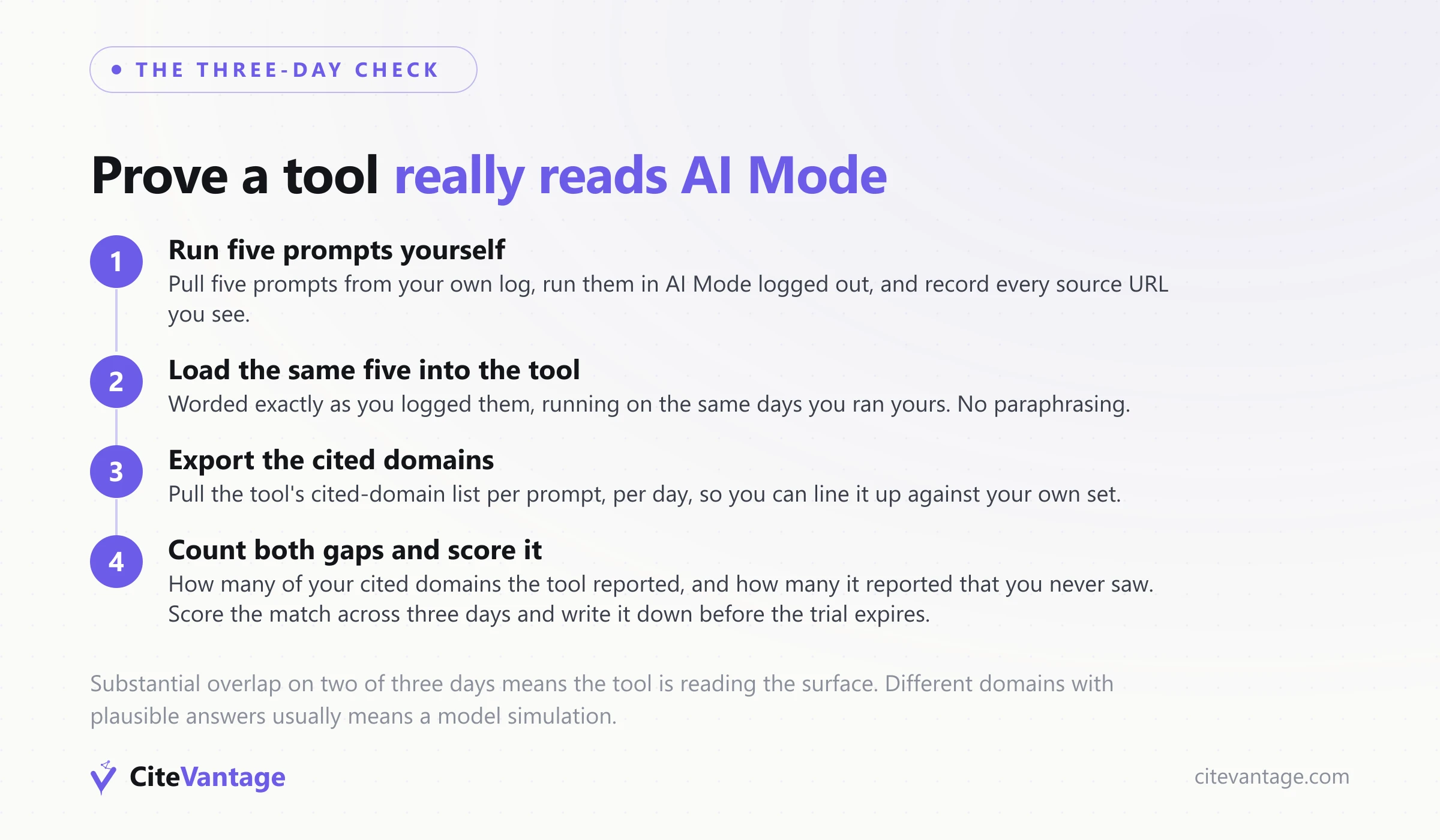
- Load those five prompts into the tool you are trialling, worded exactly as you logged them.
- Export the tool’s cited-domain list, per prompt, per day.
- Line that up against your own logged citation set from the same day, and count two numbers: how many of your cited domains the tool reported, and how many it reported that you never saw.
- Score the match across three days and write it down before the trial expires.
Three outcomes, and they mean different things:
- Substantial overlap on two of three days. The tool is reading the surface.
- Consistently different domains but plausible answers. You are probably looking at a model simulation, or AI Overviews data wearing an AI Mode label.
- Overlap that swings wildly day to day. Read the next section before you blame the tool.
Expect some disagreement even from a good tool. The reason is structural.
Why do two AI Mode tracking tools report different results?
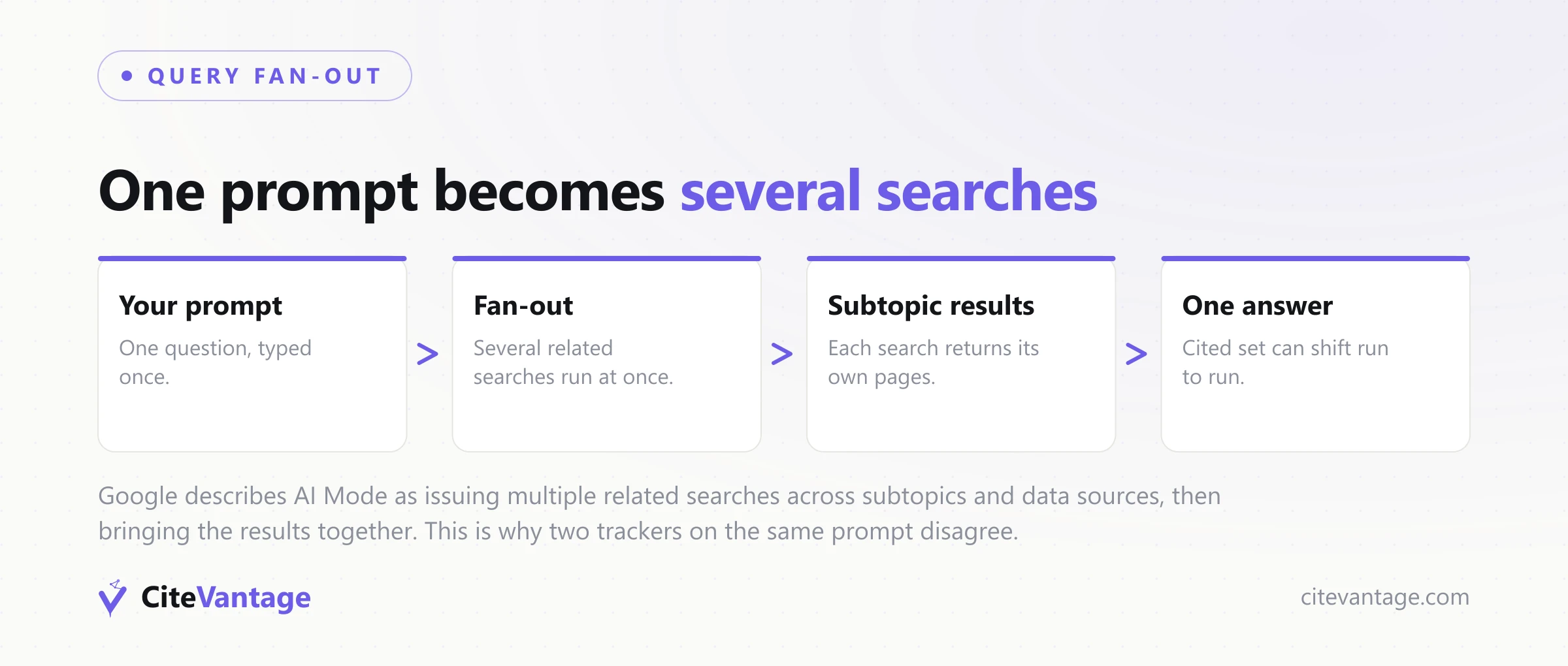
Because the prompt you track is not the query Google runs. AI Mode expands one prompt into several searches before it writes anything, so two tools sampling that process land on different citation sets. You are not tracking a ranking. You are sampling a distribution.
Google calls it query fan-out. In Google’s own description, AI Mode works by “issuing multiple related searches concurrently across subtopics and multiple data sources and then brings those results together.” One prompt in, a handful of searches underneath, one answer out. Change the prompt slightly and the searches underneath change too.
Personalization compounds it. Lily Ray, Vice President of SEO Strategy and Research at Amsive, spot-checked tracking-tool output against the answers she got herself. In comments reported by PPC Land she said “the answers almost never match up, in large part because ChatGPT is personalizing and rewriting the prompts based on what it knows about me.” She was talking about ChatGPT. The same mechanism runs inside AI Mode.
Which is why you read the trend over weeks and keep your prompt set stable. If you want the layer underneath this, how AI decides which brands to recommend covers the selection side of the same problem.
How much should you spend on AI Mode tracking in 2026?
Less than the vendors want and more than zero. Budget for a tracker the way you budget for a smoke alarm, not a growth channel. Two numbers set the range, and almost nobody holds them side by side, because apart they each tell a convenient story.
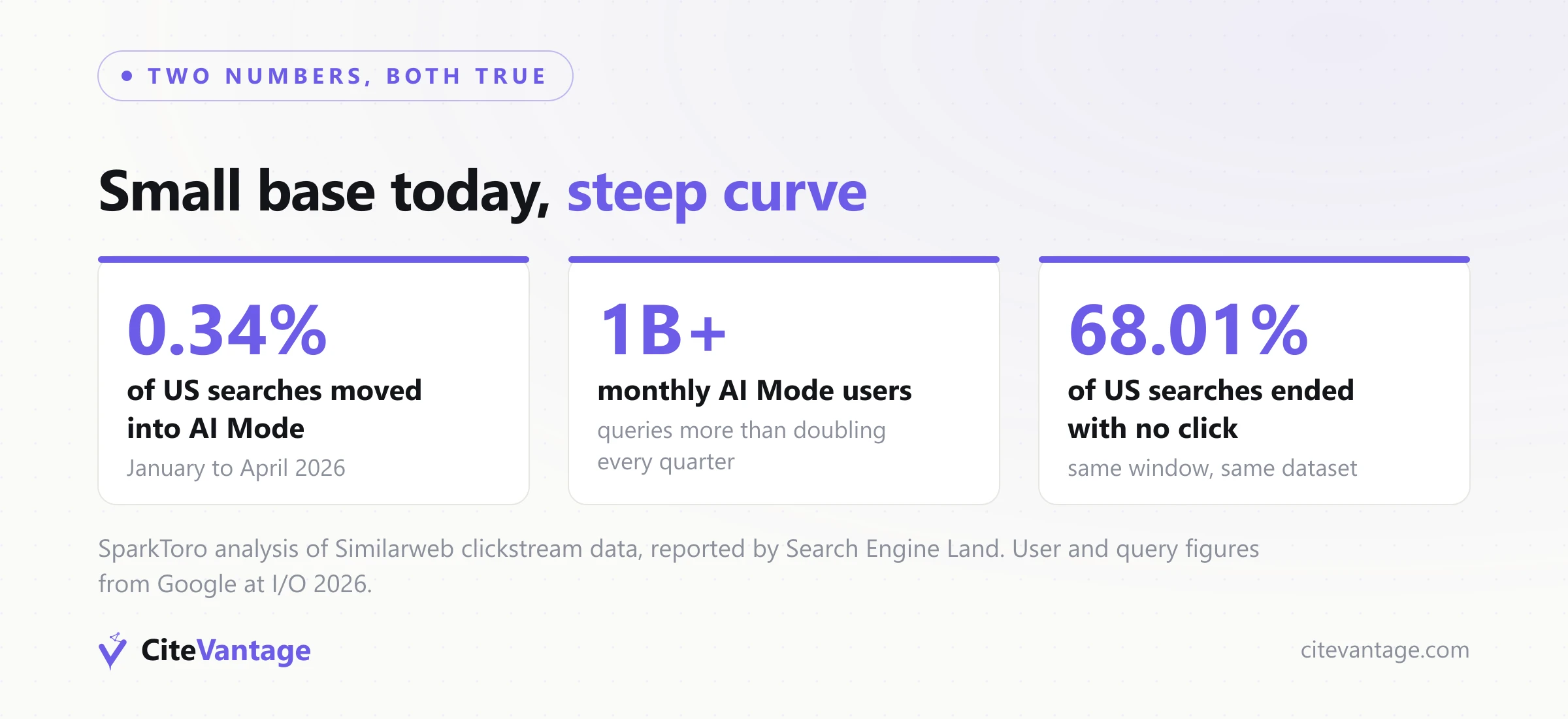
SparkToro’s analysis of Similarweb clickstream data, reported by Search Engine Land, found AI Mode “played only a limited role” in early 2026, with just 0.34% of US Google searches transitioning into it between January and April. Google said at I/O 2026 that AI Mode had surpassed one billion monthly users, with queries more than doubling every quarter since launch.
Both are true. Small base, steep curve. The surface is not where your revenue is today, and the growth rate is why you start measuring now instead of arguing about it in a year.
Same study, wider context: 68.01% of US Google searches ended without a click in that window, and where AI Overviews appeared, on over 20% of searches, click-through rates fell by nearly 60%. The click is leaving. Being named replaces it.
So, tiered and plain:
- A single brokerage or agent team: start with the free Search Console report and a manual weekly check. Move to a paid tool when a real budget decision depends on the number.
- Already paying an SEO retainer: one entry-tier tool at $20 to $99 a month is a rounding error against that retainer, and the trend line is worth it.
- Agency or multi-brand operator: pay for prompt-level exports. You will have to prove the work, and screenshots of a dashboard are not proof.
For real estate brokerages specifically, the tracking line should sit well under what you spend on being citable in the first place. Which is the next problem.
A tracker tells you the score. It does not change the score, and that is a different job with a different budget. When the dashboard finally says nobody mentions you, the fix order matters more than the tool, and we laid that out in our teardown of the AEO tools that track brand mentions. For what the score looks like once that fix work lands, our review of successful GEO campaigns case studies collects the campaigns that published a baseline, a named engine list and a dated window.
AI Mode tracking is one shelf in a bigger aisle, and the shelves price very differently. If you are still deciding which kind of product you need at all, our category map of the most popular AI visibility products for SEO sorts them into five groups and compares them on price per tracked prompt.
Before you commit to any of the best AI Mode SEO tracking tools, get a baseline. We run a free AI Visibility Snapshot: we check the engines for your brand, we send back what we find, and you decide from there whether a paid tracker earns its line in the budget.
Where to start with AI Mode SEO analysis tools
Pick from the table by where AI Mode sits in the plan, not by the headline price. Run the three-day check before the trial ends. The best AI Mode SEO analysis tools are the ones that survive it. Then put the rest of the budget into being the page AI Mode cites, because no tracker does that part for you.
Abdul Subkhan is the Founder of CiteVantage, an AI Citation Visibility agency that gets brands named by ChatGPT, Perplexity, Google AI Mode and AI Overviews. Updated July 2026.
Frequently asked questions
What is the difference between AI Mode tracking and AI Overview tracking?
+
They watch two different surfaces. Ahrefs compared 540,000 query pairs and found AI Overviews and AI Mode cited the same URLs only 13.7% of the time. The best AI Mode SEO tracking tools query AI Mode directly rather than inferring it from AI Overviews data.
Are there free AI Mode tracking tools that give reliable results?
+
One, and it is Google's. The Search Generative AI report in Search Console shows impressions from AI Overviews and AI Mode for free, straight from Google. Free tiers of paid trackers usually sample a handful of prompts once a week, which is too thin to trend.
How do I access AI Mode tracking in Google Search Console?
+
It appears as a Search Generative AI performance view alongside your normal Search report. Google announced it on June 3, 2026, starting with a subset of site owners in the UK, then widened access on June 23. Not June 2025, which several tool roundups still claim.
What is the average cost of AI visibility tracking tools in 2026?
+
There is no honest average. Entry pricing we checked in July 2026 ran from $20 a month for a solo dashboard to $399 a month for a mid-tier platform seat. The single industry-average figure circulating on this topic comes from one vendor's own analysis, so we do not repeat it.
How often do cited sources change in Google AI Mode responses?
+
Often enough that a single reading means little. Query fan-out turns one prompt into several searches, and personalization rewrites what gets asked, so the cited set shifts between runs and sometimes inside the same day. Read a stable prompt set over weeks instead.
What is the difference between scraping-based and API-based AI Mode tracking tools?
+
What they can see. A scraping tool renders the AI Mode result the way a browser does, so it captures the citation set Google actually served. An API-only tool queries a model instead, which can approximate the answer text but not the real sources.
More in AI SEO, GEO and AEO
- Domains AI Cites on Real Estate: The Open List
- Hostinger CDN Blocks GPTBot: HTTP 429 Case Study
- AI Search Statistics 2026: Sourced and Dated
- AI Tools for SEO and AEO: Track ChatGPT Mentions
- Best AI SEO Agencies 2026: 15 Firms Ranked
- Can AI Crawlers Reach Your Site? How to Check
- GEO Case Studies: Successful Campaigns
- GEO vs SEO vs AEO: The Real Difference in 2026
- Generative Engine Optimization: GEO and AEO Guide
- Google Preferred Sources: Myths, Broken
- How to Check if ChatGPT Recommends Your Brand
- How to Get Cited by ChatGPT: 2026 Playbook
- How to Get Cited by Google Gemini
- How to Get Cited by Perplexity: 9 Source Signals
- How to Rank in Google AI Overviews: 2026 Guide
- How to Run an AI Visibility Audit Step by Step
- How to Track Competitors in AI Search Results
- Most Popular AI Visibility Tools for SEO
- SEO and GEO Strategy: Make Them Work Together
- Schema Markup for AI Search: Types That Matter
- What Is llms.txt? Complete Setup Guide
Start from the hub: AI SEO, GEO and AEO
See where AI is hiding your brand
Free multi-engine audit across ChatGPT, Gemini, Google AI & Perplexity.
See who AI names instead of me