How to Get Cited by Google Gemini: What Actually Works
By Abdul Subkhan Published
Part of AI SEO, GEO and AEO
Images in this guide are free to reuse (CC BY 4.0). Credit CiteVantage with a link to this page.
How to get cited by Google Gemini starts with the boring part: Gemini grounds its answers on the Google Search index, so indexed and snippet-eligible is the entry ticket. Then the surprising part: 52.15% of Gemini citations come from brand-owned websites, per Yext. Fix your own pages first. Earned mentions compound from there.
We audited 181 ecommerce brands and found 87% were cited zero times across four AI engines. That invisibility is the problem this guide fixes, for Gemini specifically. And the audience is not small. The Gemini app passed 750 million monthly active users, disclosed in Sundar Pichai’s prepared remarks for Alphabet’s Q4 2025 earnings call and reported by TechCrunch in February 2026. AI Overviews, the Gemini-powered layer inside Google Search, reaches more than 2 billion monthly users per Alphabet’s Q2 2025 earnings call.
How does Gemini select citations?
Gemini uses grounding with Google Search. It takes your prompt, fans it out into several related search queries, retrieves indexed pages, and cites the ones it pulls the answer from. Retrieval runs on ordinary Google rankings. Citation depends on whether your page hands the model a clean, extractable answer.
That grounding step is why every Gemini playbook starts with SEO fundamentals. The model is not browsing some private library. It is searching Google, same as your customers, and it can only cite what the index contains.
One complication. “Gemini” is really three surfaces, and they behave differently.
The Gemini app is the standalone assistant at gemini.google.com and on mobile. It decides per prompt whether to ground with search, and when it does, it lists the pages it drew from.
AI Overviews is the AI summary at the top of normal Google results. It generates an answer from retrieved pages and links its sources inline. This is the surface with 2 billion-plus monthly users, and we break it down in the Google AI Overviews playbook.
AI Mode is the newer conversational search tab inside Google. It runs a heavier query fan-out than a standard search, which means it retrieves a wider net of pages per question than a single ranking would suggest.
The practical consequence is plain. Everything that helps you rank helps you get retrieved. But retrieval is not citation. Two pages can both be pulled for the same prompt, and the one with a direct, quotable answer under a question-shaped heading gets named while the other feeds background. Structure decides the second step.
Why do brand citations in Gemini favor your own website?
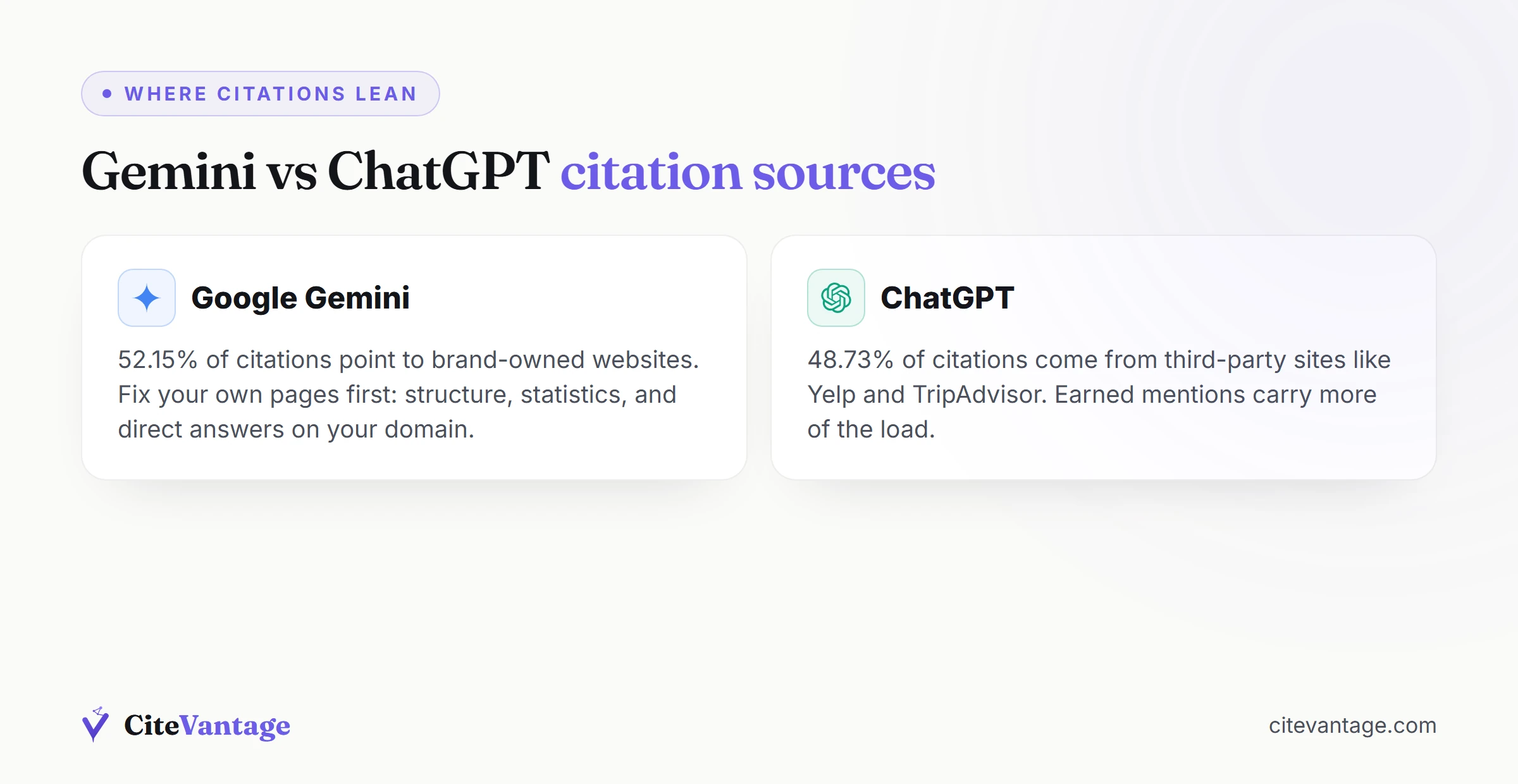
52.15% of Gemini citations point to brand-owned websites, per Yext’s analysis of 6.8 million citations across Gemini, ChatGPT, and Perplexity. ChatGPT leans the other way, pulling 48.73% of its citations from third-party sites. On Gemini, the pages you control are the main event, not the warm-up.
That finding comes from Yext’s October 2025 analysis of 6.8 million citations across 1.6 million AI responses, and it is the strategic spine of this whole article. Yext’s own read: Gemini “acts more like a traditional search engine” and rewards structured, factual content on the brand’s own domain.
Here is the same split as a planning table.
| Engine | Where its citations lean | What that means for you |
|---|---|---|
| Google Gemini | 52.15% from brand-owned websites | Fix your own pages first. Structure, statistics, direct answers on your domain. |
| ChatGPT | 48.73% from third-party sites (Yelp, TripAdvisor, MapQuest) | Earned mentions on other people’s sites carry more of the load. |
Source: Yext analysis of 6.8 million citations, October 2025.
The contrast matters for budget. On ChatGPT you chase mentions on sites the model already trusts, which is slow and partly out of your hands. We wrote up that whole approach in our ChatGPT citation playbook. On Gemini the first and biggest wins are edits you can ship this week, on pages nobody can take away from you. Own pages first. Earned media second, as the compounding layer.
One more thing from our own audit work. Authority is weaker than people assume. In our ongoing multi-engine citation audits we have watched DA-10 sites beat DA-90 sites inside ChatGPT answers. Domain strength helps you rank, and ranking helps retrieval. But once pages are retrieved, structure on your own domain is doing real work that a backlink profile cannot do for you.
What does Google say you need, and what does the data actually show?
Google’s official line is that you need nothing beyond an indexed, snippet-eligible page. The citation data says structure still moves the odds: adding statistics, quotations, and named sources lifted generative-engine visibility by up to 40% in Princeton’s GEO study. Both things are true: Google sets the floor and the data shows the edge.
No ranking guide we found reconciles these two honestly, so here it is.
What Google officially says
Google Search Central’s “AI Features and Your Website” documentation, together with its May 2026 guide to optimizing for generative AI features, is blunt. To appear in AI Overviews or AI Mode, a page only needs to be indexed and eligible for a snippet, with “no additional requirements.” Google says you do not need “new machine readable files, AI text files, markup or Markdown,” which means Google ignores llms.txt for its AI features. And structured data “isn’t required for generative AI search.”
Take Google at its word on the floor. Nothing extra is required to be eligible.
What the citation data shows
Eligible and cited are different outcomes. Three verified findings show what separates them.
- The Princeton GEO study (Aggarwal et al., KDD 2024) tested content changes against generative engines and found that adding citations, quotations, and statistics can lift visibility in AI responses by up to 40%. Same information, restructured, measurably more visible.
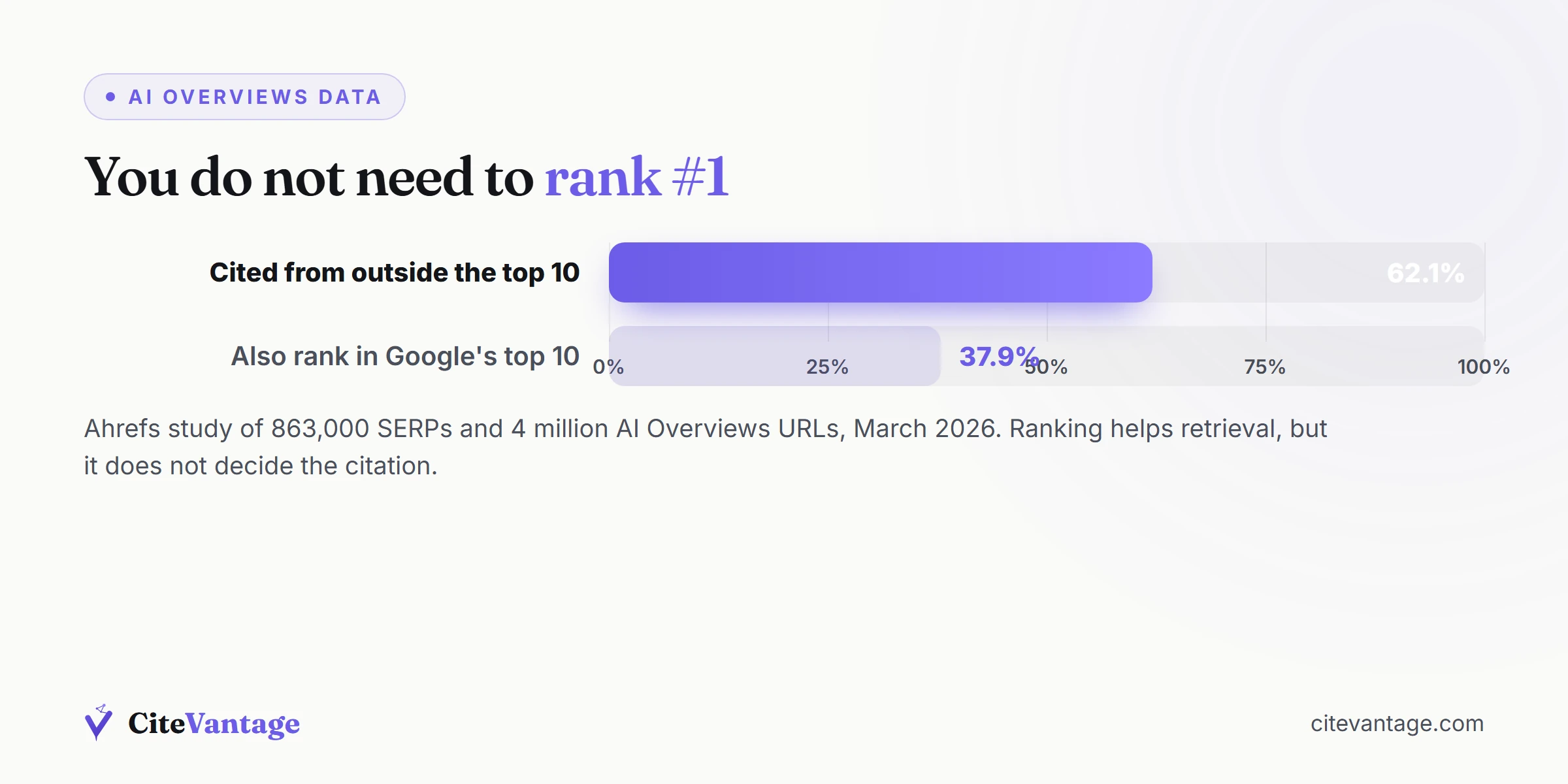
- Ranking helps but does not decide it. Ahrefs studied 863,000 SERPs and 4 million AI Overviews URLs in March 2026 and found only 37.9% of cited pages also rank in the top 10. About 62% of citations come from outside it. Correlated, not identical.
- Freshness is not the lever people think it is, at least not here. Across 17 million citations on 7 platforms, Ahrefs found AI assistants cite content 25.7% fresher than organic results on average, but Google’s AI Overviews actually cite slightly older content, around 16 days older. Accuracy and structure age better than constant re-dating.
| Google says | The data shows |
|---|---|
| Indexed + snippet-eligible, “no additional requirements” | Statistics, quotes and named sources lift visibility up to 40% (Princeton, KDD 2024) |
| Structured data “isn’t required for generative AI search” | Structure still decides which retrieved page gets quoted; 62% of AIO citations rank outside the top 10 (Ahrefs) |
| No new files needed; llms.txt is ignored | True for Google. Other engines are a separate question. |
Now the correction most guides get wrong. Google-Extended does not gate AI Overviews. Per Google’s own crawler documentation, Google-Extended controls whether crawled content “may be used for training future generations of Gemini models” and for grounding in Gemini Apps and Vertex AI. Google states it “does not impact a site’s inclusion in Google Search nor is it used as a ranking signal in Google Search.” Plenty of guides tell readers to allow Google-Extended to get into AI Overviews. That is not what the control does. Allowing it affects model training and Gemini app grounding, not your AI Overviews eligibility, which rides on normal indexing.
And the llms.txt nuance in one paragraph: for Gemini, skip it, because Google has said plainly it is ignored. Other engines treat the file differently, and it costs almost nothing to publish, so the decision is engine-specific. We covered what llms.txt actually does and which engines read it separately.
How to get cited by Google Gemini: the seven moves that matter
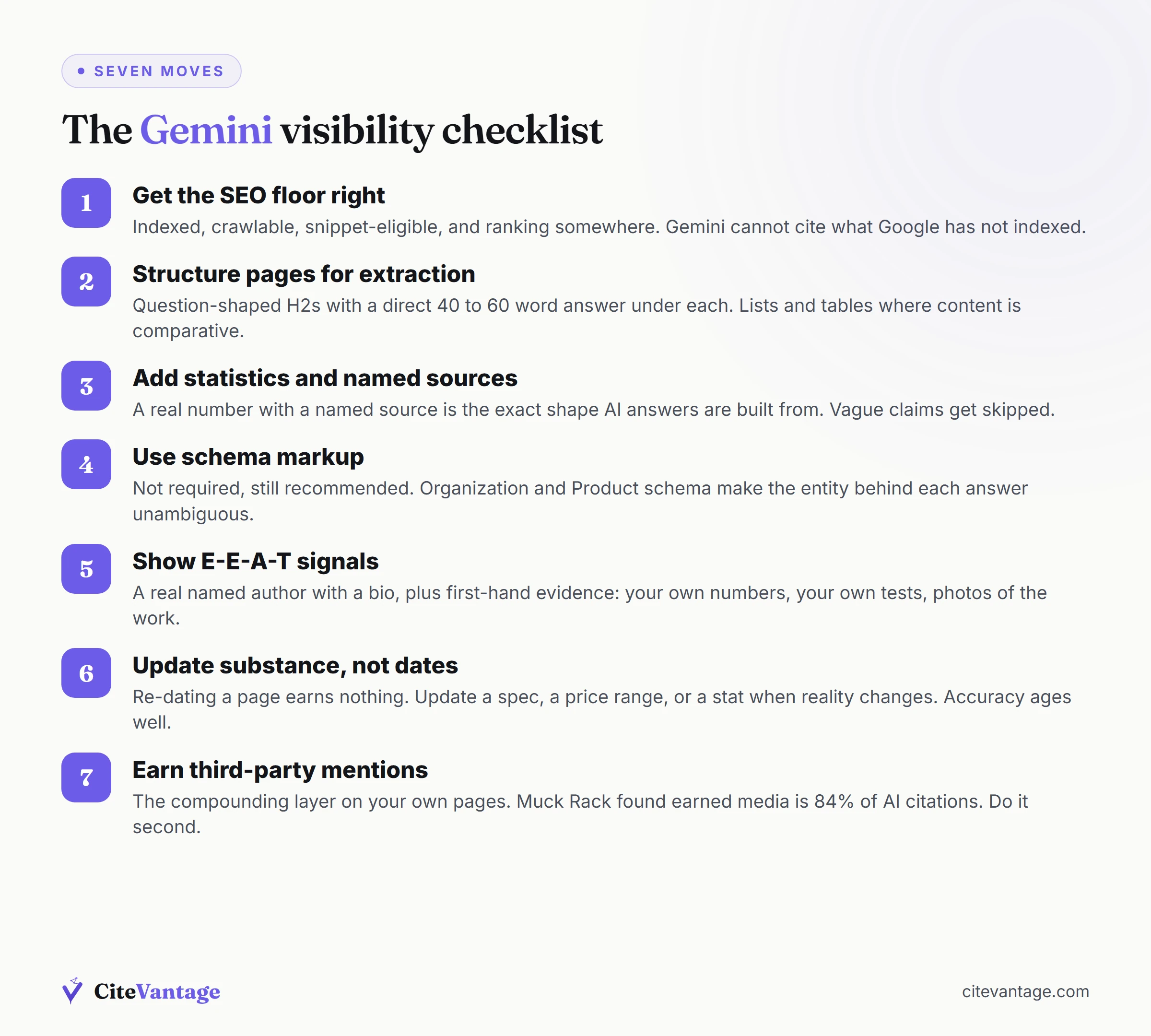
Seven moves raise your odds: get the SEO floor right, structure pages for extraction, add statistics and named sources, use schema, show real authorship, update substance rather than dates, and earn third-party mentions. None of them require new tools. All of them can start this week.
This is generative engine optimization applied to one engine. In order of sequence, not importance:
1. Get the SEO floor right. Indexed, crawlable and snippet-eligible, and ranking somewhere for the questions you want to be cited on. Gemini cannot cite what Google has not indexed. Check Search Console for coverage problems before touching anything else. If your money pages are not in the index, that is the whole to-do list for now.
2. Structure pages for extraction. Question-shaped H2s that match what buyers actually ask. A direct 40 to 60 word answer under each one. Lists and tables wherever the content is comparative. The goal is a block the model can quote without editing. If a screenshot of the block answers the question completely, it is extraction-ready.
3. Add statistics, named sources and quotable lines. The Princeton finding from the last section is the evidence. A sentence with a real number and a named source is the exact shape AI answers are built from. Vague claims get skipped. “Fast shipping” is filler. “Orders ship within 24 hours, tracked” is quotable.
4. Use schema markup. Google says it is not required for generative AI search, and we position it the same way: not required, still recommended. Organization schema disambiguates who you are. Product schema disambiguates what you sell and for how much. Clean entities are easier to attribute, and attribution is the citation.
5. Show E-E-A-T signals. A real named author with a bio. First-hand evidence inside the content itself: your own numbers, your own tests, photos of the actual work. Gemini retrieves from an index Google built around these signals, so pages that demonstrate experience get retrieved for more queries in the first place.
6. Keep facts current, but update substance, not dates. Remember the Ahrefs freshness pair: AI Overviews cite slightly older content on average. Re-dating a page without changing it earns nothing. Updating a spec, a price range or a stat when reality changes keeps the page accurate, and accuracy is what actually ages well on Google surfaces.
7. Earn third-party mentions. Muck Rack’s May 2026 Generative Pulse, built on 25 million-plus links from AI responses, found earned media accounts for 84% of all AI citations, journalism alone 27%, and paid placements just 0.3%. On Gemini this is the compounding layer on top of your own pages, not the starting point. Do it second. Do it anyway.
What works for ecommerce brands specifically?
Most ecommerce brands start from zero. In our audit of 181 ecommerce brands, 87% were cited zero times across four AI engines. Bad news for the category, good news for you, because on Gemini the fastest fixes sit on pages you already own, and almost nobody in your niche has made them.
Starting from zero means the own-domain work above produces visible movement fast. There is no incumbent to displace on most product queries. The answer slot is simply empty.
What the seven steps look like on a store:
- Product pages with spec tables instead of spec paragraphs. A table row is the most extractable format you can publish.
- Honest comparison pages. “X vs Y” and “best A for B” pages that name competitors and state trade-offs plainly are exactly the shape buying-intent prompts take in Gemini.
- Collection pages that answer buying questions in prose up top, not just a grid of products under a one-line heading.
- Product schema with price and availability, so the entity behind each answer is unambiguous.
This is our lane. Our RIPT Apparel case study shows what the on-domain rebuild looks like on a real store, and our ecommerce AI visibility service is the done-for-you version of everything in this guide.
How to tell if you are cited in Gemini, and how to track it every month
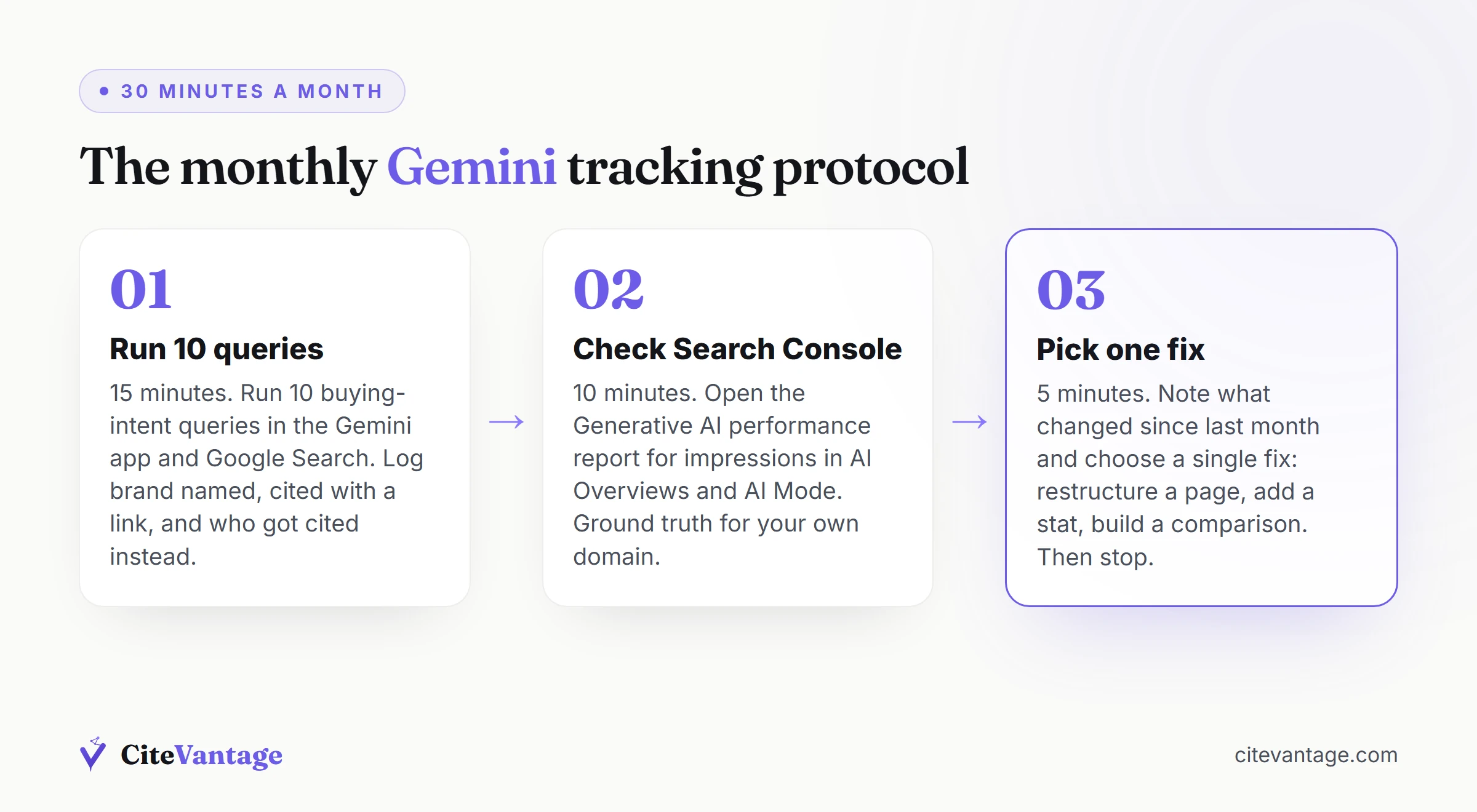
Thirty minutes a month covers it. Run a fixed set of 10 buying-intent queries in the Gemini app and in Google Search, log who gets named, then check Search Console’s Generative AI performance report for impressions from AI experiences. Same queries every month, or the trend data is noise.
Step 1, 15 minutes. Write down 10 queries your customers actually ask when they are close to buying. Not vanity queries about your brand name. Real ones, like “best breathable work shirts for summer” if that is what you sell. Run each in the Gemini app and in Google Search to catch AI Overviews. Log three things per query: brand named yes or no, cited with a link yes or no, and who got cited instead. The competitors column becomes your mention target list later.
Step 2, 10 minutes. Open Search Console’s Generative AI performance report. It shows how many times your pages appeared in AI Overviews and AI Mode. The first version reports impressions only, no clicks yet, and Google is rolling it out to a subset of sites first, so if your property does not have it yet, check back. It is still the closest thing to ground truth for your own domain, and it costs nothing.
Step 3, 5 minutes. Note what changed since last month and pick one fix. One. A page to restructure, a stat to add, a comparison page to build. Then stop until next month.
We run this exact protocol on citevantage.com, our own client #1, as part of the citation sprint on our own site. Same 10 queries, same log, every month. It is unglamorous and it works, mostly because the discipline of a fixed query set is what turns anecdotes into a trend line.
Set expectations accordingly. Movement typically shows over weeks, not days, and we will not quote a precise timeline because we have not verified one.
If you would rather have the baseline done for you, our free AI Visibility Snapshot checks where your brand stands across Gemini and the other major engines before you spend a single hour on fixes.
Frequently asked questions
Does Google Gemini use a separate index?
+
No. Gemini grounds its answers with Google Search, which means it retrieves from the same index Googlebot has always built. There is no second index to submit to and no separate crawler application to file. If a page is not indexed and eligible for a snippet in regular Google Search, Gemini cannot cite it. Indexing is the floor everything else stands on.
Do backlinks still matter for Gemini?
+
Yes, in two ways. Links still feed the rankings that decide what Gemini retrieves, and mentions on other sites build the trust layer: Muck Rack's May 2026 analysis of 25 million AI-cited links found 84% of AI citations are earned media. But on Gemini your own domain carries unusual weight, so fix your own pages before chasing links.
How long does it take to get cited in Google Gemini?
+
No verified benchmark exists, and anyone quoting an exact number is guessing. It depends on where you start: an indexed site with real rankings can see movement in weeks, a site with crawl problems takes longer. In our own work the honest answer is weeks, not days, measured with the same query set every month.
Is optimizing for Google Gemini worth it?
+
The audience says yes. The Gemini app passed 750 million monthly active users per Alphabet's Q4 2025 remarks, and AI Overviews reach over 2 billion monthly users. Meanwhile most brands are absent: in our audit of 181 ecommerce brands, 87% were cited zero times across four AI engines. Empty field, large audience.
What type of content works best in Gemini?
+
Structured, factual pages on your own domain. Question-shaped headings with a direct 40 to 60 word answer under each, statistics with named sources, and comparison tables where the content is comparative. Yext's 6.8-million-citation study found Gemini favors brand-owned sites more than ChatGPT or Perplexity do, so extraction-friendly pages you control are the highest-return work.
More in AI SEO, GEO and AEO
- Domains AI Cites on Real Estate: The Open List
- Hostinger CDN Blocks GPTBot: HTTP 429 Case Study
- AI Search Statistics 2026: Sourced and Dated
- AI Tools for SEO and AEO: Track ChatGPT Mentions
- Best AI Mode SEO Analysis Tools for 2026
- Best AI SEO Agencies 2026: 15 Firms Ranked
- Can AI Crawlers Reach Your Site? How to Check
- GEO Case Studies: Successful Campaigns
- GEO vs SEO vs AEO: The Real Difference in 2026
- Generative Engine Optimization: GEO and AEO Guide
- Google Preferred Sources: Myths, Broken
- How to Check if ChatGPT Recommends Your Brand
- How to Get Cited by ChatGPT: 2026 Playbook
- How to Get Cited by Perplexity: 9 Source Signals
- How to Rank in Google AI Overviews: 2026 Guide
- How to Run an AI Visibility Audit Step by Step
- How to Track Competitors in AI Search Results
- Most Popular AI Visibility Tools for SEO
- SEO and GEO Strategy: Make Them Work Together
- Schema Markup for AI Search: Types That Matter
- What Is llms.txt? Complete Setup Guide
Start from the hub: AI SEO, GEO and AEO
See where AI is hiding your brand
Free multi-engine audit across ChatGPT, Gemini, Google AI & Perplexity.
See who AI names instead of me