The Most Popular AI Visibility Tools for SEO, Ranked
By Abdul Subkhan Published Updated
Part of AI SEO, GEO and AEO
Images in this guide are free to reuse (CC BY 4.0). Credit CiteVantage with a link to this page.
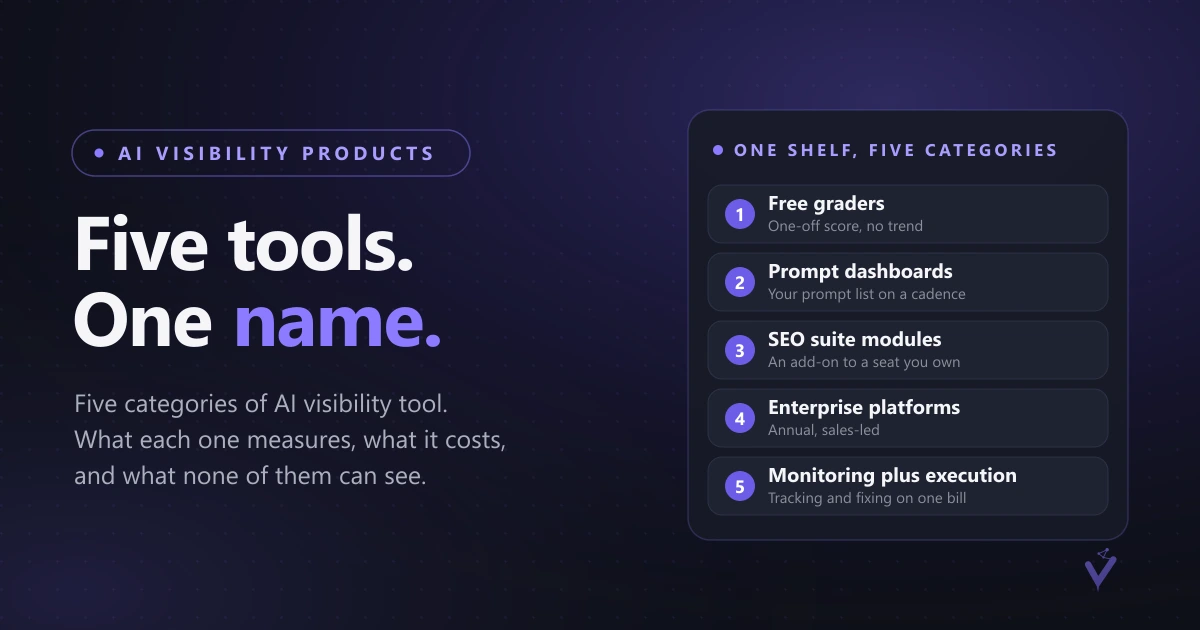
The most popular AI visibility products for SEO are not one kind of tool. They are five: free graders, prompt-monitoring dashboards, AI modules bolted onto the SEO suite you already pay for, enterprise answer-engine platforms, and monitoring-plus-execution platforms. Each measures a different thing. Each prices differently. Buying the wrong category is the most common way this money gets wasted.
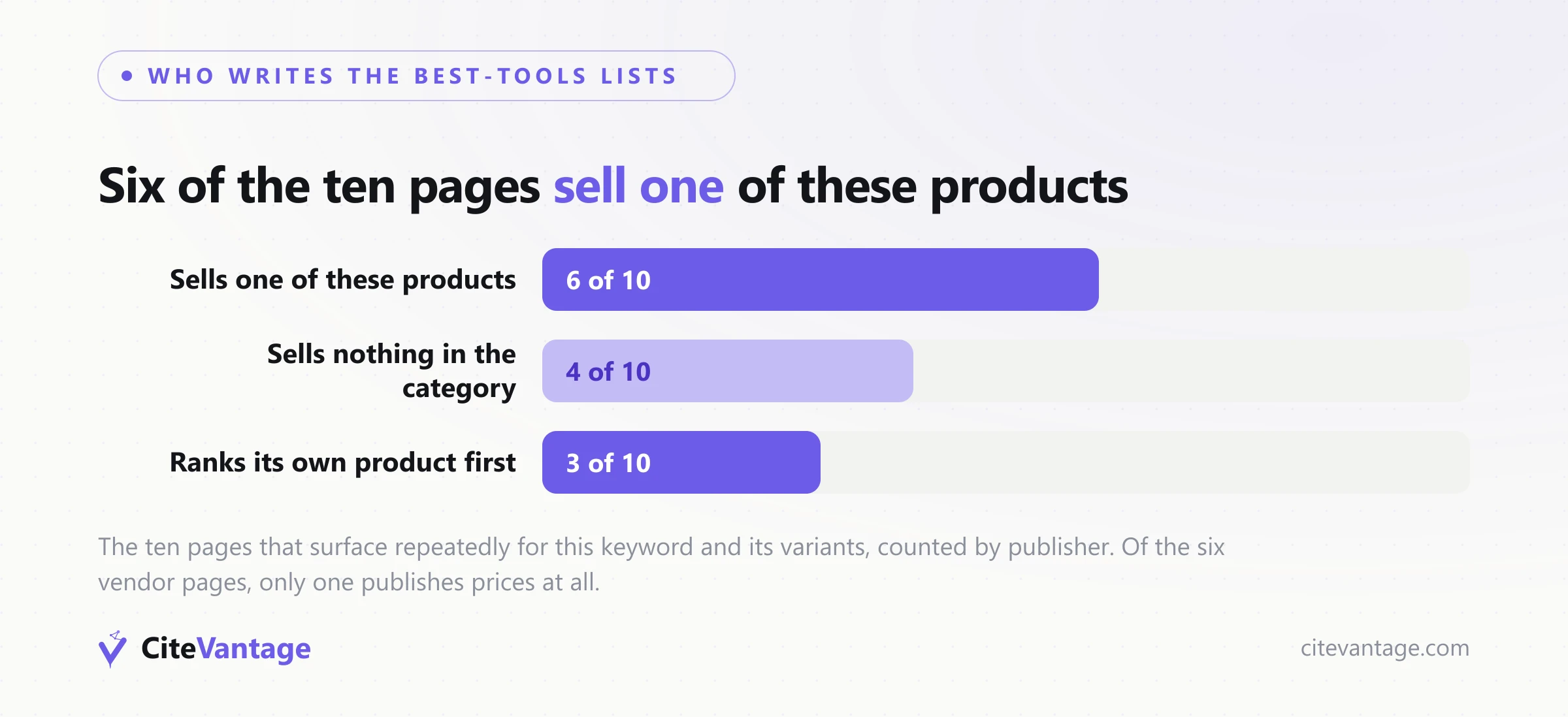
Most of the guides ranking for this search are published by a company that sells one of these products. That is a count, not a smear, and the table below does the counting. The cost to you is simple: you read a ranked list built around one vendor’s category, buy a dashboard, and three months later you own a chart of a problem the chart cannot fix.
What follows is the category map for the most popular AI visibility products for SEO, how the measurement works, what they cost, and a test for whether you need one yet.
What is an AI visibility tool, and what does it actually do?
An AI visibility tool asks AI engines a fixed list of questions on a schedule and records whether your brand gets named or linked in the answers. That is the whole mechanism. Everything else in the product is presentation: charts, alerts, competitor columns, exports for the client deck.
Nearly every product in the category tracks the same five things:
- Visibility or mention rate. The share of your tracked prompts where the engine names you.
- Share of voice against a list of competitors you define.
- Citation sources. Which URLs the engine actually pulled to build the answer. The most useful metric in the set, and the most ignored.
- Sentiment. Whether the mention is positive, neutral or negative.
- AI referral traffic, stitched from your analytics rather than from the engine.
Engine coverage varies by product and by plan. The common list is ChatGPT, Gemini, Google AI Overviews, Google AI Mode, Perplexity, Claude, Copilot, Grok and DeepSeek. Entry plans usually cover a subset, so check which engines yours includes.
Who writes the “best AI visibility tools” lists, and do they sell one?
Most of them sell one. We opened the ten pages that surface repeatedly for this keyword and its variants, and counted who publishes each one. Six of the ten are published by a company selling an AI visibility product. Four are not. Of the six vendors, three rank their own product at number one.
| Page | Who publishes it | Sells one of these products? | Ranks its own product first? |
|---|---|---|---|
| The 8 best AI visibility tools | Zapier, software directory | No | Not applicable |
| What are the most effective AI visibility products? | Semrush | Yes | Not evidenced, short answer page with no ranked list |
| The 10 best AI visibility tools in 2026 | Frase | Yes | Yes |
| 18 best AI visibility tools for marketing agencies | Profound | Yes | Yes |
| AI visibility checker guide | Search Engine Land, trade press | No | Not applicable |
| 9 platforms ranked by AEO score | Independent practitioner | No | Not applicable |
| Leading AI visibility optimization tools | Analyze AI | Yes | Yes |
| AI visibility tools pricing comparison | Siftly | Yes | Not evidenced, pricing-only comparison |
| The 10 best tools for tracking AI visibility | Brainlabs, agency | No | Not applicable |
| Best AI visibility tools for ecommerce | Alhena | Yes | Not evidenced, 12-tool ecommerce cut |
Naming the four neutral pages matters as much as naming the six vendors. Zapier publishes a price for seven of the eight tools it lists, with Similarweb the only sales-only entry. Of the six vendor pages, only Siftly publishes prices at all, and Profound publishes none.
One more receipt, stated as a fact about a method rather than an accusation about a person. The single page in this set that publishes a stated scoring model and weightings builds part of that model on one vendor’s own published citation research, and that vendor comes out on top of the ranking. The research itself is good work: Profound’s citation-source study covers 11.84 billion citations from eight AI models collected between 16 April and 16 July 2026, and finds roughly 57% of citations globally point to brand-owned sites, with ChatGPT lowest at 47% and Gemini highest at 69%. Useful numbers. Also the numbers a competitor is being scored against.
Our own disclosure, one sentence: CiteVantage is an agency, we sell services and none of these products, and we pay for several of them.
What are the most popular AI visibility products for SEO, by category?
Five categories, and the one you need depends on whether you are measuring, fixing, or reporting to somebody else. A brand checking whether it exists in AI answers needs a different product from an agency proving retainer value across 14 clients. Same shelf, different tools.
| Category | What it actually does | Named examples | Price basis | Best for |
|---|---|---|---|---|
| Free graders and checkers | One-off score from a small prompt sample | Semrush AI Search Visibility Checker, Ahrefs Brand Radar free check, SE Ranking, Omnia, Pixelmojo | Free, capped prompts and engines | Finding out whether you show up at all |
| Prompt-monitoring dashboards | Runs your prompt list on a cadence, charts mentions and citations | Peec AI, Otterly.ai, ZipTie, Rankscale, Hall, Scrunch, AthenaHQ | Monthly, metered on tracked prompts | Ongoing tracking for one brand |
| AI modules inside SEO suites | Adds an AI answer tab to the platform you already use | Semrush AI Visibility Toolkit, Ahrefs Brand Radar, SE Ranking, Surfer, Similarweb, Conductor | Add-on to an existing seat | Teams already paying for the suite |
| Enterprise answer-engine platforms | Panel or clickstream data on top of prompt sampling | Profound, BrightEdge, Evertune, Adobe LLM Optimizer, Brandlight | Annual, sales-led | Large brands and agencies with many workspaces |
| Monitoring plus execution | Tracking bundled with a content or fixing layer | Frase, Writesonic, AirOps, Rankability | Monthly, seats plus prompts | Teams who want one bill for both halves |
1. Free graders and checkers. These run a handful of prompts once and hand back a score out of 100. Worth ten minutes of your time. A free check tells you whether you appear at all, which is a real answer, but a single sample of an answer that regenerates differently every time is not a trend and should never be treated as one.
2. Prompt-monitoring dashboards. The core of the category and the products most people mean by AI visibility tools. You define the prompts, the tool runs them on a schedule, and you get mention rate, competitor share and cited URLs over time. Our guide to AEO tools that track brand mentions in ChatGPT compares these one by one.
3. AI modules bolted onto existing SEO suites. Cheapest path if you already pay for the suite, because the AI tab is an add-on rather than a new contract. Coverage is usually narrower than a dedicated dashboard, and the AI Mode data in particular varies a lot between platforms, which we broke down in our review of the best AI Mode SEO tracking tools.
4. Enterprise answer-engine platforms. Different data source, different price floor. These layer panel or clickstream data on top of prompt sampling, which is how they claim to see behaviour rather than just answers. Sales-led, annual and rarely sensible below a certain spend.
5. Monitoring plus execution. The pitch is that measuring is not enough, so buy the fixing layer with it. The pitch is correct. Worth noticing that the companies making it are the ones selling the execution layer.
How do AI visibility tools work, and why do two of them disagree about the same brand?
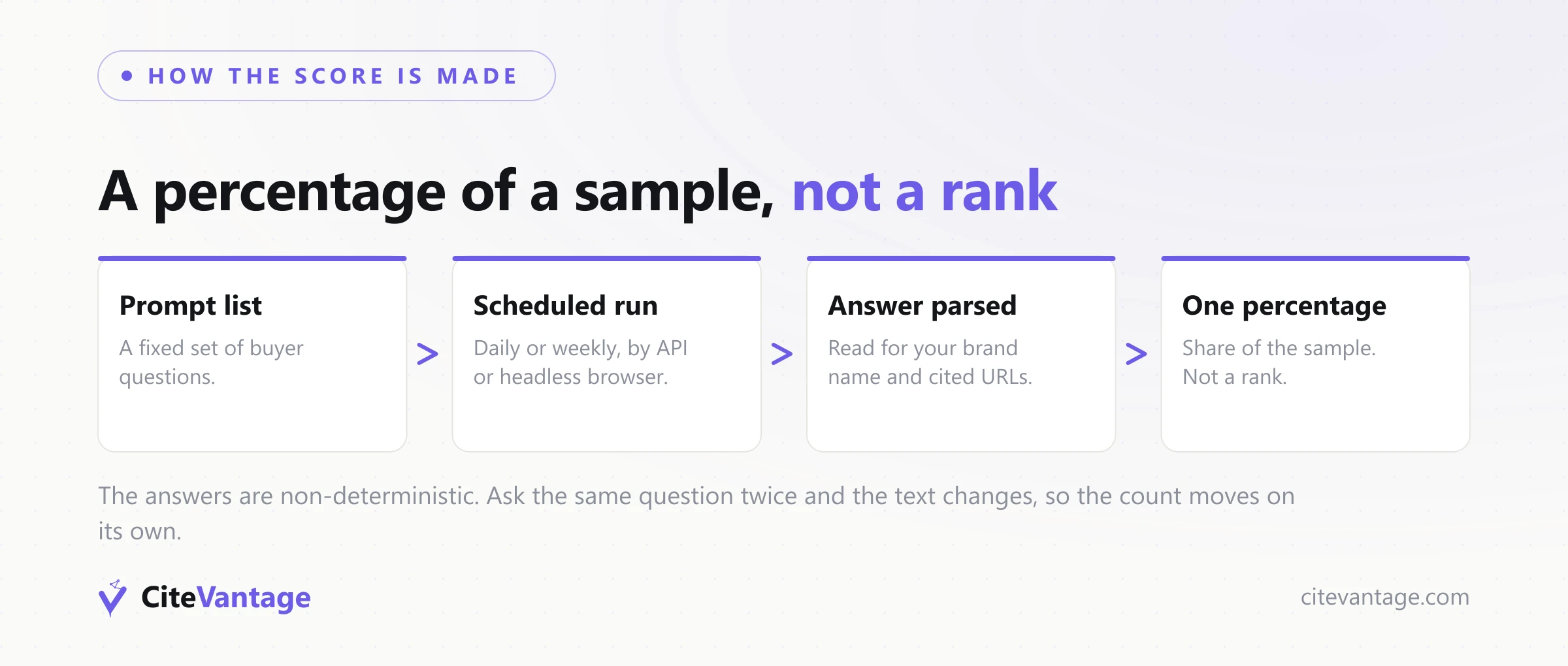
They run a fixed prompt list against the engines on a cadence, through model APIs or scripted browser sessions, then parse each answer for your brand name and the URLs cited. The answers are non-deterministic. Ask the same question twice and you get different text, so the count moves on its own.
What the tool is actually doing behind the score
You or the vendor writes a prompt list. The tool runs it daily or weekly, either through the model’s API or a headless browser pretending to be a logged-out user, reads each answer for your brand and the cited links, and rolls the results into a percentage.
That percentage is a share of a sample. Not a rank. If you appear in 18 of 60 tracked prompts, the dashboard says 30%, and 30% of your prompt list is not 30% of anything a buyer sees.
The mechanics also point at what the engines respond to. The Princeton-led GEO paper presented at KDD 2024 tested content changes against a 10,000-query benchmark and found that adding citations, quotations and statistics lifted visibility in generative engine responses by up to 40%. That is a content result, not a dashboard result. No tracker performs it for you.
Why the same brand gets two different scores in the same week
Two honest tools can report two different numbers. The causes are mundane:
- Different prompt lists. Fifty prompts and eighty prompts are different denominators.
- Different engine and model versions, sampled on different days.
- API answers versus logged-out browser answers. The same engine behaves differently through each door.
- Different cadence, different country, different language.
- The plain fact that the same question asked twice returns different text.
In our own multi-engine audits we have watched DA-10 sites beat DA-90 sites inside ChatGPT answers. Which is the clearest reason a visibility score is not a ranking. It is a sample, taken on a Tuesday.
What can AI visibility products not see?
The most popular AI visibility products for SEO measure a synthetic anonymous session. Your buyer is not in a synthetic anonymous session. That gap is not a bug in any specific product. It is the shape of the whole category, and no vendor page lists it.
- Logged-in and memory-personalised answers. The engine remembers the user, their past chats and their stated preferences. The tool has none of that context, so it samples a stranger.
- Product surfaces like ChatGPT Shopping. Product cards and shopping results come from a different retrieval path than the chat answer being sampled. A brand can be absent from one and present in the other.
- Per-country and per-language drift. The same prompt in the same engine returns a different brand set in Australia than in the US. Most entry plans track one market.
- Thread context. Answers get shaped by whatever the user asked three messages earlier. A cold single-turn prompt is the least realistic version of the query your buyer types.
None of that makes the tools useless. It makes them directional. Treat the number as a trend line, never as a measurement of your actual buyer.
What do the most popular AI visibility products for SEO cost?
Headline prices run from free to a few hundred dollars a month, with enterprise platforms sold by contract. The headline is close to meaningless on its own, because plans are metered on tracked prompts, and a cheap plan with a small allowance can cost more per prompt than a dearer plan with a big one.
Two independent price checks, neither run by a vendor selling in this table:
| Product | Published price | Source and date checked |
|---|---|---|
| Profound | $82.50 to $332.50/mo on annual billing | Zapier, tested Feb 2026 |
| Profound | About $499/mo | Siftly, verified June 2026 |
| Otterly.ai | $25 to $160/mo | Zapier, tested Feb 2026 |
| Otterly.ai | About $29/mo | Siftly, verified June 2026 |
| Peec AI | EUR 89 to EUR 199/mo | Zapier, tested Feb 2026 |
| ZipTie | $58.65 to $84.15/mo | Zapier, tested Feb 2026 |
| Semrush AI Visibility Toolkit | $99/mo per domain | Zapier, tested Feb 2026 |
| Ahrefs Brand Radar | $199/mo add-on | Zapier, tested Feb 2026 |
| Clearscope | $129/mo | Zapier, tested Feb 2026 |
| Similarweb | Sales contact only | Zapier, tested Feb 2026 |
Look at the two Profound rows and the two Otterly rows. Same products, two checks four months apart, materially different numbers. Prices in this category move faster than the guides quoting them, so treat every figure above as a starting point and re-check on the vendor’s own page.
Zapier’s test is the only page here that prints the prompt allowance next to the price. Profound’s Starter includes 50 tracked prompts and Growth 100. Otterly’s Lite covers 15, Standard 100. Peec AI’s Starter 25, Pro 100. Semrush’s toolkit, 25. Do the division before you sign. Semrush at $99 a month for 25 prompts is about $4 per tracked prompt, and a dearer plan carrying a 100-prompt allowance can work out cheaper per prompt than a budget plan capped at 25. Siftly’s comparison prints no allowances, so ask the vendor for the number. Siftly does name what pushes the bill up as you scale: tracked prompt volume, number of brands or workspaces, and depth of historical data.
Which companies offer AI citation tracking for real estate?
None of them, specifically. Every tool in the tables above is horizontal: it tracks whatever prompts you load, and not one ships a real estate prompt set, a city-level view, or a competitor list built from the brokerages an engine actually names in your market.
That is less a gap in the tools than a description of the job. For a brokerage the prompts are local, “best real estate agent in Tampa” rather than “best real estate agent”, and the answer changes by city, so the useful unit of tracking is the metro rather than the brand.
Read the pricing table above through that lens and it sorts itself:
- Otterly at $29 for 15 prompts covers one city across four engines, with room for nothing else. A second city means the next tier.
- Semrush and HubSpot AEO at 25 prompts fit one metro with a few comparison and brand prompts alongside.
- Rankscale and Peec AI carry the widest engine lists at entry, which matters more in real estate than most categories. In our own 150-question real estate study, the five engines each had a different most-cited source on the same questions, and 83% of cited domains were cited by only one engine. A one-engine tracker is measuring a fifth of the picture.
- Profound and the other enterprise platforms only make sense for a multi-market brokerage or a franchisor reporting across offices.
What the dashboard cannot give a brokerage is the list of sites the engines cite instead, which is the outreach list. We published a redacted sample AI visibility audit for a real estate firm that shows the prompt set, the scorecard and exactly that list, for a firm that appeared in none of 38 answers.
Do you need an AI visibility product yet?
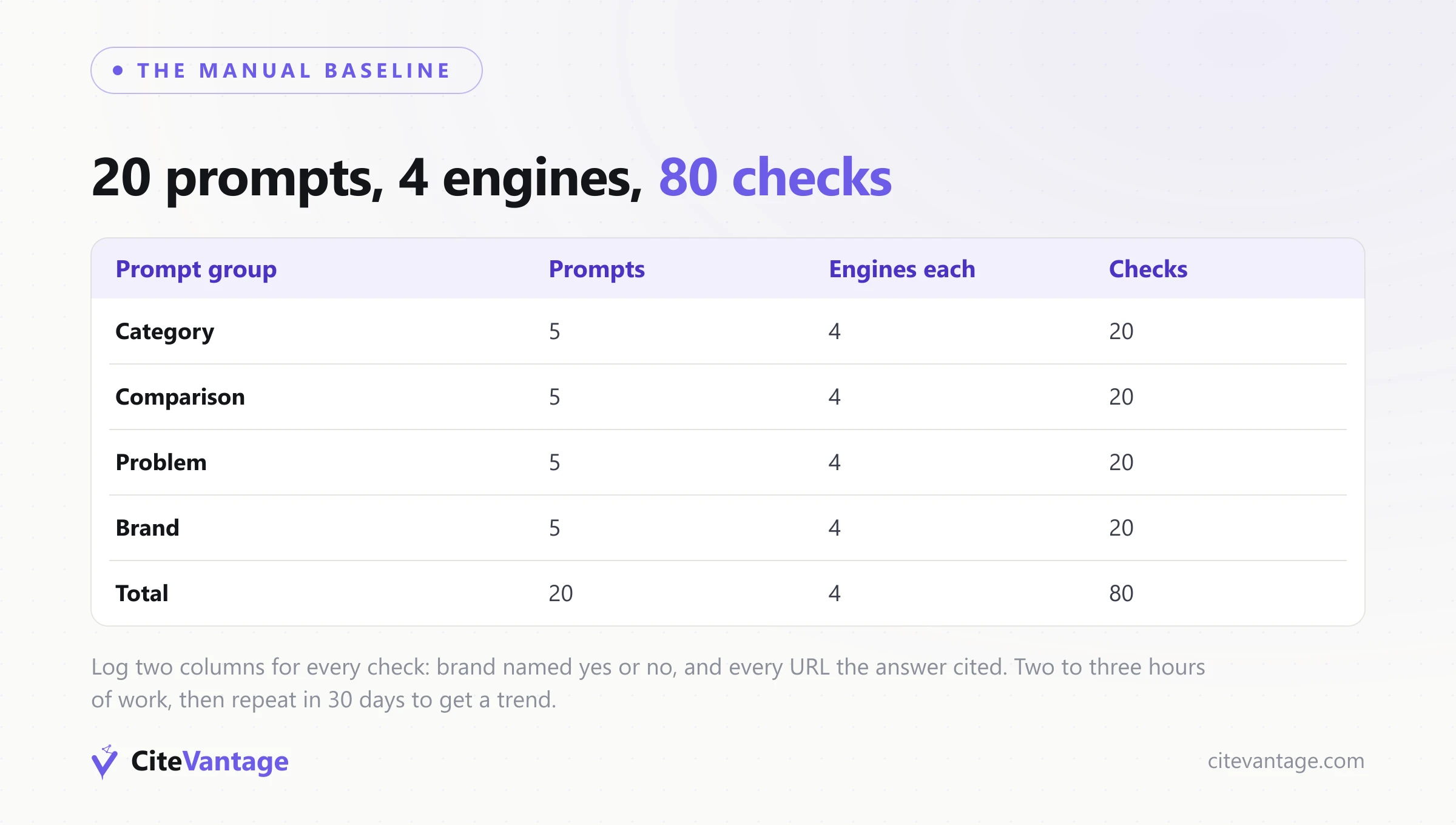
If you have never run a manual baseline, buy nothing this month. Run the baseline first. It costs an afternoon, it tells you the same thing a free trial tells you, and it teaches you what a good prompt list looks like before you pay someone to run one.
- Write 20 real buyer prompts. Five category prompts (“best real estate agent in Tampa”), five comparison prompts, five problem prompts, five brand prompts.
- Run each one in four engines. ChatGPT, Perplexity, Google AI Overviews and Gemini. Logged out, one clean session.
- Log two columns. Brand named yes or no, and every URL the answer cited. The cited URLs are the useful half, because they show which pages the engines already trust in your category.
- Repeat in 30 days and compare. Now you have a trend, built by hand, for nothing.
Two to three hours for 80 checks. Our walkthrough on running an AI visibility audit yourself covers the prompt-writing part properly.
The most popular AI visibility products for SEO start earning their fee at the point where you are tracking more prompts, more markets or more brands than one person can hand-run monthly, or where a client or a board needs the reporting on a schedule. Below that line the spreadsheet wins, and nobody selling a subscription wants to tell you so.
Does a dashboard actually fix anything?
No. The most popular AI visibility products for SEO are instruments. A thermometer is useful and a thermometer has never lowered a fever. The chart tells you that AI does not name you, and then the work of becoming nameable happens somewhere else entirely.
What the number actually told us
In our audit of 181 ecommerce brands, 87% were cited zero times across four AI engines when those engines answered questions about the brand’s own product category. Most of them had fine SEO. Real rankings, clean tech, real backlinks.
Every one of those 181 could have bought a dashboard and watched the same zero, weekly, in a nicer font. No tracker moved that number for a single one of them. We ran the same gap on citevantage.com before we sold this as a service, which is the only reason we are comfortable saying it this bluntly. The diagnosis half is covered in why your brand is invisible to AI.
What moved it instead
The work under the score, in the order it usually pays off: crawler access, so the engines can fetch you at all. Page structure that can be quoted without editing. Schema that makes your entity unambiguous. Then the third-party mentions the engines actually pull from, which sit off your domain and take the longest.
That is the whole job, and it is the same job whether you are paying $29 a month for a tracker or nothing at all. Our Bright Realty case study shows what that groundwork did for one brokerage, and our real estate SEO agency page covers how we run it. Buy the instrument if you need the instrument. Just do not confuse it with treatment.
What happens to your contract if this category consolidates?
The market for the most popular AI visibility products for SEO is consolidating while you shop in it, and buyers are signing annual deals into that. Two events from the last twelve months, both worth knowing before you commit to a 12-month term.
Adobe agreed to acquire Semrush for approximately $1.9 billion in an all-cash deal at $12 per share, announced 19 November 2025 and expected to close in the first half of 2026. Adobe’s stated rationale was generative engine optimization. Check the current status of that deal before you rely on how Semrush’s AI toolkit is packaged today.
Profound raised $96 million at a $1 billion valuation in a Series C led by Lightspeed, announced 24 February 2026, bringing total funding to $155 million and serving more than 700 enterprises. Money at that scale buys smaller tools in the same list you are choosing from.
Three buying rules follow from that, and none of them cost you anything:
- Prefer monthly billing over annual until the category settles.
- Get it in writing, before you sign, that you can export your historical prompt data if the product is absorbed, repriced or shut down.
- Re-check the price on the vendor’s own page the week you buy. Two of the most popular AI visibility products for SEO in the pricing table above show materially different figures across two checks four months apart.
Want the baseline without the afternoon? Our free AI Visibility Snapshot runs your buyer prompts across four engines and shows you which ones name you and which ones name a competitor, before you pay any vendor a monthly fee. No card, no call required to get the report.
Frequently asked questions
What is an AI visibility tool?
+
Software that asks AI engines a fixed list of questions on a schedule and records whether your brand is named or linked in the answers. Most tools track five things: mention rate, share of voice against named competitors, which URLs the engine cited, sentiment, and referral traffic from AI answers. It is a measuring instrument, not a fix.
Are AI visibility tools worth it?
+
Depends on scale. The most popular AI visibility products for SEO earn their fee when you are tracking more prompts, markets or brands than one person can run by hand each month, or when a client or board needs the reporting. Below that, a spreadsheet and four browser tabs give you the same answer for free.
How many prompts do I need to track?
+
Start with 20. Four groups of five: category prompts, comparison prompts, problem prompts and brand prompts. Run them across ChatGPT, Perplexity, Google AI Overviews and Gemini, log a yes or no plus the cited URLs, then repeat in 30 days. Twenty real buyer prompts beat 200 invented ones.
Is there a free AI visibility checker?
+
Several. Semrush, Ahrefs, SE Ranking, Omnia and Pixelmojo all run free checks. Each samples a handful of prompts once and hands back a score. That tells you whether you show up at all, which is worth knowing. It cannot tell you a trend, because a single sample of a non-deterministic answer is not a trend.
Why do two AI visibility tools give different numbers for the same brand?
+
Because they are not measuring the same thing. Different prompt lists, different engine and model versions, API answers versus logged-out browser sessions, different cadence, different country. On top of that, the same question asked twice returns different text. Two honest tools can report two different scores for the same brand in the same week.
Do AI visibility tools fix the problem or just report it?
+
They report it. In our audit of 181 ecommerce brands, 87% were cited zero times across four AI engines. Every one of them could have bought a dashboard and watched the same zero. The number moves when the pages, the schema, the crawler access and the third-party mentions change.
More in AI SEO, GEO and AEO
- Domains AI Cites on Real Estate: The Open List
- Hostinger CDN Blocks GPTBot: HTTP 429 Case Study
- AI Search Statistics 2026: Sourced and Dated
- AI Tools for SEO and AEO: Track ChatGPT Mentions
- Best AI Mode SEO Analysis Tools for 2026
- Best AI SEO Agencies 2026: 15 Firms Ranked
- Can AI Crawlers Reach Your Site? How to Check
- GEO Case Studies: Successful Campaigns
- GEO vs SEO vs AEO: The Real Difference in 2026
- Generative Engine Optimization: GEO and AEO Guide
- Google Preferred Sources: Myths, Broken
- How to Check if ChatGPT Recommends Your Brand
- How to Get Cited by ChatGPT: 2026 Playbook
- How to Get Cited by Google Gemini
- How to Get Cited by Perplexity: 9 Source Signals
- How to Rank in Google AI Overviews: 2026 Guide
- How to Run an AI Visibility Audit Step by Step
- How to Track Competitors in AI Search Results
- SEO and GEO Strategy: Make Them Work Together
- Schema Markup for AI Search: Types That Matter
- What Is llms.txt? Complete Setup Guide
Start from the hub: AI SEO, GEO and AEO
See where AI is hiding your brand
Free multi-engine audit across ChatGPT, Gemini, Google AI & Perplexity.
See who AI names instead of me