How to Check if ChatGPT Recommends Your Brand in 10 Minutes
By Abdul Subkhan Published
Part of AI SEO, GEO and AEO
Images in this guide are free to reuse (CC BY 4.0). Credit CiteVantage with a link to this page.
Here is how to check if ChatGPT recommends your brand: open a fresh chat and ask the questions a real buyer would ask, such as “best [your category] for [use case]”. Run each question with web search on and off. Record whether your brand is named and linked. Then repeat the same test on Perplexity, Gemini and Google AI Overviews.
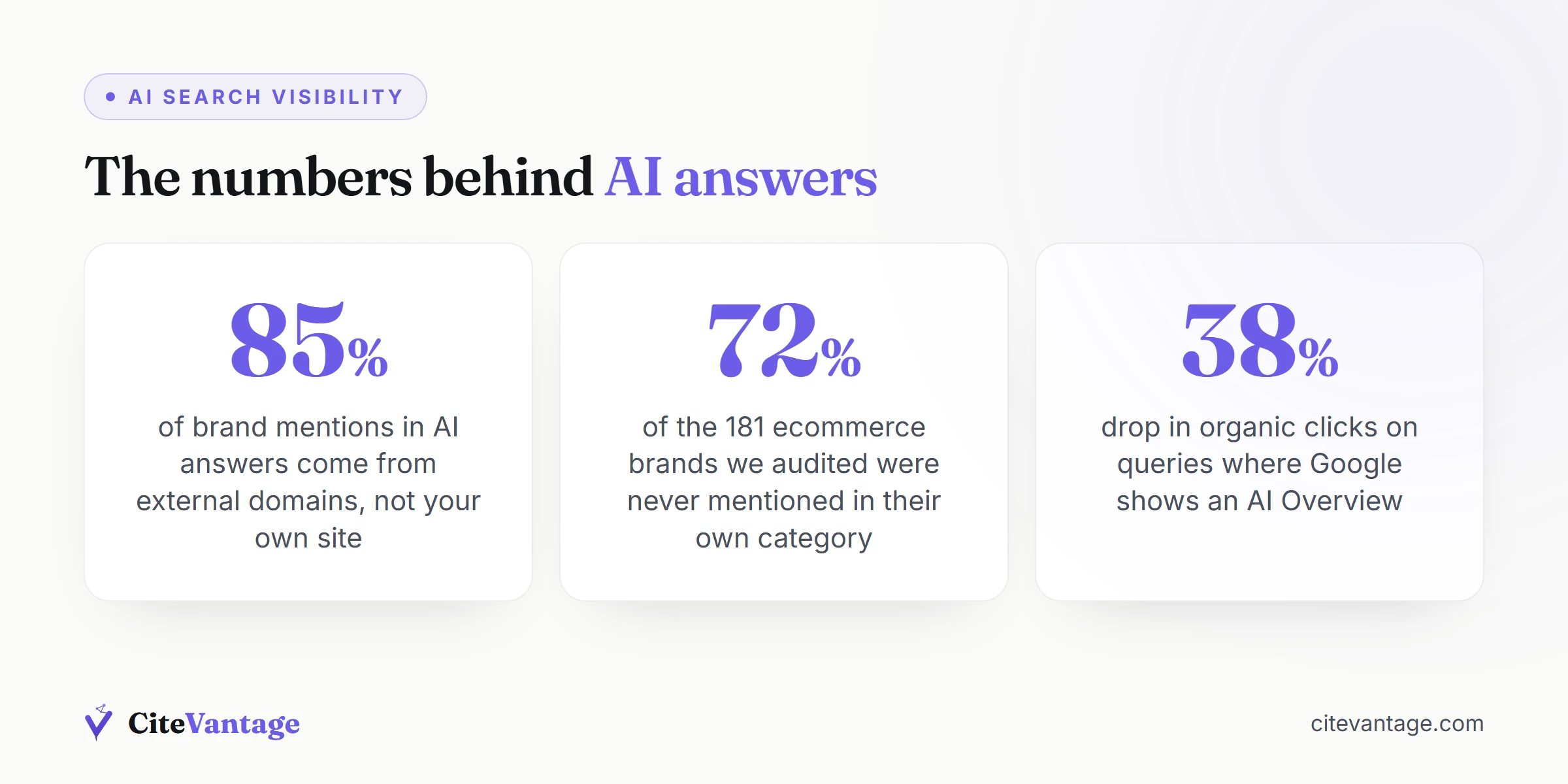
That is the whole test in four sentences. The rest of this guide makes it repeatable, so the number you get this month can be compared to the number you get next month. When we audited 181 ecommerce brands across the four major engines, 87% were never mentioned when AI answered questions about their own category. Most of them had no idea, because nobody had ever checked.
TL;DR: Write 10 real buyer questions. Ask them in a fresh ChatGPT chat, with web search on and off. Score each answer: 2 if you are named and linked, 1 if named only, 0 if absent. Repeat on Perplexity, Gemini and Google AI Overviews. The pattern of scores tells you whether your problem is findability, extractability or authority.
Why does it matter whether ChatGPT recommends your brand?
Because buyers now ask AI before they buy, and the answer often ends the search. Google AI Overviews cut organic clicks on triggered queries by about 38% in a randomized field study, and zero-click searches climbed from 54% to 72%.
A zero-click search is one where the person gets their answer and never visits any website. The brands named inside those answers absorb the demand. Everyone else is simply not in the room.
This is what people mean by AI visibility: whether answer engines like ChatGPT, Perplexity, Gemini and Google AI Overviews mention your brand when they answer a buyer’s question. An answer engine is any tool that replies with a synthesized answer instead of a list of links. Getting mentioned more often is the goal of GEO (generative engine optimization) and AEO (answer engine optimization), two names for roughly the same discipline. We explain the mechanics in what is generative engine optimization.
But strategy comes second. Measurement comes first. You cannot fix a visibility problem you have never measured, and you cannot claim victory without a baseline. This test is the baseline.
What do you need before you run the ChatGPT visibility test?
Three things, none of them technical: somewhere to record results, accounts on the engines you are testing, and ten minutes of honesty about what you are actually measuring. The one setup step people underestimate is memory. If you use ChatGPT regularly, turn memory off before testing, or the engine will name you because you have discussed yourself with it before.
- A spreadsheet or a sheet of paper. Columns for the question, the engine, and the score.
- Accounts on the engines. ChatGPT works logged out, but Perplexity and Gemini are easier with free accounts.
- Ten minutes of honesty. You are testing what buyers see, not what you hope they see. Do not ask leading questions that hand the engine your brand name.
One setup step matters more than people expect. If you use ChatGPT regularly, turn memory off before you test, or use a temporary chat. We cover why in the fresh-chats section below, but the short version is that ChatGPT remembers your past conversations, and a model that already knows you run the brand will name the brand. What you get back is an echo of your own account rather than visibility.
Step 1: Which buyer questions should you write down?
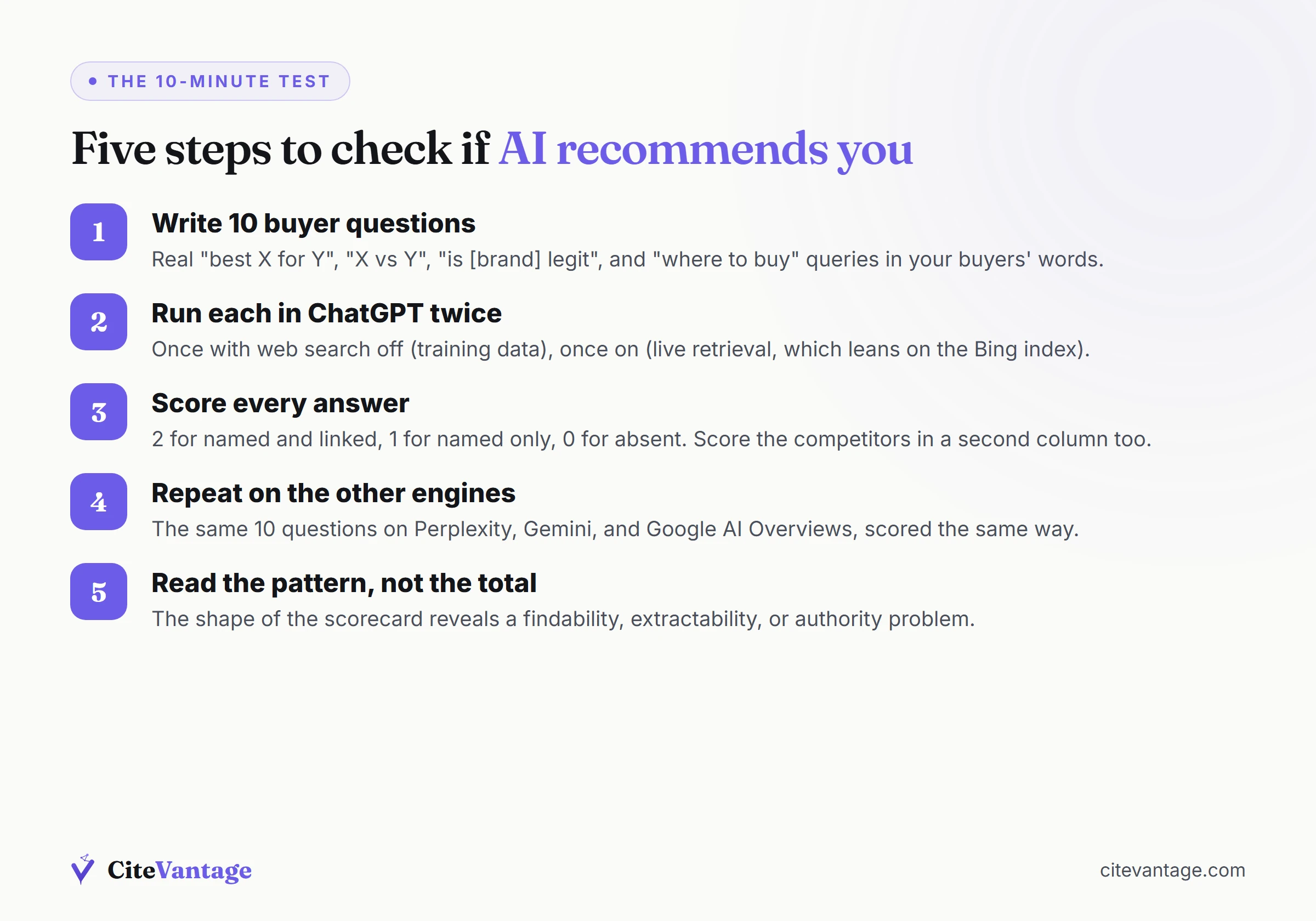
Write 10 questions a real buyer would type in the week before they spend money. These are called buyer intent queries: questions asked by someone close to a purchase, not someone browsing. Spread them across four categories. The split matters: a category question, a competitor question, a problem question and a price question all get answered from different sources.
- “Best X for Y” questions. The category question with a use case attached. “Best soy candles for small apartments.” “Best accounting software for freelancers.” These decide who gets recommended.
- “X vs Y” questions. Direct comparisons between you and a competitor, and between two competitors where you should appear as an alternative. “Maple & Main vs Homesick candles.”
- “Is [brand] legit / worth it” questions. Trust questions about your own brand. “Is Maple & Main legit?” These show what AI says about you when someone checks you out.
- “Where to buy X” questions. Purchase-ready queries. “Where can I buy hand-poured candles online in the US?”
Use your customers’ words, not your industry’s words. If buyers say “non-toxic candles” and your site says “clean-burning botanical wax systems”, test the buyer’s phrasing. The engine answers the question that was asked.
A balanced set looks like this: four category questions, two comparisons, two trust questions, two purchase questions. Write them down before you open any chat window, so you ask every engine the exact same thing.
Step 2: How do you run the ChatGPT brand mention check?
Open a fresh chat. Ask question one. Read the answer and score it (scoring is step 3). Then, and this is the part most people skip, run the same question in both of ChatGPT’s modes. The default model answers from what it already knows, while the browsing mode goes and reads the live web, and the two regularly return different names for the same question.
Mode one: web search off. With search off, ChatGPT answers from training data, the fixed snapshot of the web the model learned from months ago. This mode tells you whether your brand made it into the model itself. If ChatGPT can describe you accurately with no internet access, you exist in its long-term knowledge. If it draws a blank, you were not a visible enough entity when the model was trained.
Mode two: web search on. With search on, ChatGPT performs live retrieval: it fetches current pages from the web and builds its answer from them, usually with source links. ChatGPT’s web search leans on the Bing index, so a site that Bing has not indexed is effectively invisible to ChatGPT search no matter how well it ranks on Google. This mode tells you whether your live web footprint is findable and citable right now.
The two modes fail for different reasons, which is exactly why you test both. Training data reflects your history. Retrieval reflects your present. A brand can be strong in one and absent in the other, and the fix is different in each case.
Use a new chat for each question, or at minimum for each category. Do not correct the model, do not say “what about [your brand]?”, and do not argue. The moment you feed it your name, the test is over for that chat.
Step 3: How do you score what comes back?
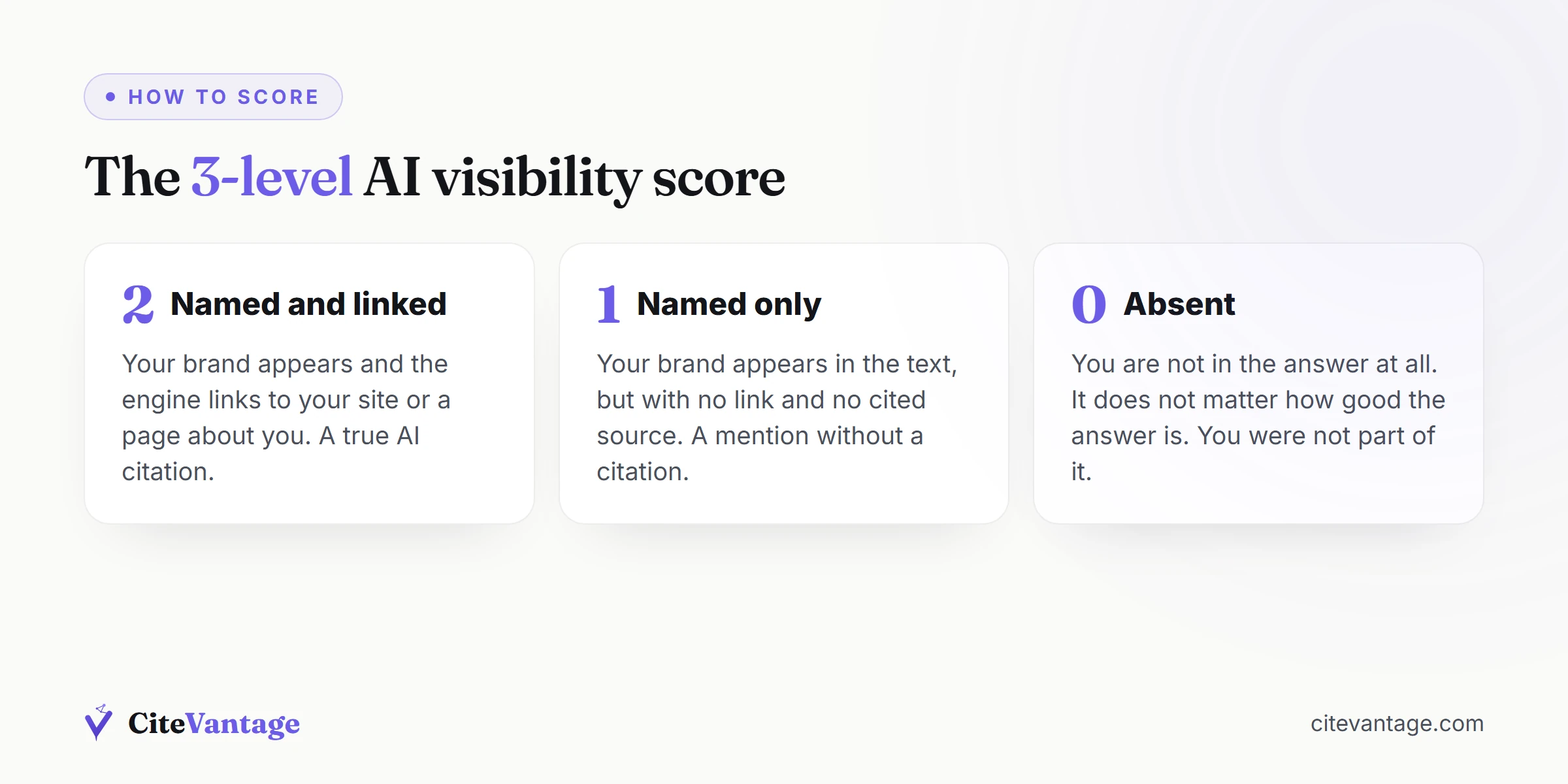
Keep it almost stupidly simple, because a scoring system you will not repeat next month is worthless. Three levels: 2 if you are named and linked, which is a true citation; 1 if you are named in the text with no link or source, which is a mention rather than a citation; 0 if you are absent. Nothing finer than that.
- 2 = Named and linked. Your brand appears in the answer and the engine links to your site or cites a page about you. This is a true AI citation: the engine both recommends you and points at a source.
- 1 = Named only. Your brand appears in the text, but no link and no cited source. This is a brand mention without a citation. Better than nothing, weaker than it looks, because the buyer has to go find you themselves.
- 0 = Absent. You are not in the answer at all. It does not matter how good the answer is. You were not part of it.
Score the competitors too, in a second column. Write down which brands were named in each answer and which sources the engine cited. That competitor column becomes your share of voice: out of all the brand mentions across your 10 questions, what fraction were you? If your category produces 40 brand mentions across the test and 3 are yours, your share of voice is roughly 7%, and you know exactly who owns the rest. When you are ready to run that column properly across several engines, our guide to tracking competitor rankings in AI search gives you the prompt suite and the log schema.
Step 4: Why repeat the test on Perplexity, Gemini and Google AI Overviews?
Because the engines disagree, constantly, and your buyers are spread across all of them. Perplexity retrieves and cites on nearly every answer. Gemini blends Google’s index with its own model. A brand named by one of them is regularly absent from the next, so a single-engine check tells you almost nothing about your actual exposure.
Google AI Overviews sit on top of normal searches and pull from Google’s ranking systems plus query fan-out. Only about 38% of AI Overview citations now come from pages ranking in Google’s top 10, so even your Google rankings do not predict your AI Overview presence.
Run the same 10 questions in each engine and score them the same way. For AI Overviews, type the question into Google and score the AI box at the top if one appears. Here is what a finished scorecard looks like for Maple & Main, a fictional small candle brand we will use as the example. Scores: 2 = named + linked, 1 = named only, 0 = absent.
| Buyer question | ChatGPT (search off) | ChatGPT (search on) | Perplexity | Gemini | AI Overview |
|---|---|---|---|---|---|
| Best soy candles for small apartments | 0 | 0 | 1 | 0 | 0 |
| Best non-toxic candles under $30 | 0 | 0 | 0 | 0 | 0 |
| Best candle subscription boxes | 0 | 0 | 0 | 0 | 0 |
| Best hand-poured candle brands in the US | 0 | 1 | 1 | 0 | 0 |
| Maple & Main vs Homesick candles | 0 | 1 | 2 | 1 | 0 |
| Homesick vs Brooklyn Candle Studio alternatives | 0 | 0 | 0 | 0 | 0 |
| Is Maple & Main legit? | 0 | 1 | 2 | 1 | 1 |
| Is Maple & Main worth the price? | 0 | 1 | 1 | 0 | 0 |
| Where to buy soy candles online | 0 | 0 | 0 | 0 | 0 |
| Where to buy hand-poured candles as gifts | 0 | 0 | 1 | 0 | 0 |
Maple & Main scores 15 out of a possible 100. That number alone is not the insight. The pattern is.
Step 5: What does the pattern of results tell you?
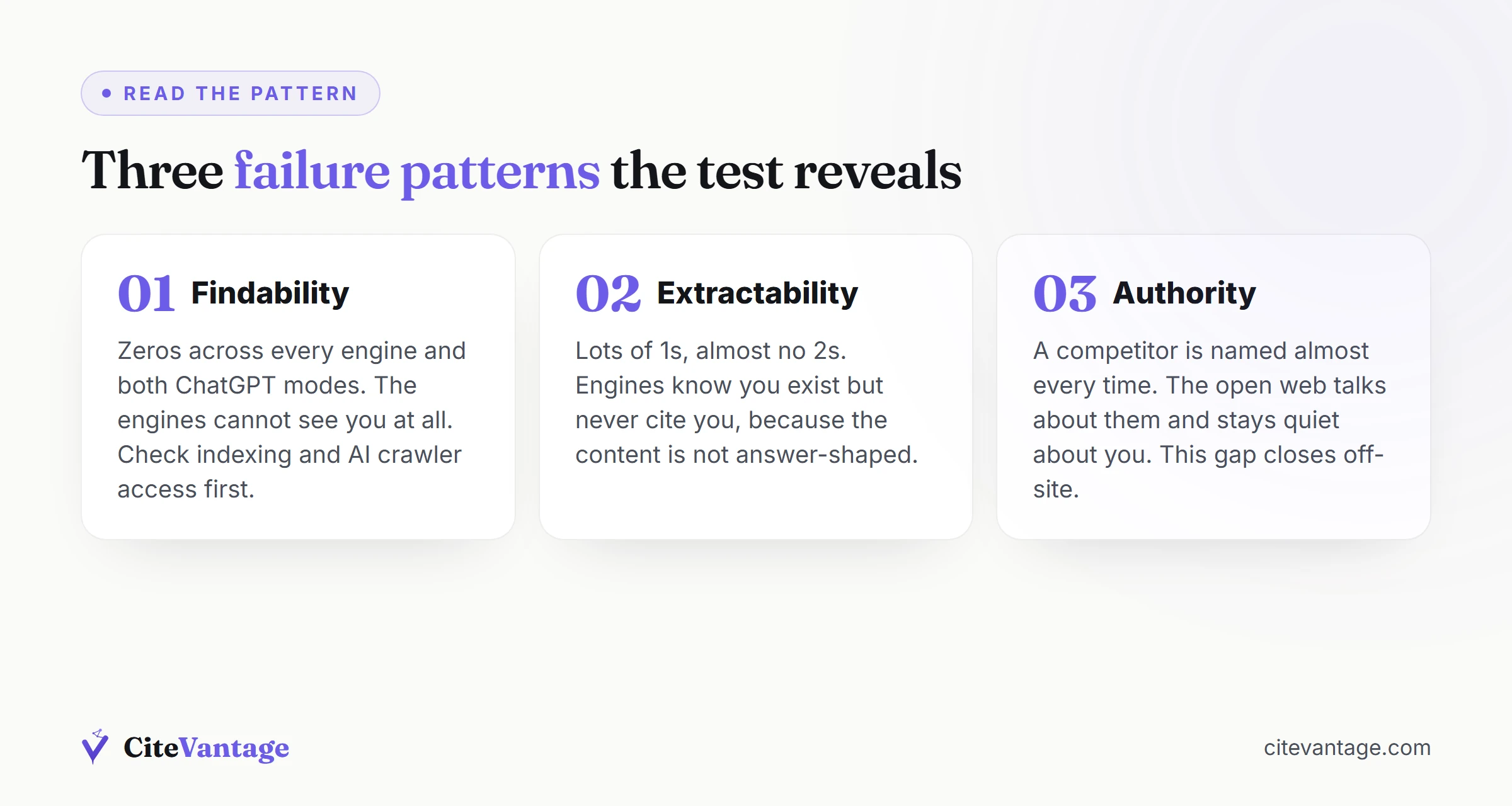
Read the scorecard by shape, not by total, because the pattern names the cause. Three cover almost every brand we audit: absent everywhere, which is a findability problem; named by some engines and not others, which is a corroboration problem; and named without links, which means the engines know you exist but cannot find a source worth citing.
Pattern one: absent everywhere. Zeros across every engine and both ChatGPT modes. This is a findability problem. The engines cannot see you at all. Check the floor first: is your site indexed in Google and Bing, are you blocking AI crawlers like GPTBot in robots.txt, and does your brand exist anywhere outside your own website? We diagnosed the seven usual causes in why is my brand invisible to AI.
Pattern two: named but never linked. Lots of 1s and almost no 2s, which is an extractability problem. The engines know you exist but never cite your pages, usually because your content is not answer-shaped. There is no clean capsule, FAQ, or comparison table for the engine to lift and point at. Your site knows things; it just does not say them in a liftable way. The fixes live in how to get cited by ChatGPT.
Pattern three: a competitor is named almost every time and you rarely are. This is an authority problem, and it is the hardest of the three. The engines can find you and read you, but the open web talks about your competitor and stays quiet about you. About 85% of brand mentions in AI answers come from external domains, so this gap closes off-site: reviews, directories, comparison posts, forum threads. You cannot publish your way out of it on your own blog.
Look at Maple & Main’s card again. It scores on its own trust questions and its own comparison, but almost never on the category questions where the buyer has not heard of it yet. That is pattern three with a touch of pattern two: real authority gap, plus pages that get mentioned but rarely cited. Now the brand knows its next quarter of work, and it learned that from a ten-minute test.
Why do fresh chats and multiple runs matter?
Two reasons, and skipping either one quietly ruins your data. Memory and personalisation mean a logged-in session answers you differently than it answers a stranger, so a familiar account can name your brand for reasons no buyer would share. And these answers vary between runs, so a single result is a sample of one rather than a measurement.
Note: Test while signed out, or in a temporary chat. A logged-in session carries memory and personalisation, so it can name your brand because you have discussed it before. That is the single easiest way to get a falsely reassuring result.
First, AI answers vary run to run. These models are probabilistic, which means the same question can produce a different answer minutes apart. We have watched the same brand surface in three of five prompts on Perplexity and zero of five on ChatGPT in the same hour. One run is an anecdote. So run your most important questions two or three times, on different days if you can, and score the typical result rather than the best one. If you appear once in three runs, record that honestly. A buyer only asks once.
Second, your own account contaminates the test. ChatGPT’s memory feature carries facts from your past chats into new ones, and custom instructions do the same. If you have ever discussed your brand with ChatGPT while logged in, the model may name you because it remembers you, not because the open web supports you. Your customers do not get that treatment. So test in a temporary chat, or with memory switched off, or logged out entirely. The same logic applies to Google: signed-in personalization can tilt AI Overviews, so an incognito window gets you closer to what a stranger sees.
The goal of the whole exercise is to see your brand the way a stranger’s AI sees it. Every shortcut that makes the test more flattering makes it less true.
What should you do after you check if ChatGPT recommends your brand?
Three moves, in order.
- Save the scorecard and date it. This is your baseline. Repeat the identical test monthly and track the total, the share of voice, and which pattern you show. Movement across months is the real signal.
- Fix in pattern order. Findability problems first, because nothing else works while engines cannot see you. Then extractability, because answer-shaped pages are fully in your control this week, the same fast on-page lever behind our RIPT Apparel case study. Then authority, because third-party consensus is the slowest lever and needs the earliest start.
- Steal the citation list. Every source the engines cited instead of you is a target. Those review sites, roundups and forums are where your category’s AI answers are actually written. Earning presence there is most of the job, and it is the core of the GEO work we do for clients.
This ten-minute test gets you a baseline fast. When you are ready for the full version, with a 0 to 100 citability score, share-of-voice math and an llms.txt check, our guide on how to run an AI visibility audit yourself walks all seven steps. And if you would rather software did the monthly logging, we reviewed the AEO tools that track brand mentions in ChatGPT, free checkers included, without selling one.
If you run a local or service business, the same test answers a sharper question: does ChatGPT recommend your home-services business when a nearby customer asks for one? A local business AI-visibility check applies the identical scoring to the map-pack and neighborhood queries your buyers actually run. To see what those answers look like in practice, our city pages show real ChatGPT and Gemini responses naming real local businesses, city by city.
If you would rather have this done for you, our free AI Visibility Audit runs the full test across ChatGPT, Perplexity, Gemini and Google AI Overviews, scores you 0 to 100, and delivers the report with ranked fixes within 48 hours. Either way, run the test. Ten minutes now beats discovering in six months that your buyers were asking, the engines were answering, and your brand was never in the answer.
Frequently asked questions
How do I check if ChatGPT recommends my brand?
+
Open a fresh ChatGPT chat and ask the questions a real buyer would ask, like "best [your category] for [use case]". Run each question twice, once with web search on and once with it off. Record whether your brand is named and linked. Then repeat the same questions on Perplexity, Gemini and Google AI Overviews. Ten questions takes about ten minutes.
Does ChatGPT know my business exists?
+
Ask it directly in a fresh chat: "What do you know about [brand name]?" with web search off. If it answers from training data, your brand made it into the model. If it draws a blank or guesses, it never learned you. Then turn web search on and repeat. If it still finds nothing, check whether your site is indexed in Bing, because ChatGPT search retrieves through Bing's index.
Why does ChatGPT mention my competitors but not me?
+
Competitors earned more of the signals AI reads: third-party reviews, directory listings, comparison posts and forum threads. Roughly 85% of brand mentions in AI answers come from external domains, not the brand's own site. If five outside sources name your rival and none name you, the model treats them as the safer recommendation. See the full breakdown at why brands stay invisible to AI.
How often should I run an AI visibility test?
+
Monthly is a sensible baseline, and always in fresh chats with memory off. AI answers shift as models retrain, engines re-crawl and competitors publish. A single test is a snapshot, not a verdict. Track the same 10 questions each month so you can measure share of voice over time instead of reacting to one lucky or unlucky answer.
What is a good score on the 10-minute AI visibility test?
+
Score each answer 2 for named and linked, 1 for named only, 0 for absent. Out of a possible 100 across ten questions and five engine modes, most small brands we audit score under 15. Anything above 50 means AI already treats you as a default answer in your category. The score matters less than the pattern, which tells you what to fix first.
Can I get this test done for me instead of running it by hand?
+
Yes. Our free AI Visibility Audit runs your real buyer questions across ChatGPT, Perplexity, Gemini and Google AI Overviews, scores you 0 to 100, and shows exactly which sources the engines cited instead of you. You get the report within 48 hours, with the top fixes ranked in order.
More in AI SEO, GEO and AEO
- Domains AI Cites on Real Estate: The Open List
- Hostinger CDN Blocks GPTBot: HTTP 429 Case Study
- AI Search Statistics 2026: Sourced and Dated
- AI Tools for SEO and AEO: Track ChatGPT Mentions
- Best AI Mode SEO Analysis Tools for 2026
- Best AI SEO Agencies 2026: 15 Firms Ranked
- Can AI Crawlers Reach Your Site? How to Check
- GEO Case Studies: Successful Campaigns
- GEO vs SEO vs AEO: The Real Difference in 2026
- Generative Engine Optimization: GEO and AEO Guide
- Google Preferred Sources: Myths, Broken
- How to Get Cited by ChatGPT: 2026 Playbook
- How to Get Cited by Google Gemini
- How to Get Cited by Perplexity: 9 Source Signals
- How to Rank in Google AI Overviews: 2026 Guide
- How to Run an AI Visibility Audit Step by Step
- How to Track Competitors in AI Search Results
- Most Popular AI Visibility Tools for SEO
- SEO and GEO Strategy: Make Them Work Together
- Schema Markup for AI Search: Types That Matter
- What Is llms.txt? Complete Setup Guide
Start from the hub: AI SEO, GEO and AEO
See where AI is hiding your brand
Free multi-engine audit across ChatGPT, Gemini, Google AI & Perplexity.
See who AI names instead of me