How to Get Cited by Perplexity: 9 Source Signals
By Abdul Subkhan Published Updated
Part of AI SEO, GEO and AEO
Images in this guide are free to reuse (CC BY 4.0). Credit CiteVantage with a link to this page.
How to get cited by Perplexity comes down to five moves: publish answer-first content that resolves a specific question in the first 100 words, keep the page fresh, allow PerplexityBot to crawl, structure passages for clean extraction, and build third-party authority through earned media. Perplexity cites its sources on every answer, so the path to a citation is unusually visible: run the question, read the footnotes, match what wins.
Perplexity citation in 50 words: Perplexity retrieves the live web on each query and footnotes the pages it synthesizes. It cites about 21.9 sources per answer, nearly 3x ChatGPT. You earn a slot with a direct answer up top, fresh content, crawler access, extractable structure and outside mentions that vouch for you.
We audited 181 ecommerce brands across four AI engines this year. 87% were never mentioned when Perplexity answered a question about their own product category, even brands sitting in Google’s top three for the same term. Good rankings did not carry over. Perplexity was reading different signals, and most of these brands had never optimized for them.
That gap is the opportunity. Below is the signal hierarchy we use, in order of leverage.
Why does Perplexity cite sources at all?
Perplexity is an answer engine, not a link engine. You ask a question, it searches the live web in real time, reads a handful of pages, and writes one synthesized answer with numbered citations underneath. Click a footnote and you land on the source.
That design makes it the most transparent engine to optimize for. ChatGPT and Gemini often answer from memory and cite inconsistently. Perplexity shows its work every time.
A few things follow from how it works:
- It pulls from the live web, so freshness and crawlability matter more than on a static-index engine.
- It cites wide. Around 21.9 sources per answer means more open slots than a single featured snippet.
- It cross references. A claim repeated across several trusted pages is safer to cite than one lone assertion.
- It rewards specificity. Pages that answer the exact query beat broad pages that mention the topic in passing.
The volume point is the one most people miss. Perplexity citing nearly three times as many sources per answer as ChatGPT means a mid-market site with a sharp page has a real shot, even against bigger domains. That width is why Perplexity is such a productive engine for software companies, and it anchors our AI visibility for SaaS companies work.
What are the 9 source signals Perplexity rewards?
We group the signals into four tiers by leverage: extraction, recency, authority and structure. Extraction and recency move citations fastest, authority is the moat that lasts, and structure is table stakes. Work them in that order, because a page Perplexity cannot extract cleanly will not be cited no matter how authoritative the domain behind it is.
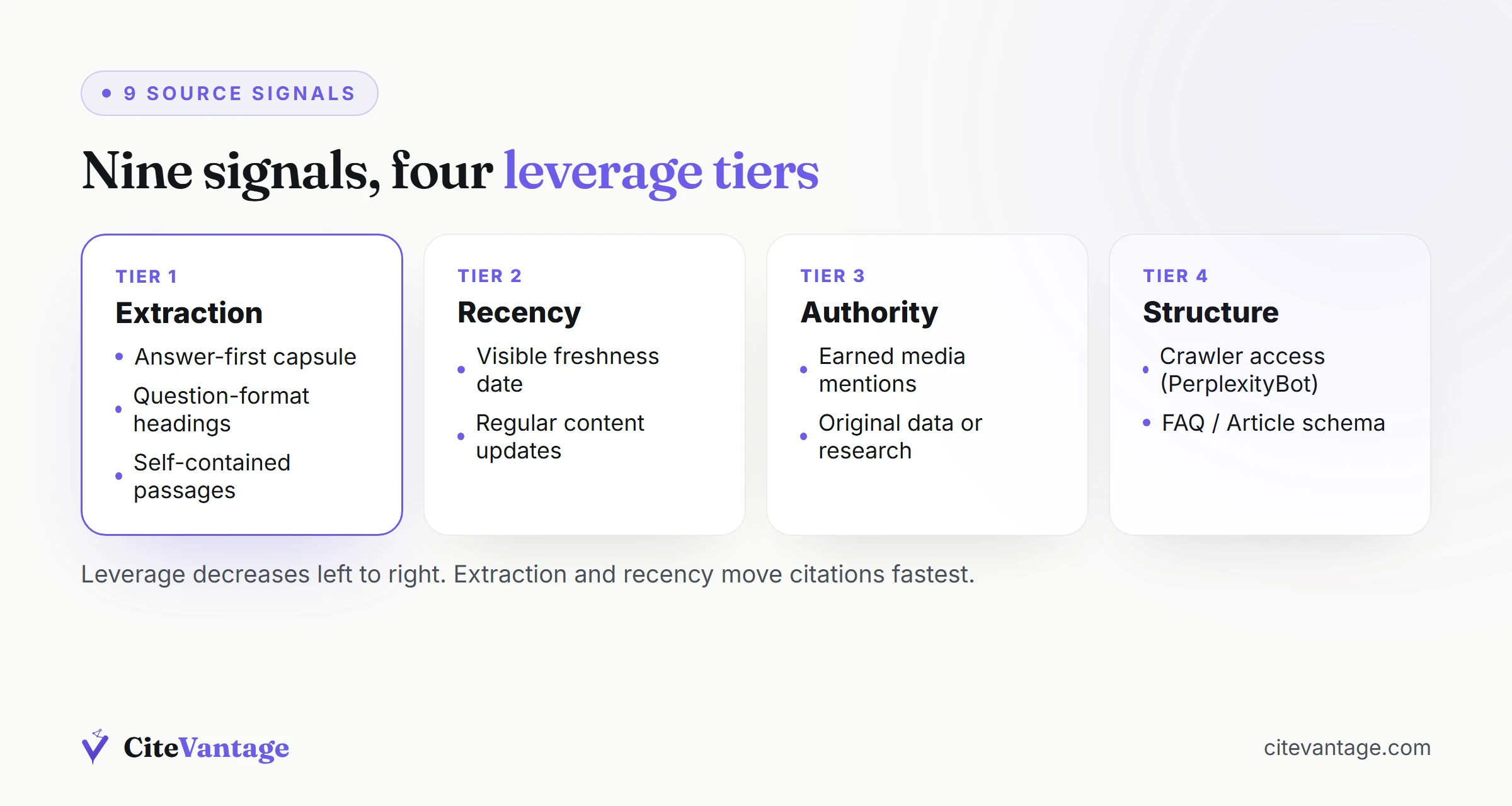
| # | Signal | Tier | What it does |
|---|---|---|---|
| 1 | Answer-first capsule | Extraction | Gives Perplexity a quotable line to lift |
| 2 | Question-format headings | Extraction | Matches the query Perplexity is resolving |
| 3 | Self-contained passages | Extraction | Lets a section stand alone as a citation |
| 4 | Visible freshness date | Recency | Signals the page is current |
| 5 | Regular content updates | Recency | Keeps you in the recency-favored pool |
| 6 | Earned media mentions | Authority | Third-party trust Perplexity cross references |
| 7 | Original data or research | Authority | Makes you a primary source it must cite |
| 8 | Crawler access (PerplexityBot) | Structure | Without it, you don’t exist to Perplexity |
| 9 | FAQ / Article schema | Structure | Helps parsing, supports the visible text |
You don’t need all nine on day one. Get crawler access and an answer-first capsule live first. Those two unblock everything else.
How do you write content Perplexity will extract?
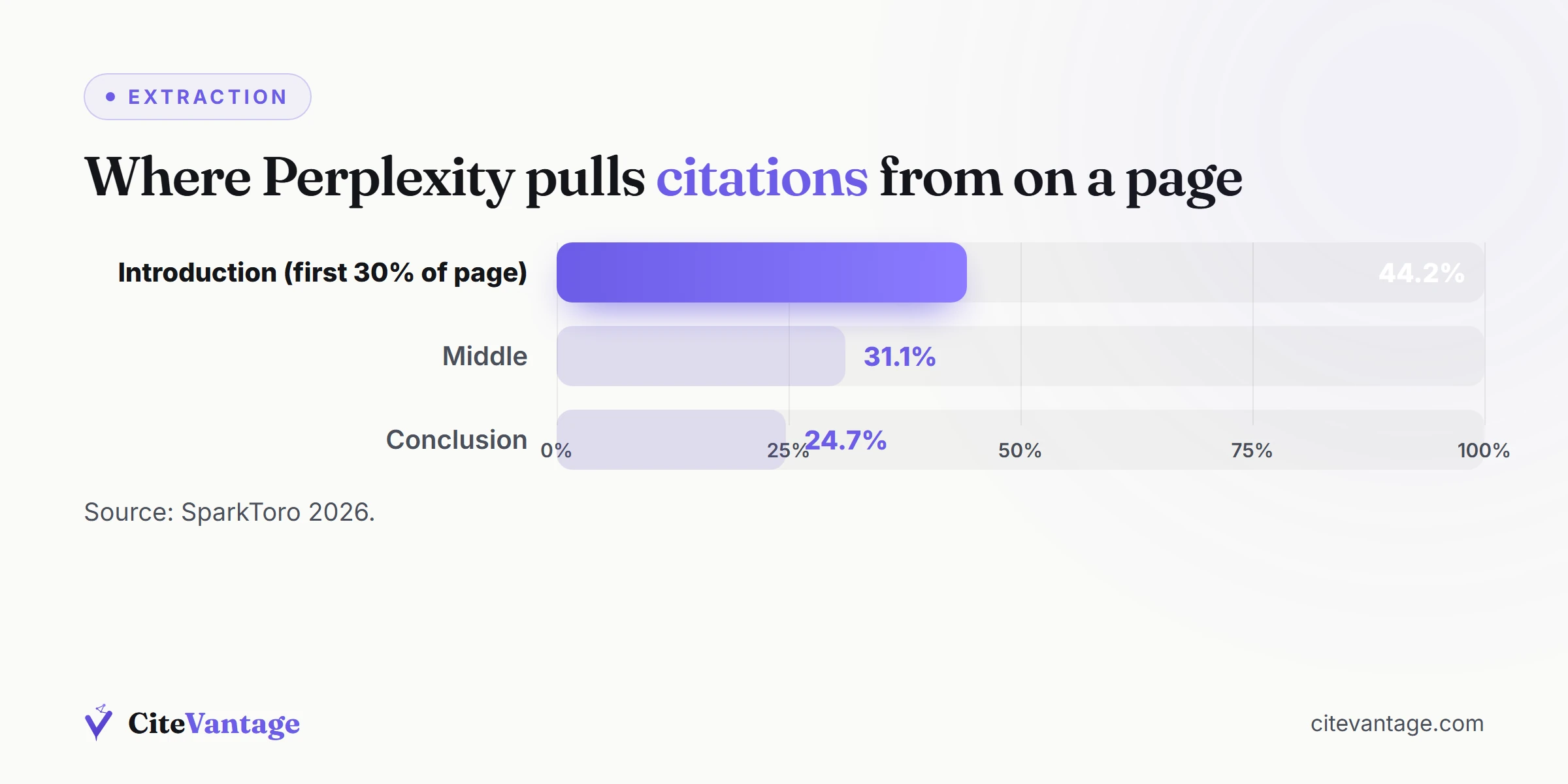
Lead with the answer. Every section should open with the direct response in one or two sentences, then expand. This isn’t a style preference. Roughly 44% of LLM citations are drawn from the first 30% of a page, the introduction, with the middle and conclusion splitting the rest. Bury your answer in paragraph nine and the model may never reach it.
The pattern we use on every page:
- Open with a 40 to 60 word capsule that answers the page’s core question, written to be lifted whole.
- Use question-format H2s that mirror how buyers actually phrase the query.
- Keep passages self-contained so a section reads as a complete answer without the rest of the page.
- Drop in numbers, dates and named specifics Perplexity can quote and attribute to you.
- Add tables for any comparison or dataset. Engines extract structured data far more than prose.
One caution on language. Write definitively. “The fastest way to get cited is X” extracts cleanly. Hedged, throat-clearing copy (“there are many factors that may potentially influence”) gives the model nothing to lift. Plain and direct wins.
We’ve watched Perplexity cite a tight 200-word FAQ answer over a 2,000-word guide on the same query. The short page was easier to extract and answered the question without making the model hunt.
Does Perplexity favor fresh content?
Yes, heavily. Recency is one of the strongest levers on Perplexity specifically, because it queries the live web instead of a frozen index. A page updated this month competes against a page updated two years ago on a signal that has nothing to do with quality, which makes republishing one of the cheapest moves available here.
The numbers back it up. Content updated in the last three months gets cited far more than stale pages, and content left untouched for three or more months loses citations at roughly 3x the rate. About half of Perplexity’s citations come from content published within the most recent year. There’s even a short decay window: new pages start losing citation share within days of going quiet.
| Content age | Citation behavior |
|---|---|
| Updated < 30 days | Strongest citation pull, freshest pool |
| Updated < 3 months | Healthy, competitive |
| Stale 3+ months | ~3x higher citation loss |
| Year-old, never updated | Largely displaced by newer pages |
Practical moves:
- Put a visible “last updated” date on the page, not just in metadata.
- Refresh your top pages on a schedule, every quarter at minimum, with real changes and current data.
- When a stat or screenshot ages out, update it rather than letting the page drift.
- Treat your best pages as living documents, not publish-and-forget assets.
Freshness is the cheapest signal to fix and one of the highest-leverage on Perplexity. Most brands we audit simply never touch their pages after launch.
Why do Perplexity citations depend so much on earned media?
Because Perplexity cross references. A claim echoed across reputable third-party sources is safer for it to cite than the same claim sitting alone on your own blog. This is the point where owned content hits a ceiling. Past it the work moves off your own domain entirely, into the publications, directories and review sites Perplexity already treats as corroboration.
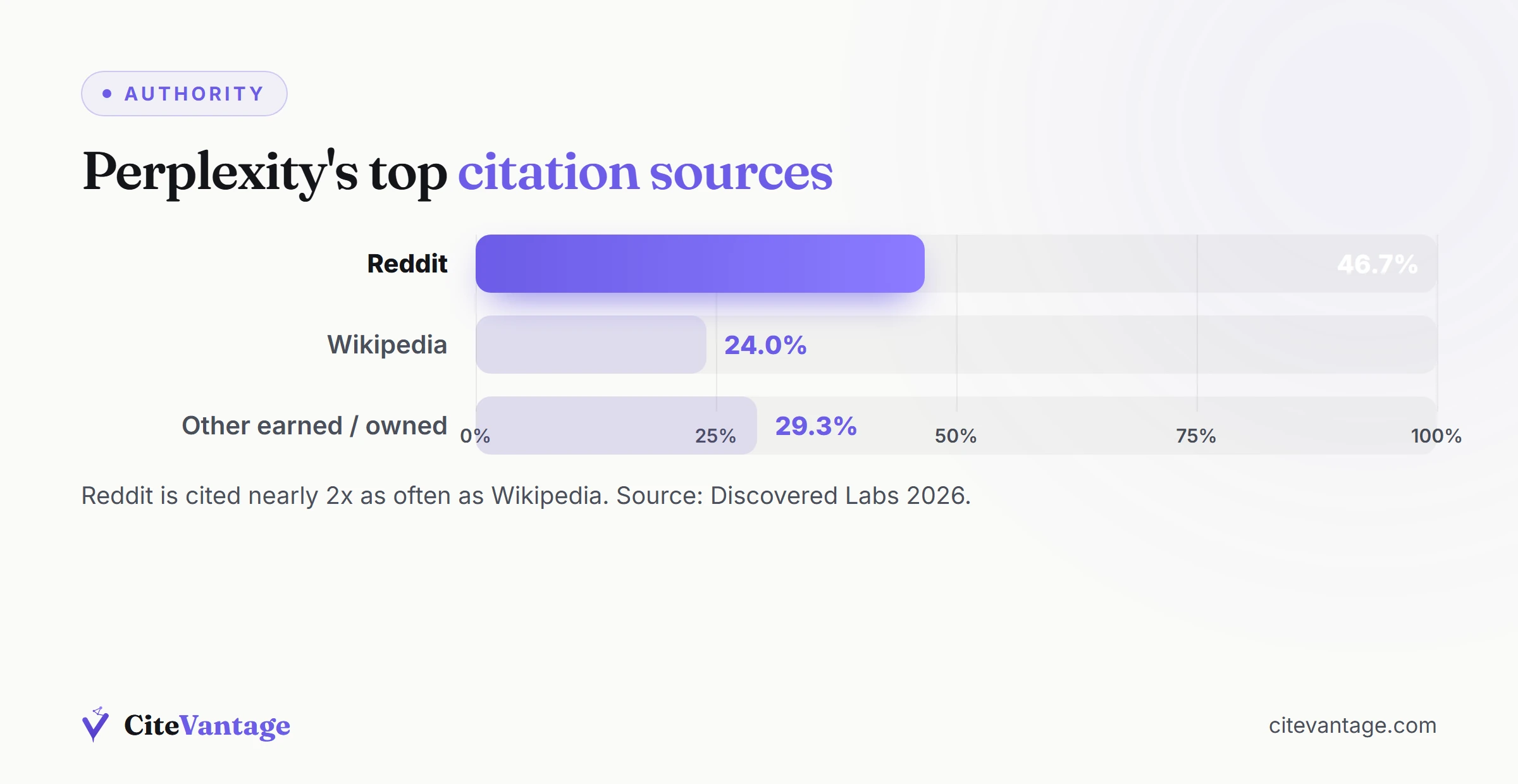
This is why Reddit punches so far above its domain authority. Reddit makes up around 46.7% of Perplexity’s top citations, close to twice Wikipedia. Detailed, specific Reddit comments answering a real question in an active subreddit get cited within two to three weeks, often faster than a fresh blog post on a young domain. The catch: promotional comments get filtered. Real advice with numbers and outcomes beats marketing copy by a wide margin.
Where to build authority that actually moves citations:
- Earned editorial mentions, a quote in a trade publication, an industry roundup, a podcast writeup. The durable signal.
- Helpful, specific contributions in the communities your buyers read, Reddit and niche forums included.
- Listings and roundups on the domains Perplexity already cites for your category.
- Original data you publish first, a survey, a benchmark, a first-party study, which forces others to cite you and turns you into a primary source.
That last one is the strongest single lever. When you own the only data on a question, Perplexity has to cite you to answer it. Our 181-brand audit number does exactly that for us: it gets quoted because nobody else ran it.
We won’t pretend earned media is fast. It takes weeks and real outreach. But it’s the only citation signal that compounds, and it’s the one your competitors are least likely to be working on.
Is Perplexity SEO the same as Google SEO?
No. They share a foundation, but the goal differs enough to need separate tactics. Google ranks ten links and most clicks go to the top few. Perplexity writes one answer and footnotes several sources, so being “page one” matters less than being extractable and trusted.
The hard evidence: only about 11% of domains are cited by both ChatGPT and Perplexity. Roughly 89% show zero overlap. A page that wins on ChatGPT can be invisible on Perplexity, which means you measure each engine separately and tune for each. Generic “AI SEO” advice that treats all engines as one will leave citations on the table.
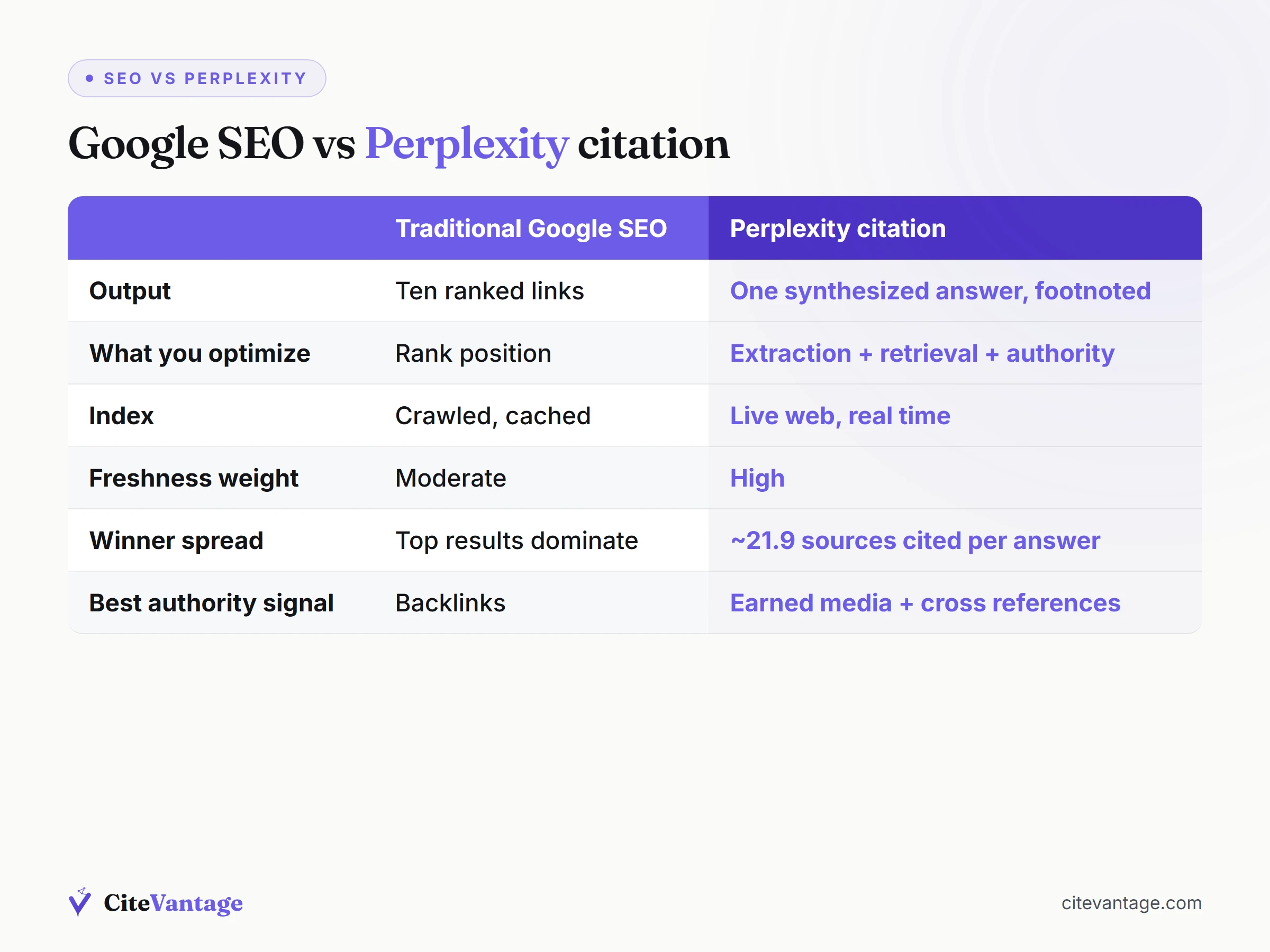
| Traditional Google SEO | Perplexity citation | |
|---|---|---|
| Output | Ten ranked links | One synthesized answer, footnoted |
| What you optimize | Rank position | Extraction + retrieval + authority |
| Index | Crawled, cached | Live web, real time |
| Freshness weight | Moderate | High |
| Winner spread | Top results dominate | ~21.9 sources cited per answer |
| Best authority signal | Backlinks | Earned media + cross references |
If you’re working all four engines, our guides on getting cited by ChatGPT and optimizing for Google AI Overviews cover the differences. The underlying discipline is generative engine optimization, and the strategy split between GEO and classic search is in GEO vs SEO vs AEO.
What about llms.txt, JSON-LD and other myths?
Skip llms.txt for citations. No major engine has committed to reading it, and Google’s own AI optimization guidance tells site owners not to bother with it or with manufactured “mentions.” It won’t get you cited by Perplexity. Spend the half hour on it if you want, then go and do the work that actually moves citations.
JSON-LD is overrated as a citation lever too. Schema helps engines parse your page, and pages with FAQ, HowTo or QAPage markup do appear 20 to 30% more often in AI summaries. But independent technical testing found Perplexity, ChatGPT, and Claude all missed facts that existed only inside JSON-LD. The fix is simple: keep your schema, and also write the same facts in plain, visible body text where the model actually reads.
Quick myth check:
- llms.txt: near useless for citations today. Don’t prioritize it.
- JSON-LD alone: helps parsing, won’t carry a fact the body text omits.
- Keyword stuffing the LSI list: Perplexity rewards a clear answer, not density.
- Blocking AI crawlers “to protect content”: removes you from the index Perplexity cites from.
This is also where brands accidentally sabotage themselves. We’ve audited sites that blocked PerplexityBot at the CDN by default, then wondered why they never appeared. Check robots.txt and your WAF rules before anything else.
What earns the most Perplexity citations?
Perplexity citations follow the signals, not your Google rank. The pages that win most are answer-first, freshly dated, extractable and backed by earned mentions on the domains Perplexity already trusts. Get PerplexityBot crawling, lead every section with the direct answer, keep the page current, and seed a genuine third-party footprint. Do that and Perplexity citations compound instead of decaying.
How to get cited by Perplexity: the audit to run today
Five steps, no tools required and about thirty minutes start to finish. The point is to find out whether Perplexity currently cites you on the questions your buyers ask, and if it does not, which sources it reached for instead. Write the answers down, because you will re-run this later:
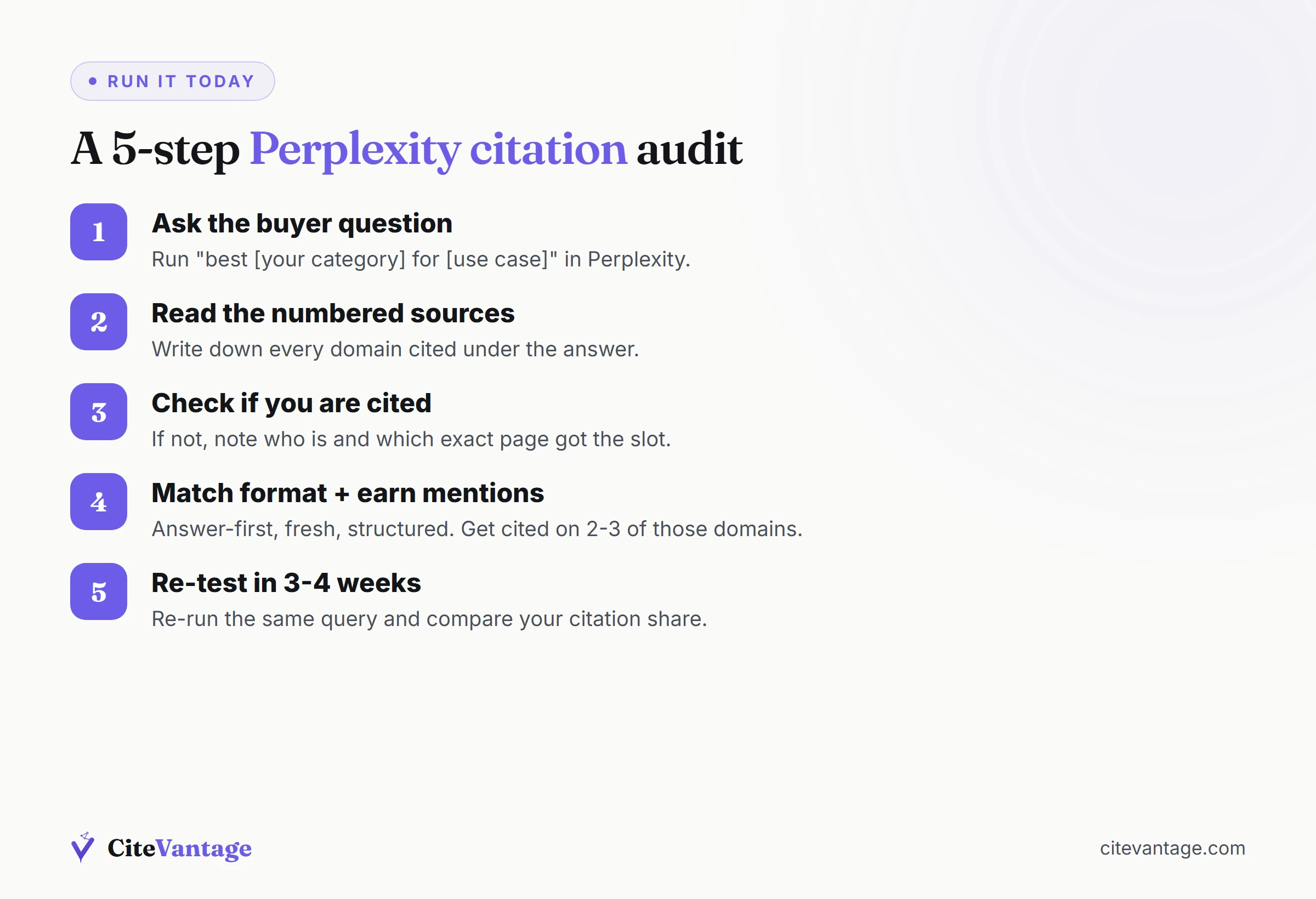
- Ask Perplexity your buyer’s real question, for example “best [your category] for [use case].”
- Read the numbered sources under the answer. Write down every domain.
- Check whether you’re there. If not, note who is and which specific page got cited.
- Match that page’s format, answer-first and freshly structured, then earn a mention on two or three of the cited domains.
- Re-run the same query in three to four weeks and compare.
Do that across your ten most important buyer questions and you have a citation gap map. That map is exactly what we build in a free AI visibility audit across all four engines, scored 0 to 100, so you can see who Perplexity cites instead of you.
Start with the two unblockers: allow PerplexityBot, and put an answer-first capsule at the top of your most important page. Then layer in freshness and earned media. Citations follow the signals, not the rank.
Frequently asked questions
How do you get your website cited in Perplexity AI?
+
Publish a direct answer in the first 100 words, keep the page fresh, allow PerplexityBot in robots.txt, and earn third-party mentions. Perplexity retrieves the live web on every query, so it pulls pages that satisfy the exact question and carry outside authority. We run the buyer's question in Perplexity, read the cited domains, then match that format and get mentioned on those same sites.
Does publishing on Reddit help get citations from Perplexity?
+
Yes, more than most owned content. Reddit makes up roughly 46.7% of Perplexity's top citations, nearly twice Wikipedia. A specific, useful comment in an active subreddit can get cited within two to three weeks, faster than a blog post on a new domain. Promotional replies get ignored. The ones that win answer a real question with numbers and a clear outcome.
How long does it take to appear in Perplexity citations after publishing?
+
Days to a few weeks if your site is already indexed and crawlable. Perplexity reads the live web, so fresh pages can surface fast. New domains with no authority take longer, sometimes never. In our sprints we've seen a well-structured page get cited inside two weeks once a couple of earned mentions pointed at it.
Should I block or allow Perplexity crawlers in robots.txt?
+
Allow PerplexityBot if you want citations. It surfaces and links your pages in Perplexity search and is not used to train models, per Perplexity's own crawler docs. Block it and you remove yourself from the index it cites from. Check your robots.txt and your WAF or CDN rules, since many sites block AI crawlers by default without realizing it.
What content structure does Perplexity prefer for citations?
+
Self-contained, answer-first passages. Lead each section with the direct answer in one or two sentences, then expand. Use question-format headings, short bullet lists and tables for data. Roughly 44% of LLM citations come from the first 30% of a page, so put the quotable line up top, not in a conclusion the model may never reach.
How important is structured data like JSON-LD schema for Perplexity citations?
+
Useful, not decisive. FAQ and Article schema help engines parse your page, and pages with FAQ, HowTo or QAPage markup show up 20 to 30% more often in AI summaries. But independent tests found Perplexity missed facts that lived only in JSON-LD. Keep schema, write the same facts in visible body text, and don't expect markup alone to win citations.
Can smaller websites compete with big brands for Perplexity citations?
+
Yes, more than on Google. Perplexity cites about 21.9 sources per answer, nearly 3x ChatGPT and pulls a large share of pages from outside Google's top results. That width gives mid-market sites real openings. You win on answer quality, freshness, and earned mentions rather than raw domain authority alone.
Why is Perplexity citation strategy different from Google SEO?
+
Because the goal is different. Google ranks ten links; Perplexity synthesizes one answer and footnotes its sources. Only about 11% of domains are cited by both ChatGPT and Perplexity, so the same page can win on one engine and miss on another. You optimize for extraction and live retrieval, not just blue-link position.
Does Perplexity cite older content or only recent pages?
+
It strongly favors fresh content. Pages updated in the last three months get cited far more than stale ones, and content sitting untouched for 3+ months loses citations at roughly 3x the rate. Around half of Perplexity's citations come from content published in the most recent year. Add a visible last-updated date and refresh pages on a schedule.
How do I monitor whether my content is cited by Perplexity?
+
Run your buyer's real questions in Perplexity and read the numbered sources under each answer. Log which domains appear and whether you're one of them. Re-test every few weeks since the live index shifts. Tracking tools like Otterly and ZipTie automate this across queries, but the manual check costs nothing and shows you exactly who is beating you.
Is llms.txt necessary for Perplexity indexing and citations?
+
No. No major engine has committed to reading llms.txt, and Google's own guidance tells site owners to skip it. It won't get you cited by Perplexity. Spend that time on answer-first content, crawl access, freshness and earned media, which are the signals that actually move citations.
How do ecommerce and Shopify stores get cited by Perplexity?
+
Publish answer-first buying guides and comparisons that resolve the shopper's question in the first 100 words, keep them freshly dated, allow PerplexityBot, and seed a genuine Reddit footprint, which is roughly 46.7% of Perplexity's top citations. Perplexity reads the live web every query and cites about 21.9 sources per answer, so mid-market stores have real openings when the page is fresh, extractable and backed by an earned mention.
More in AI SEO, GEO and AEO
- Domains AI Cites on Real Estate: The Open List
- Hostinger CDN Blocks GPTBot: HTTP 429 Case Study
- AI Search Statistics 2026: Sourced and Dated
- AI Tools for SEO and AEO: Track ChatGPT Mentions
- Best AI Mode SEO Analysis Tools for 2026
- Best AI SEO Agencies 2026: 15 Firms Ranked
- Can AI Crawlers Reach Your Site? How to Check
- GEO Case Studies: Successful Campaigns
- GEO vs SEO vs AEO: The Real Difference in 2026
- Generative Engine Optimization: GEO and AEO Guide
- Google Preferred Sources: Myths, Broken
- How to Check if ChatGPT Recommends Your Brand
- How to Get Cited by ChatGPT: 2026 Playbook
- How to Get Cited by Google Gemini
- How to Rank in Google AI Overviews: 2026 Guide
- How to Run an AI Visibility Audit Step by Step
- How to Track Competitors in AI Search Results
- Most Popular AI Visibility Tools for SEO
- SEO and GEO Strategy: Make Them Work Together
- Schema Markup for AI Search: Types That Matter
- What Is llms.txt? Complete Setup Guide
Start from the hub: AI SEO, GEO and AEO
See where AI is hiding your brand
Free multi-engine audit across ChatGPT, Gemini, Google AI & Perplexity.
See who AI names instead of me