Schema Markup for AI Search: Which Schema Types Matter in 2026
By Abdul Subkhan Published
Part of AI SEO, GEO and AEO
Images in this guide are free to reuse (CC BY 4.0). Credit CiteVantage with a link to this page.
Schema markup for AI search comes down to a short list. In 2026, the schema types that matter are the ones that state facts AI cannot safely guess. Organization and Product/Offer come first, then Article and BreadcrumbList as hygiene. Schema verifies your facts without winning you citations on its own, and FAQPage no longer earns a visible result.
Most “which types matter” lists still open with FAQPage and promise a citation boost. Both are out of date. Google removed FAQ rich results on May 7, 2026, and the two real studies on schema and AI citations point in opposite directions. This piece re-ranks the types for how AI reads them now, reconciles those studies plainly, and gives you a rule for deciding what to mark up. If generative engine optimization is new to you, start there, then come back.
Does schema markup for AI search actually work?
Sometimes, and mostly on Google’s own surfaces. Schema helps AI engines confirm facts they would otherwise guess or skip. It does not reliably lift pages that are already being cited, and most non-Google engines do not read it directly. Treat it as fact verification. Not a citation switch you flip.
The two best studies on this disagree, and that is the honest starting point. Ahrefs tracked 1,885 pages that added JSON-LD schema against 4,000 matched control pages from August 2025 to March 2026. The result across engines: Google AI Overviews down 4.6%, AI Mode up 2.4%, ChatGPT up 2.2%. The last two are indistinguishable from zero. Ahrefs put it flatly: “Adding schema produced no major uplift in citations on any platform.”
Otterly ran a different test. 319 tracked prompts, seven AI platforms, December 2025 to March 2026. Their brand-coverage numbers swung hard in both directions, with AI Overviews up 611% and ChatGPT down 71%, which is how two studies asking the same question ended up with opposite headlines.
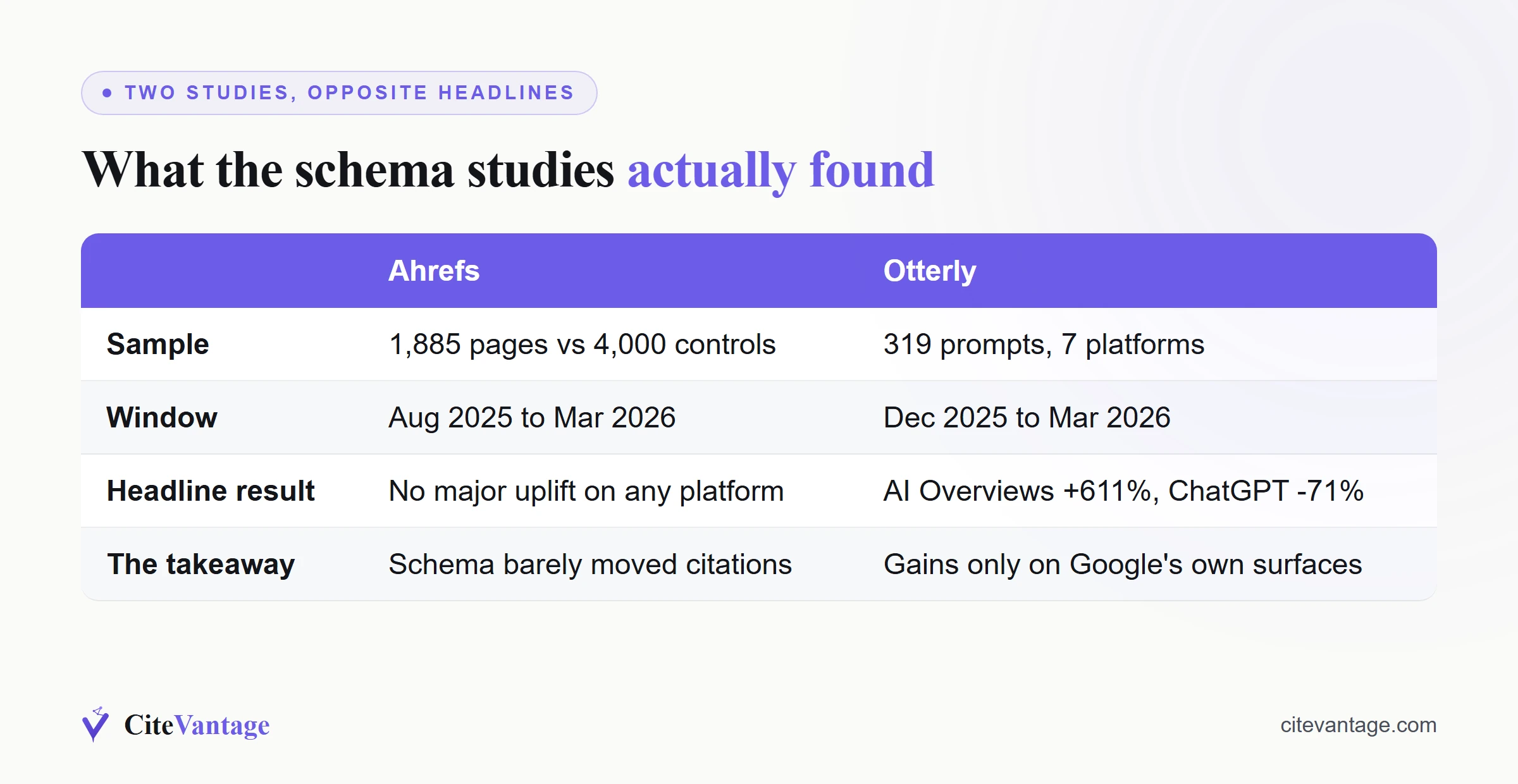
What the studies actually agree on
They agree more than the headlines suggest. Schema helps Google’s own surfaces, where structured data has always been read closely. Schema does little to nothing for the engines that lean on live retrieval of readable text. Google itself said in April 2025 that structured data gives an advantage in search results, as reported by Search Engine Land. Microsoft’s Fabrice Canel, a principal product manager, said in March 2025 that schema helps its LLMs understand content for Copilot. The official line is real. The measured lift is Google-shaped.
Why prevalence is not proof
Here is the trap most pages fall into. Ahrefs found that 53% of AI-cited pages use JSON-LD schema, roughly three times the rate of non-cited pages. That reads like a smoking gun until you get to Ahrefs’ own caveat, which calls it correlation rather than causation. Pages that earn citations tend to be better pages in every other respect as well, and better pages tend to carry schema, so prevalence is a hint rather than a verdict.
Which schema types for AI search matter most?
Mark up facts AI cannot safely infer. Tier 1 is Organization, which says who you are, and Product/Offer, which states price, availability, and rating. Tier 2 is Article, BreadcrumbList, WebPage and Person, which describe page structure and authorship. Everything else is optional. That is the whole ranking, and it is different from the pre-2026 lists.
Here is the tiered read.
| Schema type | Tier | What it verifies | Why it matters for AI |
|---|---|---|---|
| Organization | 1 | Entity identity, sameAs profiles | AI cannot safely guess who you are |
| Product / Offer | 1 | Price, availability, GTIN, rating | The exact facts AI shopping answers require |
| Article / BlogPosting | 2 | Author, date, headline | Confirms freshness and authorship |
| BreadcrumbList | 2 | Site hierarchy | Page-structure hygiene |
| WebPage / Person | 2 | Page and author entity | Supports E-E-A-T signals |
| FAQPage | Demoted | Q&A pairs | Still parsed, no visible result since May 2026 |
A correlation cross-check, not a to-do list. An empirical study from Spotlight looked at 5,499 websites cited by AI models and counted the schema types present. The most frequent were ImageObject, ListItem, SiteNavigationElement, Person, Question and Answer, WebPage, BreadcrumbList, Organization, AggregateRating and Product. Notice that most of those are page-furniture types a normal CMS emits on its own. That is prevalence again, not a ranking of what wins. Do not read it as a checklist.
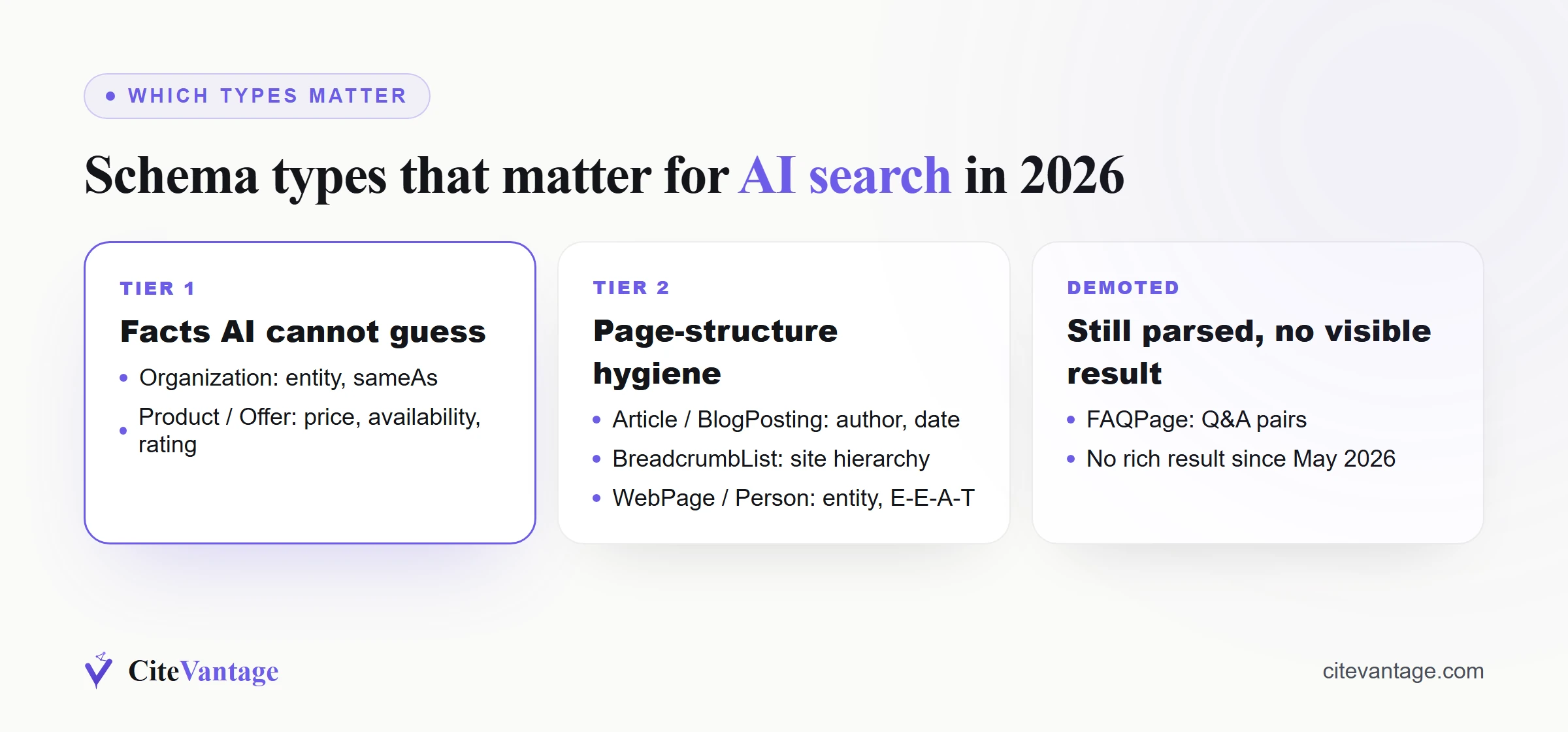
Tier 1: facts AI cannot guess
Two types earn their place before anything else. Organization tells the engine your name, logo, and sameAs links to profiles like LinkedIn, Clutch, and Wikidata, so it can resolve who you are and attribute a claim to you. Product and Offer state the numbers a machine will not invent: price, priceCurrency, availability, GTIN, brand, AggregateRating. These are the facts with a single right answer. Guessing wrong is worse than not answering, so AI leans on the markup when it exists.
Tier 2: page-structure hygiene
The rest is clean-up. Article and BlogPosting confirm the author and publish date, which supports freshness for time-sensitive queries. BreadcrumbList describes where the page sits in your site. WebPage and Person round out the entity picture and feed E-E-A-T signals. Useful, all of it. None of it wins a citation on its own. And one rule holds across every type: only mark up what is visible on the page. Schema-only facts do not get extracted, and hiding them breaks Google’s own guidelines. Our technical rail on llms.txt covers the sibling question of what crawlers can reach in the first place.
Is FAQ schema deprecated in 2026, and should you remove it?
FAQPage is not deleted. It is demoted. Google removed FAQ rich results from Search on May 7, 2026, so the markup no longer earns a visible result. You do not need to remove it. The FAQ content still helps AI. The markup no longer wins the SERP feature. That is the correction almost every ranking page has missed.
Walk the dates, because they matter for planning. The phase-out began in 2023, per Search Engine Journal. Full removal landed May 7, 2026. Rich Results Test support ends June 2026. Search Console API reporting ends August 2026. Google’s documentation is direct about what to do next: “FAQ structured data can stay in place. The markup won’t cause problems, but it also won’t produce visible results in Google Search.”
So keep the markup or drop it. Either is fine. What you should not do is keep listing FAQPage as the number one schema for AI search, which is exactly what most guides still do three months after it lost its feature.
Keep the FAQ content, demote the markup
The confusion comes from mixing content with markup. A clean question-and-answer block is extractable prose. AI pulls the answer whether or not it sits inside a FAQPage wrapper. We have watched Perplexity quote a plain 200-word FAQ section over a 2,000-word guide with full schema. So keep writing tight FAQ sections. They earn citations as text. Just stop counting the FAQPage tag as a lever that moves anything.
What schema can ChatGPT and Perplexity actually read?
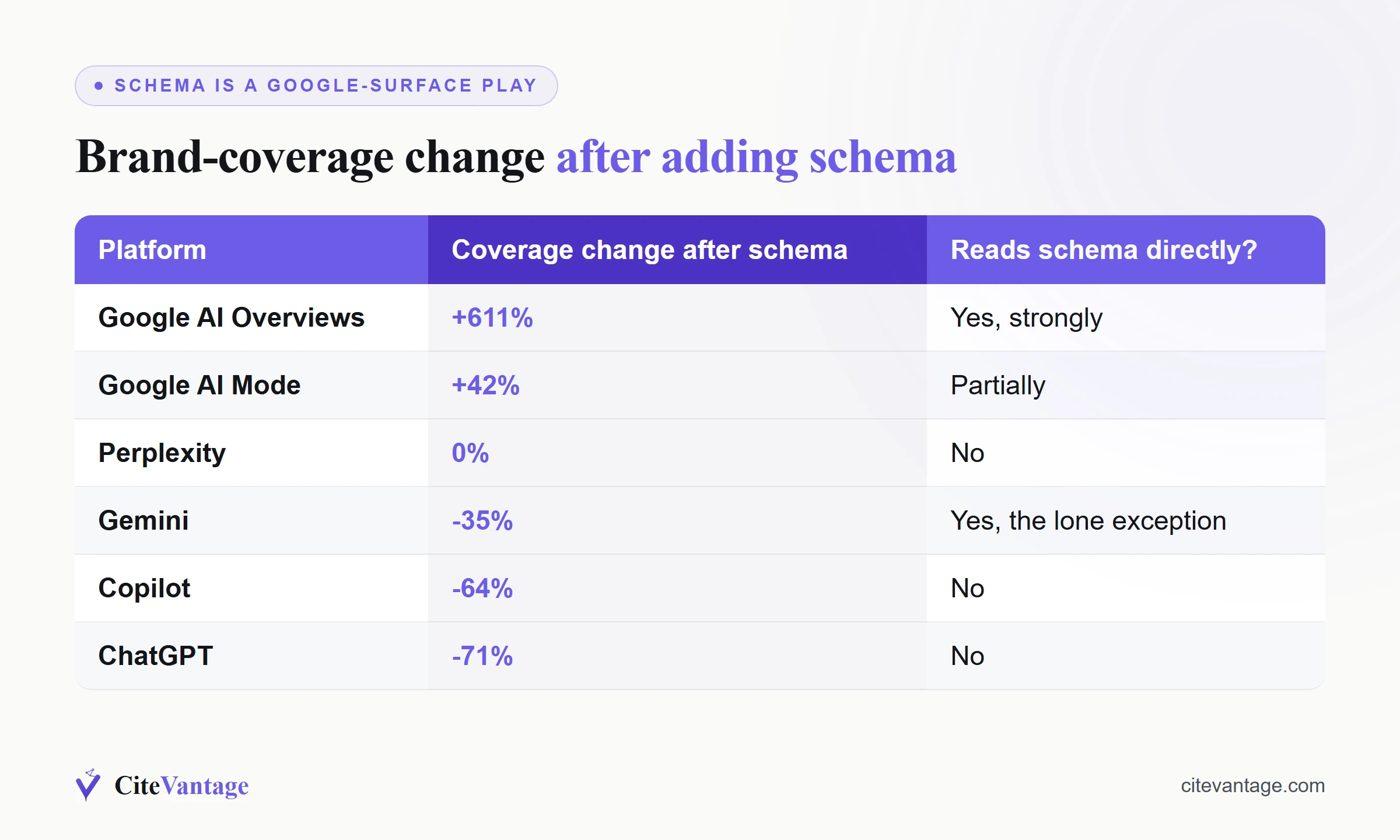
Not much, directly. In Otterly’s test, six of seven AI platforms could not fetch or correctly interpret schema markup when asked directly. Gemini was the lone exception that retrieved it. Google’s own surfaces use it best. ChatGPT, Copilot and Perplexity lean on readable on-page content, not your JSON-LD. If your plan is “add schema so ChatGPT cites us,” the data says that plan is thin.
The full split is worth seeing in one place, because competitors quote it piecemeal.
| Platform | Brand-coverage change after schema | Reads schema directly? |
|---|---|---|
| Google AI Overviews | +611% | Yes, strongly |
| Google AI Mode | +42% | Partially |
| Perplexity | 0% | No |
| Gemini | -35% | Yes, the lone exception |
| Copilot | -64% | No |
| ChatGPT | -71% | No |
Those numbers come from Otterly’s experiment, 319 prompts across seven platforms. Their conclusion, verbatim: “Six out of seven AI Search platforms were unable to fetch or correctly interpret schema markup when directly asked.” Read the pattern, not each cell. Schema is a Google-surface play. Everywhere else, the negative swings tell you the win comes from clear, answerable content, not markup.
For the engines that ignore your JSON-LD, the work is different. Our guides on how to get cited by ChatGPT and how to get cited by Perplexity go into the answer-capsule and third-party-mention work that actually moves those two.
What structured data do AI shopping answers need?
For AI comparison and shopping answers, product data needs GTIN, brand, availability, price, priceCurrency and AggregateRating, the core Product and Offer fields. Miss any one of those and your products can go invisible in AI shopping queries. SEOptimer notes that Product, Offer, and Brand markup is what keeps products showing accurately in AI-generated shopping results.
This is the single place where schema is close to non-negotiable, because these are exact facts AI will not invent.
This is Tier 1 earning its keep. Product and Offer are where markup pays, since a shopping answer that names a price, a rating, and stock status cannot afford to guess. The required fields split into three simple jobs.
- Identity: GTIN and brand, so the item is unambiguous
- The offer: price, priceCurrency, availability, the numbers a buyer compares
- Social proof: AggregateRating, which AI surfaces in “best” and comparison answers
For Shopify and WooCommerce founders, this is the highest-return schema on the site, and it is the part default themes get half-right. Our ecommerce GEO service exists partly because so many product feeds ship with the type set and the fields blank. Which brings up the failure mode most stores never check.
Can schema markup hurt your AI visibility?
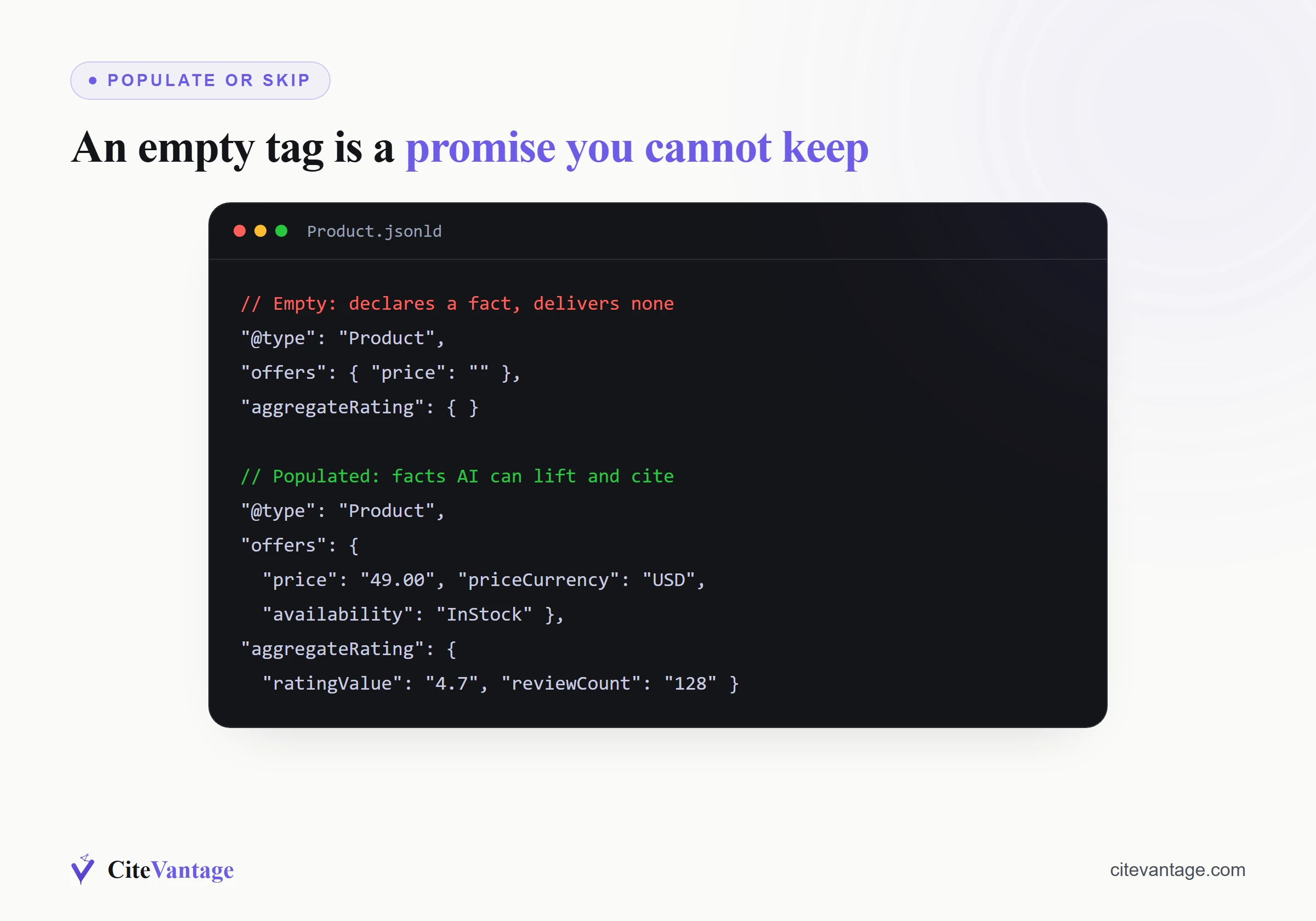
Yes, when it does not match the page. Otterly found that no AI platform could answer a question from schema-only facts, and Google AI Mode even reported schema types that were not on the page at all. An empty Product tag with no price and no rating is a broken promise a machine can see. It declares a fact and then fails to state it. That reads as noise.
Warning: Never mark up something the page does not visibly show. Structured data describing content a human cannot see is a policy violation, and the specific case worth naming is
aggregateRatingon your own Organization: reviews you control make the page ineligible for star results and put a manual action on the table.
The underused point is this: the properties are the signal, not the type declaration. Price, rating, author, date. Those carry the meaning. A Product label with nothing inside it tells an engine to expect commercial facts, then delivers none. Half-filled schema from a default plugin is the common failure mode for DTC stores, and it is invisible until someone reads the raw output. So the test is not “do we have schema.” The test is “is every property populated with a real value that also shows on the page.”
A simple rule for deciding what to mark up
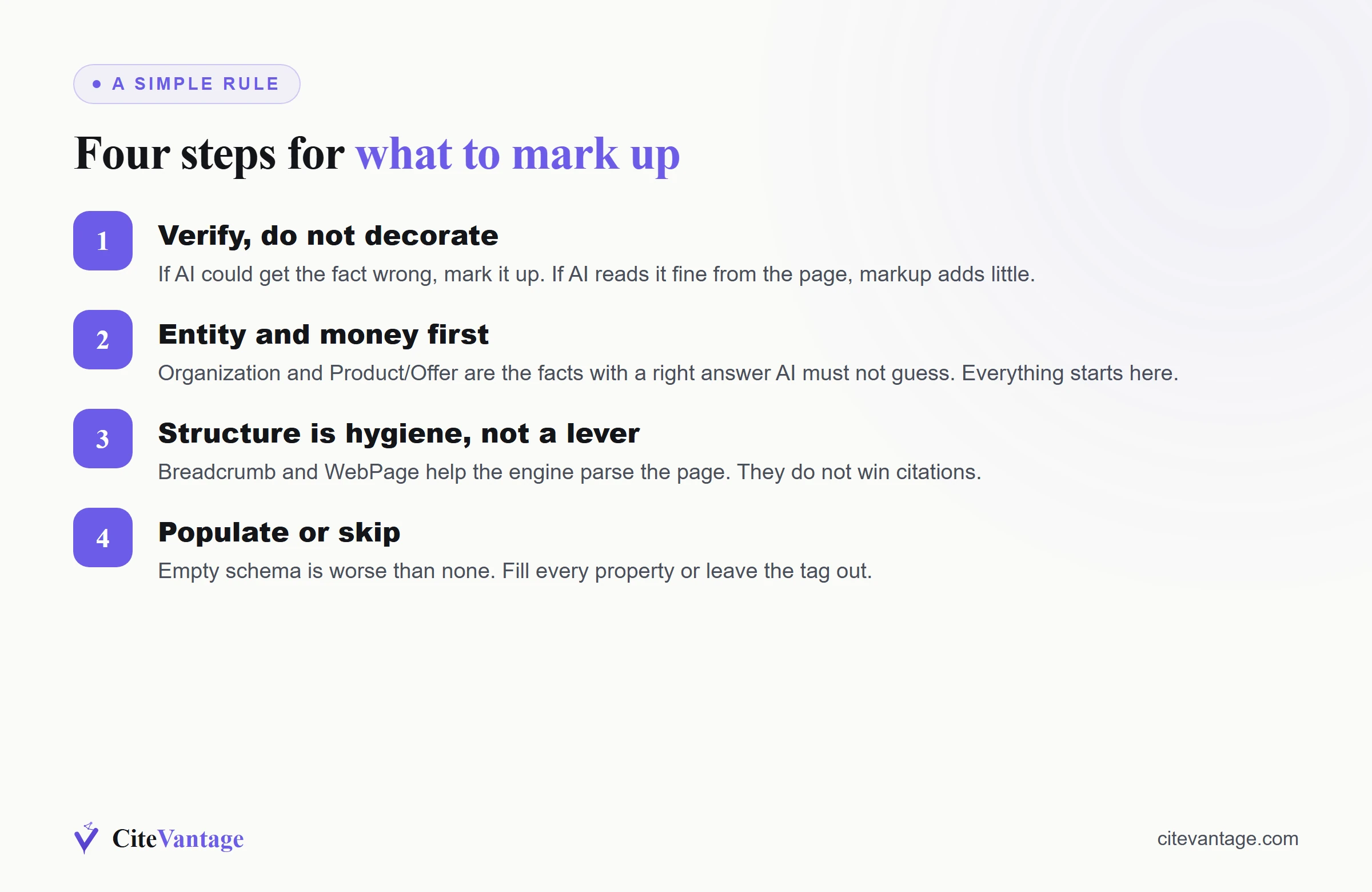
Mark up the facts AI cannot safely guess, and treat the rest as hygiene. Start with your entity, Organization, and your commercial facts, Product and Offer. Add page-structure schema like Breadcrumb and WebPage as clean-up. Stop treating schema as a citation lever. Treat it as a fact-verification layer. That single reframe fixes most schema strategies.
Four steps, in order.
- Verify, do not decorate. If AI could get the fact wrong, mark it up. If AI reads it fine from the page, markup adds little.
- Entity and money first. Organization and Product/Offer are the facts with a right answer AI must not guess. Everything starts here.
- Structure is hygiene, not a lever. Breadcrumb and WebPage help the engine parse the page. They do not win citations.
- Populate or skip. Empty schema is worse than none. Fill every property or leave the tag out.
Now the part that matters most, from our own data. In our audit of 181 ecommerce brands, 87% were cited zero times across four AI engines. Schema was not the dividing line: plenty of the invisible brands carried clean markup, and plenty of the cited ones carried almost none. In ongoing audits we have watched DA-10 sites beat DA-90 sites inside ChatGPT answers, which tells the same story from a different angle. Schema is not what separates cited brands from invisible ones. If your brand is missing from AI answers, the reasons your brand is invisible to AI run deeper than a missing tag. The RIPT Apparel case study shows what closing that deeper gap looked like for one ecommerce brand.
Where schema markup for AI search fits, and where it does not
Schema verifies the facts you already state on the page. It will not tell you whether AI names your brand today. Those are two different questions, and only one of them shows up in your structured data. The free AI Visibility Snapshot answers the second one.
It checks where you stand across ChatGPT, Perplexity, Gemini and Google AI Overviews, so you know whether the problem is your markup, your content, or the fact that no trusted source mentions you yet.
Frequently asked questions
Does schema markup help you get cited by ChatGPT and Perplexity?
+
Barely, when asked directly. In Otterly's experiment, six of seven AI platforms could not fetch or correctly interpret schema. ChatGPT and Perplexity read the on-page content, not your JSON-LD. Schema helps Google's own surfaces most. For the rest, a clear answer in plain text does the work.
Is JSON-LD required for AI search?
+
It is the standard, not a legal requirement. JSON-LD is Google's recommended format, per SEOptimer, and by far the most common one, because it parses as standalone JSON without crawling the HTML. If you mark up anything, mark it up in JSON-LD. Microdata and RDFa are the old way.
Should I remove FAQ schema after Google dropped rich results?
+
No. Google's own docs say it can stay in place, will not cause problems, and simply will not produce a visible result anymore. Removing it is wasted effort. Google dropped FAQ rich results on May 7, 2026, per Search Engine Journal. The markup is demoted, not broken.
What is the best schema for AEO and GEO?
+
Organization and Product/Offer. Those carry the facts AI cannot safely guess, who you are and what you sell for how much. Structure schema like BreadcrumbList and WebPage is hygiene, useful but not a citation lever. Start with entity and money. Add the rest as clean-up, not as strategy.
Can empty or wrong schema hurt my AI visibility?
+
Yes, when it does not match the page. Otterly found that no AI platform could answer from schema-only facts, and Google AI Mode even reported schema types that were not on the page at all. An empty Product tag with no price or rating declares a fact it cannot back up. Populate every property with a real value that also appears on the page, or leave the tag out.
What product fields do AI shopping answers need?
+
GTIN, brand, availability, price, priceCurrency and AggregateRating, the core Product and Offer fields. Miss one and your products can drop out of AI shopping and comparison answers. This is the one place schema is close to non-negotiable, because these are exact facts an AI will not invent for you.
More in AI SEO, GEO and AEO
- Domains AI Cites on Real Estate: The Open List
- Hostinger CDN Blocks GPTBot: HTTP 429 Case Study
- AI Search Statistics 2026: Sourced and Dated
- AI Tools for SEO and AEO: Track ChatGPT Mentions
- Best AI Mode SEO Analysis Tools for 2026
- Best AI SEO Agencies 2026: 15 Firms Ranked
- Can AI Crawlers Reach Your Site? How to Check
- GEO Case Studies: Successful Campaigns
- GEO vs SEO vs AEO: The Real Difference in 2026
- Generative Engine Optimization: GEO and AEO Guide
- Google Preferred Sources: Myths, Broken
- How to Check if ChatGPT Recommends Your Brand
- How to Get Cited by ChatGPT: 2026 Playbook
- How to Get Cited by Google Gemini
- How to Get Cited by Perplexity: 9 Source Signals
- How to Rank in Google AI Overviews: 2026 Guide
- How to Run an AI Visibility Audit Step by Step
- How to Track Competitors in AI Search Results
- Most Popular AI Visibility Tools for SEO
- SEO and GEO Strategy: Make Them Work Together
- What Is llms.txt? Complete Setup Guide
Start from the hub: AI SEO, GEO and AEO
See where AI is hiding your brand
Free multi-engine audit across ChatGPT, Gemini, Google AI & Perplexity.
See who AI names instead of me