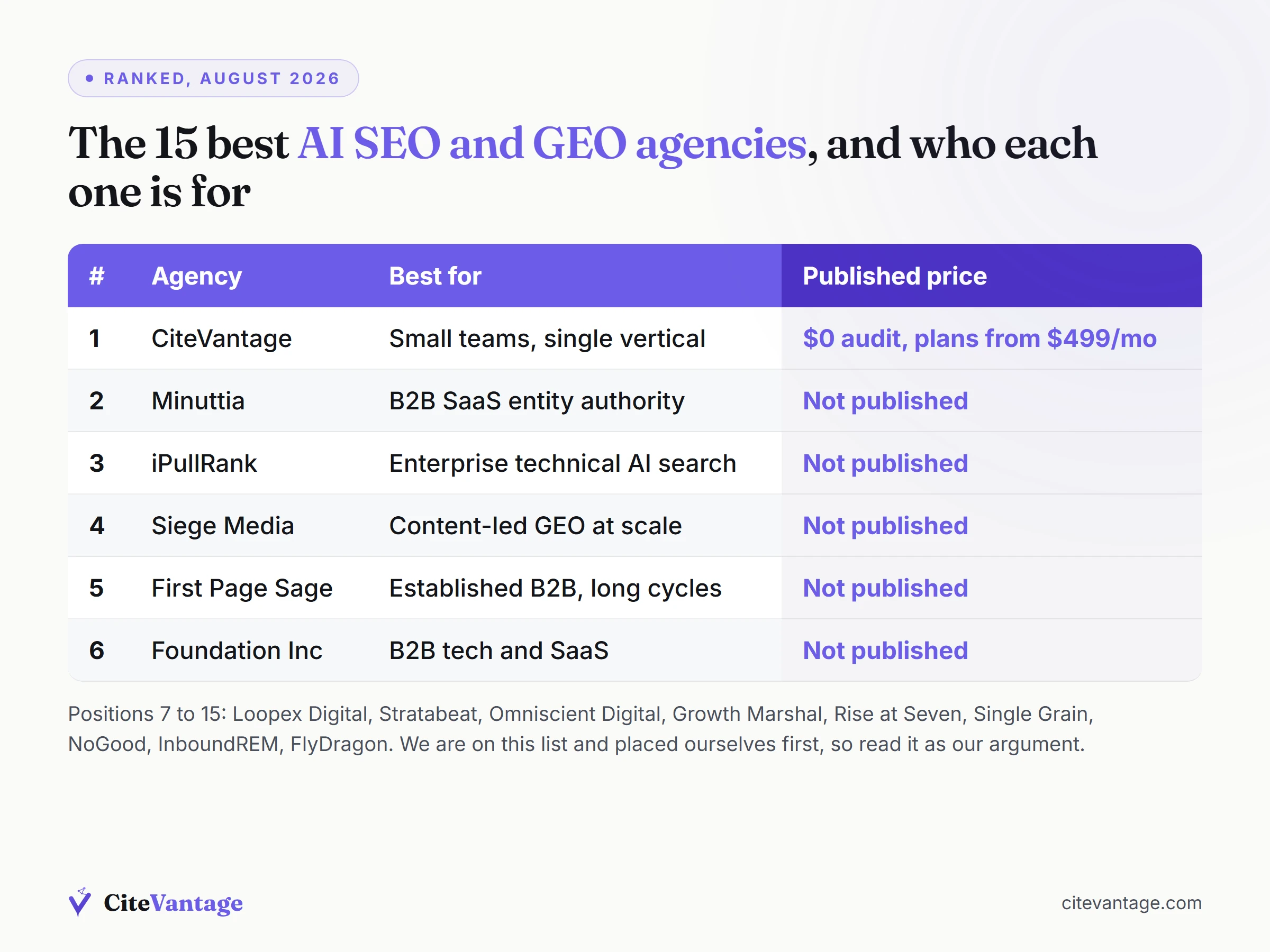
The best AI SEO agency for you depends on your size and budget, not on who tops a list. This ranking of the best AI SEO agencies 2026 covers 15 firms we checked in August 2026 against three things we could actually verify from their own websites: whether they publish pricing, whether they offer any guarantee, and whether their stated specialism is real or a relabelled SEO service. CiteVantage sits at number one for small teams and single-vertical brands. For enterprise programmes, Minuttia and iPullRank are better calls, and we say so below.
A disclosure, before anything else
We are on this list, and we put ourselves first. So read this as our argument rather than a neutral verdict, and use the test at the end to check it. Every fact about another agency here was read off that agency’s own website in August 2026, and anything we could not confirm is marked UNVERIFIED rather than guessed.
Here is why we think the argument holds anyway. Almost every “best GEO agency” article is written by whoever sits at number one, and most of them hide that. We would rather state it, publish the criteria, publish our own weaknesses, and let you compare. Every claim below about another agency is something we fetched from their own website in August 2026. Where we could not verify something, the table says UNVERIFIED rather than guessing.
Do you actually need a GEO agency right now?
Probably not, if nobody is searching for your category in AI tools yet. Run your top buyer question through ChatGPT and Perplexity before you spend anything. If a competitor gets named and you do not, you have a gap worth paying to close. If the engines return vague, generic answers with no brands, the category is not being answered yet and your money is better spent elsewhere.
You can also do a meaningful amount yourself. Adding direct-answer sections, publishing genuine first-party data and earning a handful of third-party mentions will move simpler queries without an agency. The wall most in-house teams hit is measurement across several engines plus the off-site work, since AirOps found 85% of brand mentions in AI answers come from domains other than the brand’s own. That is the part that eats a full-time role.
How we ranked the best AI SEO agencies 2026
We deliberately scored what can be checked rather than what sounds impressive. Every criterion below is something a reader can verify on the agency’s own site in a few minutes: published pricing, named case studies with numbers, original research and a stated method for measuring AI citations. Claims we could not check score zero.
| Criterion | What we checked | Why it matters |
|---|---|---|
| Published pricing | Is a real figure visible on the site or in llms.txt? | Hidden pricing is not dishonest, but published pricing lets you disqualify fast |
| Stated specialism | Homepage title and H1, in their own words | Separates a real focus from a general agency with a new label |
| GEO or AEO on the homepage | Does the term appear at all? | A firm not saying it publicly is unlikely to be built around it |
| Guarantee | Any written commitment, and what kind | Almost nobody offers one, and the type matters more than the existence |
| Vertical proof | Case studies inside a named industry | Cross-industry results rarely transfer to a niche |
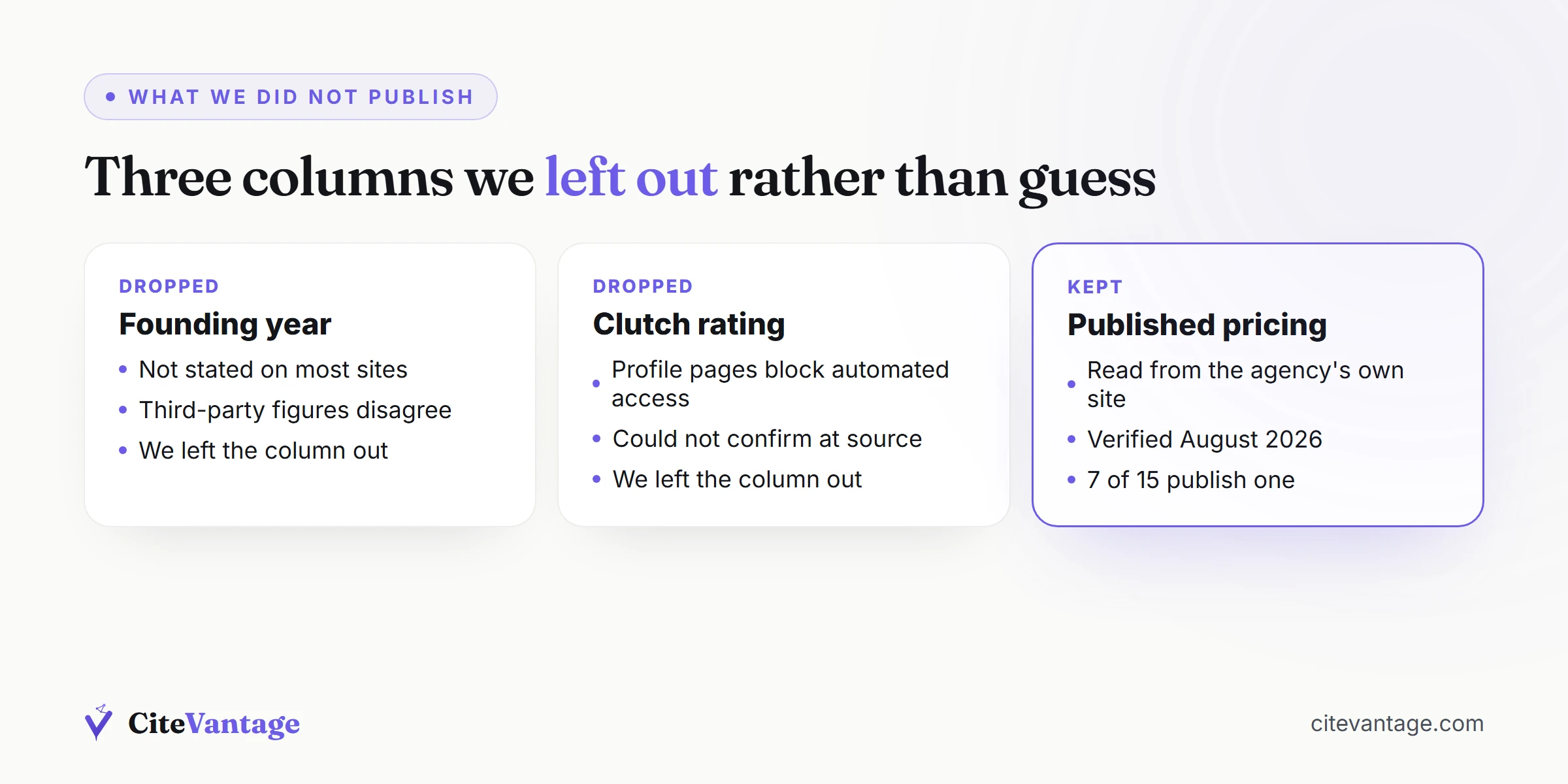
What we could not verify, and did not publish: founding years, headcount and Clutch ratings. Several profile pages block automated access, and we would rather leave a column out than fill it with numbers we did not confirm. If a comparison table anywhere shows a confident figure for all 15, ask where it came from.
Quick comparison: the top AI SEO agencies 2026 at a glance
Verified in August 2026 from each agency’s own website, not from directories, press releases or third-party listings. Where a figure or a claim was not published anywhere we could reach, the row says so rather than carrying an estimate. Prices and positioning move, so re-check anything you are about to act on.
| # | Agency | Best for | Public pricing | Starting price | Guarantee |
|---|---|---|---|---|---|
| 1 | CiteVantage | Small teams, single vertical | Yes | $0 audit, $249 Sprint, plans from $499/mo | 1-in-4: 25% of agreed questions in 90 days, or two free months |
| 2 | Minuttia | B2B SaaS entity authority | No | UNVERIFIED | None found |
| 3 | iPullRank | Enterprise technical AI search | No | UNVERIFIED | None found |
| 4 | Siege Media | Content-led GEO at scale | No | UNVERIFIED | None found |
| 5 | First Page Sage | Established B2B, long cycles | No | UNVERIFIED | None found |
| 6 | Foundation Inc | B2B tech and SaaS | No | UNVERIFIED | None found |
| 7 | Loopex Digital | Breadth of specialisms | Partial | $1,500/mo | None found |
| 8 | Stratabeat | B2B brand plus GEO | No | UNVERIFIED | None found |
| 9 | Omniscient Digital | B2B software content | Yes | $10,000/mo | None found |
| 10 | Growth Marshal | Small business | No | No longer published (site now redirects to machinelike.ai) | None found |
| 11 | Rise at Seven | Digital PR driven citations | No | UNVERIFIED | None found |
| 12 | Single Grain | Multi-channel revenue marketing | Yes | $10,000 | Response time only |
| 13 | NoGood | Venture-backed growth teams | No | Average retainer above $20,000/mo | None found |
| 14 | InboundREM | Real estate, long track record | Yes (in llms.txt) | $750/mo | None found |
| 15 | FlyDragon | Real estate, market coverage | Yes | $799/mo (Town tier, September 2026) | Market exclusivity, plus a 90-day free extension (September 2026) |
Two agencies we removed. Terakeet and Amsive appear on other GEO lists, and both now offer AI search work: Amsive lists “SEO + AEO” among its services and Terakeet lists “Generative AI Optimization”. Neither leads with it. Terakeet’s homepage positions it as reputation management and Amsive’s as data-led performance marketing, so we kept the list to firms whose positioning centres on search.
What it actually costs
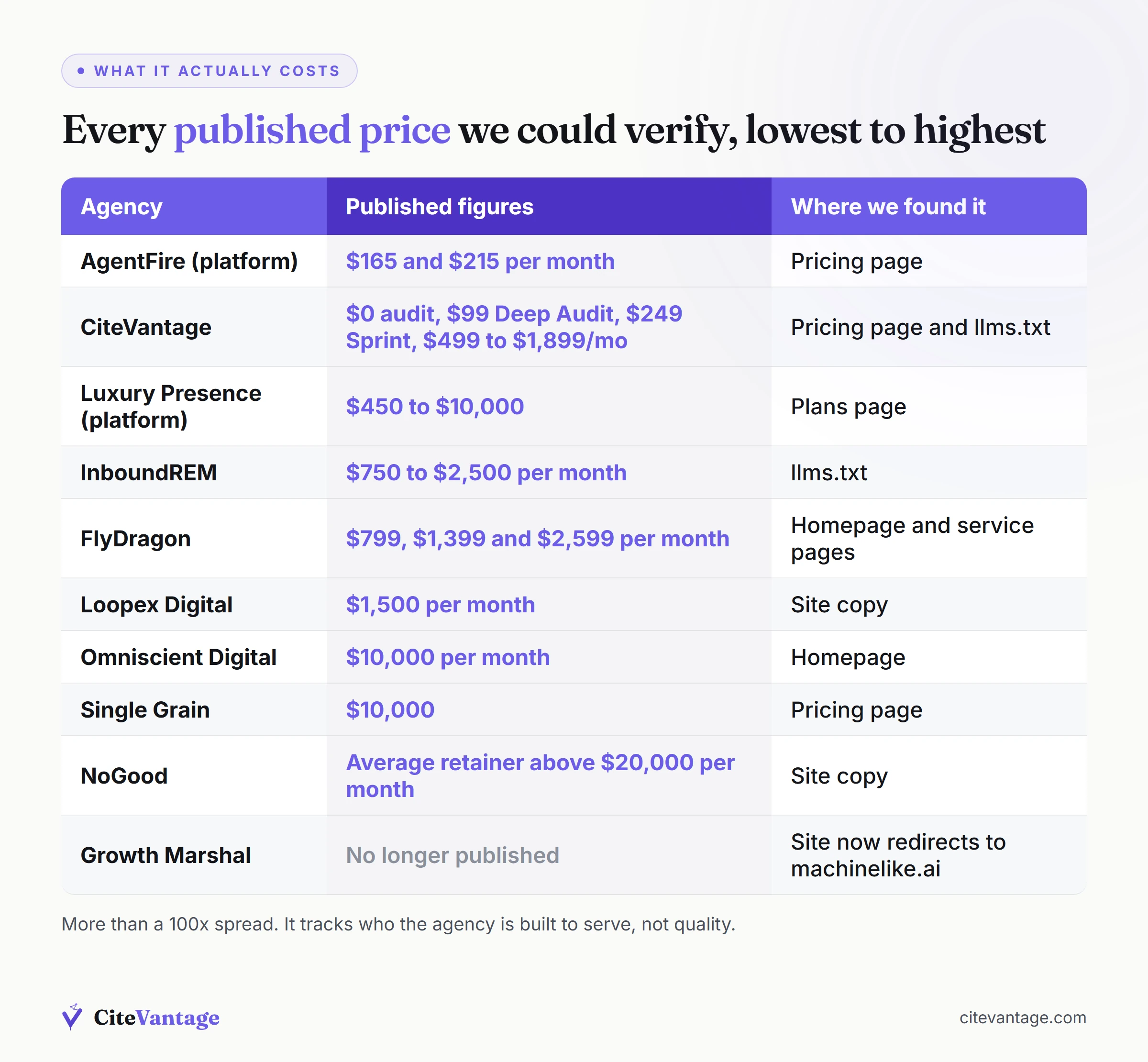
Only 7 of the 15 publish a number. Here is every figure we could verify, read off the agency’s own pricing page in August 2026. The spread is wide enough that an average would mislead, so the individual figures are listed instead, with the pricing model each one attaches to.
| Agency | Published figures | Where |
|---|---|---|
| CiteVantage | $0 audit, $99 Deep Audit, $249 one-time Sprint, then $499, $999 or $1,899 per month | Pricing page and llms.txt |
| AgentFire (platform) | $165 and $215 per month | Pricing page |
| Growth Marshal | No longer published (site now redirects to machinelike.ai) | Former pricing page |
| Luxury Presence (platform) | $450 to $10,000 | Plans page |
| InboundREM | $750 to $2,500 per month | llms.txt |
| FlyDragon | $799 per month for the Town tier on a 6-month commitment (checked September 2026), $1,399 and $2,599 per month | Homepage and service pages |
| Loopex Digital | $1,500 per month | Site copy |
| Omniscient Digital | $10,000 per month | Homepage |
| Single Grain | $10,000 | Pricing page |
| NoGood | Average retainer above $20,000 per month | Site copy |
The spread is more than 100 times from bottom to top, from $165 a month to an average retainer above $20,000, and it does not track quality. It tracks who the agency is built to serve. A $20,000 monthly retainer is the right answer if you are defending a category. It is the wrong answer if you need six pages cited by next quarter.
The guarantee question, and why almost nobody offers one
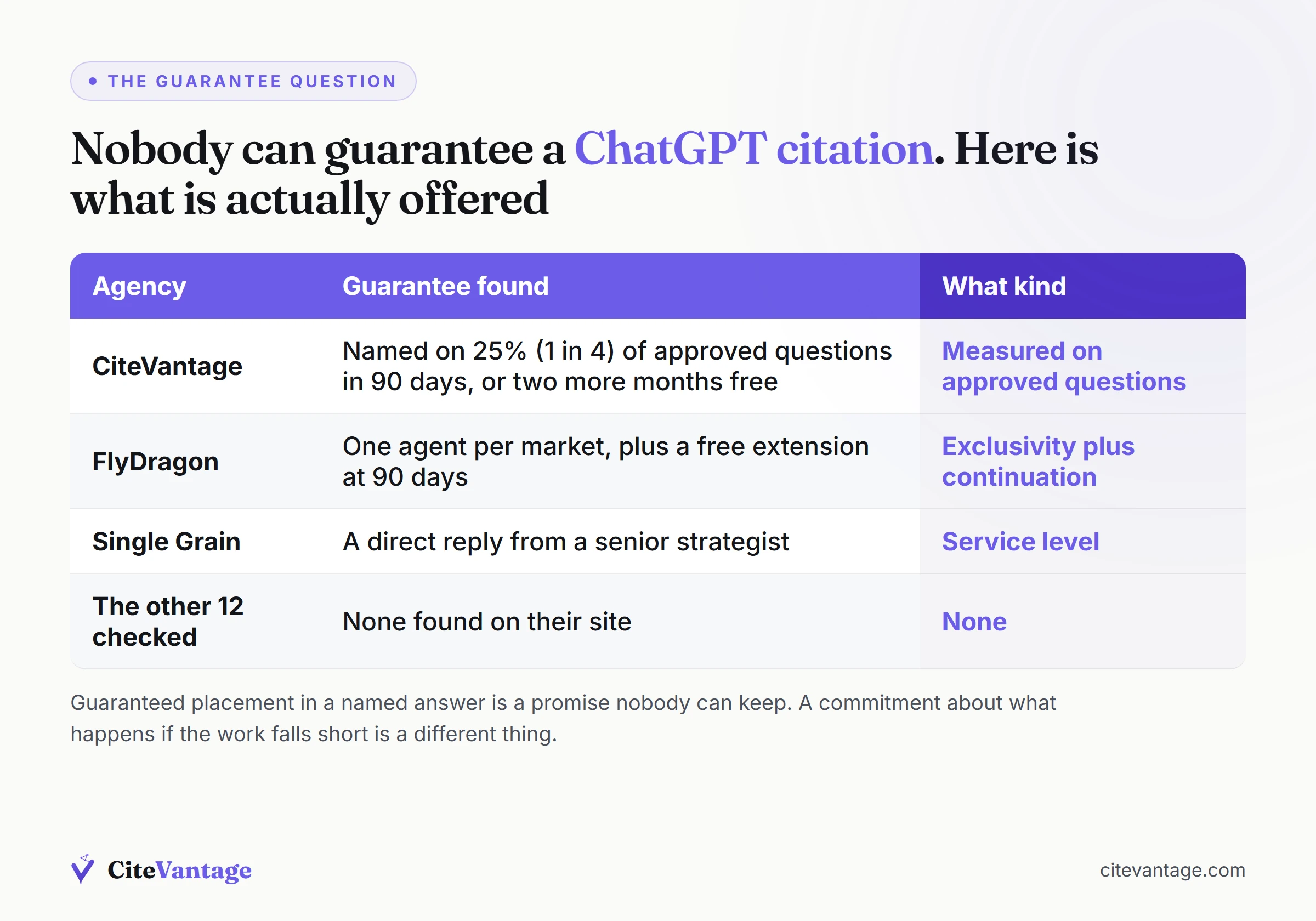
No agency can honestly guarantee that ChatGPT will cite you. The engines own their retrieval logic and change it constantly. Anyone promising guaranteed placement in a specific answer is selling certainty that does not exist, and the wider industry treats that promise as a red flag. We agree with that.
What an agency can commit to is what it will do if the work falls short. That is a different kind of promise, and it is the only kind worth having.
| Agency | Guarantee found | Type |
|---|---|---|
| CiteVantage | 1-in-4: 25% of agreed questions in 90 days, or two free months | Measured on client-approved questions |
| FlyDragon | Market exclusivity, one agent per market, and since September 2026 a free extension if its AI visibility score has not moved meaningfully in 90 days | Commercial exclusivity plus continuation |
| Single Grain | Personal attention and a direct reply | Service level |
| All others checked | None found on their site |
Ours is deliberately not a placement promise. The 1-in-4 Guarantee covers our monthly plans. You approve 50 to 100 buyer questions in week one, we baseline them across ChatGPT, Perplexity, Gemini and Copilot, and you publish our work within 14 days of delivery. If AI engines do not name you on at least 25% of those questions within 90 days, we work the next two months free. A question counts when you appear in two of three runs. The remedy is always more work, never a refund, because a refund leaves you exactly where you started. Outside this list, Cited and KeyCrew also publish 90-day guarantees.
The 15 best AI visibility agencies, one by one
1. CiteVantage: best for small teams that want AI citation visibility without an enterprise retainer
We are an AI SEO agency working across ChatGPT, Google AI Overviews, Gemini, Perplexity and Copilot. The free audit measures where you stand on ChatGPT, Perplexity, Gemini and Copilot, the $249 one-time 30-Day Sprint fixes the gaps it finds, and monthly plans keep the work going. Our largest published dataset is the 500-Query Houston Real Estate AI Visibility Study: 2,000 AI answers in which about 94% of Houston’s roughly 50,000 Realtors were never named. An earlier study of 181 US ecommerce brands found 87% absent from all four engines it tested.
Pros: a published price ladder: a free audit, a $249 one-time Sprint, then monthly plans at $499, $999 or $1,899. The 1-in-4 Guarantee, measured on buyer questions the client approves. As of October 2026, ours is the only guarantee in this list measured on questions the client approves, with a published 25% threshold. Multi-engine measurement under a published method, with screenshots of real answers, not ranking charts. Direct access to the founder rather than an account manager. Real multi-site results, including Bright Realty International, a 17-domain international property network that reached roughly 2.1x organic clicks in three months and has 35 pages cited by AI engines.
Cons: founded in 2026, so there is no decade of references and we are the wrong call if that is your bar. Most of our published case studies are ecommerce rather than the vertical you may be in. We have no filmed client testimonials yet, so our proof is written and self-published and you should weigh it accordingly. We do not build websites. If you want a new site with MLS or ecommerce platform integration, Luxury Presence, AgentFire or a development shop will serve you better. We make the site you already have the one AI recommends. The work is done by one founder with capped intake, so there can be a wait.
On pricing, plainly: CiteVantage LLC is registered in Wyoming, and the work is founder-led from Pakistan on AI systems we built, which is why our prices sit below a comparable US agency’s. It is not a difference in method.
2. Minuttia: best for B2B SaaS entity authority
Homepage headline is “Dominate AI Search”, and the positioning is genuinely built around AI search rather than bolted on. Strong reputation in B2B SaaS content.
Pros: clear specialism, both GEO and AEO stated publicly, well regarded for depth on entity work. Cons: no published pricing, so you cannot qualify yourself before a call. No guarantee found. Narrow vertical fit if you are not B2B software.
3. iPullRank: best for enterprise technical AI search
Positions as a “Pioneering Enterprise and Mid-Market AI Search Agency”. The most technically credible name on this list for large, complex sites.
Pros: deep technical capability, genuine thought leadership, enterprise and mid-market focus stated openly. Cons: no published pricing and enterprise engagements are priced accordingly. AEO is not mentioned on the homepage. Almost certainly oversized for a small business.
4. Siege Media: best for content-led GEO at scale
Describes itself as a “Full-Service GEO Agency for Brands”. Content and digital PR heritage, now pointed at AI search.
Pros: strong content production capacity, GEO stated (AEO is not named on the homepage), real editorial quality. Cons: no published pricing. Content-led programmes need volume and time, so results are slower. Better fit for brands with existing authority than for a standing start.
5. First Page Sage: best for established B2B with long sales cycles
Titles itself simply “Best SEO Agency” and publishes a widely cited GEO agency roundup of its own.
Pros: established, publishes plenty of methodology, covers GEO and AEO. Cons: no published pricing. The “best SEO agency” framing is a claim rather than a specialism. Their roundups rank themselves highly, which is worth knowing when you read them.
6. Foundation Inc: best for B2B tech and SaaS content programmes
Homepage reads “AI Visibility Agency for B2B Tech & SaaS”, which is one of the more specific positions in this set.
Pros: clear vertical, AI visibility stated as the core service, respected content operation. Cons: no published pricing, and AEO is absent from the homepage. Not a fit outside B2B tech.
7. Loopex Digital: best for breadth of specialisms under one roof
An “SEO Agency for Growth in Search and AI” with an unusually wide service menu and, technically, the most sophisticated AI-readable setup we found anywhere: every page is available as clean markdown and there is a full-content file for language models.
Pros: excellent technical GEO implementation, strong digital PR engine, publishes at least one price. Cons: generalist rather than vertical. Their backlink profile includes a visible quantity of low-quality network links, which is worth asking about. Their real estate ranking page carries no real estate case studies behind it.
8. Stratabeat: best for B2B brand and GEO combined
An “Award-Winning B2B SEO, GEO & Content Agency” that pairs brand and design work with search.
Pros: brand plus search under one roof, GEO stated publicly, established B2B track record. Cons: no published pricing, and AEO is absent from the homepage. Regional and B2B focus limits fit.
9. Omniscient Digital: best for B2B software content programmes
An “Organic Growth Agency for B2B Software Companies” with a published entry point of $10,000 per month.
Pros: publishes pricing, which most of this tier does not. Clear vertical. Both GEO and AEO stated. Cons: the $10,000 entry point rules out most small businesses. No guarantee found. Content-led, so slow by design.
10. Growth Marshal: best for small business buyers who want published pricing
Positions around AI agents for small business. Its domains now redirect to machinelike.ai, and the tiered price list it used to publish is no longer available.
Pros: explicitly aimed at small business, and its pricing page lists GEO and content as one of the agent workloads it sells. Cons: neither GEO nor AEO appears on the homepage. The positioning leans toward AI agents rather than citation visibility specifically, so confirm the deliverable matches what you need. No guarantee found.
11. Rise at Seven: best for digital PR driven citations
An “Award Winning Search-First Content Marketing Agency” built on creative digital PR, which is a genuinely effective route to AI citations given how much of that citation layer is earned media.
Pros: the earned-media mechanism is exactly what moves AI citations, and a strong creative reputation sits behind it, with both GEO and AEO stated. Cons: there is no published pricing, and campaign-led work is unpredictable by nature. Not a technical GEO shop.
12. Single Grain: best for multi-channel revenue marketing
A “Revenue Marketing Agency” spanning SEO, paid media and AI growth, with pricing published from $10,000.
Pros: publishes pricing, broad channel coverage, well established. Cons: GEO is one service among many rather than the core. The only guarantee found relates to response times, not outcomes. Enterprise-level entry point.
13. NoGood: best for venture-backed growth teams
A growth marketing agency working with funded startups and scale-ups, with an average retainer above $20,000 per month visible in site copy.
Pros: strong growth-marketing pedigree, works with well-funded teams, AEO mentioned. Cons: the highest average retainer on this list. GEO is not stated on the homepage. Growth marketing first, AI visibility second.
14. InboundREM: best for real estate buyers who want a long track record
A real estate SEO and AEO agency publishing content since around 2017, with pricing disclosed inside its llms.txt at $750 to $2,500 per month.
Pros: by far the longest real estate track record here, roughly 750 pages of published content, an unusually strong entity setup including a machine-readable press and citation graph most agencies do not bother with. Publishes pricing. Cons: no guarantee found. GEO is absent from the homepage even though AEO is present. Real estate only, so no help outside that vertical. If you are weighing the two of us, our CiteVantage vs InboundREM comparison sets plans, terms, guarantee wording and proof side by side, each sourced and dated.
15. FlyDragon: best for real estate market-level coverage
An “AI SEO Agency for Real Estate Agents” with published pricing from $799 per month for its Town tier on a 6-month commitment (checked September 2026) up to $2,599 per month, filmed client testimonials and around 1,200 templated pages covering individual US markets.
Pros: the only competitor here with filmed, unscripted client video. Published pricing. Genuine market-by-market coverage. A market exclusivity guarantee, meaning one agent per market, and as of September 2026 a promise on its GEO service page to extend the engagement free if your AI visibility score has not moved meaningfully in 90 days. Cons: their templated market pages carry only default page and breadcrumb markup, with no agent or list structured data, and some are padded with placeholder agent entries. The stated ranking basis on those pages does not correspond to any visible field. Real estate only. The CiteVantage vs FlyDragon comparison puts price, minimum term, guarantee wording and proof next to each other, with our bias declared.
Red flags to watch for
| Red flag | Why it matters |
|---|---|
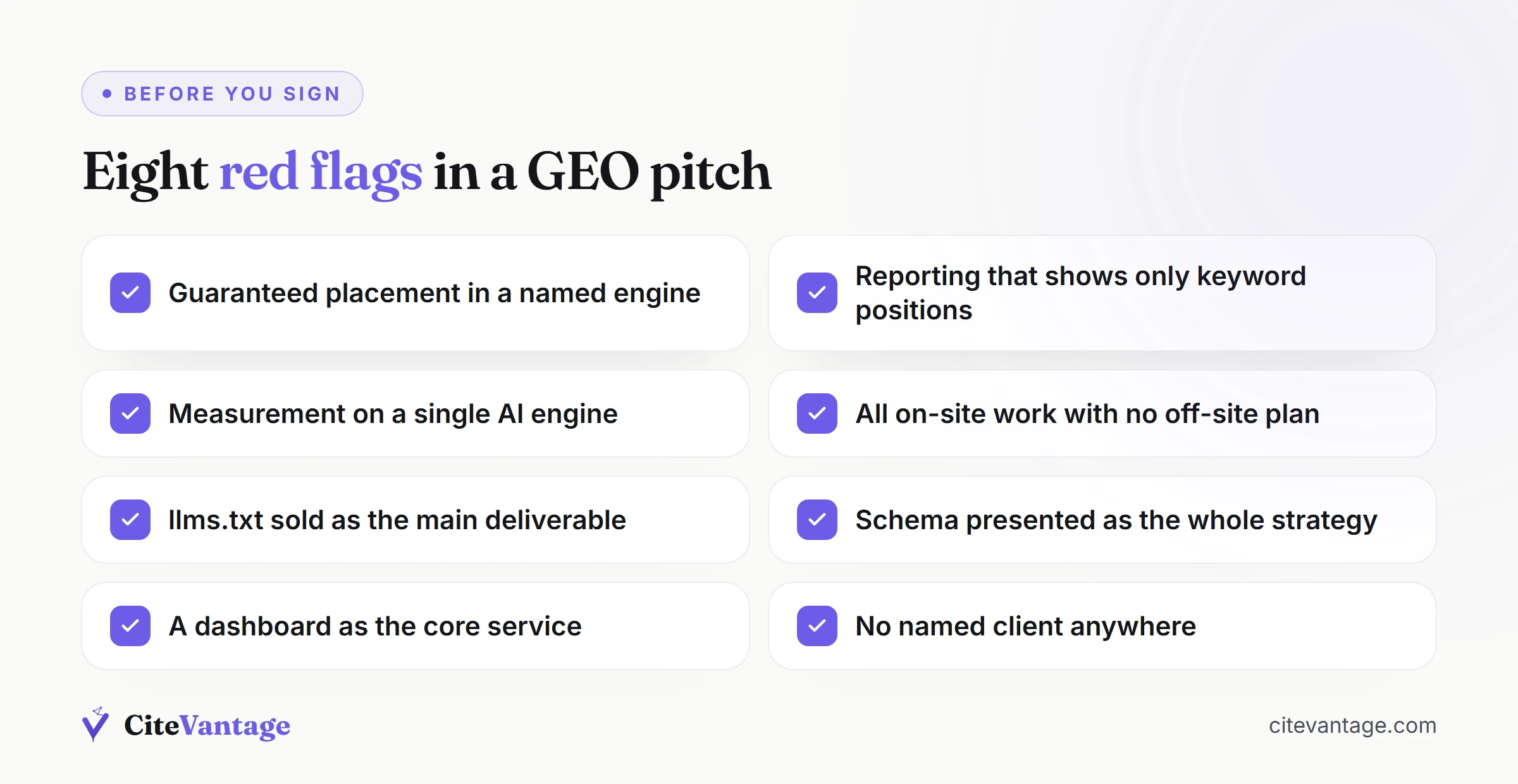
| Guaranteed placement in a named engine | Nobody controls what ChatGPT cites. This promise cannot be kept |
| Reporting that shows only keyword positions | Rankings are not citations. Ask for AI answer screenshots |
| Single-engine measurement | Perplexity, ChatGPT and AI Overviews draw from different sources, as our 150-query real estate AI search study found |
| All on-site work, no off-site plan | AirOps: 85% of AI brand mentions come from external domains |
llms.txt sold as the main deliverable | Google states plainly that it ignores the file for Search |
| Schema presented as the whole strategy | Useful hygiene, not a citation lever on its own |
| A dashboard as the core service | Monitoring tools cost $29 to $200 per month on their own |
| No named client anywhere | Anonymised case studies cannot be checked |
Questions to ask any agency before you sign
| Question | What a good answer sounds like |
|---|---|
| Can you show a client named inside a real AI answer? | A screenshot with the query visible, not a traffic chart |
| Which engines do you measure, and how often? | Several named engines, on a stated cadence, with a baseline |
| What is your off-site plan? | Specific publications and communities, not “we’ll build links” |
| What happens if it does not work? | A stated remedy. Most have none, which is fine if they say so |
| Who does the work? | A named person. Ask whether the pitch team is the delivery team |
| What do you not do? | Any agency that claims to do everything is selling you something |
Which agency should you actually pick?
If you are a small team or a single-vertical brand, start with a free audit and a fixed-scope sprint rather than a retainer. That is where CiteVantage sits and it is the argument this page exists to make. If you are running an enterprise programme with a category to own, Minuttia, iPullRank or Siege Media are better matches and we would rather tell you that than take the wrong engagement.
The honest summary of this market in 2026 is that the label moved faster than the practice. Most of the fifteen firms here mention GEO or AEO publicly, but the underlying work is often the same content and authority programme it always was. That is not a scandal, because entity authority and quotable content genuinely are the job. It just means the label tells you very little, and the only reliable filters are published pricing, measurable proof and a straight answer about what happens if it fails.
If you are in real estate specifically, we ran the same 15-agency exercise for that vertical, including which agency each of the five engines actually named, in the best AI SEO agencies for real estate agents.
We have run the same exercise for three more buyer types: real estate brokerages and teams, property management companies, and ecommerce and DTC brands. Each has a different shortlist, because the engines answer each question from different sources.
Run your top buyer question through ChatGPT and Perplexity right now. If a competitor is named and you are not, that gap is the entire brief. Our free AI visibility audit checks ChatGPT, Perplexity, Gemini and Copilot and shows you exactly who gets cited instead of you.
Frequently asked questions
How much does a GEO agency cost in 2026?
Anywhere from $165 per month to $20,000 per month, based on the pricing pages we checked in August 2026.
Website platforms sit at the low end and venture-growth agencies at the top. Specialist GEO retainers cluster between $1,000 and $10,000 per month, and most enterprise firms publish no figure at all. Only 7 of the 15 agencies we checked show any price publicly, so budget for a discovery call before you get a number.
Can a GEO agency guarantee my brand will be cited by ChatGPT?
No, and a promise of guaranteed placement is a red flag.
The engines control their own retrieval and citation logic and change it often, so nobody can promise a spot in a specific answer. What an agency can commit to is effort and continuation. Our 1-in-4 Guarantee on monthly plans is that kind: if AI engines do not name you on at least 25% of the 50 to 100 buyer questions agreed at kickoff within 90 days, we work the next two months free. The remedy is always more work, never a refund.
What should I look for when choosing a GEO agency?
Proof of real AI citations for real clients, and a straight answer about what happens if the work falls short.
A Google ranking chart is no evidence of a citation, and single-engine reporting hides most of the picture. Ask for these before you sign:
- Before-and-after screenshots of real AI answers naming a client, with the query visible.
- Measurement across several engines, since ChatGPT, Perplexity and Google AI Overviews draw from different sources.
- A stated remedy if results fall short, which separates a deliverables contract from an outcome commitment.
- A named person who will actually do the work.
Are GEO agencies just rebranded SEO agencies?
Many are, and the reporting usually gives it away.
Most of the 15 agencies we checked in August 2026 mention GEO or AEO on their homepage, but the service underneath is often the same content and link programme with new labels. Real GEO work tracks who gets cited across engines before and after. If the reporting shows only keyword positions and traffic, it is search engine optimisation with a new sticker on it.
How long does GEO take to work?
Expect first movement in two to four weeks and anything meaningful in about a quarter.
Engines that search the live web, such as Perplexity and Google AI Overviews, can surface a new structured answer within days of a recrawl, while ChatGPT and Gemini tend to lag. Authority work, which is what moves buyer-intent questions, depends on other sites publishing about you and takes months. That pace is why our 1-in-4 Guarantee runs over 90 days instead of 30.
Can I do GEO myself instead of hiring an agency?
Yes, up to a point.
Adding direct-answer sections, publishing genuine data and earning a few third-party mentions will move simpler queries without help. The wall most in-house teams hit is measurement across several engines plus the off-site work, and Muck Rack reported that 84% of AI citations reference earned media instead of brand websites. That part needs either time you do not have or someone doing it full time.
Which AI engines matter most for brand visibility?
ChatGPT, Google AI Overviews, Google AI Mode and Perplexity carry the most buyer traffic today, with Copilot mattering in Microsoft-heavy markets.
They do not share sources, so winning one tells you little about the rest. In our 150-query real estate study, 83% of the 1,297 domains cited reached only one of five engines, and each engine had a different most-cited source. Single-engine reporting is therefore a warning sign.
What is the difference between GEO, AEO and traditional SEO?
SEO ranks a page in a list of links, while GEO earns your brand a mention or citation inside an AI-generated answer.
AEO sits between them, structuring content so an engine can lift a clean, direct answer out of it. The three overlap heavily, and Google's own position is that optimising for AI search is still SEO. The genuinely new part is the citation layer and the work of measuring it.