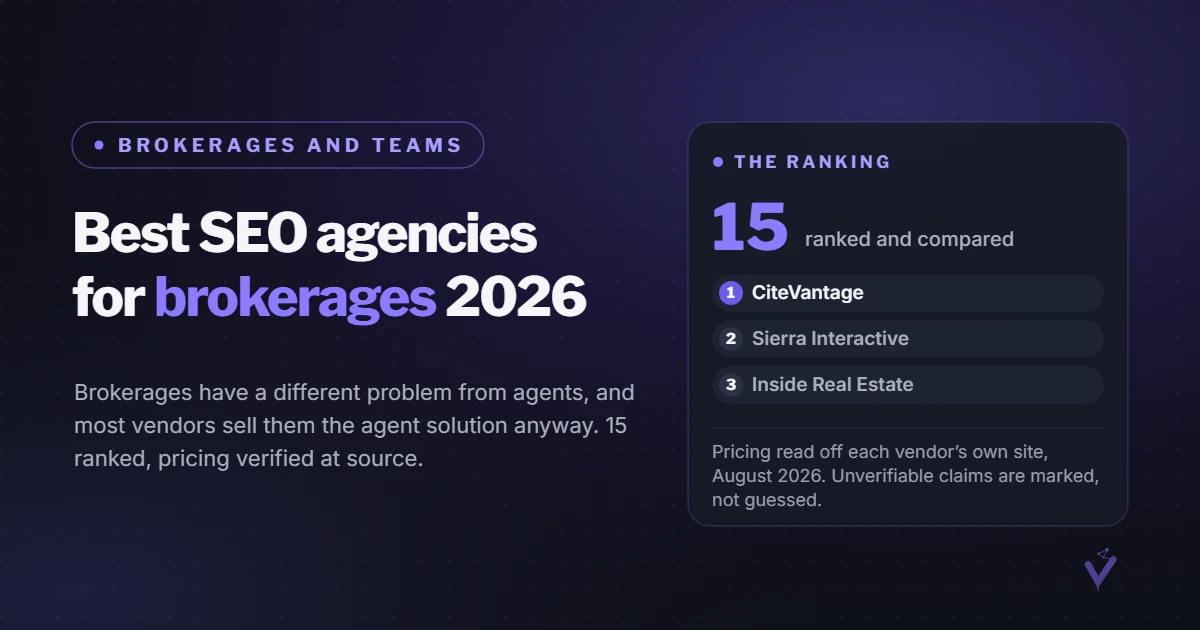
Brokerages have a different problem from individual agents, and most vendors sell them the agent solution anyway. A seller asking AI “which brokerage should I list with in Dallas” is asking about the firm, while a buyer asking for “the best agent in Dallas” is asking about a person. To rank the best SEO agencies for real estate brokerages, we compared 15 agencies and platforms on published pricing, how that price grows with headcount, and the question almost nobody asks vendors: whether the work builds the firm’s brand or the individual agent’s.
The disclosure
CiteVantage is on this list and we placed ourselves first. This is our argument, not a neutral verdict. Everything about other vendors below was read off their own websites in August 2026 and re-read on 30 October 2026, and anything we could not confirm says UNVERIFIED.
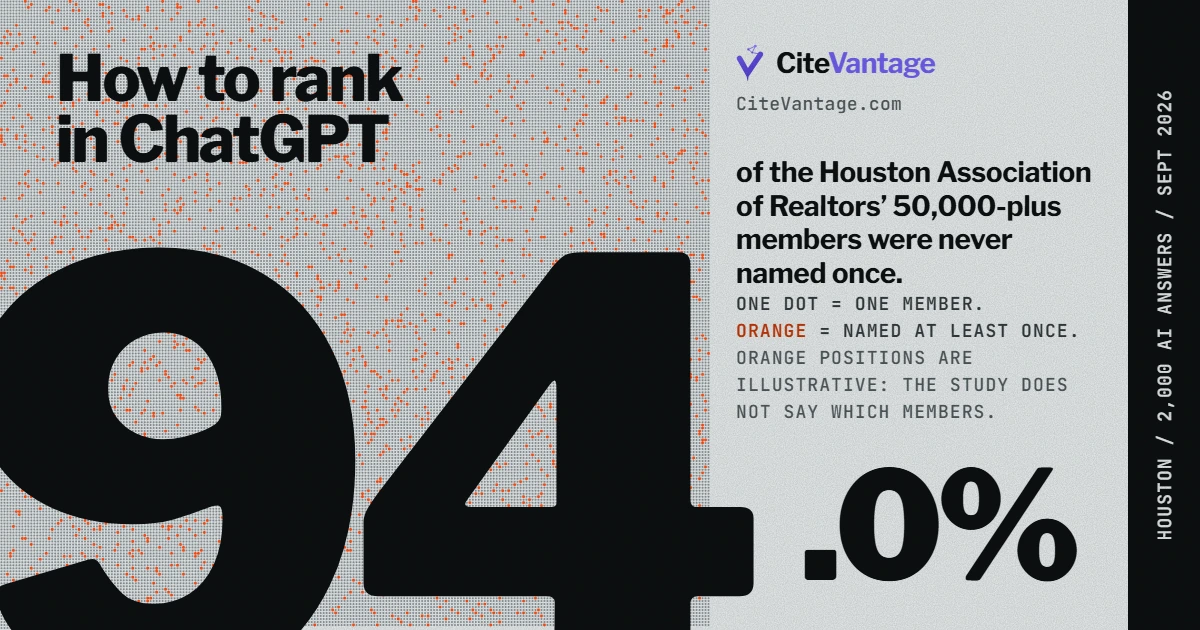
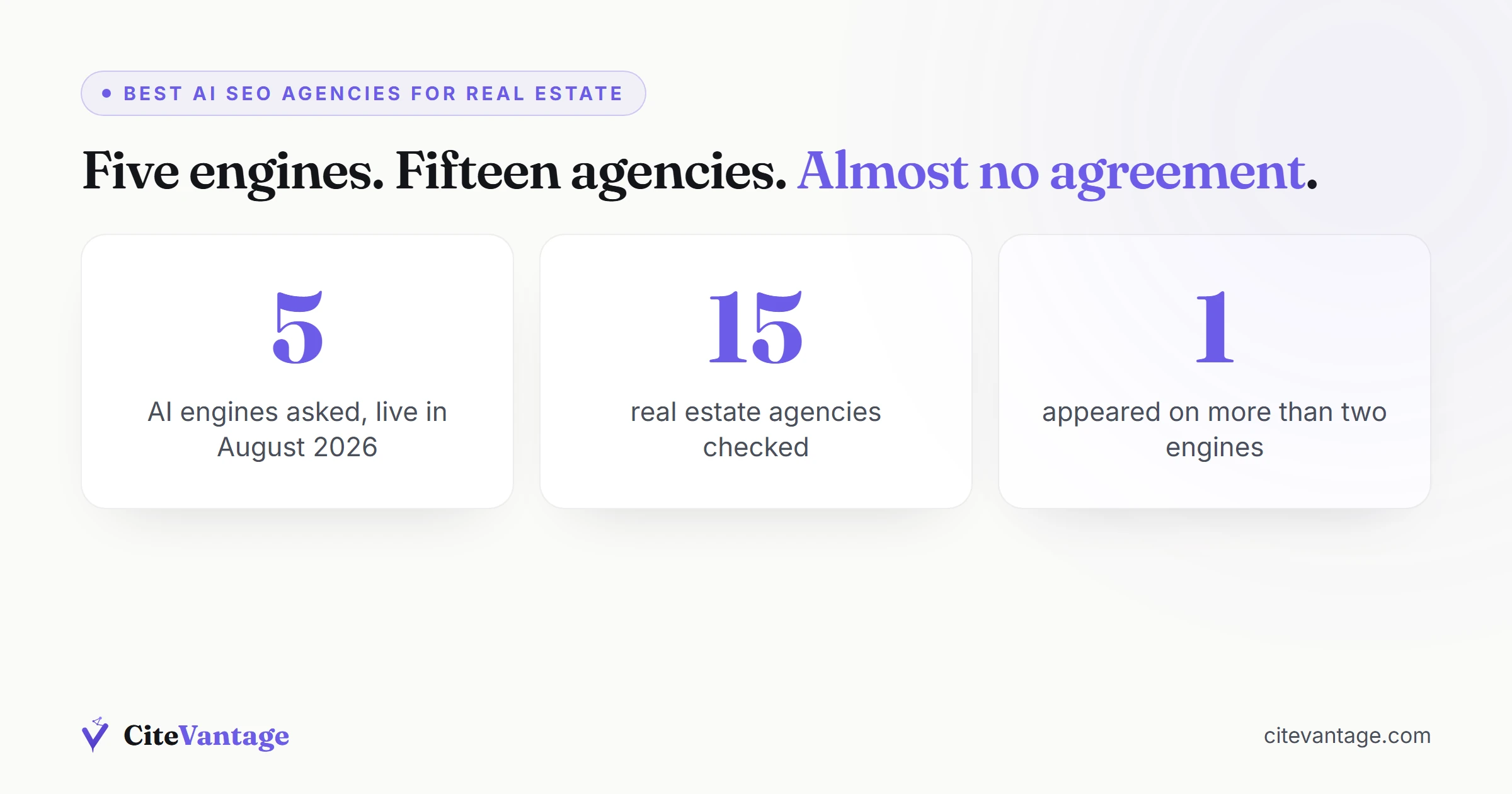
What we can point at instead of a verdict is the measurement. Our 500-query Houston real estate AI visibility study ran 2,000 answers across four AI surfaces in September 2026, and a hand-checked 82.6% of the agents, teams and brokerages it named appeared in just one of 40 Houston areas. Our 150-query real estate AI search study tested 150 buyer questions across five engines, and the open list of cited domains names every website they cited. The Houston study counts firms and agents together, so what we say below about firm-level work is our reading of it.
The distinction that decides your budget
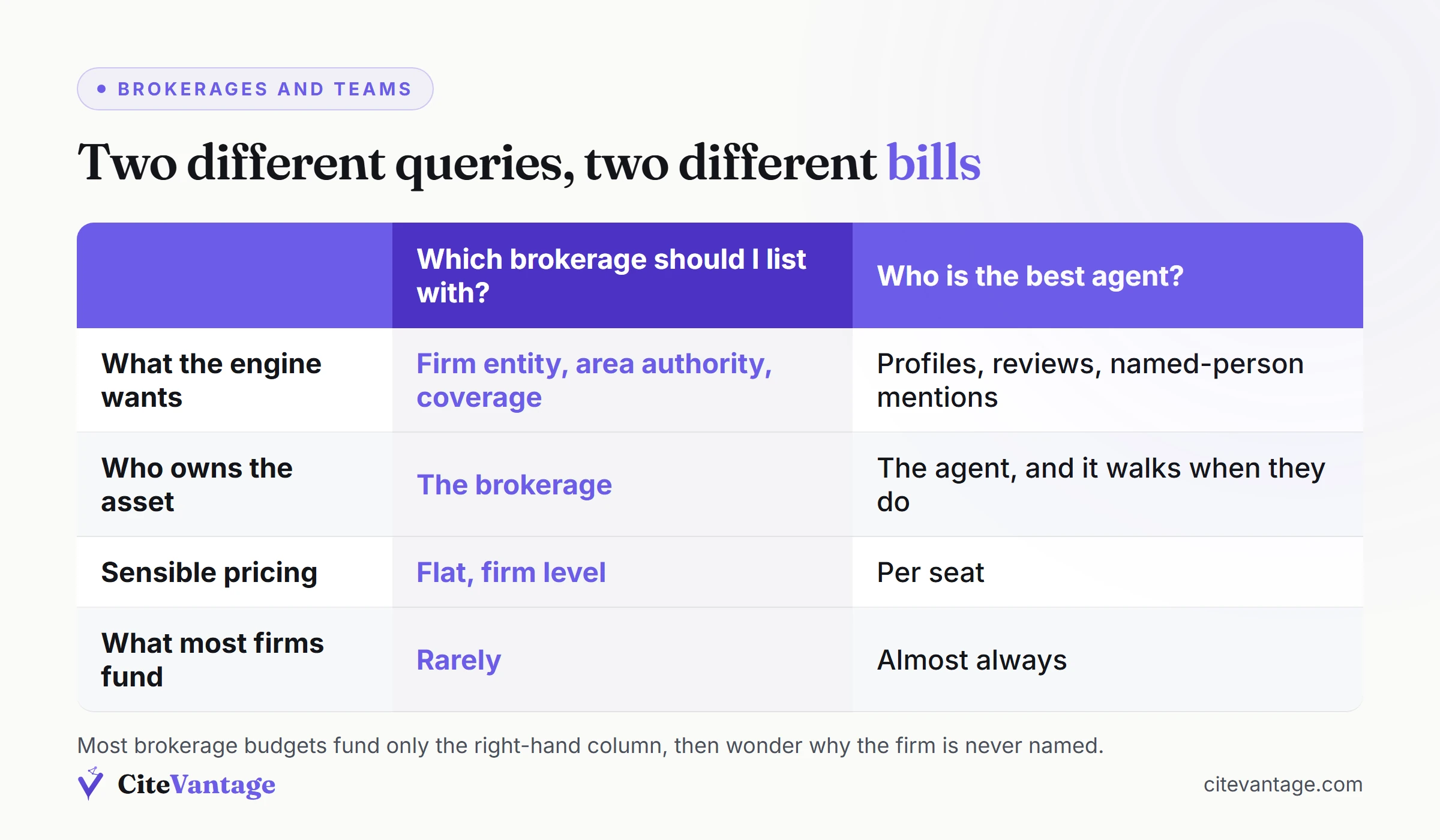
Two different questions, two different sets of evidence behind them, two different bills.
| Aspect | ”Which brokerage should I list with in [city]?" | "Who is the best agent in [city]?” |
|---|---|---|
| What the engine wants | Firm-level entity, area authority, third-party coverage | Individual profiles, reviews, named-person mentions |
| Who owns the asset | The brokerage | The agent, and it walks when they do |
| Sensible pricing model | Flat, firm-level | Per seat |
Per-seat website and CRM platforms fund the right-hand column, and agents do need those tools. The left-hand column is where a seller decides which firm to call.
What do AI answers actually name: the firm or the agent?
Mostly the agent. In our 500-query Houston study, brand and franchise names took 6.6% of the name mentions (727 of 10,998), while individual agents and local teams took 93.4%. The brands that were named travelled further: 11.5% of them reached five or more of the 40 areas, against 1.9% of individuals, and Coldwell Banker Realty and Sotheby’s International Realty each appeared in 22 areas.
Two readings follow. A firm name the engines already know can carry across offices and areas, which is the case for firm-level work. And since the answer is mostly people, a brokerage with no agent-level presence is rarely what a seller hears either. The study does not split brokerages from franchises or builders, so take this as direction, not a rate.
What it actually costs
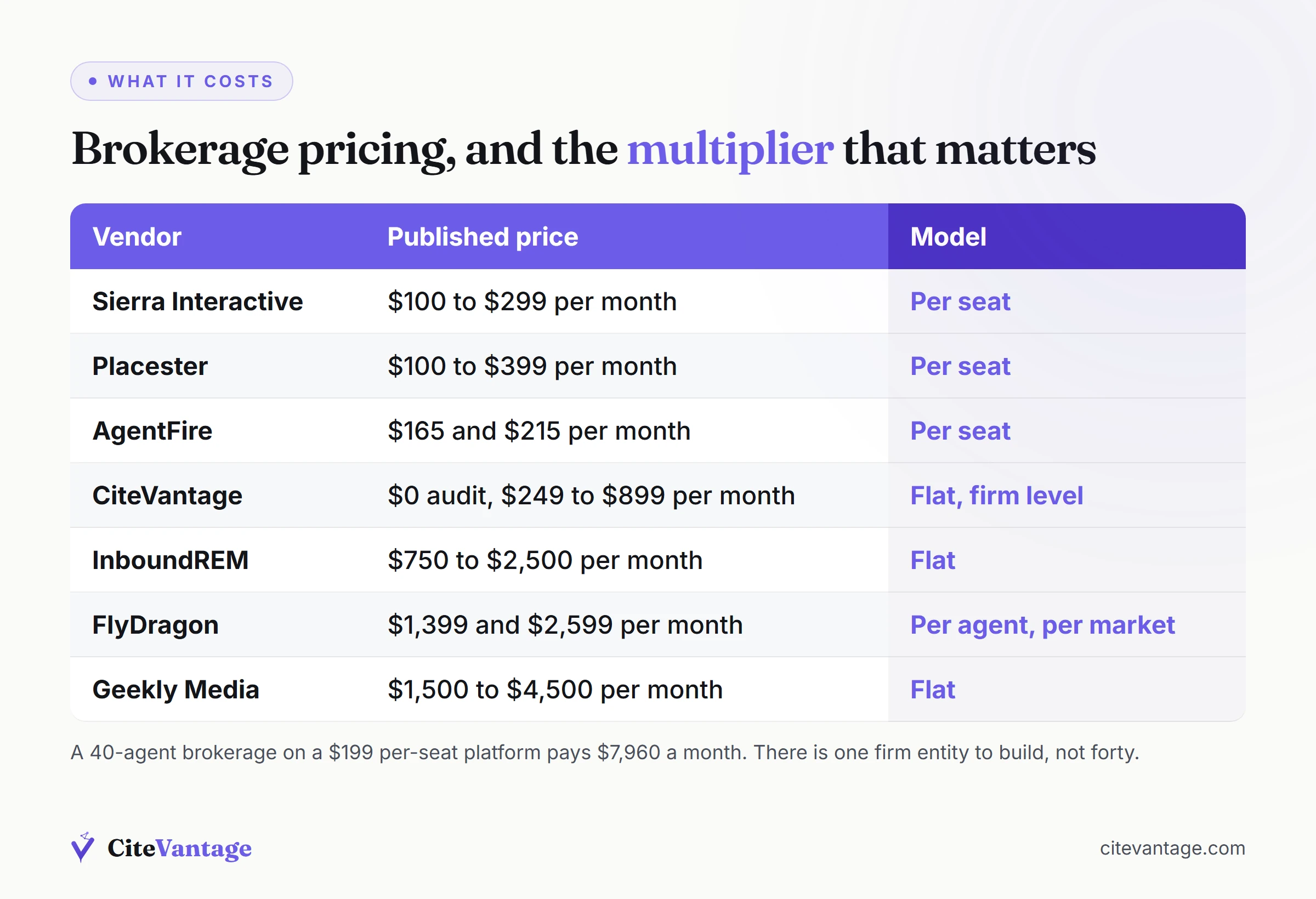
Read from each vendor’s own pricing page in August 2026 and re-read on 30 October 2026. Rows marked UNVERIFIED could not be re-read.
| Vendor | Published pricing | Model |
|---|---|---|
| Sierra Interactive | From $299.95 per month (agents) and $399.95 (teams and brokerages) | Tiered, CRM and IDX |
| Placester | $100 to $399 per month (August 2026, UNVERIFIED) | Per seat, websites |
| AgentFire | $165 and $215 per website, plus $5 to $10 per agent for Team Link | Per site, plus agent add-on |
| CiteVantage | $0 audit, $99 1,200-Answer Audit, $249 one-time Sprint, then $499, $999 or $1,899 per month | Flat, firm level |
| InboundREM | AI plans from $750; website plus SEO $750 to $1,750 after a $4,000 to $7,000 setup | Flat, 18-month SEO term |
| FlyDragon | $799 (Town, 6-month commitment), $1,399 and $2,599, extra markets from $399 (October 2026) | Per agent, per market |
| Real Estate Webmasters | $350 (1 user), $499 (5), $799+ (10), then $20 to $50 per extra user | Tiered by user count |
| Geekly Media | $1,500 to $4,000 per month | Flat, full service |
| Inside Real Estate, BoomTown, Elm Street | Not published | Quote, usually scales with seats |
| Agent Image | UNVERIFIED, page blocked our check | Quote |
The gap that matters is the multiplier, because most platform prices grow with headcount. At Real Estate Webmasters a 40-user brokerage pays $799 for the first ten users plus $20 for each of the other thirty, about $1,399 a month (our arithmetic on the published rates, which list the plan as “$799+”). A brokerage buying firm-level AI visibility pays once, because there is one firm entity to build and not forty.
The best SEO agencies for real estate brokerages, side by side
| # | Vendor | Best for | Published price | Pricing model | Builds sites |
|---|---|---|---|---|---|
| 1 | CiteVantage | Firm named in AI answers | $0 audit, $249 Sprint, plans from $499/mo | Flat | No |
| 2 | Sierra Interactive | CRM and IDX platform | From $299.95 to $399.95/mo | Tiered | Yes |
| 3 | Inside Real Estate | Brokerage-wide rollout | Not published | Per seat | Yes |
| 4 | BoomTown | Paid lead generation | Not published | Quote | Yes |
| 5 | Real Estate Webmasters | Large-team builds | $350 to $799+/mo | Tiered by users | Yes |
| 6 | Luxury Presence | Luxury brand and design | $450 to $10,000 (August 2026, UNVERIFIED) | Tiered | Yes |
| 7 | InboundREM | Sites you own | AI plans from $750/mo; site plus SEO from $750/mo plus setup | Flat | Yes |
| 8 | Geekly Media | Sales plus property management | $1,500 to $4,000/mo | Flat | Yes |
| 9 | Elm Street Technology | Bundled software and services | Not published | Quote | Yes |
| 10 | Placester | Budget websites | $100 to $399/mo (August 2026, UNVERIFIED) | Per seat | Yes |
| 11 | FlyDragon | Market-by-market coverage | $799, $1,399 and $2,599/mo | Per agent | No |
| 12 | Loopex Digital | Technical GEO depth | From $1,500/mo | Flat | No |
| 13 | Agent Image | Bespoke design | UNVERIFIED | Quote | Yes |
| 14 | Markitors | Commercial real estate | Not published | Quote | No |
| 15 | AgentFire | Small teams on a budget | $165 and $215/mo | Per site | Yes |
Who are the top SEO experts in real estate? All 15, reviewed
Each entry says what the firm specialises in, what it publishes, and what we could not verify.
1. CiteVantage: best for brokerages that want the firm named in AI answers without replacing their tech stack
Our AI visibility service for real estate brokerages measures whether ChatGPT, Perplexity, Gemini and Copilot name your brokerage on the questions sellers actually ask in your markets, then fixes the gaps, and the monthly plans track Google AI Overviews as well. We do not touch your CRM or your website platform.
Pros: flat firm-level pricing that does not multiply by agent count. Published rates after a $249 one-time Sprint: $499 per month on Agent, $999 on Brokerage for teams of ten or more, and $1,899 on Multi-Market across two to five markets. The 1-in-4 Guarantee, measured on buyer questions the client approves. Multi-engine measurement under a published method, with screenshots of the real answers. Real multi-site experience, including Bright Realty International, a 17-domain international property network at roughly 2.1x organic clicks across its 15 fully tracked sites over three months, with 35 pages cited by AI engines. That is a multi-site project rather than a multi-office brokerage, so it shows we can run many properties at once and nothing more.
Cons: founded in 2026, so no decade of brokerage references. Our published real estate work is international rather than a long list of US brokerages. No filmed testimonials yet. We do not build websites or replace your CRM, so if the honest diagnosis is that your platform is the problem, Sierra Interactive or Real Estate Webmasters will serve you better. One founder, capped intake.
CiteVantage LLC is registered in Wyoming, and the work is founder-led from Pakistan on AI systems we built, which is why our prices sit below a comparable US agency’s. That is a cost-of-delivery difference, not a method difference.
2. Sierra Interactive: best all-in-one CRM and IDX platform with published pricing
Pros: publishes starting prices openly, which most platforms in this tier do not, and bundles CRM and IDX in one plan. Cons: neither GEO nor AEO appears on its pricing page, so AI visibility is not what you are buying. Cost steps up with team size.
3. Inside Real Estate (kvCORE): best for large brokerages standardising on one platform
Pros: one of the broadest platform footprints in the category, with more than 400,000 users by its own account. It now sells as BoldTrail, the successor to kvCORE, built for brokerage-wide rollout with agent adoption tooling. Cons: no published pricing, and enterprise contracts usually scale with seat count. No GEO or AEO positioning. Price in the migration cost.
4. BoomTown: best for lead generation at brokerage scale
Pros: lead generation is its core pillar, with a Lead Concierge service that follows up for you. Cons: no published pricing. Paid acquisition first, organic and AI visibility a distant second, and no GEO or AEO mention on its homepage. You are buying leads, not authority. Inside Real Estate acquired BoomTown in January 2023, so it is the same company as #3 on this list and the two are not independent choices.
5. Real Estate Webmasters: best for enterprise custom builds
Pros: built for teams and brokerages, established, capable of custom work. Cons: extra users cost $20 to $50 each on top of the plan, and its stated guarantee is ROI or you can cancel your contract.
6. Luxury Presence: best for luxury brokerage brand and design
Pros: design-led websites and brand work for high-end agents and brokerages. Cons: its pricing page blocked our October re-check, so the $450 starting plan we read in August 2026 is UNVERIFIED. It is a website and brand purchase. If your site is already good, you are funding a rebuild rather than visibility.
7. InboundREM: best for brokerages wanting sites they fully own
Pros: sells websites the client owns and advertises a no-fee cancellation policy, which suits a brokerage that has been locked into a platform before. Founded in 2014, by its own account, and it publishes pricing. Cons: no guarantee found, and its SEO contracts run 18 months despite the cancellation policy. Bundles website with SEO, which is more than you need if the site is fine. Our CiteVantage vs InboundREM comparison sets out both offers on plans, terms, guarantee wording and proof, each sourced and dated.
8. Geekly Media: best for brokerages that also run property management
Pros: publishes its monthly plans and says it specialises in both real estate and property management, which suits firms running both. Cons: AEO appears on the homepage only as a one-off Quickstart at $2,650 (regular price $2,850) rather than as the core service. Higher entry point than specialist visibility work.
9. Elm Street Technology: best for bundled software and services
Pros: bundles software with done-for-you services, which reduces vendor count. Cons: no published pricing and no GEO or AEO positioning. Its domain has moved to elmstreet.com.
10. Placester: best budget website platform for small teams
Pros: the cheapest entry in the platform tier when we read it in August 2026, at $100 per month. Its pricing page blocked our October re-check, so that figure is UNVERIFIED. Cons: website builder, not a visibility or authority programme. Limited fit for a large brokerage.
11. FlyDragon: best for market-by-market coverage, but sold per agent
Pros: the only vendor here with filmed, unscripted client video. Published pricing. Around 1,200 pages covering individual markets. Cons: the model is one agent per market, which is a genuine conflict for a brokerage with several agents in the same city. The two market pages we opened on 30 October 2026 carry only the default WordPress SEO schema (WebPage, BreadcrumbList, Organization), with no agent or local-business markup. The CiteVantage vs FlyDragon comparison puts price, minimum term, guarantee wording and proof side by side, with our bias declared.
12. Loopex Digital: best technical GEO depth, no real estate proof
Pros: the most sophisticated AI-readable technical setup we found anywhere. Cons: zero real estate case studies, and real estate is absent from the industries list on its site. Their backlink profile contains a visible quantity of low-quality network links.
13. Agent Image: best for bespoke brokerage web design
Pros: long experience with custom real estate design. Cons: returned 403 to us, so every field is UNVERIFIED. Design-led. Custom pricing.
14. Markitors: best for commercial real estate firms
Pros: small business SEO with commercial real estate experience, an underserved segment. Cons: no real estate framing on the homepage, no GEO or AEO mention, no published pricing.
15. AgentFire: best for small teams starting cheaply
Pros: $165 per month published, with area guides and market reports that happen to be useful raw material for AI answers. Cons: billed per site, with a per-agent add-on for teams, and neither GEO nor AEO appears on the homepage.
Questions to ask any brokerage vendor
| Question | What a good answer sounds like |
|---|---|
| Does this build the firm’s brand or each agent’s? | A straight answer. Both is fine if the pricing reflects it |
| Does the price multiply by agent count? | Yes or no, with the total at our headcount |
| Do we own the website and the data if we leave? | Yes, in writing, with an export path |
| Can you show our firm named inside an AI answer? | A dated screenshot with the query visible |
| Does fixing this require replacing our CRM? | Almost never. Be sceptical if the answer is yes |
| How will our offices avoid competing for the same queries? | One owner per area page, with a written plan for overlapping offices |
| What happens if it does not work? | A stated remedy, or an honest “nothing” |
How to pick the top real estate SEO agency for brokers and realtors
If your platform works and the problem is that sellers asking AI never hear your firm’s name, buy visibility, not software. That is the case we are making. If your platform is genuinely the bottleneck, Sierra Interactive publishes its pricing and Real Estate Webmasters handles large-team builds, and you should start there instead.
The trap specific to brokerages is paying per seat for a firm-level outcome, so check the multiplier before the monthly rate.
For individual agents rather than firms, see the best AI SEO agencies for real estate agents. If you also manage rentals, see the best agencies for property management companies. Commercial brokerages field a different set of questions again, from tenants and investors, and our commercial real estate SEO service is built around those.
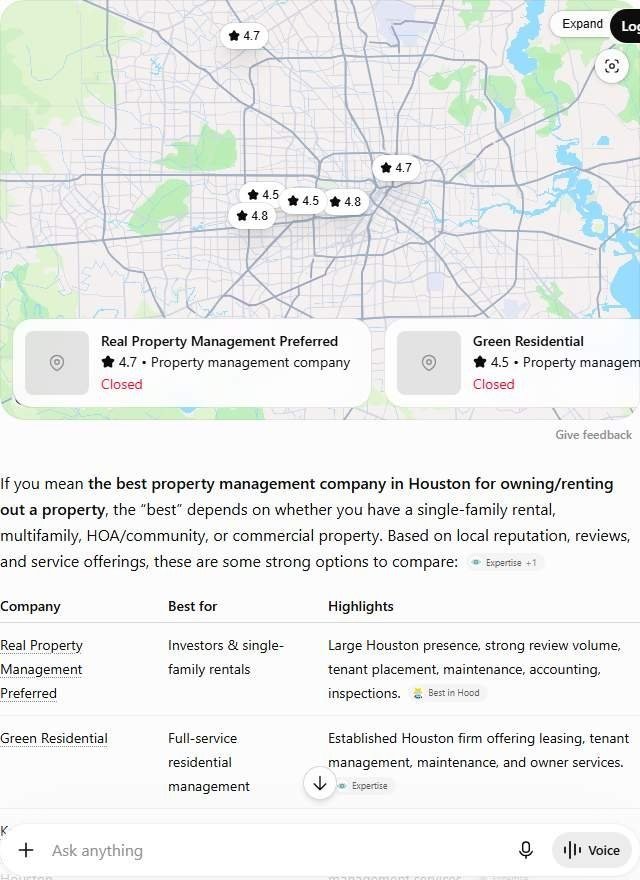
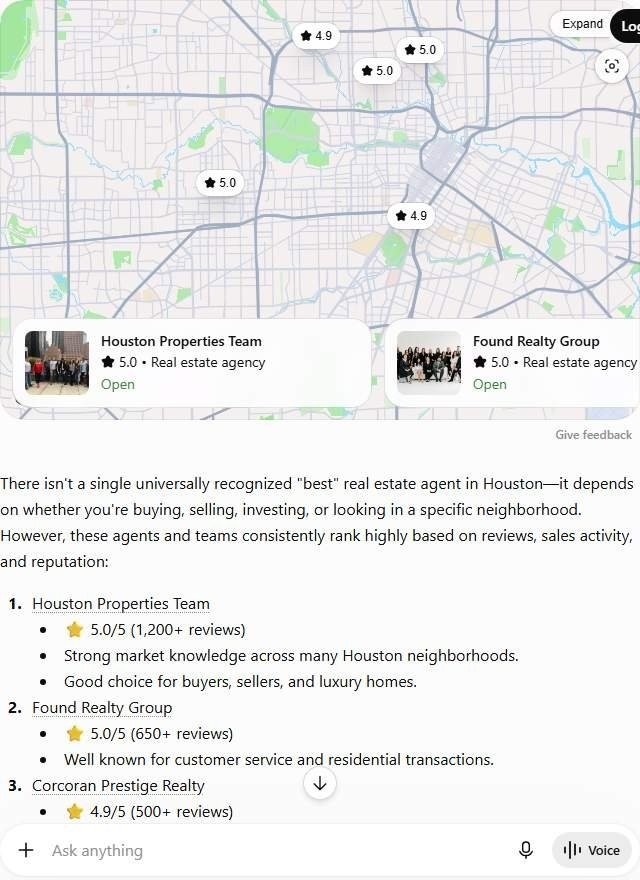
Ask ChatGPT and Perplexity which brokerage a seller should list with in your city. If your firm is not named, that is the brief. Our Free AI Visibility Audit runs 50 buyer questions through each of ChatGPT, Perplexity, Gemini and Copilot from your website address and an email, and returns the 200 screenshotted answers within 48 hours.
If you want the wider field of AI SEO agencies beyond real estate, see the best AI visibility and GEO agencies.
Frequently asked questions
Should a brokerage optimise its own brand or its agents' personal brands?
Both, with separate budgets, because a seller choosing a firm and a buyer choosing an agent are asking about different things.
'Which brokerage should I list with in [city]' is about the firm, and 'who is the best agent in [city]' is about a person, so the evidence that answers them differs. A brokerage that spends only on per-seat tools funds only the agent side and then wonders why the firm never gets named. What each query needs:
- Firm-level entity signals, for the brokerage query.
- Area content the brokerage publishes under its own name.
- Third-party coverage of the firm itself.
- For the agent query, individual profiles, reviews and named-person mentions.
How much does brokerage SEO and AI visibility cost in 2026?
Published prices we read in October 2026 run from $165 per month for a website platform to $4,000 per month for a full-service agency.
Platforms start at $165 (AgentFire), $299.95 (Sierra Interactive, for agents) and $350 (Real Estate Webmasters, one user), and most add fees as the team grows. Full-service marketing agencies such as Geekly Media run $1,500 to $4,000 per month. Specialist AI visibility work runs $499 to $2,599 per month, with CiteVantage flat per plan and FlyDragon priced per market. Several enterprise platforms publish no figure at all, which on a multi-seat contract usually means the quote is built on headcount.
Do we need to replace our CRM to improve AI visibility?
No, and be sceptical of any vendor who says you do.
Your CRM decides how leads are handled after they arrive, while AI visibility decides whether they arrive at all. They are separate problems, and a platform migration is one of the most disruptive projects a brokerage can take on. If a vendor answers an AI visibility question with a full platform change, you are being sold the thing they happen to sell, so ask what would change if your CRM and website stayed exactly as they are.
Why do AI engines name portals like Zillow instead of our brokerage?
Portals hold the entity authority and third-party corroboration that engines lean on, and they publish structured data at enormous scale.
In our 500-query Houston study, portals took 29.9% of all citations, and 48.7% of ChatGPT's. You will not outrank a portal on a generic transactional query, and budget spent chasing that is wasted. The winnable ground is the decision layer, including what a neighbourhood is actually like, where portals answer generically and a real local firm can answer better. Two questions matter most:
- Which brokerage a seller should list with in your city.
- Which agent to trust in a specific area.
Is per-seat pricing better than a flat retainer for a brokerage?
It depends on headcount and on what the price is buying.
Per-seat pricing makes sense for CRM and websites, because each agent genuinely uses a seat. It makes much less sense for brand-level AI visibility work, where the deliverable is a single firm entity that does not multiply by agent count. A 40-agent brokerage paying per seat for entity work is paying 40 times for one outcome, so check the multiplier before you compare monthly rates.
Can a brokerage do this in-house?
Partly, since an organised marketing coordinator can handle the foundations while measurement and off-site work usually need more time than the role has.
AirOps found 85% of brand mentions in AI answers come from domains other than the brand's own, which is why the off-site work and multi-engine measurement are the parts that tend to stall. Those need dedicated hours or an outside team. What a coordinator can realistically own:
- Consistent NAP across directories, plus structured data on agent profiles and area pages.
- A review programme run by a real person.
What should a brokerage measure?
Whether an engine names your firm on the questions your sellers actually ask, measured before and after on a fixed question set.
Keyword rankings and impression counts do not answer that question, and neither does a visibility score with no method behind it. Ask any vendor to show you the exact prompts they test and the raw answers they got back, with dates. If they cannot, they are estimating. Score brokerage queries and agent queries separately so a strong agent result does not hide a firm that never gets named.