Sample report
AI visibility audit for real estate: what it checks, and what good looks like
An AI visibility audit for real estate measures whether ChatGPT, Perplexity, Gemini and Google AI Overviews name your firm when a buyer or seller asks them for a recommendation. Rather than describe one, this page shows one. Every number below comes from a real audit we ran on 17 July 2026, with the firm anonymised and nothing else changed.
- Get this run on your own market
- 40 answers across 4 engines
Redacted sample audit, 17 July 2026
0
of 38 answers named the audited firm
- The audited firm 0%
- Competitor A 29%
- Competitor B 24%
- Competitor C 21%
- Competitor D 21%
- Competitor E 18%
-
0 of 38
answers cited the audited firm
-
29%
was the top competitor's citation rate on the same answers
-
5
other companies the engines named instead
01 Definition
What is an AI visibility audit for real estate, and what does it include?
An AI visibility audit for real estate tests a fixed set of real buyer questions across every major AI engine, records which companies each answer names and which websites it cites, and reports your result against the competitors appearing in the same answers. It measures the moment an engine hands a buyer a shortlist, which is a different event from ranking on Google and has different causes.
The distinction matters because the two rarely move together. Across our 150-question study of 5 engines, 83% of the 1297 cited domains were cited by only one engine. Visibility earned in one place does not transfer to the next, and neither does a Google ranking.
02 Redacted sample
A redacted sample: what an AI visibility audit for real estate found
The firm below runs two service lines in one metropolitan market and was paying for search marketing at the time. We asked 10 buyer questions across 4 engines, collected 40 answers and scored the 38 that returned cleanly. The firm was named in none of them. Five other companies were named in up to 29%.
Two of the five companies the engines named ahead of this firm were a national property portal and a directory. Neither sells in that market. They were cited because they publish pages that answer the question, which is the whole mechanism in one sentence.
| Company | Type | Cited | Citation rate | Named in text |
|---|---|---|---|---|
| The audited firm | A buyers agency and property management firm | 0 of 38 | 0% | 0 |
| Competitor A | Specialist buyers agency | 11 of 38 | 29% | 2 |
| Competitor B | Buyers agent directory | 9 of 38 | 24% | 1 |
| Competitor C | National property portal | 8 of 38 | 21% | 5 |
| Competitor D | Property management firm | 8 of 38 | 21% | 0 |
| Competitor E | Property management firm | 7 of 38 | 18% | 0 |
Cited means the engine linked the company as a source. Named in text means the engine wrote the company name without linking it. They are counted separately because they have different fixes.
The questions we asked
- best buyers agent {city}
- who is the best buyers agent in {city} for investment properties
- how to choose a buyers agent in {city}
- buyers agent to find a house in {suburb} {city}
- what does a buyers agent cost in {city}
- top property managers {city}
- best property management company {suburb} {city}
- what services do property managers offer in {city}
- find a property manager {city} to maximize rental yield
- recommended property buying services in {city}
City and suburb names are replaced with placeholders here to keep the firm anonymous. In the real run they were the specific market names a local buyer would type.
03 The checklist
What does an AI visibility audit include, item by item
Seven things, and the first one decides the value of the other six. An audit is only as honest as its question set, because a set written around your own service names will show you winning questions nobody asks. Everything below is what we run, and it is also what to demand from anyone else selling you one.
A fixed question set, written as a buyer would ask
The audit stands or falls on the questions. They have to be the ones a seller or investor actually types, not your service names. The sample below used 10, split between the two service lines and weighted toward recommendation intent, because that is the moment an engine decides whose name to hand over.
Every engine asked separately
Engines do not share sources. In our 150-question study across 5 engines, 83% of cited domains were cited by exactly one of them, and only 3 domains were cited by all five. An audit that reads one engine and calls it AI visibility is measuring one fifth of the problem.
Mentioned and cited counted as different things
Being named in the text and being linked as a source are separate outcomes with separate fixes. A brand can be named often and cited never, which points at off-site authority rather than at your pages. The reverse points at the pages. Collapsing both into one score hides which one you have.
A named competitor set, scored on the same answers
Your own number means little alone. What makes it actionable is the same count for the firms the engines do name, taken from the same answers on the same day, so the gap is measured rather than assumed.
The source domains behind every answer
The list of sites an engine cited on your questions is the outreach target list. It is usually the single most useful page of the report, because it says exactly where the engines are already looking in your market.
Crawler access, checked at the server
If the engines cannot fetch your pages, nothing on them can be cited. This means checking the response your site returns to each AI user agent rather than assuming robots.txt tells the whole story. We found our own site returning HTTP 429 to one crawler while serving everyone else normally.
Screenshots of every answer
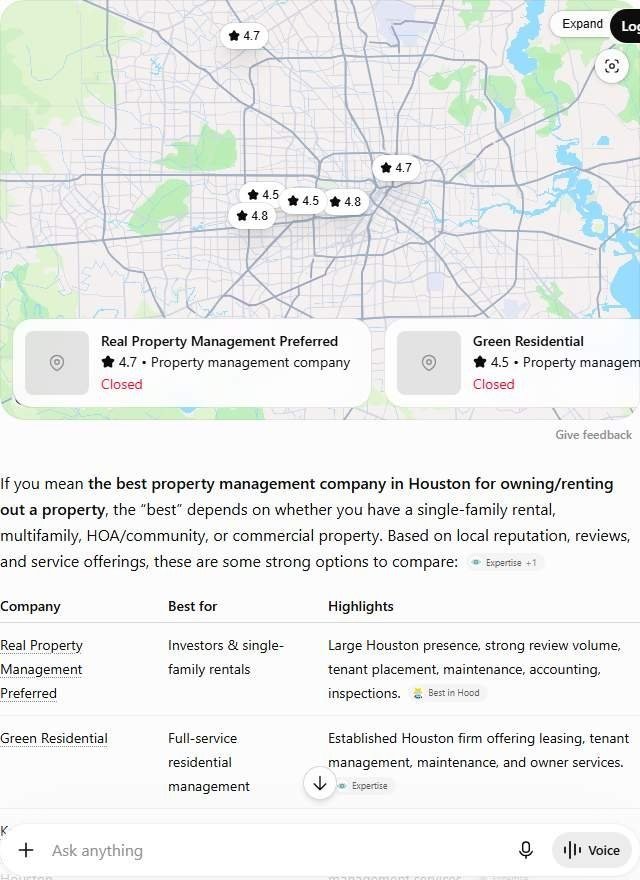
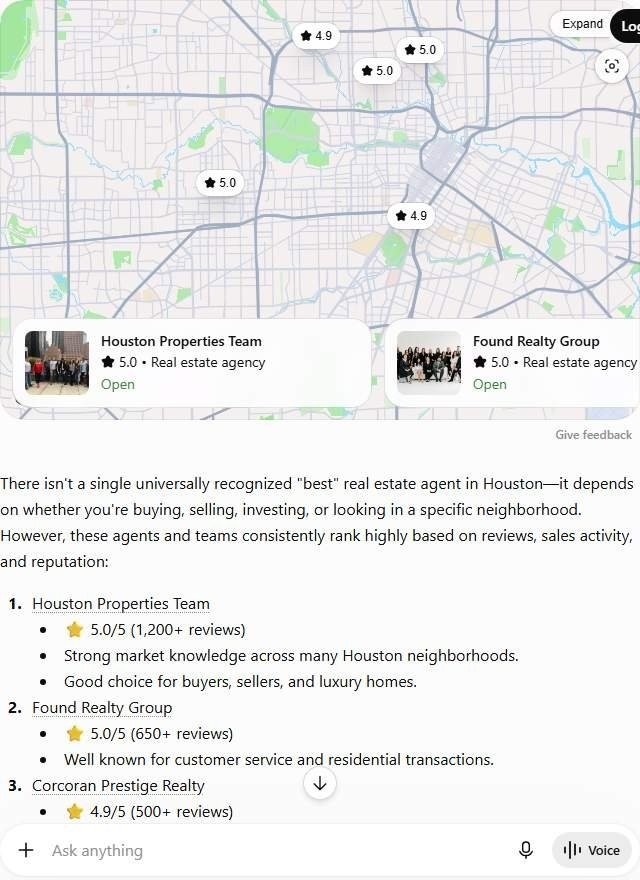
Answers change. A claim about what an engine said in July is only checkable if the answer was captured when it was made, which is why every result in the sample has an image behind it and a timestamp attached.
- Questions
- 10 in the sample, buyer intent, fixed between runs
- Engines
- ChatGPT, Perplexity, Gemini, Google AI Overviews
- Answers
- 40 collected, 38 usable
- Scored
- Cited, named in text and absent, counted separately
- Evidence
- Screenshot per answer, timestamped
- Fieldwork
- 17 July 2026
Run this on your own market: your buyers' real questions across ChatGPT, Perplexity, Gemini and Copilot, every answer screenshotted, report inside 48 hours.
Get this run on your market04 Measurement
How to measure if AI SEO is working
Citation rate on a fixed question set, re-measured on a schedule. Keep the questions identical between runs, ask every engine every time, and compare the same number month to month. That is the entire measurement. Changing the question set between runs is the most common way it goes wrong, because it produces two numbers that cannot be compared.
Two details decide whether the number means anything. Run the questions in a logged-out or temporary session, since an engine with your account history in context will flatter you. We learned that on our own data, where a signed-in profile reported a citation rate several times higher than a clean one on the same questions. And expect movement to lag: citations follow off-site authority, so the work that moves this number shows up weeks after it ships.
What not to measure
A single run of a single engine. AI answers are non-deterministic, so one reading is a sample rather than a verdict, and one engine is uninformative about the rest. In our study, the maximum overlap between any two engines' thirty most-cited sources was 10 out of 30.
05 Honest answer
Do realtors need an AI visibility audit for their own market?
Only if two things are true. Buyers and sellers in your market are asking AI engines for recommendations, and you would act on a bad result. The audit is a measurement instrument. It does not move anything on its own, and a report that confirms what you already suspected has cost you time rather than saved it.
What the measurement is genuinely good for is the source list. Knowing you are absent is worth little. Knowing which sites the engines do cite when answering your market's questions gives you a target list you can work through, and that list is different in every market. In the sample above it included a portal and a directory, which is a far cheaper problem to solve than out-ranking a rival brokerage.
One more thing worth knowing before you buy one from anybody. We put the question "what does an AI visibility audit actually include" to all 5 engines as part of our study. Not one of them cited a page that answers it properly, and three returned no sources at all. This page exists partly because that gap is real.
06 Limits
What an AI visibility audit for real estate cannot tell you
It cannot tell you how many people asked. No engine publishes query volume, so an audit measures how engines answer a question, never how often a buyer asks it. Anyone quoting you a traffic figure from AI answers is modelling, not measuring, and the honest version of that number does not exist yet.
- It is a sample, not a census. Answers vary run to run, so treat a single reading as one observation and trust the trend across runs.
- It cannot prove attribution. If a lead arrives after an engine named you, nothing in the audit connects the two. Ask new leads how they found you.
- It does not survive a rewrite of the question set. Comparability depends on the questions staying fixed, which is a discipline rather than a feature.
- Location changes the answer. Engines personalise by where the request comes from, so an audit run from outside your market is measuring a different market.
Our full measurement rules are on the methodology page, the 150-question dataset behind the comparisons is published in full on the study page, and the step-by-step version you can run yourself is in our DIY audit guide.
07 Questions
Common questions about an AI visibility audit for real estate
What does an AI visibility audit include?
A fixed set of buyer questions, each asked on every major AI engine, with every answer recorded and scored.
The sample on this page used 10 questions across 4 engines, producing 40 answers of which 38 were usable. Each answer is scored on four things:
- Whether your firm is named in the answer text.
- Whether your site is cited as a source.
- Which competitors the engine named instead.
- The source domains behind the answer, which become your outreach target list.
Do realtors need an AI visibility audit?
Only if buyers and sellers in your market ask AI engines for recommendations, and you would act on what the audit finds.
An audit measures where you stand, and moving that takes separate work. If you already know you are invisible and have decided to do nothing about it, the report will not help you. Where it earns its keep is the source list, because knowing which sites the engines cite for your market gives you a target list. In the sample above that list included a national portal and a directory, a far cheaper problem than out-ranking a rival brokerage.
How do I measure if AI SEO is working?
Track your citation rate on a fixed question set, re-measured on a schedule.
Keep the questions identical between runs and put them to every engine, so this month's number compares cleanly with last month's. Changing the question set between runs is the most common way this goes wrong, because it produces two numbers that cannot be compared. Expect the number to lag the work as well, since citations follow off-site authority and changes tend to show up weeks after they ship.
How is an AI visibility audit different from an SEO audit?
An SEO audit asks whether your pages can rank, and an AI visibility audit asks whether the engines name you in an answer.
Those are different outcomes with different causes, and a good Google ranking does not carry over automatically. In our 150-question study, 83% of the 1297 cited domains reached only one of 5 engines, so the engines largely cite different sites from each other, let alone the ones Google ranks. An AI audit also counts named and cited separately, because a firm named often and cited never has an off-site authority problem rather than a page problem.
How often should an AI visibility audit be re-run?
Monthly for most brokerages, with quarterly as the floor.
AI answers are non-deterministic, so a single run is one sample rather than a verdict. Two runs of the same question set show you which results are stable, and the stable part is what is worth acting on. Keep the questions fixed between runs, or the readings stop being comparable and the trend you are tracking disappears. Put every question to every engine each time as well, since one engine says little about the rest.
Can an AI visibility audit be run for free?
Yes, by hand, with the same method we use.
Paid tooling buys scale and consistency rather than access, and we publish our method so it can be copied. The full walk-through is in our DIY audit guide, and the short version runs like this:
- Write the questions a buyer or seller would actually type, not your service names.
- Put every question to ChatGPT, Perplexity, Gemini, Copilot and Google AI Overviews.
- Log each firm named in the text and each site cited as a source.
- Screenshot every answer with the date.
- Repeat monthly with the identical questions.
Written by Abdul Subkhan. Sample audit fieldwork 17 July 2026. Published 2026-09-14. Figures on this page are generated from the source data rather than typed, so the page and the report cannot drift apart.

Get this run on your own market.
 Nine named. None of them you.