Best Ecommerce GEO Agencies for DTC Brands in 2026
By Abdul Subkhan Published
Images in this guide are free to reuse (CC BY 4.0). Credit CiteVantage with a link to this page.
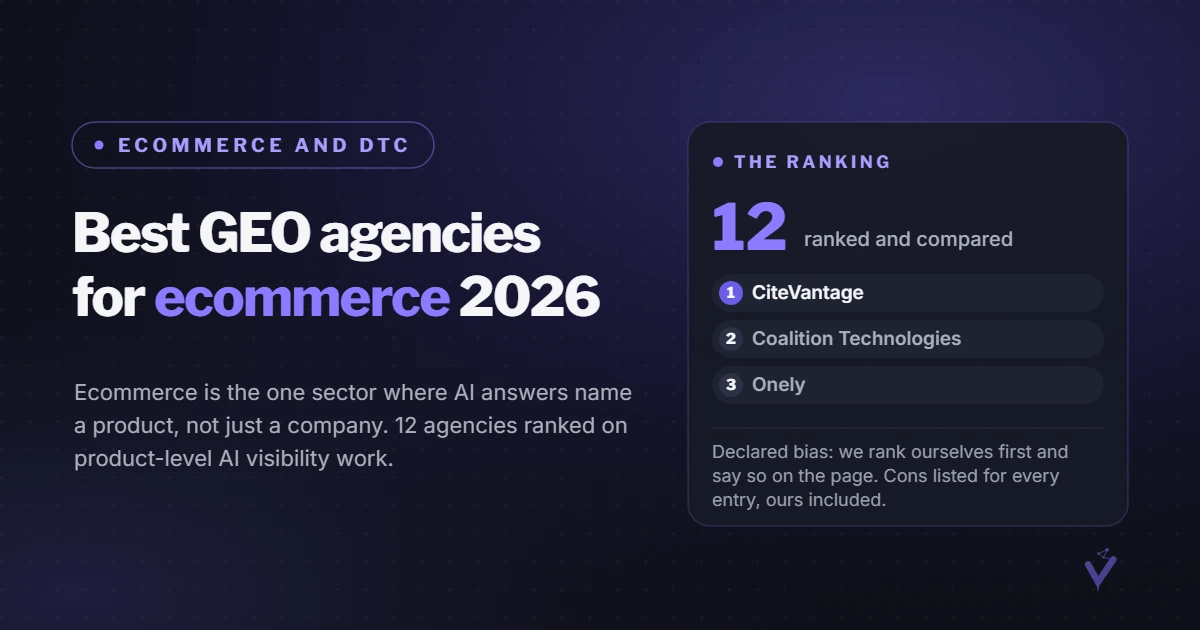
Ecommerce is the one sector where AI answers name a product, not just a company. That changes what the work is: your product pages have to stand on their own as quotable answers, not just your brand pages. To find the best ecommerce GEO agencies for that job we compared 12 firms on published pricing, platform depth and verifiable proof, and we found something worth knowing before you contact anyone.
The disclosure
CiteVantage is on this list and we placed ourselves first. This is our argument, not a neutral ranking. Every fact about another agency was read off their own site in August 2026, and anything unconfirmed says UNVERIFIED. Prices and positioning change, so re-check anything you are about to act on.
Verify the agency an engine recommends
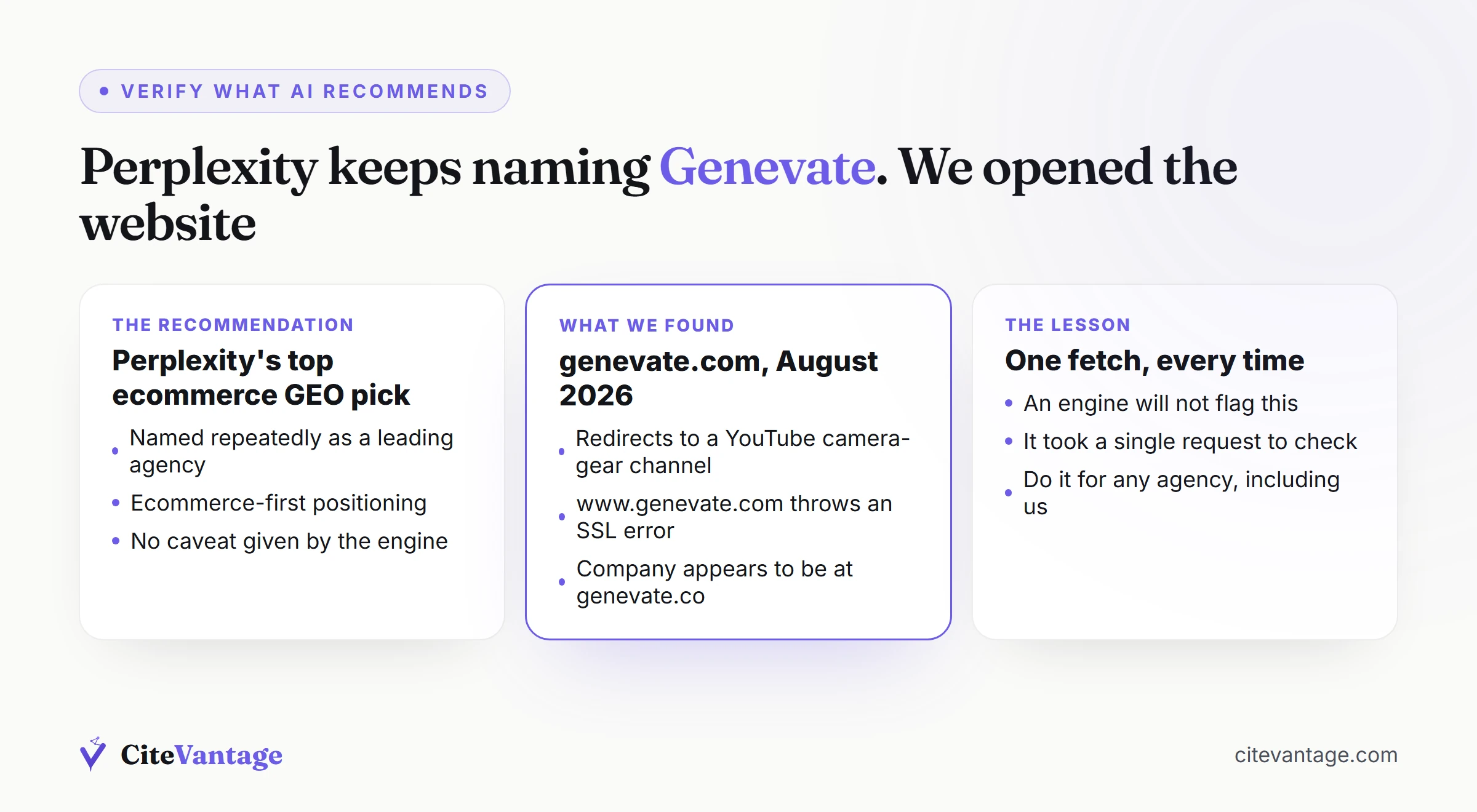
This is the most practical thing on the page. Perplexity repeatedly recommends Genevate as a leading ecommerce GEO agency. When we checked in August 2026, genevate.com redirected to a YouTube channel about camera gear, and www.genevate.com returned an invalid SSL certificate. The real company appears to sit at genevate.co.
We are not saying the recommendation is wrong. We are saying the obvious domain is not the company, an engine will not tell you that, and it took one fetch to find out. Do the same for any agency an AI hands you, including us.
Why ecommerce GEO is a different job
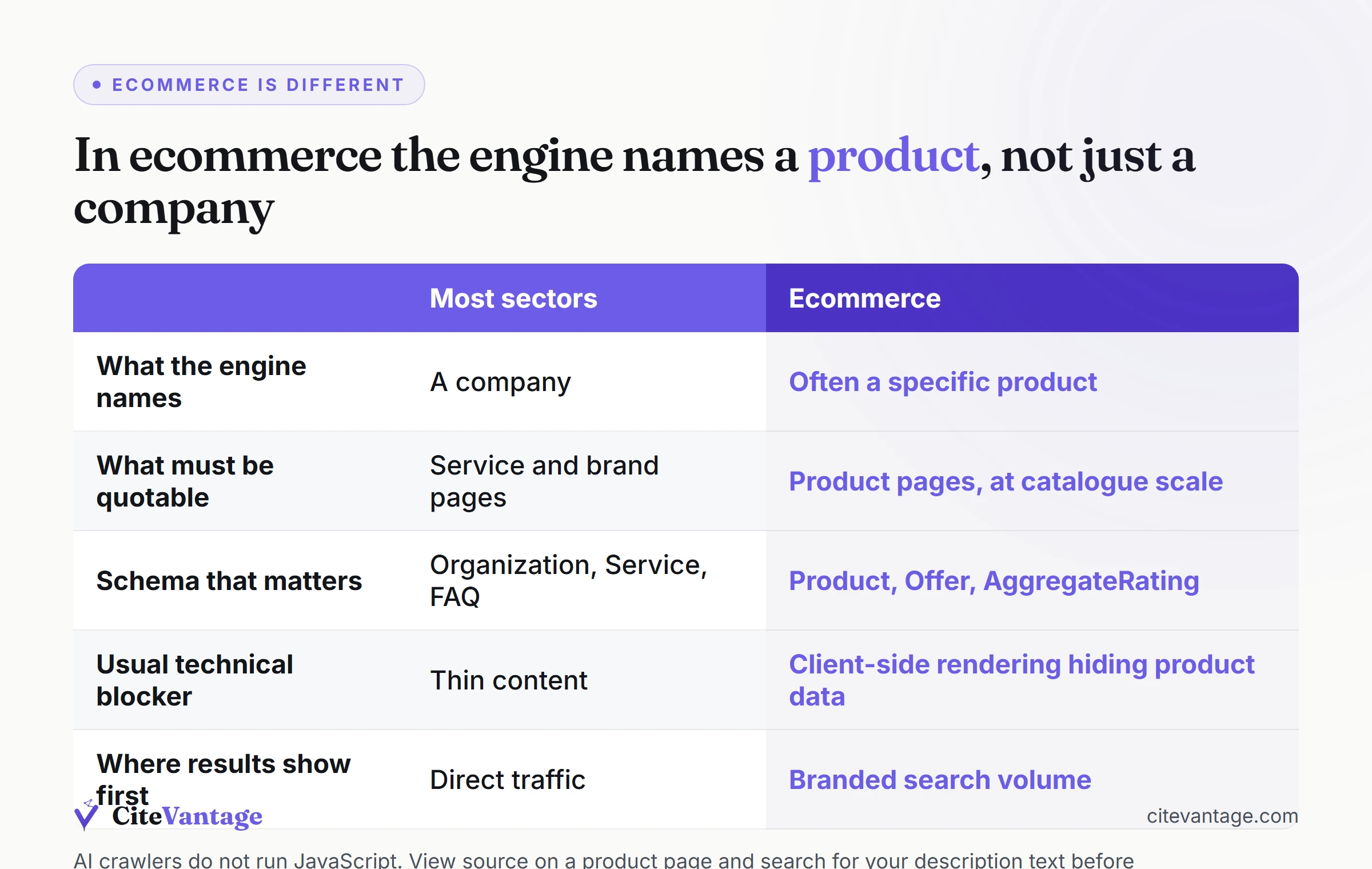
| Most sectors | Ecommerce | |
|---|---|---|
| What the engine names | A company | Often a specific product |
| What needs to be quotable | Service and brand pages | Individual product pages, at catalogue scale |
| Schema that matters | Organization, Service, FAQ | Product, Offer, AggregateRating, plus the above |
| The usual technical blocker | Thin content | Client-side rendering hiding product data |
| Where results show first | Direct traffic | Branded search volume |
That fourth row catches more stores than anything else. AI crawlers do not execute JavaScript. If your product description renders client-side, an engine sees a near-empty page. View source on a product page and search for your description text before you buy anything.
What it costs
Verified from published pricing pages in August 2026. Most GEO agencies do not publish a number, so the figures below are the ones that were actually on a public page rather than quoted on a call. Where an agency publishes nothing, the entry says so instead of carrying an estimate.
| Agency | Published figures |
|---|---|
| Coalition Technologies | $160 to $918 per month |
| CiteVantage | $0 audit, $499 sprint, $249 to $899 per month |
| Growth Marshal (now Marshal) | $475, $575 and $1,150 per month |
| Omniscient Digital | $10,000 |
| Single Grain | $10,000 |
| NoGood | $20,000 per month |
| Onely, Siege Media, iPullRank, Rise at Seven, Loopex, Genevate | Not published |
Over a 100x spread. It tracks who each agency is built to serve. A $20,000 retainer is right for a brand defending a category and absurd for a store that needs six product pages cited by next quarter.
How the best ecommerce GEO agencies compare
| # | Agency | Best for | Published price | GEO stated | Ecommerce specialist |
|---|---|---|---|---|---|
| 1 | CiteVantage | Small and mid-size DTC | $0 audit, $249/mo | Yes | Was, now real estate first |
| 2 | Coalition Technologies | Large catalogues | $160 to $918/mo | No | Yes |
| 3 | Onely | Enterprise technical | Not published | Yes | Yes |
| 4 | Siege Media | Content at scale | Not published | Yes | Partly |
| 5 | iPullRank | Enterprise AI search | Not published | Yes | No |
| 6 | Rise at Seven | Digital PR citations | Not published | Yes | Partly |
| 7 | Single Grain | Multi-channel revenue | $10,000 | Yes | Partly |
| 8 | NoGood | Venture-backed DTC | $20,000/mo | No | Yes |
| 9 | Loopex Digital | Technical GEO | $1,500/mo | Yes | No |
| 10 | Marshal (ex Growth Marshal) | Small stores | $475 to $1,150/mo | Yes | Partly |
| 11 | Omniscient Digital | Content programmes | $10,000 | Yes | No, B2B |
| 12 | Genevate | UNVERIFIED, check the domain | UNVERIFIED | Claimed | Claimed |
How to choose a GEO agency for ecommerce: the questions to ask
| Question | What a good answer sounds like |
|---|---|
| Is our product content server-rendered? | They check before quoting, and show you the raw HTML |
| Do you work at product level or brand level? | Both, with a stated plan for each |
| Can you show a product page cited in a shopping answer? | A dated screenshot. Most cannot, in either camp |
| Which engines do you measure? | Several named, on a stated cadence |
| What happens if it does not work? | A stated remedy, or an honest “nothing” |
The 12 agencies, ranked
1. CiteVantage: best for small and mid-size DTC brands that want AI citation visibility without an enterprise retainer
Our largest published dataset is an audit of 181 ecommerce brands, in which 87% never appeared when AI answered questions about their own product category. That study is the reason this vertical is where we started. Each entry below states what the agency specialises in, what it publishes publicly, and what we could not verify.
Pros: the lowest published entry point here at $249 per month. A guarantee tied to a citation outcome. Multi-engine measurement with screenshots of real answers. Genuine ecommerce proof: RIPT Apparel went from 2,170 to 8,450 monthly organic clicks in 18 days (GSC-verified), a UAE home decor client grew organic traffic 40% with zero ad spend, and we shipped 5,000 optimised meta titles in 3 days on a large catalogue. Direct founder access.
Cons: founded in 2026, so no decade of references. No filmed client testimonials, so proof is written and self-published. We do not build or rebuild stores, so if your Shopify theme is the actual blocker you need a developer first. We are also now primarily a real estate agency, so ecommerce is no longer our main focus, and you should know that before hiring us. Small team, capped intake.
Pricing sits below a comparable US agency because CiteVantage LLC is registered in Wyoming and delivered by a founder-led team in Pakistan.
2. Coalition Technologies: best for large catalogues, with contracted work hours
Pros: publishes pricing from $160 to $918 per month. Uniquely contracts a specific number of expert work hours in every agreement and argues openly that agencies refusing to do so deliver templates instead. That is a real, checkable commitment and a good answer to “what am I actually paying for”. Genuine large-catalogue experience. Cons: a general SEO agency rather than a GEO specialist. The work-hours model rewards volume, not necessarily outcomes.
3. Onely: best for enterprise technical SEO on complex stores
Pros: deep technical capability, particularly on JavaScript rendering and crawl budget, which are the two issues that most often block large stores from being read by AI crawlers at all. Strong reputation. Cons: no published pricing. Enterprise-oriented. GEO is not the headline positioning.
4. Siege Media: best for content-led growth at scale
Pros: describes itself as a full-service GEO agency, real editorial quality, strong content production capacity. Cons: no published pricing. Content-led programmes need volume and time, so this is a poor fit from a standing start with a small catalogue.
5. iPullRank: best for enterprise technical AI search
Pros: the most technically credible name here for large, complex sites. Genuine thought leadership on AI search. Cons: no published pricing. Almost certainly oversized for a small store.
6. Rise at Seven: best for digital PR that earns AI citations
Pros: creative digital PR is a genuinely effective route to AI citations given roughly 85% of them point at sources other than your own site. Strong creative reputation. Cons: no published pricing. Campaign-led work is unpredictable by nature. Not a technical or product-page shop.
7. Single Grain: best for multi-channel revenue marketing
Pros: publishes pricing from $10,000, broad channel coverage, well established. Cons: GEO is one service among many. The only guarantee found relates to response times, not outcomes. Enterprise entry point.
8. NoGood: best for venture-backed DTC growth teams
Pros: strong growth marketing pedigree with funded DTC brands. Cons: the highest entry point here at $20,000 per month. GEO is not stated on the homepage. Growth marketing first, AI visibility second.
9. Loopex Digital: best technical GEO implementation
Pros: the most sophisticated AI-readable setup we found anywhere, with every page available as clean markdown and a full-content file for language models. Publishes a price. Cons: generalist rather than ecommerce-specific. Their backlink profile contains a visible quantity of low-quality network links, which is worth asking about directly.
10. Growth Marshal (now Marshal): best for small stores wanting published pricing
Pros: transparent tiers from $475 per month, explicitly aimed at small business. Cons: note the rebrand, growthmarshal.io now redirects to runmarshal.com. The positioning leans toward AI agents rather than citation visibility, so confirm the deliverable matches what you need.
11. Omniscient Digital: best for content programmes with a B2B tilt
Pros: publishes pricing at $10,000, clear methodology, strong content operation. Cons: built for B2B software rather than DTC ecommerce. High entry point. Slow by design.
12. Genevate: frequently recommended by Perplexity, verify the domain first
Pros: consistently named by Perplexity as a leading ecommerce GEO agency, with an ecommerce-first positioning that would be a genuine fit if the delivery matches. Cons: see the warning at the top of this page. As of August 2026 genevate.com redirects to a YouTube camera-gear channel and www.genevate.com throws an SSL error; the company appears to be at genevate.co. We could not verify pricing, team or case studies. Treat everything about this one as UNVERIFIED until you have spoken to them directly.
Red flags in an ecommerce GEO pitch
| Red flag | Why it matters |
|---|---|
| ”We will get ChatGPT to rank your products #1” | Shopping answers have no rank. Nobody controls citations |
| No check of whether your product content is server-rendered | AI crawlers do not run JavaScript. This is the first thing to test |
| Product schema proposed that does not match the page | A structured data violation, not an optimisation |
| Brand content only, no product-level plan | In ecommerce the engine often names the product |
| Reporting on sessions only | AI effects surface in branded search first |
| One engine measured | They disagree with each other almost completely |
Which GEO agencies for DTC brands actually fit your store?
If your store renders server-side and the problem is that buyers asking AI never hear your brand, buy visibility work and measure it on branded search. If your product content is hidden behind JavaScript, fix that first, because nothing else will work until you do.
Be straight with yourself about scale. Under roughly $2M in revenue, a $10,000 retainer is not a stretch, it is a mistake. Above it, a $249 sprint will not defend a category.
And whatever an engine recommends, open the website first. We found the most-recommended name in this category pointing at a YouTube channel about camera gear.
For the general market see the best AI SEO and GEO agencies. Our full ecommerce research is in the 181-brand AI visibility study, and our free AI visibility audit checks all four engines against your real buyer questions.
Frequently asked questions
What is the biggest GEO difference between ecommerce and other sectors?
+
The unit of the answer. In most sectors an engine names a company. In ecommerce it increasingly names a product, so your product pages have to be quotable on their own, not your brand pages. That means specific attributes, real specifications, genuine review content and Product schema that matches what is on the page. A brand-level content programme alone will not get a specific SKU into a shopping answer.
How much does ecommerce GEO cost in 2026?
+
Verified from published pages in August 2026: $160 to $918 per month (Coalition Technologies), $249 to $899 per month (CiteVantage), $475 to $1,150 per month (Growth Marshal), and $10,000 upward at the enterprise end (Single Grain, Omniscient Digital), reaching $20,000 per month (NoGood). Several agencies publish nothing. The spread is well over 100x and it tracks who they are built to serve, not quality.
Do AI engines actually drive ecommerce sales yet?
+
They drive consideration more than checkout. The pattern we see is buyers using an engine to build a shortlist, then searching the brand name directly. That makes AI citations look worthless in last-click attribution while quietly deciding which three brands got considered at all. Watch branded search volume alongside any AI visibility work, because that is usually where the effect shows up first.
Is our Shopify theme holding us back?
+
Sometimes, and it is worth checking before buying anything else. AI crawlers do not execute JavaScript, so if key product content renders client-side, an engine sees an almost empty page. View the raw HTML source of a product page and search for your description text. If it is not there, that is the first fix and no amount of content work compensates for it.
Should we use a generalist GEO agency or an ecommerce specialist?
+
For product-level visibility, specialists who understand catalogue scale, variant handling and Product schema will move faster. For brand-level authority the work is closer to universal. The honest test is to ask any agency to show you a product page they got cited in a shopping answer. Most cannot, in either camp, because the discipline is genuinely new.
One of the agencies AI keeps recommending seems hard to find. Is that normal?
+
It happens more than it should, and it is a good reason to verify before you contact anyone. Perplexity repeatedly recommends Genevate as a top ecommerce GEO agency. When we checked in August 2026, genevate.com redirected to a YouTube channel about camera gear, and the actual company appears to be at genevate.co. The recommendation may well be sound; the obvious domain is not the company. Always check the destination an engine hands you.
What should an ecommerce brand measure?
+
Whether engines name your brand and your specific products on real buyer questions, tracked on a fixed question set before and after. Pair it with branded search volume, since that is where the downstream effect usually appears. Do not accept a single vanity visibility score with no stated method, and do not accept one engine, because they disagree with each other almost completely.
See where AI is hiding your brand
Free multi-engine audit across ChatGPT, Gemini, Google AI & Perplexity.
See who AI names instead of me