Apparel & print-on-demand · GEO / AEO
When someone asks AI for the best graphic tees, be the answer
How does an apparel or POD store get named in AI answers instead of Redbubble?
An apparel or POD store gets named on niche questions, not generic ones. AI prefers a specific, well-corroborated answer, so a store that owns one fandom with clean Product schema, answer-shaped collection pages, and mentions in that community can beat Redbubble on "best X tees" even when the marketplace wins the broad query.
Apparel is one of the most-asked product categories in AI search: "best funny graphic tees", "quality anime hoodies", "gift ideas for a gamer". Marketplace giants dominate those answers by default. AI SEO for a Shopify apparel or print-on-demand store is the work of changing that: a catalog engines can read, a brand they can verify, and niche pages worth quoting. Our lead ecommerce case study is an apparel store that grew organic clicks 290% in 18 days, so this playbook is proven where you sell.
Here are the ones I'd recommend:
- 1Threadless
- 2TeePublic
- 3Redbubble
All marketplaces. Independent stores are missing from this answer, including yours.
"Where can I buy funny graphic tees online?"
- 72%
- of 181 audited brands were cited zero times across four AI engines
- Source: CiteVantage 181-brand audit
- +290%
- organic clicks for apparel store RIPT in 18 days from title and indexing fixes
- Source: CiteVantage RIPT Apparel case study
- 5,000
- product meta titles refreshed in 3 days with a supervised AI pipeline
- Source: CiteVantage 5,000 Meta Titles case study
| Signal | Finding | Source |
|---|---|---|
| Brands cited zero times across four AI engines | 72% of 181 audited | CiteVantage 181-brand audit |
| Organic clicks lift for an apparel store | +290% in 18 days (2,170 to 8,450 monthly clicks) | CiteVantage RIPT Apparel case study |
| Click-through rate on the same store | 3.3% to 18.3% (+455%) | CiteVantage RIPT Apparel case study |
| Previously invisible pages pushed into the index | 33+ in one campaign | CiteVantage RIPT Apparel case study |
| Meta titles refreshed at catalog scale | 5,000 in 3 days, about 46 times faster than manual | CiteVantage 5,000 Meta Titles case study |
Real buyer questions
What buyers ask AI before choosing an apparel brand
- "Where can I buy funny graphic tees that are not Amazon?"
- "Best anime hoodies with good print quality"
- "Gift ideas for a Dungeons and Dragons fan who has everything"
- "Independent t-shirt brands like Threadless"
- "Best horror movie t-shirts online"
- "Print on demand shirts that do not crack after washing"
- "Where to buy limited edition pop culture tees"
- "Best gaming t-shirt brands right now"
Every question above is a shortlist your brand is either on or missing from.
Why does AI name Redbubble and TeePublic instead of you?
-
AI names Redbubble and TeePublic for your exact niche while your store never comes up.
-
Hundreds of product pages with auto-generated titles and descriptions AI cannot tell apart.
-
Your designs win on Instagram but AI has no idea your brand exists.
-
New drops go live with zero search visibility, so every launch depends on ads.
-
Product schema is missing or platform-default, so engines cannot tell your original designs from mass dropship listings.
How does a POD store win niche AI answers?
Niche-level AI audit
We test the niche questions that matter for your designs ("best X tees", "gifts for Y fans") across all major AI engines, then hand you a scored gap list in plain English.
Catalog SEO at POD scale
Meta titles, descriptions and Product schema fixed across the whole catalog with our supervised AI pipeline. We refreshed 5,000 titles in 3 days with it.
Collection pages that win niches
Answer-shaped collection and gift-guide pages targeting the fan and niche queries where small stores actually beat marketplaces.
Niche community proof
Honest mentions where your fandoms and niches already gather: the exact sources AI checks before naming stores.
The Shopify apparel citation playbook
01 · Step
Audit the niche questions that matter
We test the exact prompts your buyers type: "best horror movie tees", "gifts for a D&D player", "anime hoodies that are not Amazon". Across ChatGPT, Perplexity, Gemini and Google AI Overviews. You get a scored map of which answers name marketplaces, which name competitors, and which are still open.
02 · Step
Fix the catalog at POD scale
Hundreds of near-identical product pages blur together for an engine. We cluster your catalog, design a title and schema formula per cluster, then generate and QA at scale with a supervised AI pipeline. We shipped 5,000 meta titles in 3 days this way, about 46 times faster than manual editing.
03 · Step
Build a brand entity AI can verify
Organization schema, a consistent brand story across your About page, profiles and listings, plus clean Product markup on every design. Engines cross-check sources before naming a store. When your brand reads the same everywhere, a small apparel shop stops looking like a dropship ghost and starts looking citable.
04 · Step
Ship collection pages shaped like answers
Marketplaces win generic queries. You win specific ones. We build collection and gift-guide pages that each answer one niche question: who it is for, what makes the designs different, sizing, print quality. That structure gives an engine a quotable answer instead of a wall of thumbnails.
05 · Step
Seed the sources your fandom already reads
AI engines lean hard on third-party corroboration: subreddit threads, niche roundups, review platforms, fan blogs. We place honest mentions where your niche already gathers, so when an engine checks whether your store is real and actually liked, the evidence is sitting there waiting for it.
| Engine | What it weighs before naming a store | Where POD stores usually lose |
|---|---|---|
| ChatGPT | Brand recognition plus corroborated mentions across the open web | The brand exists on Instagram but almost nowhere an engine cross-checks |
| Perplexity | Live retrieval of quotable pages, with Reddit and review sources in the mix | Collection pages are thumbnail grids with no text worth quoting |
| Google AI Overviews | Existing rankings plus Product and Organization schema it can trust | Auto-generated titles and thin or missing structured data |
| Gemini | Google's index, structured data and merchant-style product signals | Chunks of the catalog were never properly indexed in the first place |
| Copilot | Bing's index and established, verifiable brand authority | The store was never indexed or verified in Bing at all |
| Grok | Real-time conversation on X plus the open web | Nobody on X is talking about the brand, so there is nothing to pull |
Qualitative view from our ongoing multi-engine citation audits. Authority is not everything: we have watched DA-10 sites beat DA-90 sites inside ChatGPT answers when the smaller site was the more specific, better-corroborated answer.
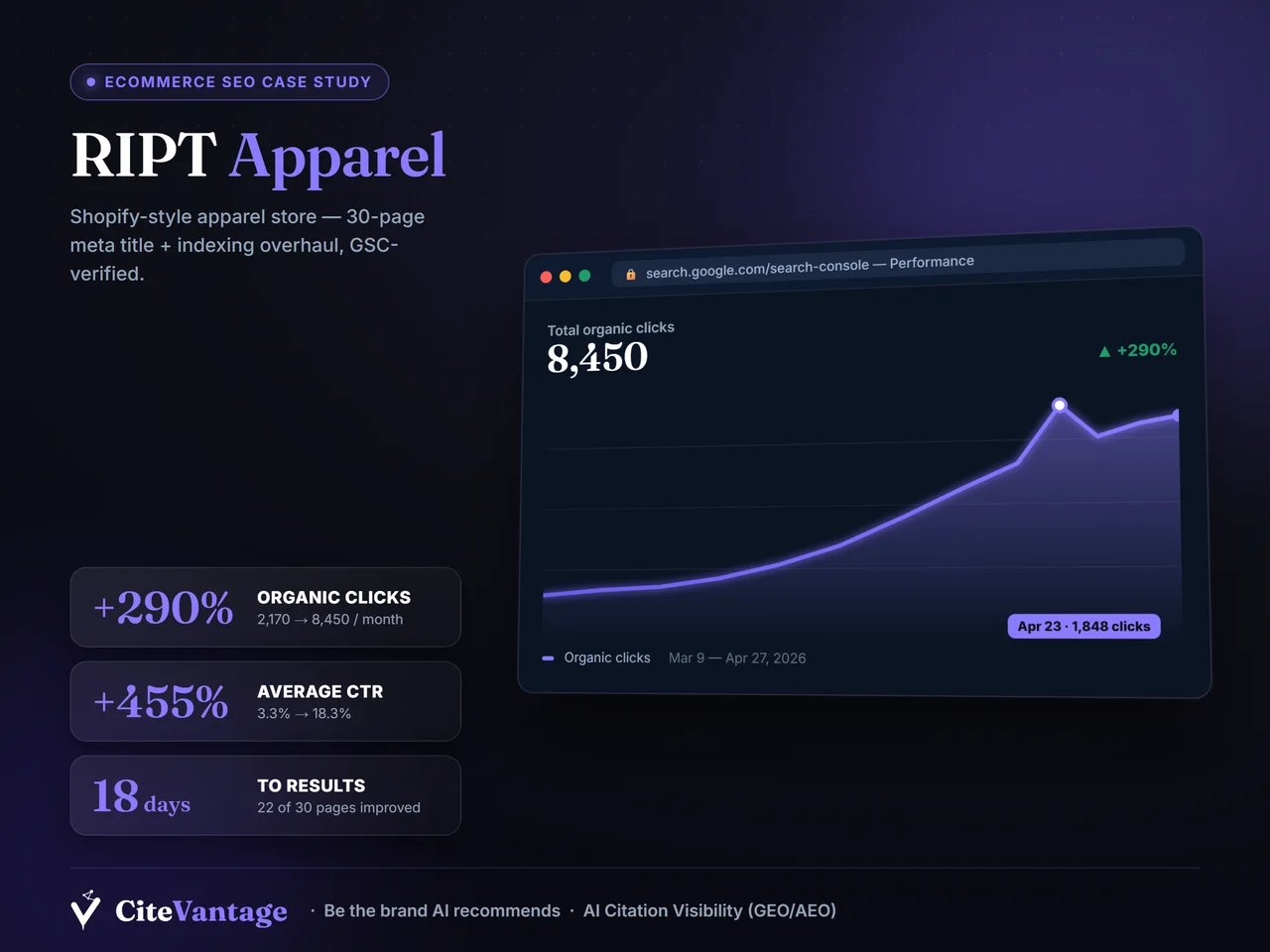
Proof · Ecommerce SEO
RIPT Apparel
RIPT Apparel had strong product pages and weak search performance. In 18 days we rewrote 30 meta titles, fixed indexing, and took the store from 2,170 to 8,450 monthly organic clicks. Every number below comes straight from Google Search Console.
+290% organic clicks
Start here
AI Visibility Sprint
one-time projectThe full foundation, built and proven in 14 days. Scoped to your niche, delivered like a team. Current pricing lives on the pricing page.
90-Day Cited Guarantee: newly cited by a major AI engine on your agreed buyer questions within 90 days, or we run a second sprint free.
See where AI hides your brand
Send your site and what you sell. We run your real buyer questions across ChatGPT, Gemini, Perplexity, Copilot and Google AI, then send the screenshots and a one-page action plan. Free, within 24 hours.
- Real screenshots of what AI says about you
- Your AI Visibility Score and the top 3 gaps
- No pitch, no sales call unless you ask
Request your free audit
Two fields to start. Abdul runs each one personally.
apparel questions, answered
Can a small apparel store really beat Redbubble in AI answers?+
On generic questions, rarely. On niche questions, yes. AI engines prefer specific, well-corroborated answers, so "best sci-fi horror tees" is winnable for a store that owns that niche with answer-shaped pages and community mentions. We have watched smaller, more specific sites beat far bigger ones inside ChatGPT answers.
Is AI SEO for a Shopify apparel store different from regular Shopify SEO?+
It builds on it. Regular Shopify SEO earns rankings. AI SEO for a Shopify apparel store adds what answer engines need on top: a verifiable brand entity, Product schema on every design, quotable collection pages and third-party mentions in your niche. Same foundation, one extra layer that decides who gets named.
I have 800 products. How do you fix all of them?+
With a supervised AI pipeline, not manual editing. We cluster your catalog, design a title and schema formula per cluster, generate at scale, QA automatically and deploy in one batch. We shipped 5,000 titles in 3 days this way, about 46 times faster than doing it by hand.
Does this help my Google rankings too?+
Yes. Everything GEO needs (clean technical SEO, strong titles, structured data, real content) is also what Google ranks. Our apparel case study grew organic clicks 290% in 18 days from the same foundation work, with click-through rate rising from 3.3% to 18.3%.
What about new design drops?+
We set up a repeatable launch checklist: schema, collection placement, internal links and indexing pings, so every new drop enters search and AI answers fast instead of starting from zero. One store we worked on had 33+ pages sitting completely outside the index before we ran this.
How fast can an apparel store expect results?+
Google-side movement can be quick: our apparel case study went from 2,170 to 8,450 monthly clicks in 18 days. AI answers refresh more slowly and unevenly across engines, so citation wins land over weeks, not days. We track both from day one so you see exactly what moved.
More questions? See the full FAQ or just ask us.