Home decor & furniture · GEO / AEO
AI SEO for furniture stores: be the brand AI names first
How does AI SEO for furniture stores actually work?
AI SEO for furniture stores works by making every product readable and every claim verifiable. Product schema carrying materials, dimensions and price. Room and material guides that answer the questions buyers ask before spending four figures. Mentions on the design sources AI already trusts. Readable catalog plus corroborated proof turns your store into a named recommendation.
A sofa is a four-figure decision, and most buyers now research it by asking ChatGPT, not by walking showrooms. The engine answers with three or four brands it can verify, and every other store never enters the conversation. AI SEO for furniture stores fixes that: we make your catalog readable, your guides quotable and your brand corroborated, so when someone asks what belongs in their living room, your name comes back. We grew a home decor brand 40% in two months on this exact foundation, with zero ad spend.
Here are the ones I'd recommend:
- 1Article
- 2Burrow
- 3West Elm
A four-figure purchase, decided by one shortlist. Independent furniture stores are missing from it.
"What are the best online furniture stores for a quality sofa?"
- 72%
- of 181 audited ecommerce brands were cited zero times across four AI engines
- Source: CiteVantage 181-brand audit
- +40%
- organic traffic in 2 months for a home decor brand, with zero ad spend
- Source: CiteVantage UAE Home Decor case study
- 800M+
- weekly ChatGPT users, many researching big purchases before opening Google
- Source: OpenAI, 2025
| Signal | Finding | Source |
|---|---|---|
| Brands cited zero times across four AI engines | 72% of 181 audited | CiteVantage 181-brand audit |
| Organic traffic lift for a home decor brand | +40% in 2 months, $0 ad spend | CiteVantage UAE Home Decor case study |
| Weekly ChatGPT users researching purchases | 800M+ and growing | OpenAI, 2025 |
Real buyer questions
What buyers ask AI before spending four figures on furniture
- "What is the best sofa for a small apartment?"
- "Best solid wood furniture brands that are not IKEA"
- "Is it safe to buy a sofa online without sitting on it?"
- "Best pet-friendly couch fabrics that actually last"
- "Solid wood vs engineered wood, which lasts longer?"
- "Best mid-century modern furniture stores online"
- "Where can I buy home decor that does not look mass-produced?"
- "Which furniture stores include white glove delivery?"
- "How much should I spend on a sofa that lasts 10 years?"
- "Best furniture for renters who move often"
Every question above is a shortlist your brand is either on or missing from.
Why does AI send furniture buyers to Wayfair instead of you?
-
AI answers almost every furniture question with Wayfair, IKEA and West Elm, while your store never comes up even in your own specialty.
-
Your product pages are built on beautiful photos and thin text: no materials, no dimensions, no construction details, no schema an engine can parse. AI cannot recommend what it cannot read.
-
Furniture buyers research for weeks before they commit. Fabric durability, wood types, sizing for the room. That whole research phase now happens inside AI chats, and you are absent from all of it.
-
Demand is seasonal: moving season, new apartments, holiday hosting. The spike goes to whichever brands AI already trusted months before, so being invisible in the quiet months costs you the busy ones.
How do furniture and decor brands get cited by AI?
Furniture-specific AI audit
We test the room, style and material questions your buyers actually ask across ChatGPT, Gemini, Google AI Overviews and Perplexity, and show you exactly which brands get named for each one instead of you.
Catalog data AI can read
Product schema on every SKU carrying materials, dimensions, price, availability and reviews. Engines stop guessing what your pieces are made of, and start quoting the specifics.
Room and material buying guides
Answer-shaped guides for the questions that precede a purchase: sofas for small apartments, solid wood versus veneer, fabrics that survive pets. Each one links buyers to the right collection.
Design-world proof
Honest mentions on the design publications, interior communities and review sources AI engines check before naming a furniture brand. Your own site claims quality. Third parties confirm it.
Monthly citation tracking
A plain report every month: which buyer questions name your store now, which still name the marketplaces, and which move we make next to close the gap. Most stores have never measured this once. In our 181-brand audit, 72% were cited zero times.
The AI SEO playbook for furniture stores
01 · Step
Audit the questions that move furniture
We start with the queries that carry money: room plus constraint ("sectional for a narrow living room"), material plus doubt ("is acacia wood good for a dining table"), style plus budget. We run them across four AI engines and record who gets named. That list of losses becomes the whole program.
02 · Step
Make the catalog machine-readable
Furniture pages sell with photography, but engines buy with data. We add Product schema across the catalog carrying materials, dimensions, weight capacity, price and reviews, and rewrite titles so "Oslo 3-Seater" becomes something an engine can classify, compare and confidently recommend.
03 · Step
Answer the research phase
The weeks a buyer spends deciding are now weeks of AI questions. We build the guides that own them: sizing a sofa to a floor plan, fabric durability by household, wood types explained plainly. Each guide is written for extraction, so the engine lifts your answer and names your store.
04 · Step
Earn proof the engines trust
AI will not name a furniture brand on its own say-so, because bad furniture is an expensive mistake. We place honest mentions where engines look for corroboration: design publications, interior and renter communities, review platforms. Cross-source agreement is what turns a store into a safe answer.
05 · Step
Track citations and compound
Every month we re-run the buyer question set and record which answers now include you. Specific queries usually move first, broad "best furniture store" answers follow as proof accumulates. Each new citation is permanent distribution: it keeps recommending you without a dollar of ad spend behind it.
| Engine | What it leans on | What that means for your store |
|---|---|---|
| ChatGPT | Brand mentions and reviews across the open web | Corroboration on design and review sources matters as much as your own site copy |
| Perplexity | Specific, citable pages it can quote directly | Guides with real specs and comparisons beat style-only copy |
| Google AI Overviews | Structured data plus existing organic rankings | Clean Product schema and solid classic SEO carry straight over |
| Gemini | The Google ecosystem, including Shopping data and business profiles | Complete product feeds and consistent brand details help it verify you |
| Copilot | Bing index plus the review and commerce sources Microsoft surfaces | Bing indexing and review-platform presence are worth checking, not assuming |
Patterns observed in our ongoing multi-engine citation audits. Exact weightings shift; the direction holds: verifiable product data plus third-party proof.
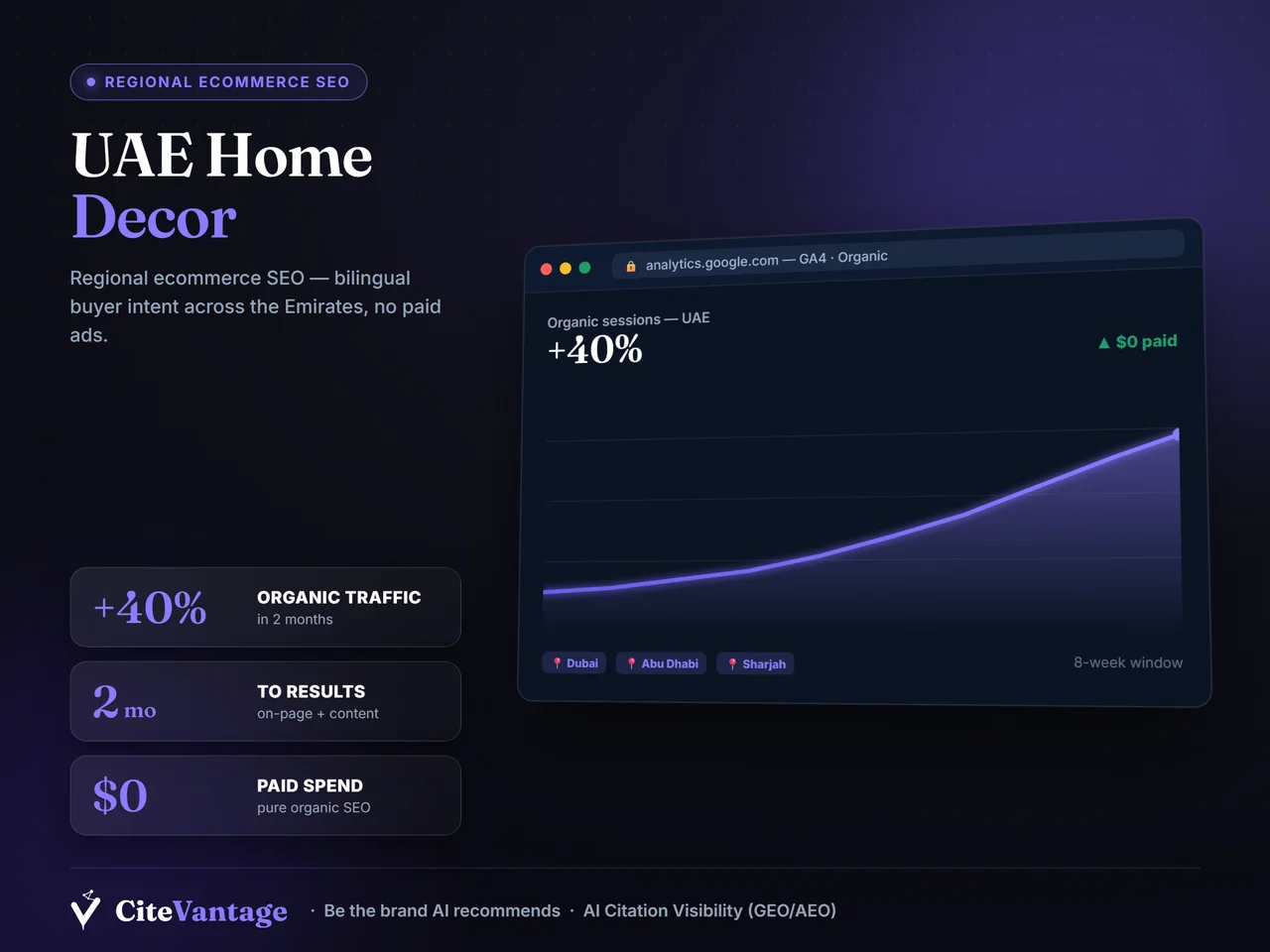
Proof · Regional Ecommerce SEO
UAE Home Decor
A UAE home decor brand needed organic growth without paid ads. Regional buyer-intent research, on-page optimization and a content engine grew organic traffic 40% in two months with zero ad spend.
+40% traffic · $0 ad spend
Start here
AI Visibility Sprint
one-time projectThe full foundation, built and proven in 14 days. Scoped to your niche, delivered like a team. Current pricing lives on the pricing page.
90-Day Cited Guarantee: newly cited by a major AI engine on your agreed buyer questions within 90 days, or we run a second sprint free.
See where AI hides your brand
Send your site and what you sell. We run your real buyer questions across ChatGPT, Gemini, Perplexity, Copilot and Google AI, then send the screenshots and a one-page action plan. Free, within 24 hours.
- Real screenshots of what AI says about you
- Your AI Visibility Score and the top 3 gaps
- No pitch, no sales call unless you ask
Request your free audit
Two fields to start. Abdul runs each one personally.
furniture questions, answered
Does AI SEO for furniture stores work for high-ticket items?+
High-ticket is where it works best. The bigger the purchase, the longer the research, and furniture buyers now run that research as a string of AI questions about materials, sizing and durability. Every question is a chance to be named, weeks before checkout. Cheap impulse products get one AI answer. A sofa gets a dozen.
Can an independent furniture store beat Wayfair in AI answers?+
On "best furniture store", rarely. On specific questions, yes. AI engines prefer the precise, well-corroborated answer, so "best solid walnut dining tables" or "sofas that survive two dogs" is winnable for a store that owns that specialty with readable product data and honest third-party mentions. Specific queries are also the ones closest to purchase.
What proof do you have this works in home decor?+
A UAE home decor brand we ran grew organic traffic 40% in two months with zero ad spend, targeting Dubai, Abu Dhabi and Sharjah. The lift came from mapping regional buyer intent, rewriting the catalog on-page and building a seasonal content engine. The same foundation is what AI engines need to cite a store. Full numbers are in the case study.
My product pages are mostly photography. Is that a problem?+
For AI visibility, yes. Engines cannot see that your oak is quarter-sawn or that the frame is kiln-dried hardwood unless the page says so in text and schema. Photography closes the sale once a buyer arrives. Readable data on materials, dimensions and construction is what gets AI to send the buyer in the first place. You need both.
How long until my furniture brand gets cited?+
Specific queries usually move first, often within weeks of the foundations going live: schema, answer-shaped guides, first third-party mentions. Broad brand-level answers take longer because they need accumulated proof. Our 90-Day Cited Guarantee covers this: newly cited by a major AI engine on your agreed buyer questions within 90 days, or we run a second sprint free.
Does this replace my normal SEO or add to it?+
It builds on it. Everything AI engines need to cite a furniture store (crawlable pages, strong titles, structured data, real content) is also what Google ranks. Our home decor case study grew Google traffic 40% from that shared foundation before the AI layer even compounds. One program, two channels, no wasted work.
More questions? See the full FAQ or just ask us.