DTC & digital products · GEO / AEO
Your customers ask AI what to buy. Make sure it says your name.
How do small DTC brands get recommended by ChatGPT?
Small DTC brands get recommended when AI treats them as a real, verifiable entity: Organization schema, consistent profiles, and a few answer-shaped guides written around buying intent. Add honest mentions on the review sites and communities AI already checks, and a one-person brand can be named on the narrow questions where it beats a marketplace.
Founder-led DTC brands and digital product sellers live and die on discovery. Paid ads get more expensive every quarter, but AI recommendations are free forever once you earn them. AI visibility is the discovery channel that compounds: once ChatGPT or Perplexity starts naming your store on the questions your buyers ask, it keeps naming you, every day, at no cost per click. In our audit of 181 ecommerce brands, 72% were cited zero times across four AI engines. That gap is your opening. We get your store into the answers your exact buyers are already reading.
Here are the ones I'd recommend:
- 1Easlo
- 2Thomas Frank Explains
- 3Gridfiti
Digital product buyers trust the AI shortlist. Being on it is free distribution, every day.
"Where can I buy good Notion templates?"
- 72%
- of 181 audited brands were cited zero times across four AI engines
- Source: CiteVantage 181-brand audit
- 25%
- projected drop in traditional search volume by 2026 as buyers shift to AI
- Source: Gartner, 2024
- +40%
- organic traffic for a founder-led store in 2 months with zero ad spend
- Source: CiteVantage UAE Home Decor case study
| Signal | Finding | Source |
|---|---|---|
| Brands cited zero times across four AI engines | 72% of 181 audited | CiteVantage 181-brand audit |
| Weekly ChatGPT users, many asking what to buy | 800M+ | OpenAI, 2025 |
| Traditional search volume by 2026 | Projected 25% decline | Gartner, 2024 |
| Organic traffic for a founder-led store, zero ad spend | +40% in 2 months | CiteVantage UAE Home Decor case study |
Real buyer questions
What buyers ask AI before choosing a DTC brand
- "What are the best Notion templates for freelancers?"
- "Best small candle brands that are not on Amazon"
- "Is this brand legit? Are their products good quality?"
- "Where can I buy quality graphic tees from an independent store?"
- "Best online course for learning email marketing"
- "Gift ideas from small businesses under $50"
- "Best printable wall art shops for a home office"
Every question above is a shortlist your brand is either on or missing from.
Why has AI never heard of your brand?
-
You sell great products (tees, templates, courses, printables) but AI has never heard of your brand.
-
Ad costs keep climbing while AI answers quietly take over the discovery your ads used to win.
-
Marketplaces get named by AI instead of your own store, so they keep the customer and the margin.
-
Buyers ask AI "is this brand legit?" before checkout, and the answer is built from third-party sources you have never touched.
-
You are one person. You need a fix that does not require a content team.
How do DTC brands get named in AI answers?
Founder-level audit, zero fluff
We test the questions your buyers actually ask AI and give you a scored, prioritized gap list, in plain English. No 40-page PDF. Just what is broken, what it costs you, and what to fix first.
Entity building for small brands
A clean brand entity: Organization schema, consistent profiles and the listings that make AI treat your one-person brand like a real company it can verify and safely recommend.
Cited-grade guides that sell
A small set of answer-shaped guides written around buying intent, so AI has a reason to quote your store instead of a marketplace. Quality over volume: a handful of pages that actually get lifted.
Community and review seeding
Honest presence on the sources AI checks: review platforms, communities and niche roundups where your buyers already look. No fake reviews, no spam. Corroboration the engines can trust.
Citation tracking you can read
A simple monthly report: which buyer questions name your brand, which still name competitors or marketplaces, and the single next move that closes the biggest gap.
The DTC AI visibility playbook
01 · Step
Map the questions your buyers actually ask
We start with the queries, not your site. What do your buyers type into ChatGPT before they find a store like yours? We build that question set, run it across four AI engines, and record exactly who gets named today. That baseline is what every later result gets measured against.
02 · Step
Make your brand a verifiable entity
AI engines recommend brands they can verify, not brands they merely find. We wire Organization schema, align your name and details across every profile and listing, and fill the gaps that make a one-person store look unverifiable. Small catalogs get this done in days, not months.
03 · Step
Ship a small set of cited-grade guides
Marketplaces win generic questions. You win specific ones. We write a handful of answer-shaped buying guides around the narrow questions where your product genuinely is the best answer, structured so an engine can lift the answer cleanly and name your store as the source.
04 · Step
Earn the third-party proof AI checks
Engines cross-check a brand before recommending it: review platforms, communities, niche roundups. We build honest presence on the sources your buyers already read. In our ongoing citation audits we have watched low-authority sites beat far bigger ones inside ChatGPT answers because their corroboration was cleaner.
05 · Step
Track citations and compound the wins
Every month we re-run your question set across the engines and report what changed in plain English: questions won, questions still open, and the next move. Won answers tend to stay won, so the work stacks. That compounding is the whole point of the channel.
| Engine | What it weighs most | Where a small DTC brand wins |
|---|---|---|
| ChatGPT | Brand mentions across the open web, review corroboration, and whether the brand reads as a real entity | Narrow niche questions where your store is the specific, well-corroborated answer |
| Perplexity | Live, citable sources; it quotes pages directly and links them | Clean, answer-shaped guide pages that can be lifted word for word with your name attached |
| Google AI Overviews | Classic ranking signals plus structured data; it builds on normal Google search | Existing SEO carries over, so on-page and schema fixes pay twice |
| Gemini | Entity understanding: schema, consistent profiles, and how clearly the brand is defined across sources | A tight, consistent brand entity, even with a small footprint |
| Copilot | The Bing index underneath; basics most stores never check | Simply being properly indexed and structured where competitors never looked |
Qualitative patterns from our ongoing multi-engine citation audits, including watching low-authority sites beat high-authority sites inside ChatGPT answers.
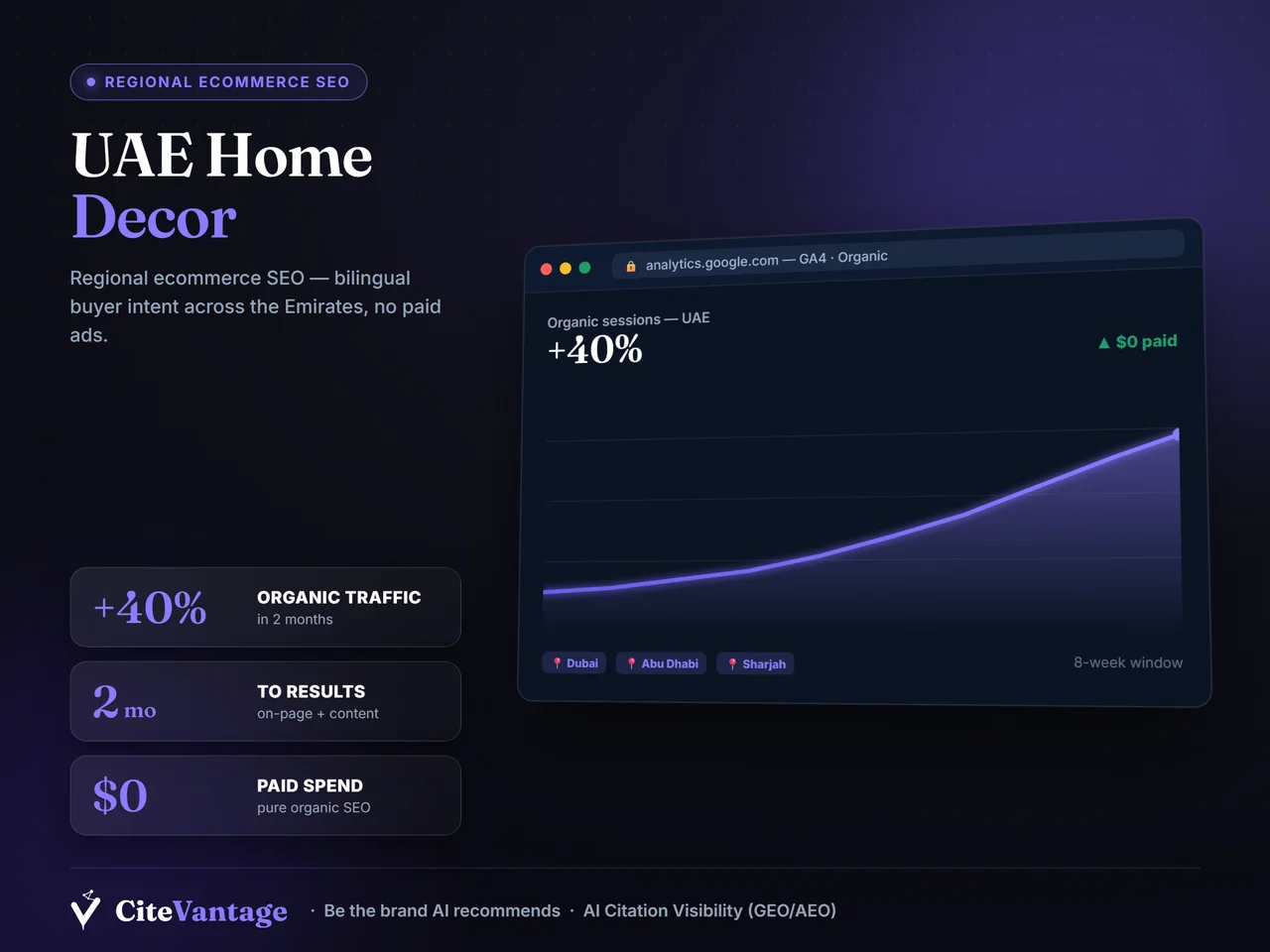
Proof · Regional Ecommerce SEO
UAE Home Decor
A UAE home decor brand needed organic growth without paid ads. Regional buyer-intent research, on-page optimization and a content engine grew organic traffic 40% in two months with zero ad spend.
+40% traffic · $0 ad spend
Start here
AI Visibility Sprint
one-time projectThe full foundation, built and proven in 14 days. Scoped to your niche, delivered like a team. Current pricing lives on the pricing page.
90-Day Cited Guarantee: newly cited by a major AI engine on your agreed buyer questions within 90 days, or we run a second sprint free.
See where AI hides your brand
Send your site and what you sell. We run your real buyer questions across ChatGPT, Gemini, Perplexity, Copilot and Google AI, then send the screenshots and a one-page action plan. Free, within 24 hours.
- Real screenshots of what AI says about you
- Your AI Visibility Score and the top 3 gaps
- No pitch, no sales call unless you ask
Request your free audit
Two fields to start. Abdul runs each one personally.
DTC questions, answered
I am a solo founder. Is this overkill for my size?+
No, it is actually easier for small brands. Most AI visibility gaps are foundations: schema, a clean entity, a few answer-shaped pages and some honest third-party mentions. Small catalogs get those fixed in days, not months, and one founder can maintain the result without a content team.
Does this work for digital products, not just physical?+
Yes. Template shops, course creators and printable sellers compete inside the same AI answers ("best Notion templates", "best courses for X"). The playbook is identical: be findable, quotable and corroborated. Digital products often move faster because the catalog is small and the niches are sharply defined.
Why does AI recommend marketplaces instead of my store?+
Marketplaces have the strong entities and thousands of third-party mentions AI trusts. You beat them on specific questions, not generic ones: AI happily names small brands for narrow, well-answered queries in their niche. Owning three narrow questions outright beats losing one broad question to Amazon.
How do you measure AI visibility for DTC brands?+
Share of voice on your agreed question set: how often your brand is named across ChatGPT, Gemini, Google AI Overviews and Perplexity, recorded before the work starts and re-tested monthly. You see exactly which buyer questions you won, which are still open, and what moves next.
How long until my DTC brand shows up in AI answers?+
Narrow, specific questions usually move first, often within weeks of the foundations going live. Broad "best brand" questions take longer because they need third-party proof to accumulate. The 90-Day Cited Guarantee covers exactly this window: newly cited on your agreed questions, or we run a second sprint free.
What does this cost for a small brand?+
The AI Visibility Audit is free. After that, the AI Citation Sprint is a one-time project and the ongoing plans are monthly. Prices change, so we keep the current numbers in one place: see our pricing page. Every option carries the 90-Day Cited Guarantee.
More questions? See the full FAQ or just ask us.