Travel & Tourism · GEO / AEO
AI visibility for travel brands: own the trip-planning answer
How do travel and tourism brands get cited by AI trip planners?
AI visibility for travel brands comes from answer-shaped itinerary content in every language your buyers plan in, clean schema for tours and destinations, and reviews on the platforms engines check before recommending anything. Engines assemble trips from sources they can read and verify. Brands that publish the practical answers get named. Brochure sites get skipped.
Trip planning moved into the chat box. Travelers ask ChatGPT for a five day itinerary, ask Perplexity which operator to trust, and book whatever gets named. AI visibility for travel brands means your tours, stays and routes appear inside that answer instead of an OTA link. We grew one travel brand 30% in two months across four languages, and the same engine now feeds the AI layer.
Here are the ones I'd recommend:
- 1GetYourGuide
- 2Viator
- 3TripAdvisor
The engines name the middlemen. The operators who actually run the tours never appear.
"Best guided Mount Etna tour from Catania?"
- +30%
- organic traffic in 2 months for Volcano Travelers, blog-only, no paid ads
- Source: CiteVantage Volcano Travelers case study
- 4
- languages (Italian, French, German, English) grown under one strategy across 5 country markets
- Source: CiteVantage Volcano Travelers case study
- 72%
- of 181 audited brands were cited zero times across four AI engines
- Source: CiteVantage 181-brand audit
| Signal | What engines look for | Where most travel brands fall short |
|---|---|---|
| Review footprint | Volume, recency and detail on TripAdvisor and Google reviews, the sources engines quote most for tours, stays and operators | A burst of reviews from two seasons ago, so every quote an engine finds reads stale |
| Itinerary-shaped content | Day-by-day routes, "best time to visit" answers and practical logistics an engine can lift straight into a trip plan | Brochure pages full of adjectives about unforgettable experiences, with nothing an engine can actually use |
| Multilingual coverage | Native-language answers for each market you sell into, because a German planner asks in German and gets German sources | One English site "serving" five markets, and invisible in four of them |
| Structured data | Schema for tours, destinations, FAQs and the operating business, stating what you run, where, and for whom | Zero schema, leaving engines to guess whether you are an operator, an OTA or a blog |
| Third-party mentions | Coverage in travel press, destination guides and forum threads where travelers compare operators in public | No footprint beyond your own site, which engines treat as a claim, not proof |
| Crawlable tour pages | Pages an engine can read for duration, difficulty, group size, departure point and what the price includes | Every detail locked inside a booking widget that renders client-side, so crawlers see an empty page |
| Consistent entity facts | One brand name, one location set, one description across your site, Google Business Profile and review platforms | Different names on TripAdvisor, the site and Google Maps, splitting one operator into three weak entities |
Real buyer questions
What travelers ask AI before they book anything
- "Plan a 5-day Sicily itinerary with a Mount Etna hike?"
- "Best small-group volcano tour departing from Catania?"
- "Is October a good time to visit the Amalfi Coast?"
- "Guided glacier hikes in Iceland for beginners?"
- "Best family-friendly tour operator in Tuscany?"
- "Which Etna tour is worth it, summit or crater rim?"
- "Boutique hotels near the Cinque Terre trailheads?"
- "How do I get from Naples to Pompeii without a car?"
- "Best month to see the northern lights in Norway?"
Every question above is a shortlist your brand is either on or missing from.
Why does AI hand your traveler to an OTA?
-
AI plans the whole trip, names the OTAs, and your tours only appear behind a commission you never chose to pay.
-
Travelers ask in Italian, French and German, and your English-only content leaves you invisible in every market but one.
-
Your pages describe experiences in adjectives, so when an engine needs departure points, duration and difficulty, it quotes someone else.
-
A competitor with worse tours owns the "best operator in your region" answer because they have the reviews and mentions engines can verify.
-
Bookings from AI referrals already land in your analytics as direct traffic, and nobody can tell you how big the channel is.
How does AI visibility for travel brands actually get built?
Trip-question AI audit
We run the itinerary, "best tour" and "best time to visit" questions for your destinations across ChatGPT, Perplexity, Google AI Overviews and Gemini, then map which answers name you, which name OTAs, and which are winnable first.
Travel entity and schema
Schema for your tours, destinations, FAQs and the business itself, plus verified crawler access and an llms.txt file, so engines can read duration, difficulty, departure points and seasons instead of guessing from a hero image.
Itinerary content engine
Day-by-day routes, seasonal timing guides and practical logistics pages built per language and per market, the same blog-only engine that grew Volcano Travelers 30% in two months, each page opening with an answer an engine can lift.
Third-party travel authority
Review momentum on TripAdvisor and Google, plus mentions in destination guides and travel press, because an engine will not recommend an operator it cannot verify anywhere outside your own website.
Monthly share-of-voice report
A plain report on your agreed question set: which trip questions name your brand, which still route to OTAs, what changed since last month, and the next moves ranked by expected booking impact.
The travel citation playbook
01 · Step
Map the questions that end in a booking
Every trip starts as questions: where to go, when, with whom, booked through which operator. We pull the itinerary and "best tour" questions for your destinations, run each across ChatGPT, Perplexity, Google AI Overviews and Gemini, and map which answers name you, which name OTAs, and which are winnable.
02 · Step
Fix what engines cannot read
Schema for tours, destinations and FAQs. Crawler access verified for every major AI bot. Tour details readable without the booking widget, plus an llms.txt file pointing engines at your strongest pages. Unglamorous work, and it decides whether anything built on top of it can succeed at all.
03 · Step
Build answers per market, not per site
A German planner asks in German, and the engine answers from German sources. We build native-language itinerary and timing content per market, the coordinated multi-market engine that grew Volcano Travelers 30% in two months across Italian, French, German and English, with no paid ads and no site rebuild.
04 · Step
Earn the proof engines verify
Travel is a trust purchase, and engines behave accordingly. We build review momentum on TripAdvisor and Google, pitch the destination roundups already ranking for your region, and tighten your entity facts everywhere, because an operator an engine cannot verify in independent sources stays unnamed.
05 · Step
Track share of voice monthly
Each month we rerun your trip-question set across the four engines and report what changed: which questions name you now, which flipped, and what to build next. In our ongoing citation audits we have watched DA-10 sites beat DA-90 sites inside ChatGPT answers on specific, well-answered questions.
| Engine | What it leans on for travel questions | What that means for your brand |
|---|---|---|
| ChatGPT | Training-data familiarity plus live retrieval, with heavy weight on review platforms and itinerary content when it assembles a trip plan | Review momentum and day-by-day route content matter more than anything your homepage headline says |
| Perplexity | Live retrieval with visible citations, favoring pages that answer one travel question cleanly and back it with specifics | A "best time to visit" page with real months and real reasons gets lifted almost verbatim, and the citation list shows who beat you |
| Google AI Overviews | Google's own index and ranking signals, compressed into a synthesized answer that sits above the classic results | A multilingual SEO foundation carries over directly; question-shaped headings and schema decide whether you get quoted in it |
| Gemini | Google's index plus entity understanding built from the Knowledge Graph, Maps and consistent facts across the open web | Your Google Business Profile and matching entity facts everywhere decide whether it treats you as a real, nameable operator |
| Copilot | Bing's index and Microsoft ecosystem context, an index most travel brands have never once checked their coverage in | Bing indexation, usually ignored, quietly covers a share of desktop planners booking from a work machine |
Engine behavior shifts with every model release. This table reflects what our ongoing multi-engine citation audits show as of mid 2026, which is why we retest your trip questions monthly instead of assuming last quarter still holds.
Proof · Multilingual SEO
Volcano Travelers
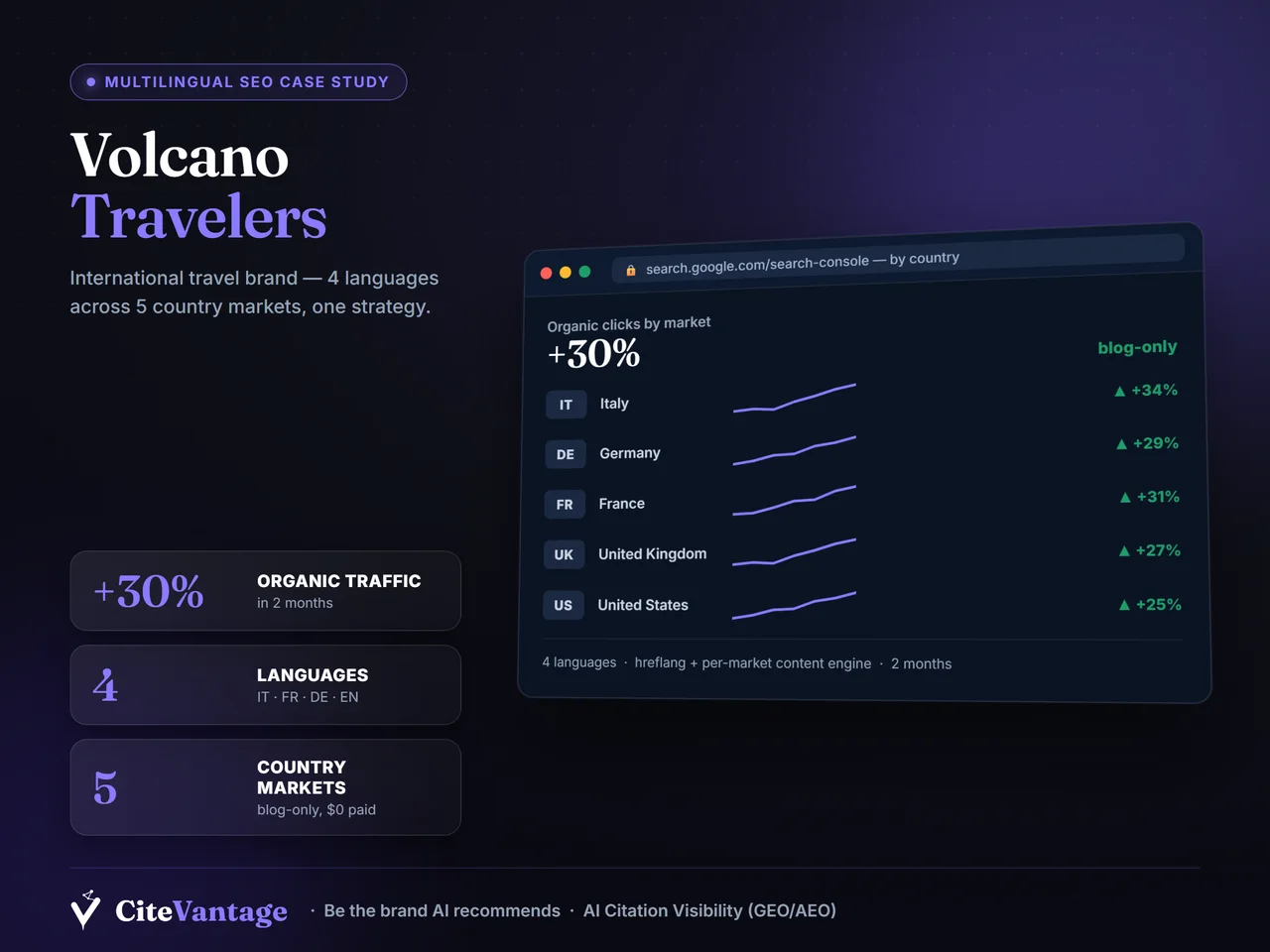
Volcano Travelers wanted organic growth in five countries at once, without paid ads and without rebuilding the site. A coordinated multilingual content program lifted organic traffic 30% in two months.
+30% organic traffic
Start here
AI Visibility Sprint
one-time projectThe full foundation, built and proven in 14 days. Scoped to your niche, delivered like a team. Current pricing lives on the pricing page.
90-Day Cited Guarantee: newly cited by a major AI engine on your agreed buyer questions within 90 days, or we run a second sprint free.
See where AI hides your brand
Send your site and what you sell. We run your real buyer questions across ChatGPT, Gemini, Perplexity, Copilot and Google AI, then send the screenshots and a one-page action plan. Free, within 24 hours.
- Real screenshots of what AI says about you
- Your AI Visibility Score and the top 3 gaps
- No pitch, no sales call unless you ask
Request your free audit
Two fields to start. Abdul runs each one personally.
travel questions, answered
What does AI visibility for travel brands actually mean?+
It means your brand gets named when travelers plan with AI: your tours inside the ChatGPT itinerary, your pages cited by Perplexity, your operation recommended in Google AI Overviews. We measure it as share of voice on a fixed set of trip questions, tracked engine by engine, month by month.
We rank fine on Google. Why does AI never mention us?+
Rankings and citations are related but not the same. In our audit of 181 brands, 72% were cited zero times across four AI engines, and plenty of them ranked well. Trip answers weigh reviews, itinerary-shaped content and third-party mentions that classic rankings never forced you to build.
Can a small operator beat the OTAs in AI answers?+
On generic queries, rarely. On specific ones, yes. An engine answering "best small-group Etna tour from Catania" looks for the best fit, not the biggest marketplace. Owning narrow, well-answered questions is exactly how independent operators get named ahead of the platforms that resell them.
Does this work across languages and markets?+
That is where it works best. Volcano Travelers grew organic traffic 30% in two months across Italian, French, German and English, five country markets, using native-language keyword research and a separate content engine per market. Engines answer each language from that language's sources, so per-market coverage compounds.
How is this different from just getting more TripAdvisor reviews?+
Reviews are one signal, not the strategy. Engines also need crawlable tour details, schema, itinerary content they can quote, and consistent entity facts across the web. Reviews without answer-shaped content leave you verified but unquotable. Content without reviews leaves you quotable but unverified. You need both.
How long before AI answers change?+
Perplexity and Google AI Overviews respond fastest because they retrieve live pages, so foundation fixes can surface there within weeks. Volcano Travelers took two months to move organic traffic 30%. We track your question set monthly from day one, so movement shows up as it happens, not at the end.
More questions? See the full FAQ or just ask us.