Images in this guide are free to reuse (CC BY 4.0). Credit CiteVantage with a link to this page.

Prefer to watch? This guide as a 3:34 video. Full transcript below.
Chapters
Full video transcript
Why Is My Brand Invisible to AI?
If ChatGPT, Perplexity, Gemini and Google AI Overviews never mention you, your brand is invisible to AI because it lacks the specific signals these engines read, which are not the same signals that rank you in classic search. They weigh third-party validation, a consistent brand entity, structured data and answer-shaped content far more than backlinks and keyword positions. You can dominate Google page one and still be absent from the answer printed above it.
This is common. Not a niche failure. When I audited 181 ecommerce brands across the four major engines, 72% were never mentioned when AI answered questions about their own category, even though most were actively investing in SEO. Getting out of that majority is doable: our from invisible to found: a home decor store case study walks through the exact sequence one store used to start showing up in AI answers.
TL;DR: Your brand is invisible to AI when the signals AI relies on are missing. About 85% of brand mentions in AI answers come from third-party sources, and only 38% of AI Overview citations come from top-10 Google rankings. Fix the off-site footprint, entity, schema and answer-shaped content, in that order.
Run the 2-minute invisibility test first
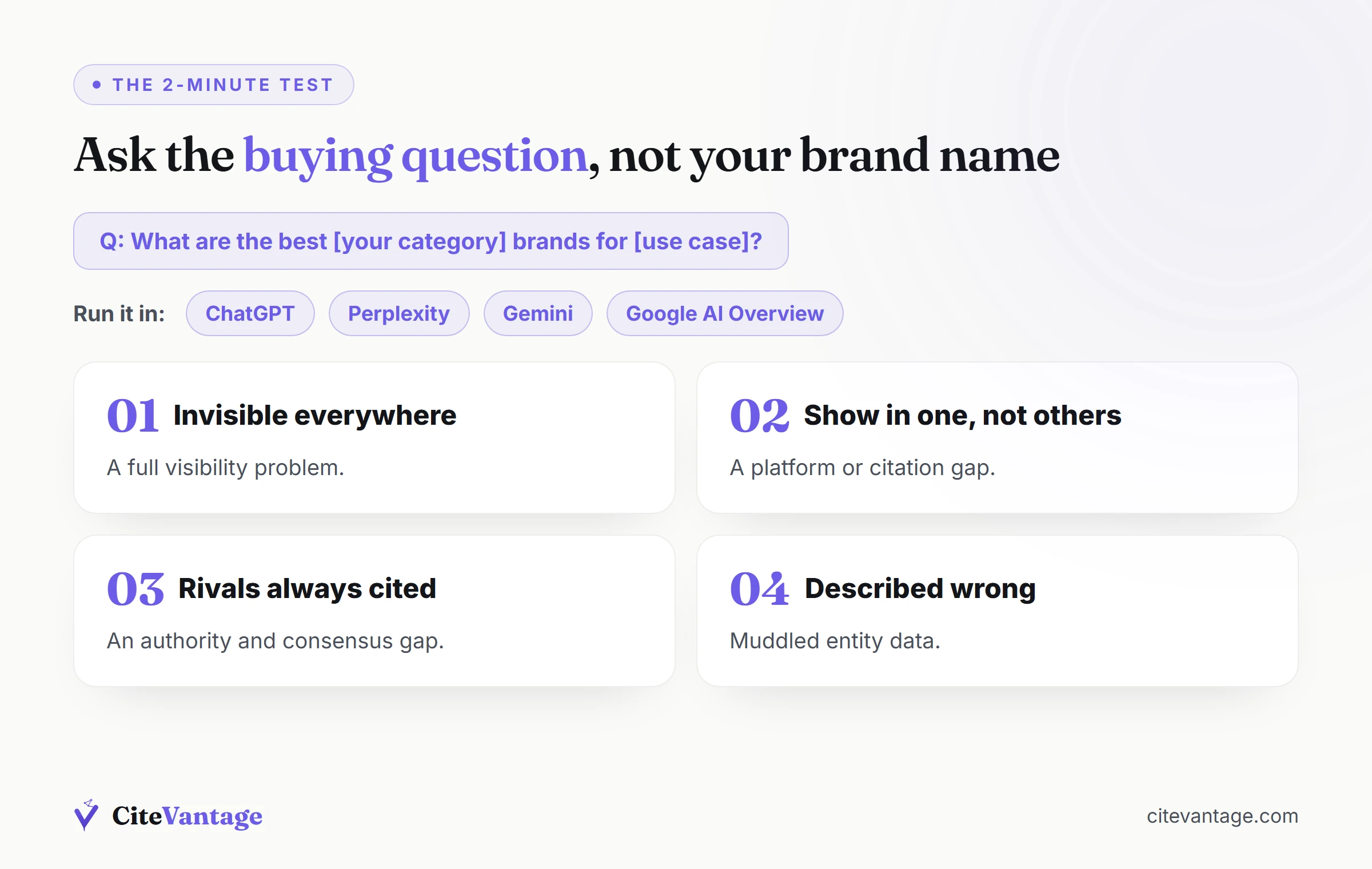
Before you chase fixes, confirm you actually have a problem and where it lives. The test is simple. Ask the buying question, not your brand name.
Open ChatGPT, Perplexity, Gemini and a Google search that triggers an AI Overview. In each one, type the question a buyer asks right before they choose someone: “What are the best [your category] brands for [use case]?” Then watch what comes back.
- If your name never appears in any engine, you have a full visibility problem.
- If you show up in Perplexity but not ChatGPT, that is a platform-specific gap, usually a citation-footprint or freshness issue.
- If competitors appear every time and you never do, that is an authority and consensus gap.
- If you appear but get described wrong, your entity data is muddled.
Run it across 10 to 20 real buyer prompts, not one. Single queries lie. We have watched the same brand surface in three of five prompts on Perplexity and zero of five on ChatGPT in the same hour. If you want to turn this quick check into a repeatable, scored monthly process, our step-by-step walkthrough on how to run an AI visibility audit yourself covers the full method.
Why is my brand invisible to AI when my SEO is fine?
Because AI visibility and SEO visibility are no longer the same thing. They drifted apart fast.
Traditional search ranks a page for a query. AI search synthesizes an answer and names a few brands inside it, frequently with no click at all. The inputs differ. Ahrefs found that only about 38% of Google AI Overview citations now come from pages ranking in the top 10, down from 76% seven months earlier. The overlap collapsed in well under a year. So “I rank, therefore AI sees me” stopped being true.
Here is the deeper reason. AI engines do not learn your brand from your website the way Google’s index does. They lean on what the open web says about you. AirOps measured this and found roughly 85% of brand mentions in AI answers come from external domains, with only about 13% coming from the brand’s own site. If your site is the only place your brand is discussed, AI treats you as unverified and routes around you.
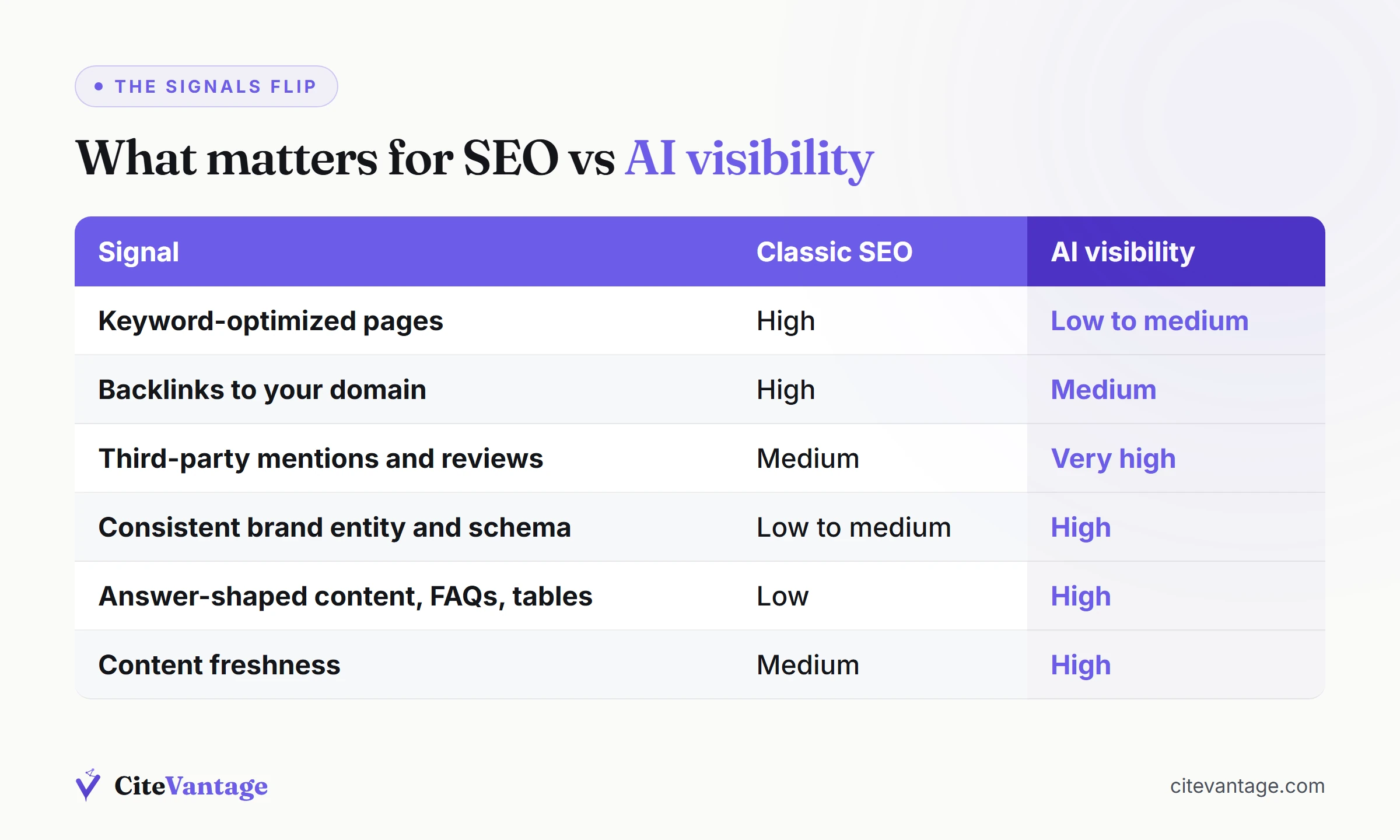
| Signal | Weight in classic SEO | Weight in AI visibility |
|---|---|---|
| Keyword-optimized pages | High | Low to medium |
| Backlinks to your domain | High | Medium |
| Third-party mentions and reviews | Medium | Very high |
| Consistent brand entity and schema | Low to medium | High |
| Answer-shaped content, FAQs, tables | Low | High |
| Content freshness | Medium | High |
That table is the whole problem in one frame. You optimized the left column. AI reads the right one.
The 7 reasons your brand is invisible to AI
We check these in order, because fixing reason seven before reason one wastes weeks. Most brands have two or three of these at once.
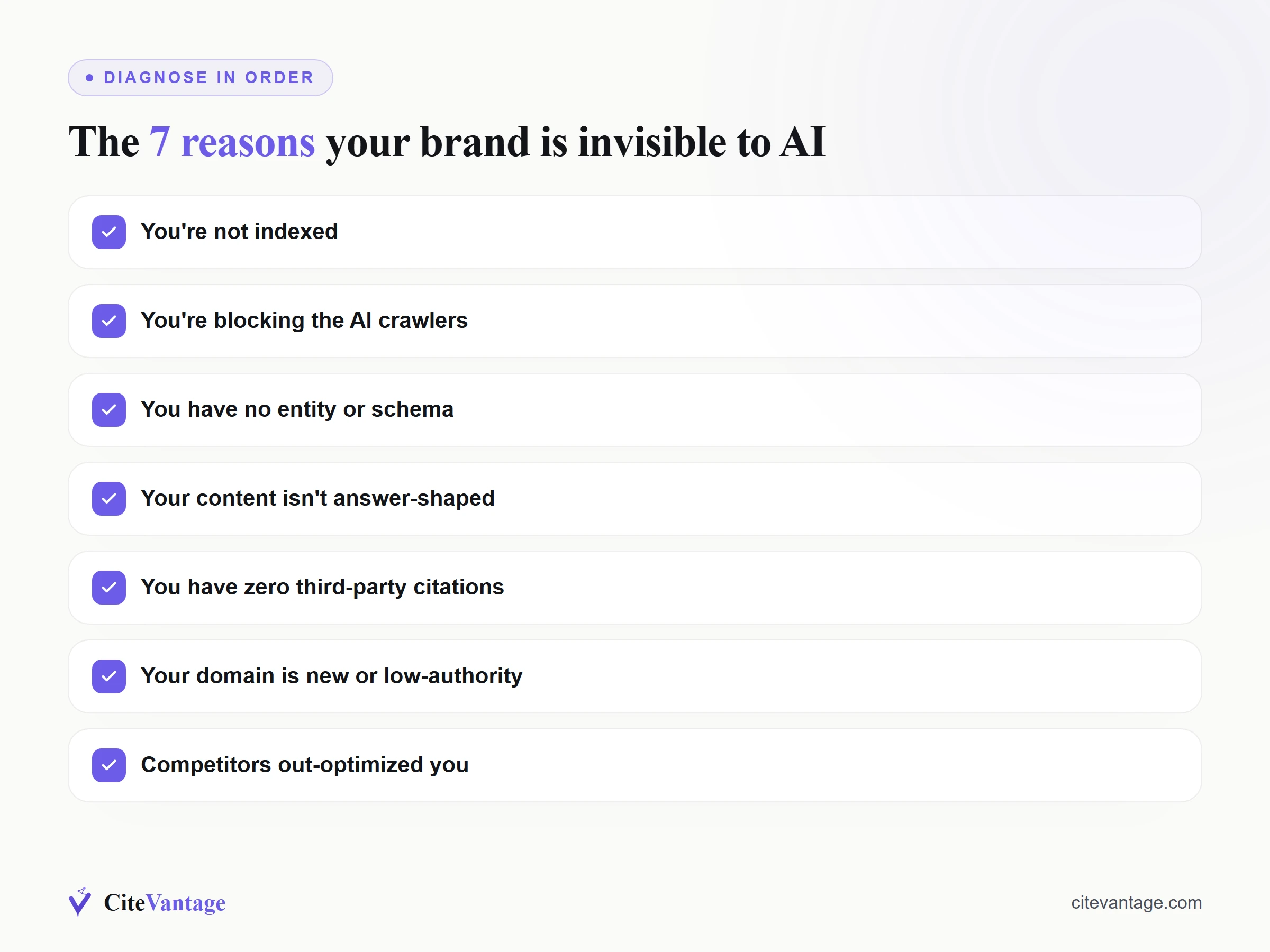
1. You’re not indexed
If Google has not indexed your pages, the AI engines that retrieve from the live web cannot find you either. This is the floor. Check: search site:yourdomain.com on Google. No results means fix indexing first, through Search Console, a clean sitemap, and removing any stray noindex tags.
2. You’re blocking the AI crawlers
A lot of sites block GPTBot, OAI-SearchBot, PerplexityBot or Google-Extended in robots.txt, sometimes by default from a theme or a CDN setting. The engine literally cannot read your catalog. Check: open yourdomain.com/robots.txt and look for disallow rules on those agents. Fix: explicitly allow the AI crawlers you want reading you.
3. You have no entity or schema
Without Organization schema and consistent sameAs links, AI has no verifiable “thing” to attach facts to. Your name, description and category float around as loose text instead of a recognized entity. Fix: add JSON-LD entity markup, then keep your name, founder, description and category identical across your site, your profiles and directories. Consistency is the signal.
4. Your content isn’t answer-shaped
If your pages are walls of sales prose with no capsules, FAQs, comparison tables or clear headers, there is nothing clean for an engine to lift. AI favors comparison articles, buying guides and direct Q&A over brochure copy. Fix: add answer capsules near the top, FAQ blocks with schema, and comparison tables. We have repeatedly watched a tight 200-word FAQ get cited over a 2,000-word feature page on the same site.
5. You have zero third-party citations
This is the one that catches strong, established brands off guard. AI weights cross-source agreement. If no reviews, directories, editorial pieces or forum threads point to you, you have no consensus signal, no matter how good your own site is. Fix: earn presence on the review sites, directories and communities AI already reads. Reddit, Trustpilot, G2 and category-specific roundups carry real weight here. Building that off-site footprint is the core of how we fix an invisible DTC brand, because it is the signal your own website cannot manufacture.
6. Your domain is new or low-authority
A site that is days or weeks old has not earned the mentions, reviews or track record AI needs to recommend it with confidence. For a new brand this is normal, a starting line and not a verdict. Fix: front-load entity signals and third-party mentions so you get cited sooner instead of waiting years for organic discovery to do it slowly.
7. Competitors simply out-optimized you
Sometimes you are findable and fine, and your rivals are just more answer-shaped, more cited and more consistent. They earned more of the right-column signals. Fix: study exactly who AI recommends in your category and which sources it pulls from, then close the schema, content and citation gap deliberately.
How do I know which of the 7 is my problem?
You map symptom to cause, then fix in priority order. Most invisibility is one or two root causes wearing several costumes.
| Symptom | Likely cause | First fix |
|---|---|---|
site: search returns nothing | Not indexed | Search Console plus a clean sitemap |
| Indexed but never quoted | No schema or not answer-shaped | Entity JSON-LD, FAQs, capsules, tables |
| Shows in Perplexity, not ChatGPT | Thin citations or stale content | Third-party mentions plus a refresh cadence |
| Competitors always cited, you never | Off-site authority gap | Reviews, directories, forum presence |
| Brand is under a month old | Too new | Front-load entity plus earned mentions |
| AI describes you wrong | Muddled entity data | Consistent name, schema, matching profiles |
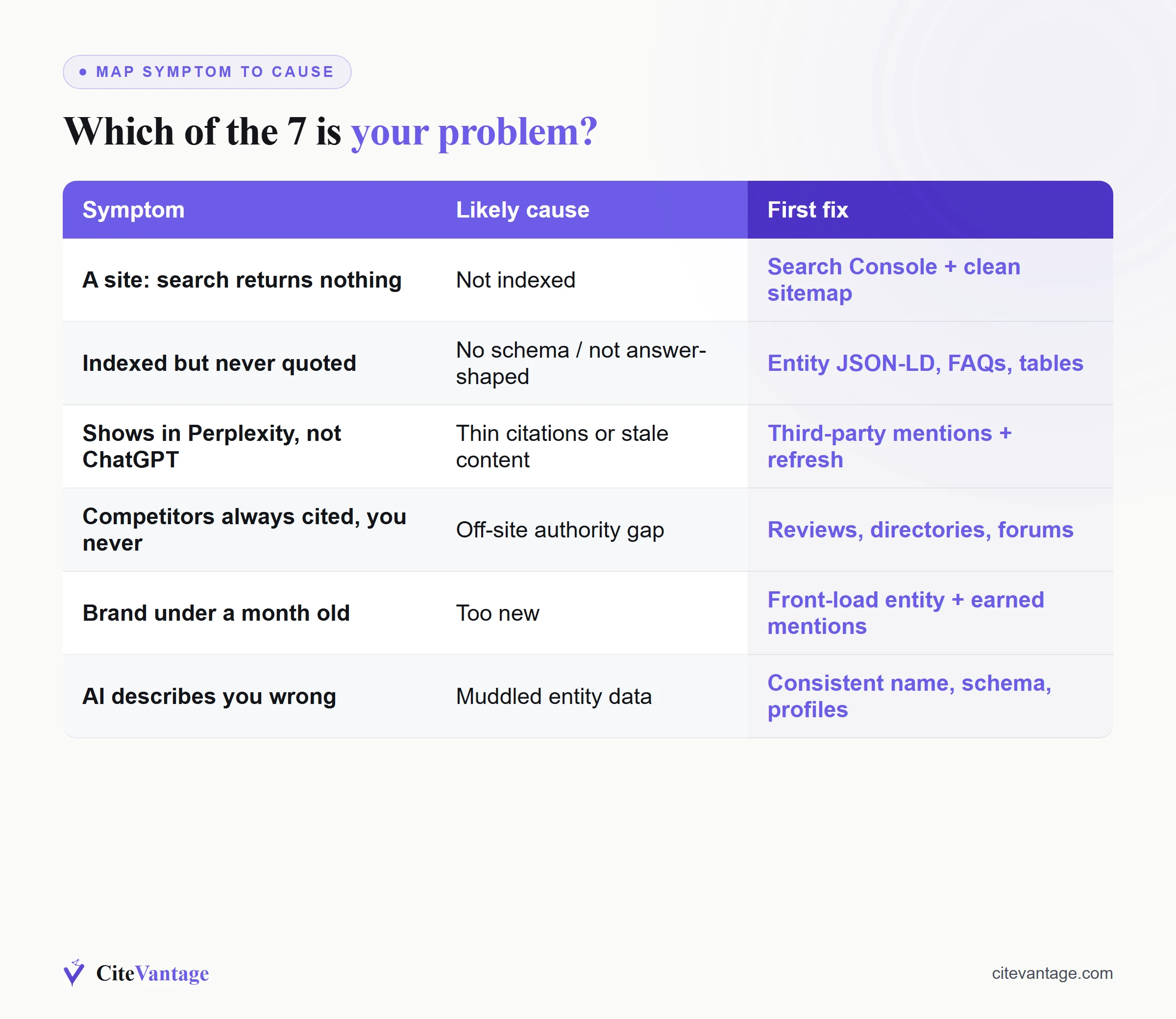
A point worth sitting with. Reasons one through four are mostly on your own site and you control them this week. Reasons five through seven live off-site and take longer, because you cannot publish your way to consensus. You have to earn it. That is also why brands with flawless websites still come up empty in our audits.
Why this is getting urgent, fast
The window where this is optional is closing. Usage moved.
Pew-tracked data shows roughly half of US adults now use AI chatbots, up sharply from a few years ago. Meanwhile Google AI Overviews now appear on a large and growing share of searches, and a randomized field study found AI Overviews cut organic clicks on triggered queries by about 38%, with zero-click searches climbing from 54% to 72%. Read that together. More buyers are asking AI, more answers resolve without a click, and the brands named inside those answers absorb the demand that used to flow to ten blue links.
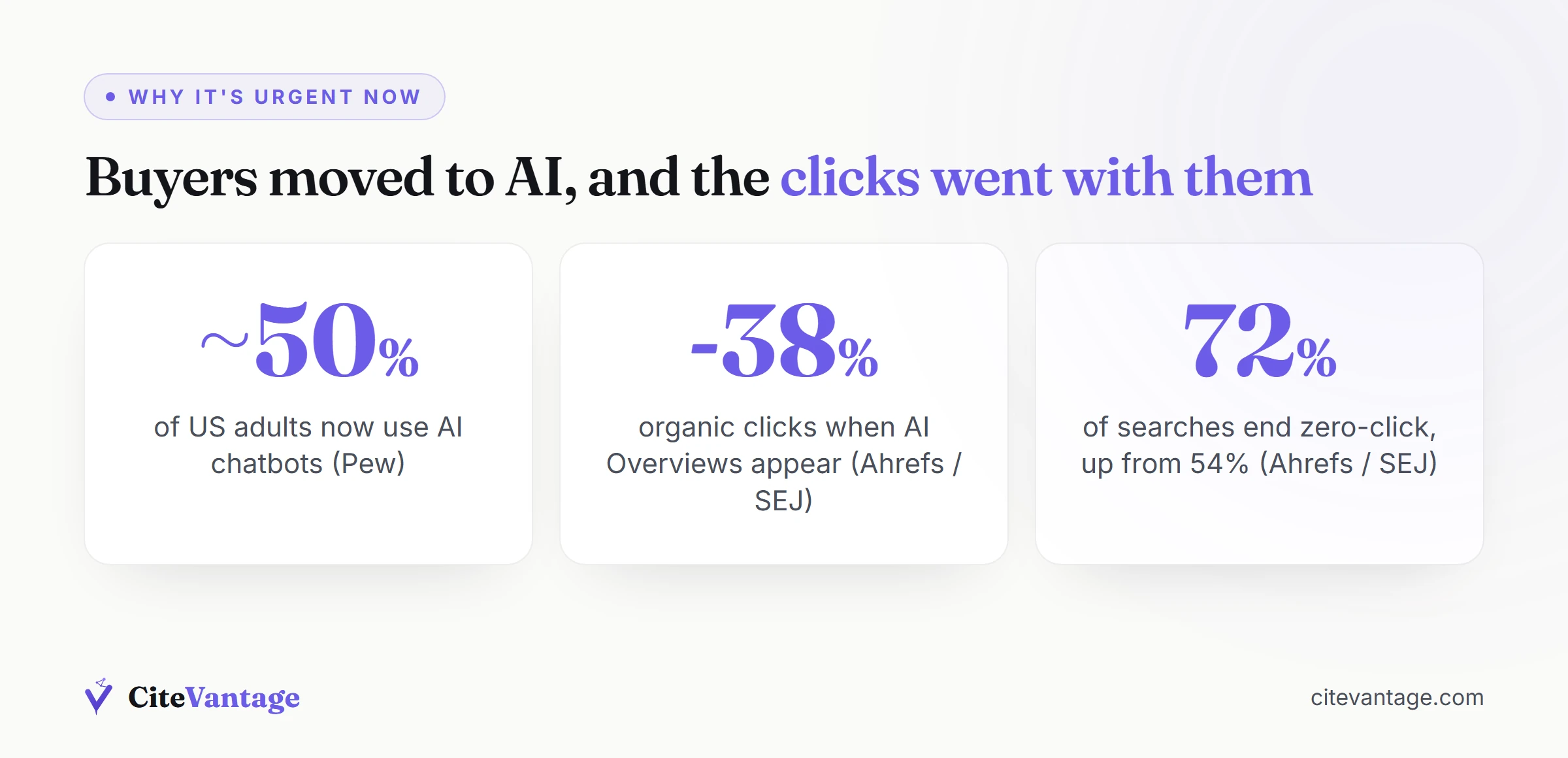
So invisibility is not a vanity problem anymore. It is a pipeline problem. A brand can have stores, traffic and a working site and still be missing from the exact moment a buyer is deciding. If you want the longer mechanics of how engines pick winners, we wrote that up in how AI decides which brands to recommend, and the discipline that fixes it is answer engine optimization.
What to do this week
Three concrete steps, in order, no fluff.
- Run the multi-engine test. Ten buyer questions across ChatGPT, Perplexity, Gemini and Google AI Overviews. Write down where you appear and which sources got cited instead of you. That list is your competitive map.
- Fix the on-site floor. Confirm indexing, unblock the AI crawlers in robots.txt, add
Organizationschema, and reshape your top pages with FAQs, capsules and a comparison table. - Start the off-site work. Pick the three review sites, directories or communities AI cited for your rivals, and earn real presence there. Consensus is the slow lever, so begin it first.
If you would rather not run the diagnosis by hand, our free AI Visibility Audit checks all four engines, scores you 0 to 100, and tells you which of the seven reasons is hurting you most. For deeper background on the broader strategy, start with what is generative engine optimization.
You do not need to win every engine in week one. You need to stop being invisible in the queries that decide your sales.
Frequently asked questions
Why is my brand not appearing in ChatGPT results?+
Usually because ChatGPT leans on third-party sources, not your website. If reviews, directories, comparison posts and forums never mention you, ChatGPT has no outside signal to confirm you exist or matter. Roughly 85% of brand mentions in AI answers come from external domains. A new domain, blocked AI crawlers, or thin entity data make it worse. Fix the off-site footprint first.
How do I check if my brand shows up in AI search results?+
Ask the buying question, not your brand name. Open ChatGPT, Perplexity, Gemini and a Google AI Overview, then type "best [your category] for [use case]" in each. Note whether you appear, in what position, and which sources got cited instead. Repeat across 10 to 20 real buyer prompts. Manual spot-checks miss platform swings, so a multi-engine audit gives a cleaner baseline.
Does ranking #1 on Google guarantee AI citation?+
No, and the gap is widening. Only about 38% of Google AI Overview citations now come from pages ranking in the top 10, down from 76% seven months earlier. AI engines pull from forums, reviews and comparison sites that never rank well in classic search. You can own page one and still be absent from the answer above it.
What causes brands to be invisible to Perplexity and Google AI Overviews?+
Different engines, overlapping causes. Perplexity favors fresh, citable, well-structured pages and trusted third-party sources; Google AI Overviews lean on its core ranking systems plus query fan-out. Common culprits across both: no schema, no off-site mentions, content that answers questions buyers never ask, and an unclear brand entity. Inconsistency between engines usually traces back to your citation footprint, not luck.
How long does it take to improve brand visibility in AI search?+
Two to four weeks for early movement on Perplexity and Google AI Overviews, which re-crawl often. ChatGPT can lag longer because some answers depend on training data and slower web retrieval. In our sprints we target a first new citation inside 14 days across agreed buyer questions. Durable, multi-engine presence is a quarterly effort, not a one-time fix.
Why do competitors appear in AI answers but I don't?+
They earned more of the signals AI reads. Usually that means more third-party mentions, cleaner structured data, answer-shaped content, and a clearer brand entity, not a bigger ad budget. AI rewards cross-source agreement. If five review sites, a Reddit thread and two comparison posts name your rival and none name you, the model treats them as the safer answer.
How important is third-party content versus my own website for AI visibility?+
Third-party content carries most of the weight. AirOps found about 85% of brand mentions in AI responses come from external domains and only 13% from the brand's own site. Your website still matters for schema, clear entity data and answer-shaped pages. But if you only invest in owned content, you are optimizing the smallest slice of what AI actually cites.
What's the difference between SEO visibility and AI visibility?+
SEO visibility means ranking a page for a query. AI visibility means getting your brand named inside a synthesized answer, often with no click at all. The overlap is shrinking: only 38% of AI Overview citations now come from top-10 pages. SEO optimizes a URL; generative engine optimization optimizes the signals, entity, citations and structure, that decide which brands get recommended.
Can I optimize my website specifically for AI search?+
Partly. On-site, you control schema, FAQ blocks, comparison tables, clear entity data and crawler access in robots.txt. Those help AI read and trust you. But the larger lever sits off-site: reviews, directories, editorial mentions and forum presence. Google itself says there are no special AI-only markup files to add. So optimize the page, then go earn the outside signals.
What are the top signals that determine if AI cites your brand?+
Five do most of the work. Third-party mentions across reviews, directories and forums; a consistent brand entity with schema and matching profiles; answer-shaped content like FAQs and tables; topical authority and freshness; and crawlable access for AI bots. Backlinks and keyword rankings still help, but they no longer decide it. Cross-source consensus is the strongest single signal we see.
Why isn't my brand showing up in ChatGPT answers specifically?+
Almost always a discovery-and-trust gap, not a content gap. If your site isn't indexed in Bing, ChatGPT search can't retrieve it, and if no review sites, Reddit threads or roundups mention you, it has no outside signal to cite. About 85% of AI brand mentions come from external domains. Get indexed in Bing first, then build the third-party footprint, then make sure your pages answer buyer questions directly and early.
See where AI is hiding your brand
Free multi-engine audit across ChatGPT, Gemini, Google AI & Perplexity.
Get your free audit