Generative engine optimization is the work of getting an AI engine to name your business inside the answer it writes, rather than merely ranking somewhere the reader never scrolls to. It has become a separate discipline from SEO because the two systems select sources differently, and we have the measurements to show how far apart they have drifted.
What is generative engine optimization?
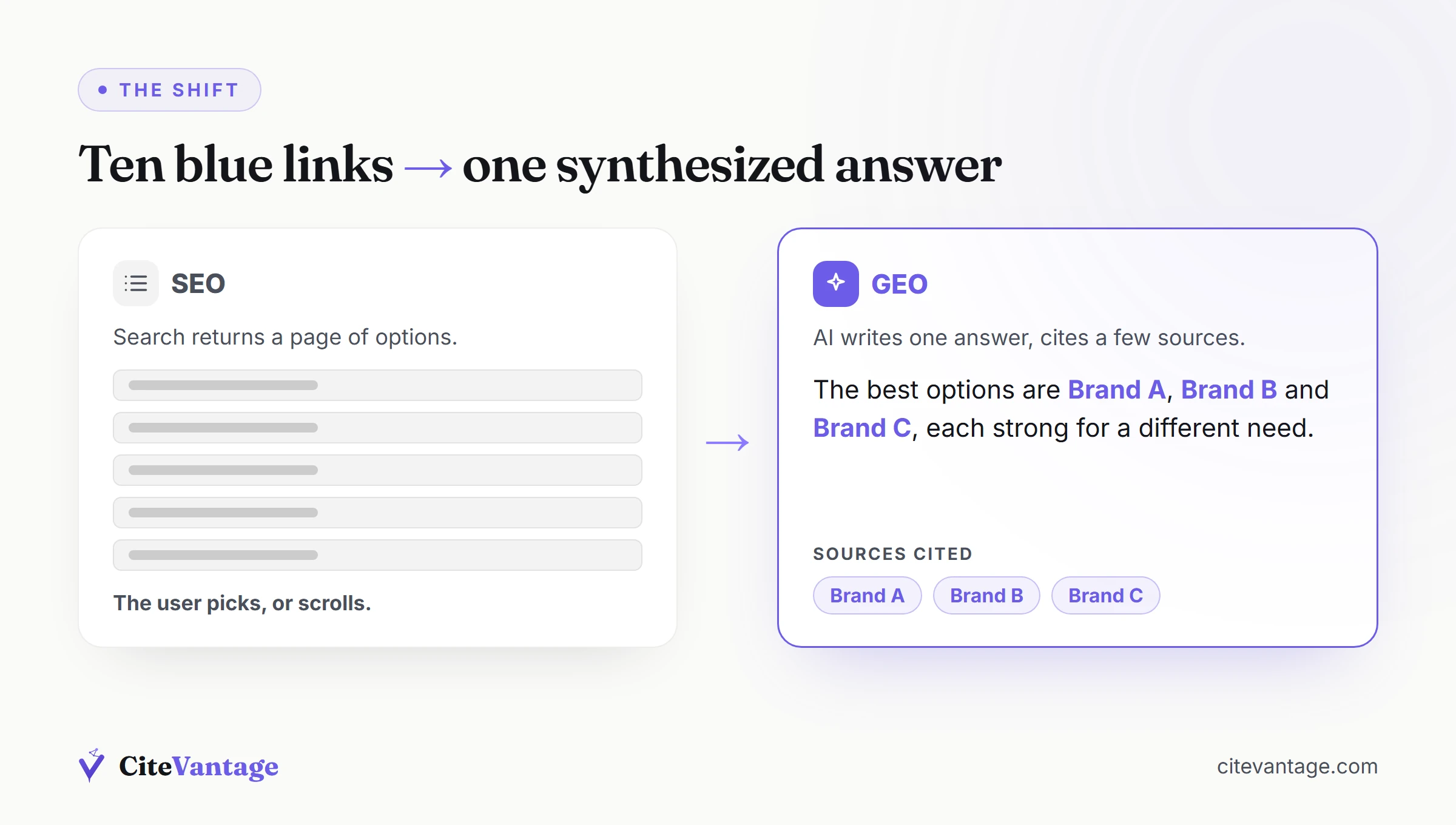
Generative engine optimization is the practice of structuring content and earning authority so that AI engines cite your brand inside a generated answer. The target is the mention, not the ranked link. Where SEO competes for a position on a results page, GEO competes to be one of the handful of sources an engine quotes when it writes the response your buyer actually reads.
That difference sounds small and it decides everything downstream. A results page shows ten links and the reader chooses. A generated answer names three sources and the reader rarely looks past them. If you are not one of the three, you did not lose a ranking. You were never in the room where the choice was made.
For a real estate agent the reader is a buyer or seller deciding who to call, and that reader is already asking AI. Veterans United Home Loans found 45% of prospective homebuyers had used AI tools in their search for a new home in its survey fielded in June 2026, up from 37% a year earlier, one of the sourced figures collected on our real estate SEO statistics page.
What is answer engine optimization (AEO), and is it different?
Answer engine optimization came first and covered a narrower problem: winning the featured snippet or the voice response, where a single extracted passage was the whole prize. GEO is the broader discipline that replaced it, covering citation inside fully written answers across several engines at once. Most practitioners now use GEO as the umbrella term and treat AEO as the extraction craft within it.
The practical overlap is large enough that arguing about the labels wastes time. Both reward the same thing, which is a passage that answers its heading directly and survives being lifted out of its page. If you want the boundaries drawn properly, including where traditional SEO still does the heavy lifting, we compare all three in GEO vs SEO vs AEO.
How invisible are most businesses to AI? Measured in two markets
Most businesses are absent from the answers that matter to them. In September 2026 we put 500 Houston real estate questions to four AI surfaces and recorded every business named in the 2,000 answers. Hand-checked, 94.0% of the Houston Association of Realtors’ 50,000-plus members were never named, and only about 3,000 agents, teams and brokerages were named at all. The full method and every name are in the 500-query Houston study.
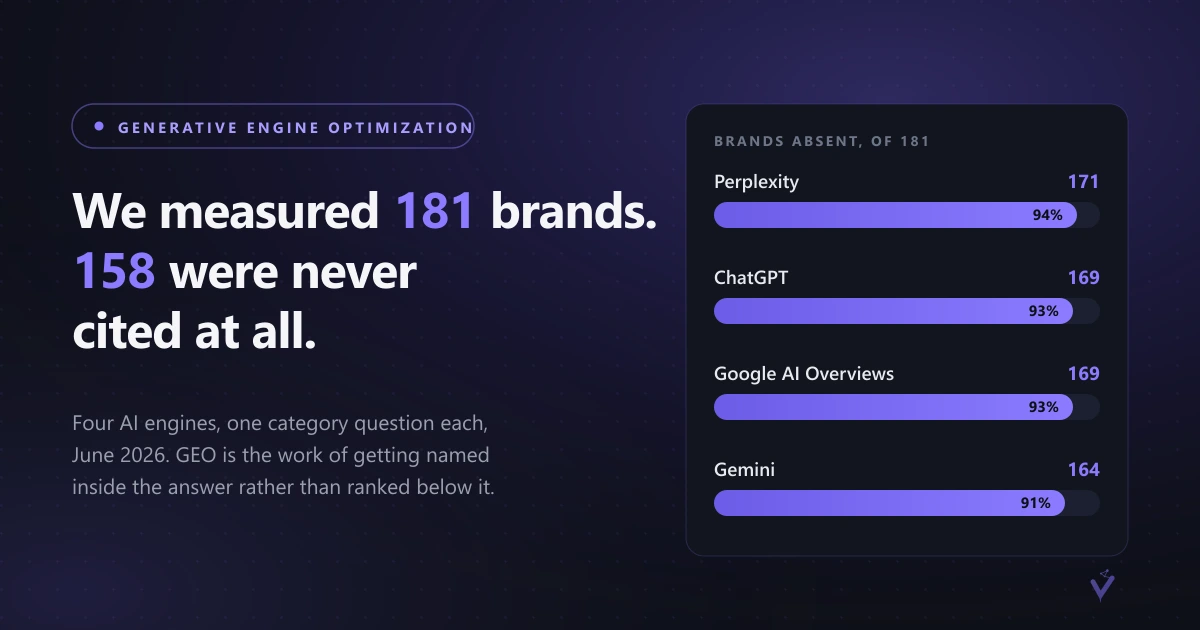
We first saw the same shape in online retail. In June 2026 we asked ChatGPT, Perplexity, Gemini and Google AI Overviews a category question for each of 181 US ecommerce brands, and 158 of them, 87 percent, were cited zero times by any engine. Its per-engine split shows the problem is not one difficult engine dragging down an average.
| Engine | Brands absent | Share of 181 |
|---|---|---|
| Perplexity | 171 | 94% |
| ChatGPT | 169 | 93% |
| Google AI Overviews | 169 | 93% |
| Gemini | 164 | 91% |
Every brand in that sample was actively running paid social at the time, so these were not dormant companies, and the engines still did not know they existed. The full method, the limitations and the row-level results are published in the 181-brand AI visibility study.
How does generative engine optimization work?
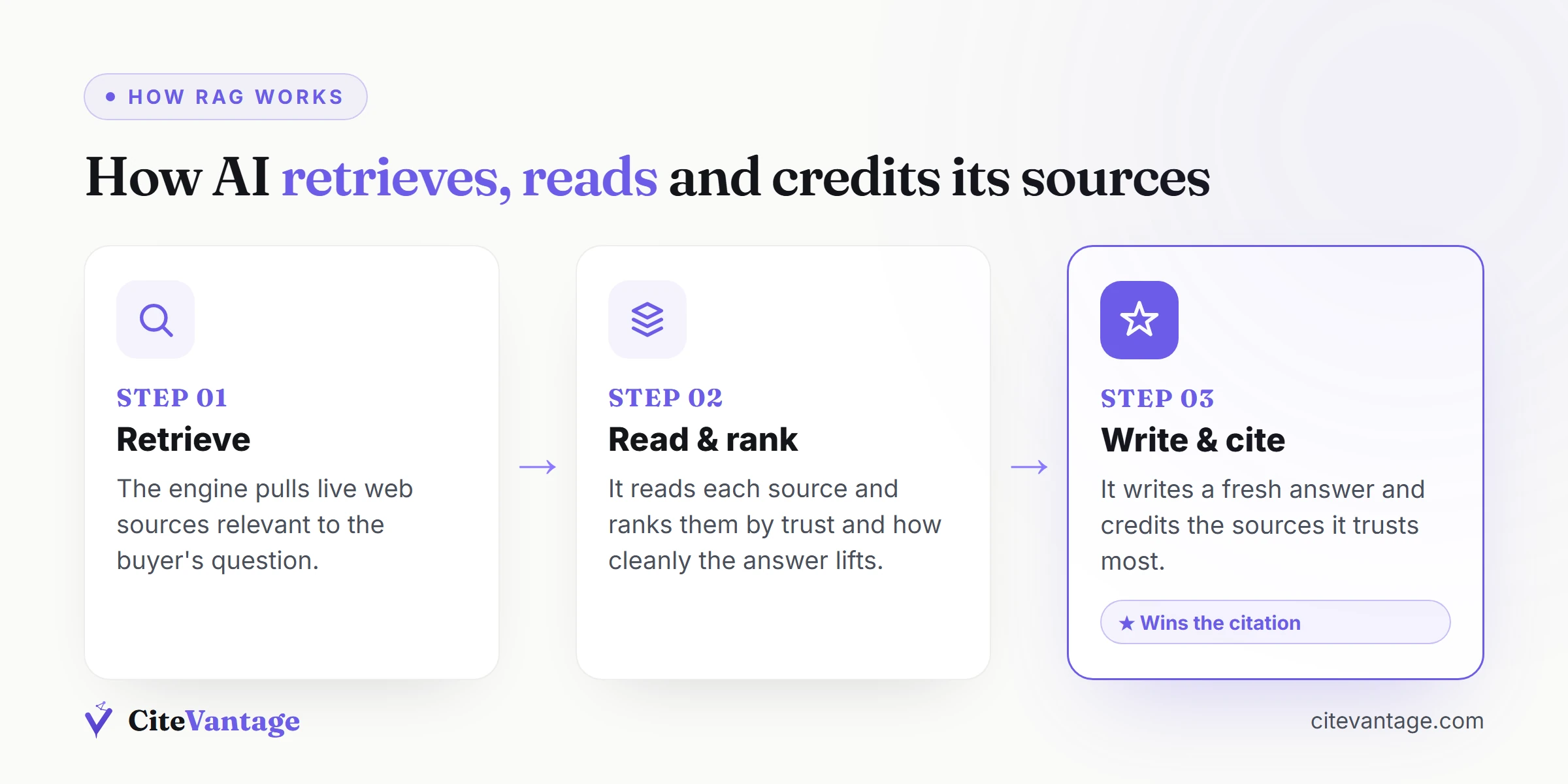
Generative engine optimization works on two stages that happen in order, and confusing them is the most expensive mistake in the discipline. First retrieval, where the engine assembles a candidate set of sources, usually by running its own search. Then selection, where it decides which of those candidates to quote and name in the answer it writes.
Almost every brand that is invisible failed at the first stage and spent its budget on the second. The two failures look identical from outside, because a page that was never retrieved and a page that was retrieved and passed over produce exactly the same result: your name is absent. Diagnosing which one you have is the first real work in any GEO programme, and it is the reason a blanket content push so often changes nothing.
How AI decides which brands to recommend
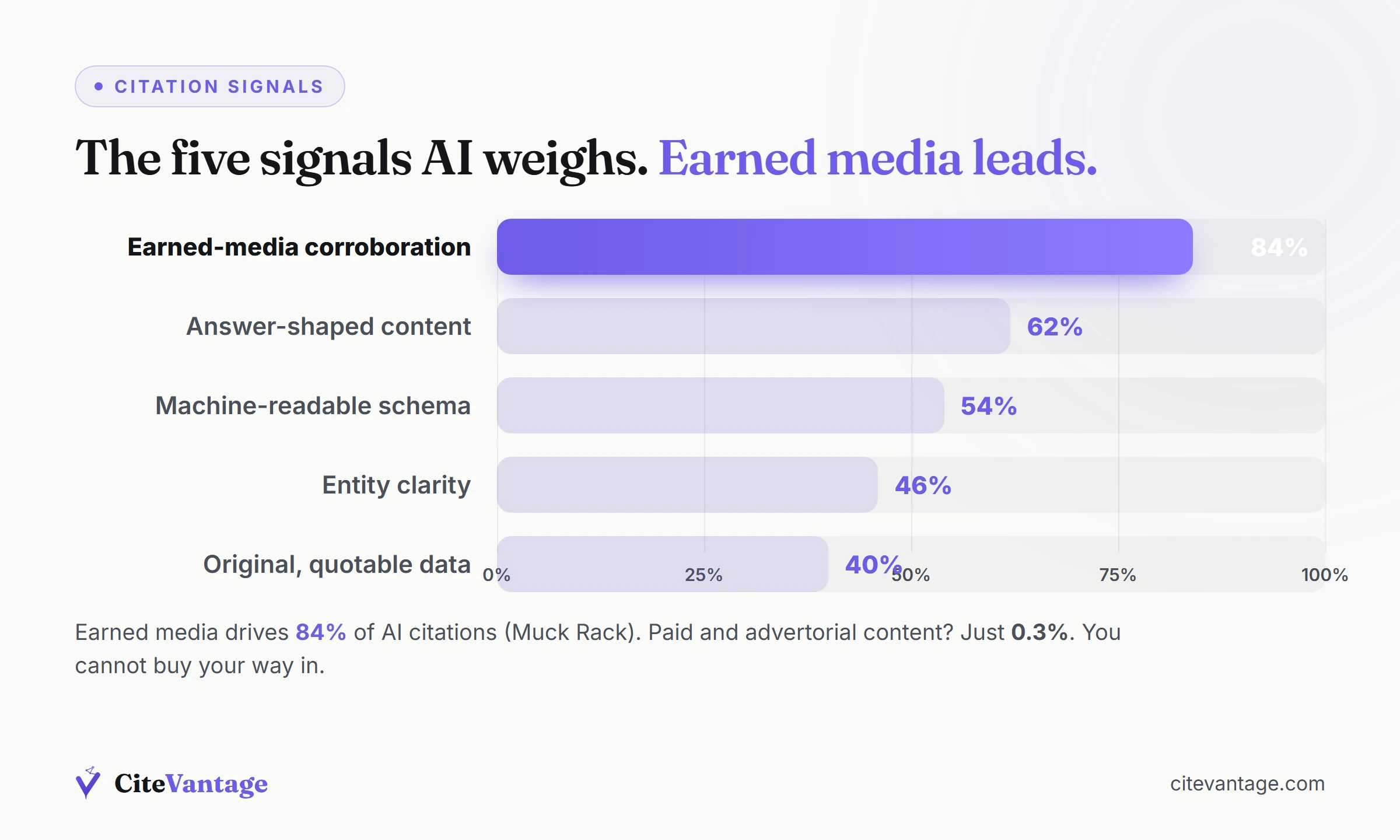
Three inputs decide it, and you can only move two. The model’s training data fixes what it knows without searching, and you cannot edit it retrospectively. Live retrieval decides what it reads at the moment of the question, which your site structure and crawler access control. Third-party corroboration decides whether it trusts what it read, and that is earned on other people’s sites.
The third input is the one teams underestimate. Engines weigh what independent sources say about you at least as heavily as what you say about yourself, which is why a thorough website and no outside mentions produces a confident brand nobody quotes. Engine by engine the emphasis shifts, so the same work pays differently in ChatGPT and Google AI Overviews.
Why AI citations do not transfer between engines
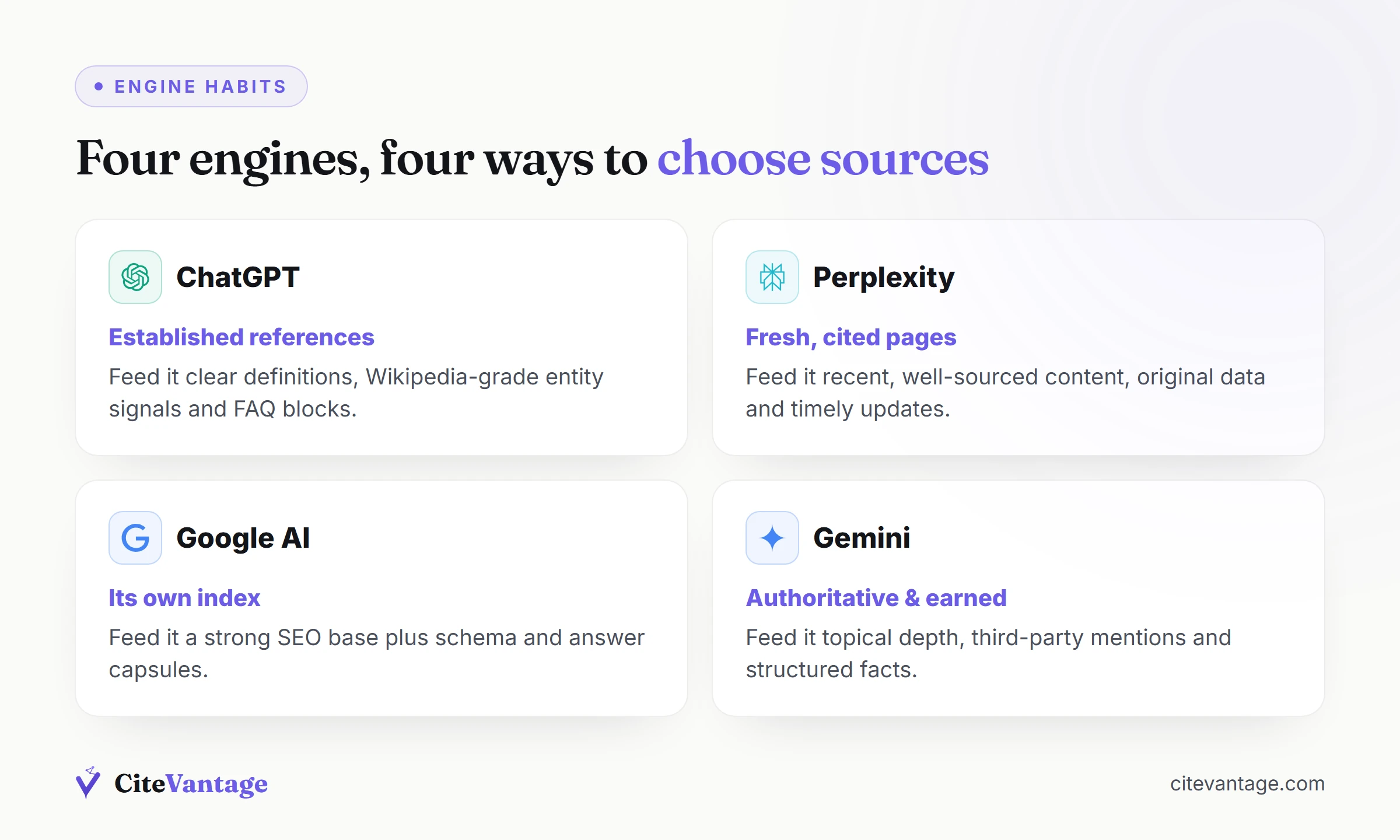
They do not transfer because each engine retrieves from a different index and selects with different rules. In September 2026 we ran 150 real estate queries across five engines and recorded 747 individual measurements. Those answers cited 1,297 distinct domains. Of those, 1,077 were cited by exactly one engine out of the five, which is 83 percent. Three domains were cited by all five.
The engines do not even agree on what a good source looks like. Google AI Overviews averaged 6.3 domains per answer and leaned hardest on YouTube, citing it in 55 answers through 91 separate links. Gemini averaged 1.3 and returned sources on only 55 of its 150 answers. Perplexity cited 618 distinct domains where ChatGPT cited 305. Reporting one blended AI visibility score across engines this different hides the engine you are actually losing, and the 150-query real estate study publishes the full matrix.
How to appear in AI search results: the access floor
Before any of this matters, the engine has to be able to fetch the page. That sounds trivial and it is where we found the most surprising failure of the year, on our own site. Your robots.txt can welcome every AI crawler in existence while your host refuses one of them at the edge, and nothing in your own configuration or server logs will show it.
We measured OpenAI’s training crawler getting refused on 8 of 8 cache-busted requests while seven other identities, including the bare GPTBot token and an ordinary browser, passed on 56 of 56, from the same machine in the same minutes. Our host later confirmed in writing that the rule is deliberate, applies across their whole platform, and cannot be switched off on a shared plan. The evidence and the raw runs are in the GPTBot case study. Check your own access before you write another word of content.
What generative engine optimization looks like in practice
A real generative engine optimization programme runs in a fixed order, because each stage is worthless without the one before it. Confirm crawler access first. Restructure pages so every section opens with a short, liftable answer. Publish something original enough to be worth quoting. Then earn third-party mentions, which is the slowest stage and the one that decides the outcome.
Measurement sits underneath all four, and it has to be per engine and repeated. A single reading tells you nothing, because answers vary between runs, and a logged-in profile with memory enabled will flatter you badly. We run this sequence for real estate firms as an AI SEO agency, but the order matters more than who executes it.
How does generative engine optimization work for a real estate agent or brokerage?
For a real estate agent or brokerage, generative engine optimization means being the name an AI engine gives when a buyer or seller asks who to hire in a specific area. In our 500-query Houston study, a hand-checked 82.6% of the agents, teams and brokerages named appeared in just one of 40 areas, so the work is won one neighbourhood and one intent at a time.
The same study shows where the engines assemble those answers. Of the 7,503 citations in them, 29.9% went to property portals (Zillow 9.1%, HAR 8.6%, Realtor.com 6.3%) and 13.7% to agent referral networks, while a firm’s own domain appeared in only 8.4% to 10.4% of the answers that named it. That changes the emphasis of the four stages above without changing their order. Crawler access and answer-first neighbourhood pages still come first, but a complete, current profile on the portals and referral networks the engines cite does more visible work than another post on your own blog.
Measurement changes too, because 83.3% of the agents named appeared on only one of the four surfaces tested. Our GEO for real estate programme runs the sequence area by area and surface by surface, and the guide to AI search for real estate agents covers the agent side in more depth.
Generative engine optimization FAQ
The questions below come up in almost every conversation we have about generative engine optimization, so they are answered directly rather than hedged. Where a claim rests on our own measurement, the sample and the date are stated so you can judge it, and where the honest answer is that nobody knows yet, that is what it says.
Frequently asked questions
What is the difference between GEO and traditional SEO?
SEO competes for a ranked link on a results page, while generative engine optimization competes to be the source an AI engine cites inside the answer it writes.
Both depend on crawlability and authority, so the groundwork overlaps. The target differs, because SEO wants the click and GEO wants the mention. A page can rank first on Google and never be named by ChatGPT, since the two systems pick their sources by different rules, and that gap is why we measure them separately.
What is the difference between GEO and AEO?
Answer engine optimization is the older, narrower term, and GEO is the umbrella that now contains it.
AEO was coined for featured snippets and voice answers, where one extracted passage was the whole prize. Generative engine optimization covers being cited inside a fully written AI answer across several engines at once. Most practitioners now treat AEO as the extraction craft inside GEO, and our GEO vs SEO vs AEO breakdown draws the lines in detail.
How do AI engines decide which sources to cite?
In two stages: retrieval builds a candidate set, then selection decides which of those candidates get quoted and named.
Retrieval usually runs as a live search at the moment of the question. Most brands fail there and never find out, because a page that was never retrieved looks exactly like one that was retrieved and passed over. Selection then favours two kinds of source:
- Passages that answer their heading directly and still make sense when lifted out of the page.
- Brands that independent sites describe the same way.
Does ranking first on Google guarantee visibility in AI search?
No. A first-page ranking helps an engine find you, but it does not decide whether you get named.
AI engines run their own retrieval and their own selection over what they retrieve, so organic strength carries over only partly. Ahrefs found only about 12% of URLs cited by AI tools overlap with Google's top 10, so most of what AI engines cite sits outside the results a ranking wins.
How many brands are actually invisible to AI search?
Most of them, in both markets we have measured.
Our 500-query Houston study collected 2,000 AI answers across four surfaces in September 2026, and a hand-checked 94.0% of the Houston Association of Realtors' 50,000-plus members were never named once. The agents who were named are held to a small patch of the market, since 82.6% of them appeared in just one of the 40 Houston areas tested. Row-level data, the query set and the analysis code are published.
Do I need to optimize separately for ChatGPT, Perplexity and Google AI Overviews?
The work is mostly shared, but each engine has to be measured on its own.
Engines rarely agree on sources. Across 747 measurements in our 150-query real estate study, 1,077 of 1,297 cited domains were cited by exactly one engine out of five, and only three were cited by all five. A single blended visibility score hides the engine you are actually losing, so report them one by one.
What kind of content gets cited by AI engines?
Content shaped like an answer, which an engine can lift whole without rewriting it.
A long guide that buries its answer in the middle of a paragraph gives the engine nothing clean to quote, however good the research behind it. The shapes that extract cleanly are easy to add to a page you already have. The ones worth building first:
- A definition of roughly 40 to 70 words that stands on its own.
- Comparison tables.
- Headings phrased the way people actually ask the question.
- Original figures published with a stated method and date.
How to appear in AI search results if my site is new?
Make sure the engines can read you first, and earn outside mentions last.
A new site has no history for an engine to lean on, so each stage has to be in place before the next one pays. Corroboration is the slowest stage and the one that matters most. The order we work in:
- Confirm AI crawlers can fetch your pages, because a host or CDN can refuse them silently.
- Open every section with a short answer an engine can lift.
- Earn mentions on sites the engines already trust.
- Re-run the same questions monthly to see what moved.
How long does generative engine optimization take to show results?
Structural fixes can show within days of a recrawl, while corroboration takes months.
Live retrieval reads the page as it stands today, so a rewritten answer can change what an engine says as soon as the page is fetched again. Corroboration depends on other people publishing about you, which you can prompt but cannot schedule. Anyone promising a fixed date for being named by an engine they do not control is guessing.
Can I stop AI engines from using my content?
Partly: robots.txt and AI-specific crawler directives state your preference, and the major crawlers respect them.
Those rules govern future crawling, and they cannot pull your pages back out of a model that has already been trained. The reverse problem is more common than people expect. Our own host, Hostinger, refuses OpenAI's training crawler at its CDN edge on every cache miss across its platform, which we documented in the GPTBot case study, so being blocked is sometimes a decision somebody else made.