
Images in this guide are free to reuse (CC BY 4.0). Credit CiteVantage with a link to this page.

Prefer to watch? This guide as a 3:52 video. Full transcript below.
Chapters
Full video transcript
GEO for Shopify: Get Your Products Cited by AI Search
Shoppers ask ChatGPT before they open a single store. “Best organic baby pajamas.” “Top minimalist jewelry under $100.” The AI returns a short list of brands, and if yours is not on it, the sale already went to whoever was. GEO for Shopify is how you get on that list. It is the work of structuring your product data, content, and brand signals so AI search engines discover your store and cite your products by name.
GEO for Shopify in one capsule: Generative Engine Optimization for Shopify means optimizing your store through Product schema, answer-shaped product content, AI crawler permissions, and third-party authority so ChatGPT, Gemini, Perplexity, and Google AI Overviews recommend your products. AI-referred Shopify traffic converts nearly 50% higher than organic, and AI orders grew almost 13x year over year in 2026.
That last number is not a forecast. It is what Shopify reported from its own Q1 2026 commerce data. Referral sessions from AI chatbots grew more than 8x year over year. Orders from those sessions grew nearly 13x. The visitors who arrive this way convert at almost 50% higher rates and spend 14% more per order. Small channel today. Fastest-growing one most merchants have.
Why ecommerce is ground zero for GEO
Product research is the exact shape of question people now hand to AI. Not “what is a CRM,” but “best wireless earbuds for small ears,” “is this brand worth it,” “what should I buy my mom.” Conversational, comparative, purchase-intent. The kind of query that used to start a ten-tab Google session now ends in a three-brand answer.
So invisibility costs more here than almost anywhere else. When an AI lists competitors in your category and skips you, that is a lost sale you never even saw bid for. And the gap is wide. We audited 181 ecommerce brands across the four major engines, and 72% were never mentioned when AI answered questions about their own category. Active SEO programs, real traffic, and still absent from the answer.
The reason is rarely a content problem. It is a data and access problem.
- Most stores ship thin schema. Roughly 75 to 85% of Shopify stores lack complete Product schema with brand, GTIN, ratings, and availability. AI will not confidently recommend a product it cannot fully parse.
- Search crawlers get blocked by accident. A robots.txt rule meant to stop scrapers often takes out the search bots that feed AI shopping answers.
- Content answers nobody. Generic PDP copy written for a brand deck does not match how a shopper phrases the question to ChatGPT.
- No third-party footprint. AI leans on reviews and “best of” lists, and a store cited nowhere outside its own domain reads as unproven.
Fix those four and you are most of the way there. None of them require a redesign.
Is GEO different from SEO for a Shopify store?
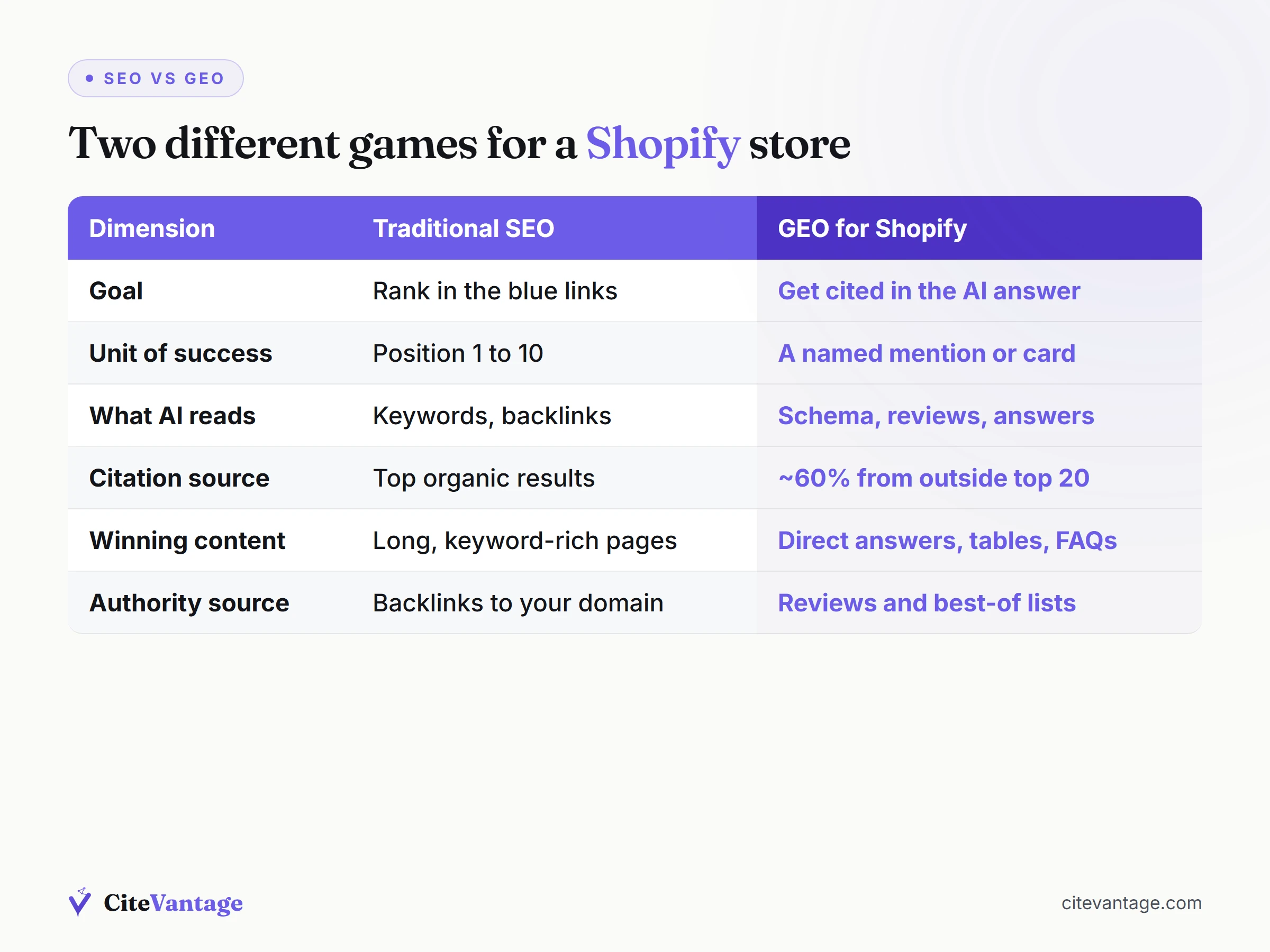
Yes, and the difference decides where you spend effort. SEO earns you a ranked position in a list of links. GEO earns you a mention inside the answer the AI writes. One is about being clickable. The other is about being quotable.
Here is where Shopify merchants get tripped up: they assume a strong Google ranking carries over. It does not, not reliably. AI engines now cite pages outside the top 20 organic results around 60% of the time. A page can sit at #1 and never get pulled into the AI answer, while a thinner page with cleaner data and a direct answer gets cited instead.
| Dimension | Traditional SEO | GEO for Shopify |
|---|---|---|
| Goal | Rank in the blue links | Get cited inside the AI answer |
| Unit of success | Position 1-10 | A named mention or product card |
| What AI reads | Keywords, backlinks, ranking signals | Product schema, reviews, answer-shaped content |
| Where citations come from | Top organic results | ~60% from outside the top 20 |
| Winning content shape | Long, keyword-rich pages | Direct answers, tables, FAQ pairs |
| Authority source | Backlinks to your domain | Third-party reviews and “best of” lists |
If you want the full breakdown of how the two relate, we go deeper in GEO vs SEO vs AEO. The short version: you still need SEO fundamentals, a crawlable site and useful content, but they are now the entry fee, not the finish line.
What schema markup does a Shopify store need for AI?
Schema is the part AI actually reads, so it is where GEO starts. Most Shopify themes add a stripped-down version of Product schema and call it done. That stripped version is usually missing the exact fields AI uses to decide whether to recommend you.
Build it in two tiers. Tier 1 is the non-negotiable floor. Tier 2 sharpens citation odds.
Tier 1, the floor every PDP needs:
Productwithname,brand,gtin,sku, and a realdescriptionOfferscarryingprice,priceCurrency, andavailabilityAggregateRatingandReviewpopulated from genuine customer reviewsOrganizationschema sitewide so AI knows who the brand is
Tier 2, the citation sharpeners:
FAQPageon PDPs and buying guides, answering real questionsBreadcrumbListon collection pages so AI understands your catalog structure- Complete Google Shopping feed attributes, kept in real-time sync
- Branded product titles that match how shoppers phrase searches
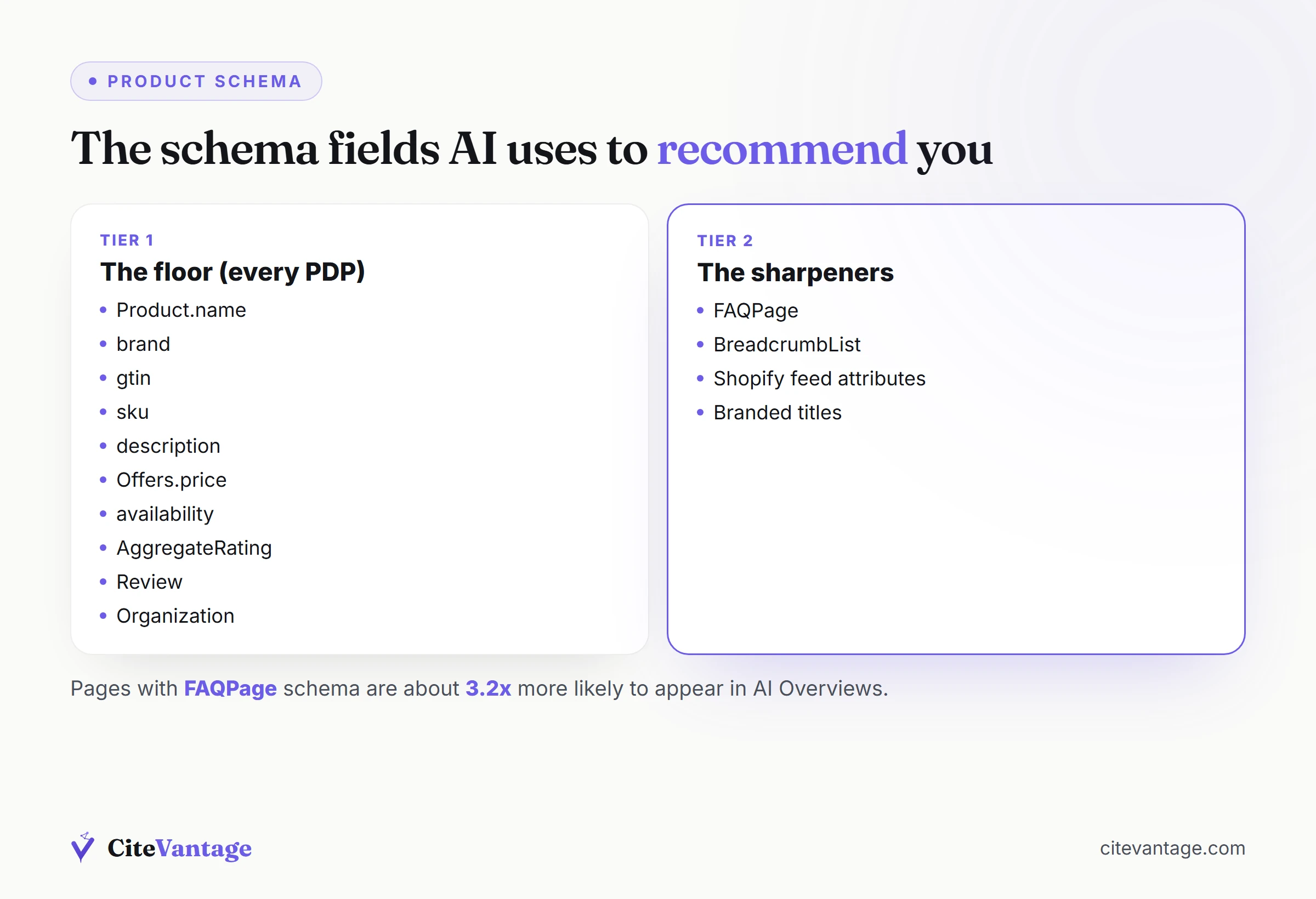
The payoff is measurable. Pages with FAQPage schema are about 3.2x more likely to appear in AI Overviews, and complete Tier 1 schema correlates with roughly 40% more AI Overview appearances. We have watched a single store go from zero AI mentions to cited across several category queries inside a month, on schema fixes alone, no new content. On an apparel store, the same title and indexing work is what produced RIPT Apparel: +290% organic clicks in 18 days. The fields live in the official Schema.org Product spec if your developer wants the canonical list.
One caution. Google’s own AI optimization guidance is blunt that you do not need gimmicks like llms.txt or content chunked into tiny fragments. Schema is real and it helps. The hacks people sell around it mostly do not.
Do I need to block AI bots from my Shopify store?
No, and this is the mistake that quietly erases stores from AI shopping results. The confusion comes from treating every AI crawler as one thing. They are two.
Training crawlers feed model training. Search crawlers fetch live pages to build an answer when someone asks a question right now. You can have an opinion about training. You cannot afford to block the search bots, because those are the ones deciding whether your products show up when a shopper asks.
| Crawler | Operator | Job | Recommended |
|---|---|---|---|
| OAI-SearchBot | OpenAI | Live search for ChatGPT answers | Allow |
| Claude-SearchBot | Anthropic | Live search for Claude answers | Allow |
| PerplexityBot | Perplexity | Indexing for Perplexity citations | Allow |
| Google-Extended | Gemini and AI Overviews access | Allow | |
| GPTBot | OpenAI | Model training | Your call |
| ClaudeBot | Anthropic | Model training | Your call |
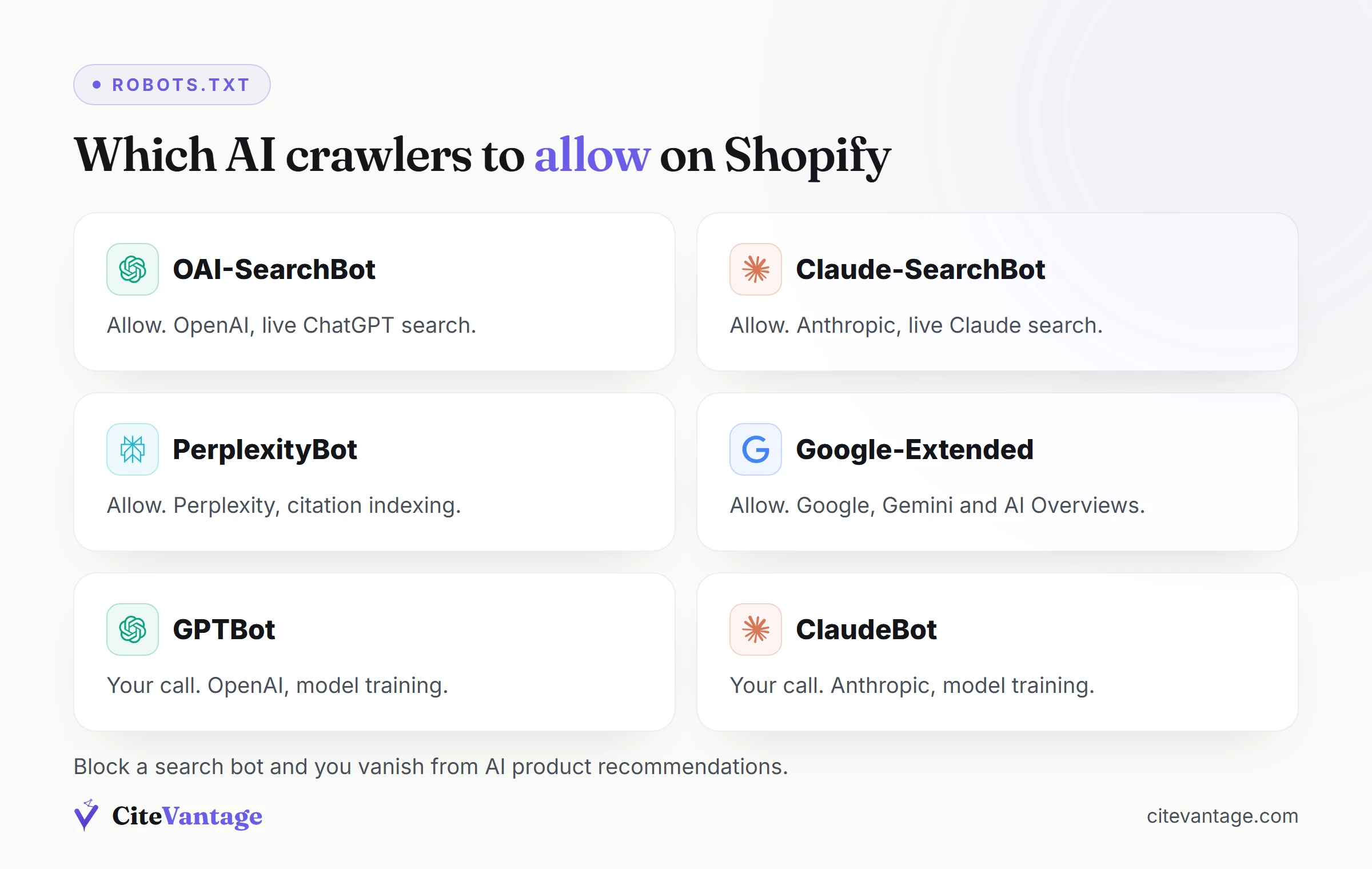
Check your robots.txt today. In our audits, a blocked search crawler is one of the three most common reasons a store with real products and real reviews is simply absent from ChatGPT shopping. The other two are incomplete Product schema and no FAQPage markup. They tend to travel together.
If you find a blanket Disallow aimed at AISO scrapers, make sure it is not catching the search bots in the same net.
How do you make Shopify content answer-shaped for AI?
AI lifts answers, so give it answers it can lift cleanly. That means leading with the conclusion, not burying it under brand voice. A PDP that opens with “Crafted with passion since 2015” gives an AI nothing to quote. One that opens with “Merino wool base layer for cold-weather runners, machine washable, sized true to fit” gives it a recommendation it can drop straight into a response.
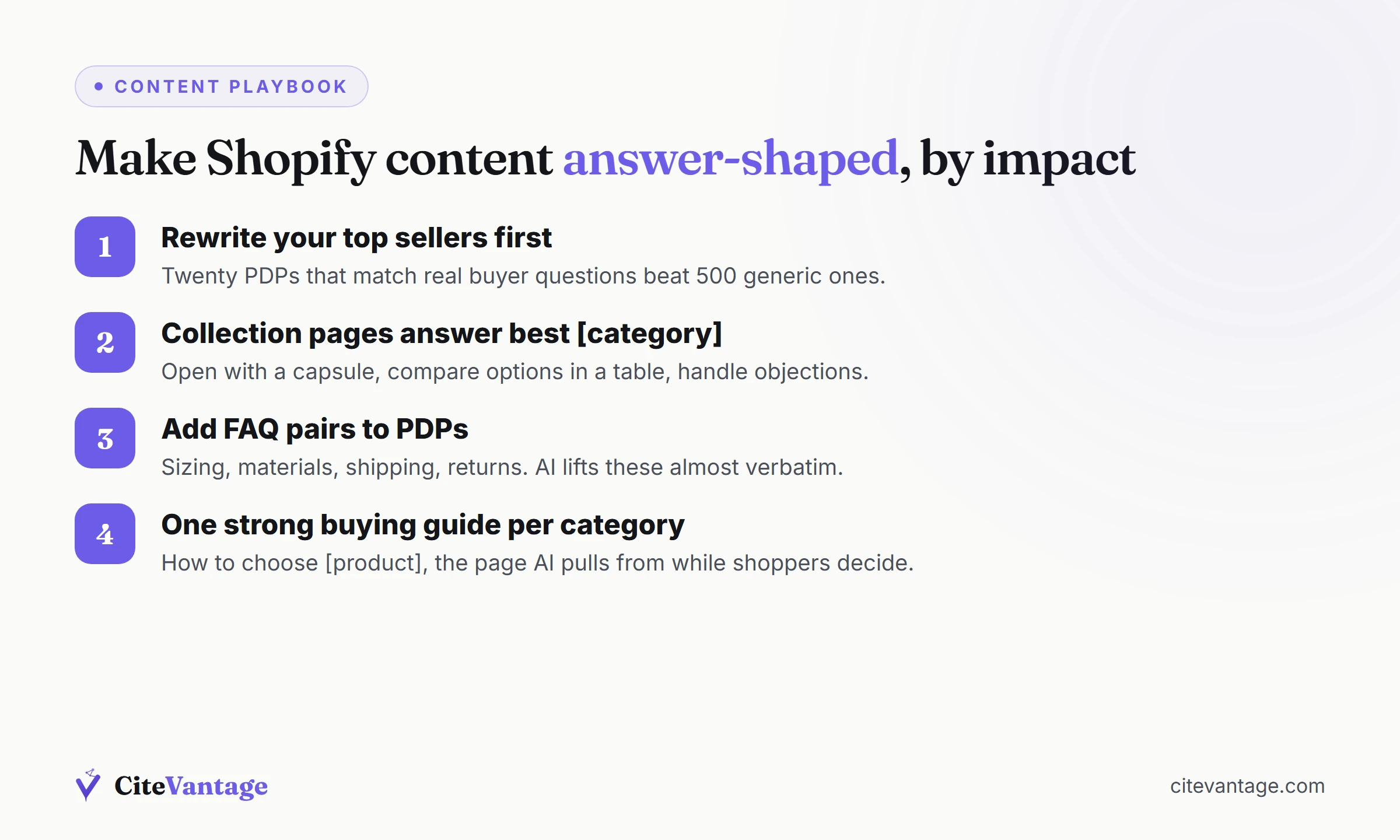
Work in this order, by impact:
- Rewrite your top sellers first. Twenty PDPs that match real buyer questions beat 500 generic ones. Lead with who it is for and what it solves.
- Make collection pages answer “best [category].” That is the query the AI receives. Open with a capsule, compare options in a table, answer the obvious objections.
- Add FAQ pairs to PDPs. Sizing, materials, shipping, returns, comparisons. The literal questions people type. AI lifts these almost verbatim.
- Build one strong buying guide per category. “How to choose [product].” This is the page AI pulls from when the shopper is still deciding.
There is a freshness angle too. Shopping answers favor current data, so live price and availability sync, plus the occasional content refresh, keeps you in rotation. Search Engine Land’s 2026 GEO guide frames freshness and earned media as core, not optional. We agree on both counts, with the caveat that for ecommerce the earned-media piece is mostly reviews and category lists.
Where do AI shopping citations actually come from?
Off your own site, more than merchants expect. When AI answers “best [category] brands,” it leans heavily on third-party validation: review platforms, “best of” listicles, Reddit threads, YouTube reviews. The store cited nowhere outside its own domain reads as unproven, no matter how good the product page is. The ChatGPT tile carousel is a partial exception worth understanding on its own, since it re-ranks your Google Shopping feed rather than open-web mentions, and we break down that mechanic in how ChatGPT shopping picks which products to recommend.
So GEO for ecommerce is part on-site, part off-site.
- Review platforms carry weight. Trustpilot, Google reviews, and category-relevant marketplaces feed the “is this brand legit” signal AI checks.
- “Best of” lists in your category get cited constantly. Earn a spot in the ones AI already quotes.
- Reddit and forums show up in AI shopping answers more than you would guess. Genuine presence, not spam.
- Your own structured reviews matter too, which is why AggregateRating in Tier 1 schema is not optional.
This is the slow part of the work. Schema and crawler fixes land in weeks. Authority builds over months. It is also where 67% of ecommerce leaders say they are already feeling organic traffic decline and scrambling to adapt, per BigCommerce’s 2026 survey. The brands moving early on authority are the ones AI will keep citing as the channel grows. You can see how the on-site and off-site pieces compound in our UAE home decor store results.
A Shopify GEO audit you can run in an hour
Start here before you change anything. You need to know where you actually stand across the engines.
| Step | What to do | What you are checking |
|---|---|---|
| 1 | Ask ChatGPT, Gemini, and Perplexity “best [your category] brands” | Are you named? Which competitors are? |
| 2 | View source on a PDP, find the Product JSON-LD | Does it have brand, GTIN, price, availability, AggregateRating? |
| 3 | Open yourstore.com/robots.txt | Are OAI-SearchBot, PerplexityBot, Google-Extended allowed? |
| 4 | Check PDPs and guides for FAQPage schema | Present, or missing entirely? |
| 5 | Search your brand on Trustpilot and “best [category]” lists | Do you appear anywhere off your own domain? |
Fix the biggest gap first, usually crawler access or schema, then re-test the engine queries in two weeks. If you would rather not do it by hand, our free AI Visibility Audit runs all four engines and returns a 0 to 100 score in 48 hours, and our ecommerce GEO service builds the schema and content stack for you. If you sell tees or print-on-demand, the tighter fit is our AI visibility for Shopify apparel and POD stores service, and for a broader direct-to-consumer catalog see GEO for DTC ecommerce brands.
A note on what not to do. Do not block AI bots out of caution. Do not rewrite all 500 PDPs in week one. Do not assume your #1 ranking carries over. Those three assumptions sink more Shopify GEO efforts than any technical gap.
Three next steps
- Open your robots.txt and confirm the search crawlers are allowed. This is the single fastest fix, and the one most likely to be silently broken.
- Audit Product schema on your top 10 PDPs for brand, GTIN, and AggregateRating, then patch what is missing.
- Pick your three highest-margin products and rewrite them answer-first, with an FAQ block, before touching anything else.
Do those three and re-run the engine queries in two weeks. If your category is competitive and you want the authority piece built properly, that is the work we do. For the answer-engine side of the same build, our guide to Shopify answer engine optimization AEO best practices walks the seven moves and clears up the robots.txt myth most guides get wrong.
Frequently asked questions
What is the difference between GEO and SEO for ecommerce?+
SEO ranks your store in a list of blue links. GEO gets your products named inside the answer an AI writes. SEO optimizes for position; GEO optimizes for citation. The overlap is shrinking too. AI cites pages outside the top 20 roughly 60% of the time, so a #1 Google ranking no longer guarantees the AI mentions you when a shopper asks for the best product in your category.
How much traffic can Shopify stores get from AI search in 2026?+
More than most merchants expect, and it is climbing fast. Shopify's Q1 2026 data showed referral sessions from AI chatbots grew more than 8x year over year, and AI-referred orders grew nearly 13x. The volume is still smaller than organic search, but it converts at nearly 50% higher rates and carries 14% higher average order values, so the revenue per visit is the part that matters.
Do I need to block AI bots like GPTBot and ClaudeBot from my Shopify store?+
No, and blocking the wrong ones makes you invisible. Separate the two jobs. Training crawlers (GPTBot, ClaudeBot) feed model training. Search crawlers (OAI-SearchBot, Claude-SearchBot, PerplexityBot) fetch live pages to answer shopping questions. Block search bots and you vanish from AI product recommendations. Allow the search bots; the training-bot decision is yours to make.
What schema markup does my Shopify store need for AI visibility?+
Product schema is the floor: name, brand, GTIN, price, availability, and AggregateRating with real reviews. Add Organization schema sitewide, BreadcrumbList on collections, and FAQPage on PDPs and guides. Schema.org Product lists every field. Most Shopify themes ship a thin version that misses brand, GTIN, and reviews, which is exactly the data AI needs to recommend you with confidence.
Why is my Shopify store not showing up in ChatGPT shopping results?+
Usually three causes stack up. Your Product schema is incomplete and missing brand or GTIN. You have no FAQPage schema answering buyer questions. And a search crawler is accidentally blocked in robots.txt. We see this exact combination constantly in audits. Fix the schema and the crawler permissions first, then check whether you are cited on the third-party lists AI already trusts for your category.
How long does it take to see results from GEO on Shopify?+
Weeks, not months, for the fast wins. Shopping queries lean on live data and refresh often, so a store with clean Product schema, allowed search crawlers, and answer-shaped content can start appearing in AI answers inside two to four weeks. Brand-authority signals, the third-party citations and reviews, take longer. Plan for a couple of quick technical wins early and a slower authority build behind them.
Do I need to rewrite all my product descriptions for AI search?+
No. Start with your best sellers and your highest-margin lines. AI favors descriptions that answer real buyer questions in plain language: who it is for, what problem it solves, how it compares. Lead with the answer, add specifics like materials and sizing, and skip the marketing filler. Twenty rewritten PDPs that match how people actually ask beats 500 generic ones.
Should I use FAQ schema on Shopify product pages?+
Yes. FAQPage schema is one of the highest-leverage moves on a PDP because AI lifts question-and-answer pairs almost verbatim. Answer the questions buyers genuinely ask: sizing, materials, shipping, comparisons, returns. Pages carrying FAQPage markup are roughly 3.2x more likely to appear in AI Overviews. Keep each answer short, factual, and specific to that product, not boilerplate copied across the catalog.
How do Google AI Overviews choose which products to recommend?+
They pull from a mix of structured product data, third-party reviews, and content that directly answers the shopping question, then synthesize a short recommendation. Ranking position helps but does not decide it. Roughly 60% of AI Overview citations come from URLs outside the top 20 organic results. Complete schema, genuine review authority, and answer-first content move you into that citation set more reliably than chasing rank alone.
How do I get my Shopify store cited by ChatGPT specifically?+
Three moves, in order. Allow OAI-SearchBot in robots.txt and submit your sitemap to Bing Webmaster Tools, since ChatGPT search reads Bing's index. Ship complete Product schema plus FAQPage on your PDPs and buying guides so ChatGPT can lift a clean answer. Then get named on the third-party lists it trusts for your category, like Reddit threads and 'best [product]' roundups. Most stores skip the Bing step, which is exactly why they never appear.
See where AI is hiding your brand
Free multi-engine audit across ChatGPT, Gemini, Google AI & Perplexity.
Get your free audit