How ChatGPT recommends products, and how a store earns a place on the shortlist
By Abdul Subkhan Published
Images in this guide are free to reuse (CC BY 4.0). Credit CiteVantage with a link to this page.
How ChatGPT recommends products comes down to structured metadata from product feeds, the user’s intent and Memory, price, availability, reviews and whether the seller is the maker of the item. For its shopping carousel, studies show it re-ranks candidates drawn overwhelmingly from Google Shopping’s top 40 results. Placement is organic. You cannot pay for it.
The scale behind that sentence is why merchants suddenly care. ChatGPT reached 900 million weekly active users in February 2026, per TechCrunch. Adobe data reported by TechCrunch shows AI traffic to US retail sites grew 393% year over year in Q1 2026. And in our own audit of 181 ecommerce brands, 87% were cited zero times across four AI engines. The traffic is real. Most brands are not in it. We run those audits at CiteVantage, and the pattern repeats weekly.
This guide covers what actually feeds the machine, what the studies prove about where candidates come from, and the order to fix things in. If you want the broader mechanics first, our guide on how AI decides which brands to recommend covers the conversational side.
How does ChatGPT Shopping actually recommend products?
OpenAI says product selection considers structured metadata from first and third-party providers, the model’s own prior response, and user context like Memory and Custom instructions, filtered through its safety standards. Results match intent, not keywords. They are organic. No partnership, ad spend or relationship with OpenAI changes what shows up.
The OpenAI Help Center puts it in one sentence: “Product results are selected independently by ChatGPT and are not ads, nor influenced by any OpenAI partnerships.”
Worth pausing on. Every ranking factor you can influence lives in your data, not in a media budget. The inputs, per the same Help Center page:
- Structured metadata about products, pulled from first and third-party providers.
- What the model already said earlier in the conversation.
- Context the user carries with them: Memory, Custom instructions, past chats.
- OpenAI’s safety standards, which filter what can be shown at all.
Two housekeeping items before the interesting parts. Your site needs to be reachable by OAI-SearchBot in robots.txt, or the reading path never sees you. And reviews matter, both on your product pages and on third-party sites, because quality is one of the four merchant ranking factors OpenAI names.
For the wider view of where this sits in the buyer’s journey, our walkthrough of AEO in product searching and the new buyer path follows a shopper from first question to decision.
One scope note. OpenAI sells ads elsewhere in ChatGPT, and its feed spec includes an ads-eligibility flag. The organic claim applies to product results, exactly as OpenAI words it. Ads are a separate surface.
What are the two systems behind ChatGPT shopping recommendations?
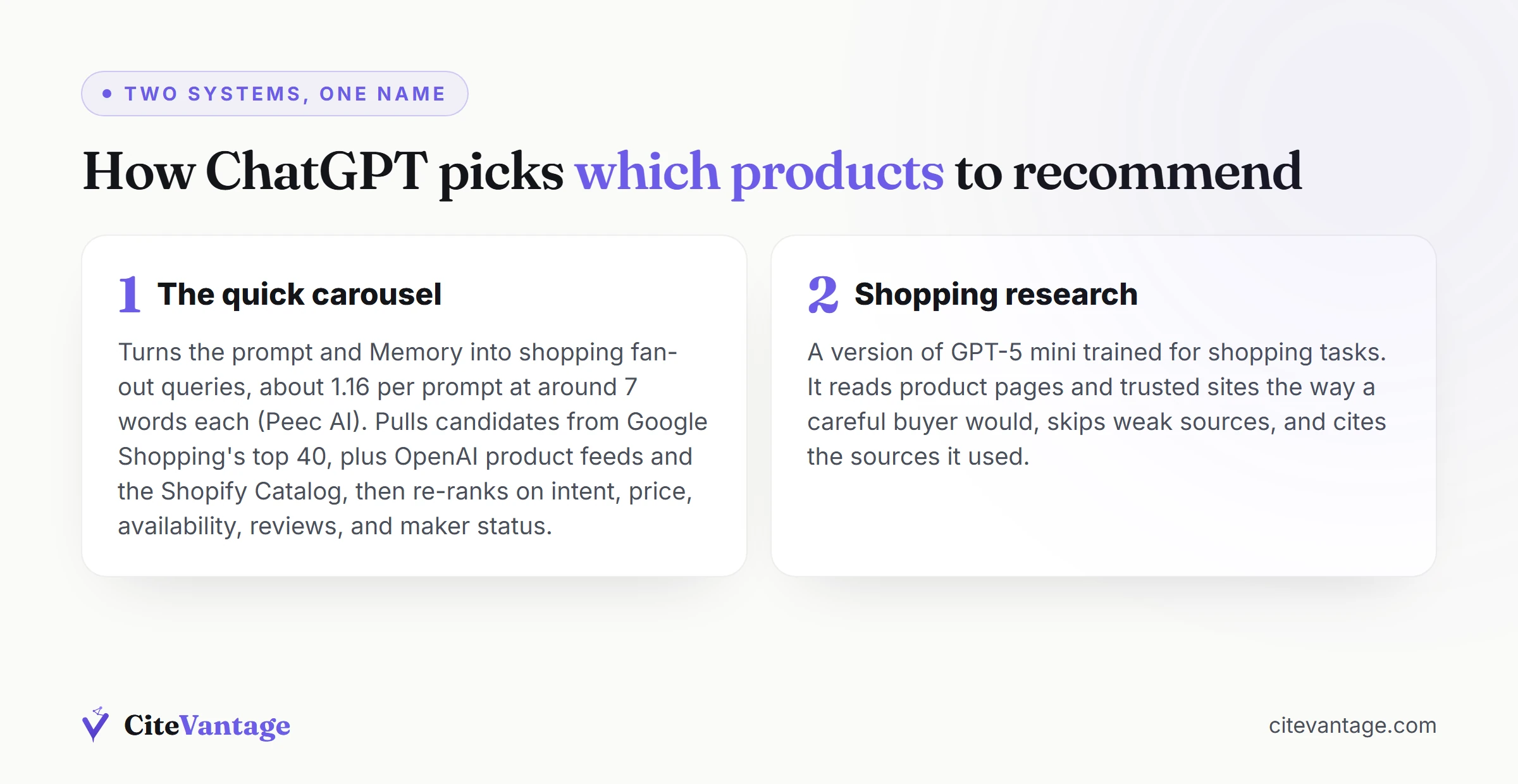
Two separate pipelines wear the same name. The quick shopping carousel re-ranks candidates pulled from product feeds and Google Shopping data, and it does this in seconds. Shopping research is a different system, a version of GPT-5 mini trained for shopping tasks that reads product pages, avoids weak sites, and cites its sources.
Most guides mash these together. They should not, because each one responds to different work.
The quick carousel
Ask ChatGPT for “best running shoes under $150” and the tile carousel that appears is a re-ranking job. Candidates come in from product feeds and shopping data, the model scores them against your query and context, and the tiles render. That path is fast and shallow, and it leans heavily on structured data. This is where your feed quality decides everything.
Shopping research
The deeper mode. OpenAI announced it on November 24, 2025: shopping research is “powered by a version of GPT-5 mini trained with reinforcement learning specifically for shopping tasks.” It reads trusted sites the way a careful buyer would, skips what OpenAI calls low-quality or spammy sites, and cites the sources it used. OpenAI also states these chats are never shared with retailers. It rolled out free across Free, Go, Plus, and Pro plans.
Two surfaces. Two different levers. The carousel eats structured data; shopping research reads and cites pages. The playbook later in this article sequences work for both.
Does ChatGPT use Google Shopping?
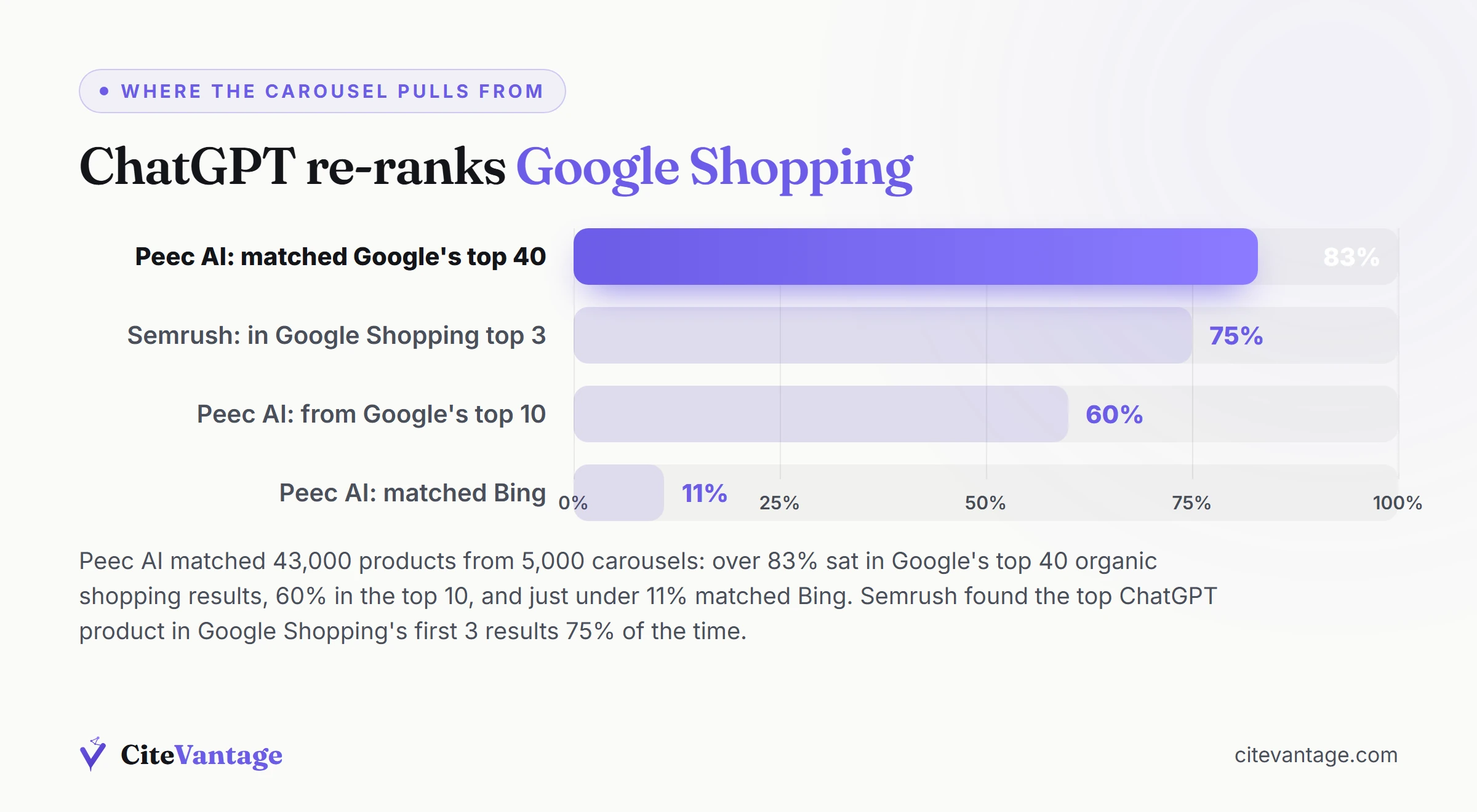
Yes, heavily, for the carousel. Peec AI matched 43,000 products from 5,000 ChatGPT carousels against Google and found over 83% sitting in Google’s top 40 organic shopping results. Semrush found the top ChatGPT product inside Google Shopping’s first 3 results 75% of the time.
This is the single most under-reported fact about ChatGPT shopping recommendations, and it changes where you spend effort first. Three studies, each bigger than the last:
| Study | Date | Sample | Finding |
|---|---|---|---|
| Semrush | 2026-01-20 | 100 shopping prompts, each run 5 times | Top ChatGPT product appeared in Google Shopping’s first 3 results 75% of the time |
| Peec AI, via Search Engine Land | 2026-03-05 | 43,000 products from 5,000 carousels | Over 83% matched Google’s top 40 organic shopping results; 60% came from the top 10; just under 11% matched Bing |
| Precis + Peec AI | 2026-06-16 | Over 1 million shopping fan-out queries | ”100% of the products we saw in ChatGPT Shopping can be explained by the top 40 products in Google Shopping” |
We treat 83% as the conservative headline number and the 100% claim as Peec’s later, larger finding. Either way the direction is the same.
The mechanics underneath come from the Peec data reported by Search Engine Land. When you ask a shopping question, ChatGPT fires shopping fan-out queries, about 1.16 per prompt, each around 7 words. Those queries pull the candidate pool the model then re-ranks. Semrush went further and found Base64-encoded Google Shopping queries sitting in ChatGPT’s own network traffic. Not inference. Observed behavior.
Which leads to the sentence no vendor guide writes: your Google Merchant Center feed is a ChatGPT ranking input. If your products are absent from Google Shopping’s top 40 for a query, the carousel has nothing of yours to re-rank. Merchants keep polishing their sites while the actual gate sits in a feed they have not opened in months.
How does ChatGPT select and rank products once you are in the pool?
OpenAI ranks merchants on availability, price, quality and whether they are the maker or primary seller of the item. On top of that sits intent matching: the model weighs your product data against the user’s query, their Memory, and their Custom instructions before anything reaches the carousel.
The Help Center wording is worth quoting because it is the only official ranking statement that exists. Merchants are “ranked based on factors like availability, price, quality and whether they are the maker or primary seller of that item.”
The four merchant factors, operationalized
- Availability. Keep stock data accurate in every feed. An out-of-stock flag removes you from consideration, and a stale in-stock flag that leads to a dead PDP burns trust.
- Price. The price in your feed must match the price on the page. Mismatches read as unreliable data, and price itself is a ranking factor, so uncompetitive pricing costs visibility too.
- Quality. Reviews and ratings, mostly. Feed fields exist for both, and third-party review presence feeds the shopping research path as well.
- Maker or primary seller. The quiet edge for DTC brands, because you make the thing and resellers do not. Win your own brand-name queries first; that is the ranking fight you are structurally favored to win. That structural edge is what we build on to get your DTC brand recommended in ChatGPT shopping.
What the feed fields control
OpenAI publishes a full product feed spec at developers.openai.com, and the fields map directly to how products appear. Required: item_id, title (150 characters), description (up to 5,000 characters), url, brand, image_url, price with currency, availability and seller_name. Also in the spec: star_rating and review_count (optional), q_and_a (recommended), and group_id for variants. Three flags control enablement: is_eligible_search, is_eligible_checkout, and is_ads_eligible.
Shopify and Etsy merchants skip the application entirely. Both catalogs are already integrated, per OpenAI’s merchant page. Your Shopify product data is already flowing into this system, clean or not. If you sell apparel or print-on-demand, getting that catalog recommendation-ready is exactly the job of our Shopify apparel AI-visibility service.
How do I get my products recommended in ChatGPT?
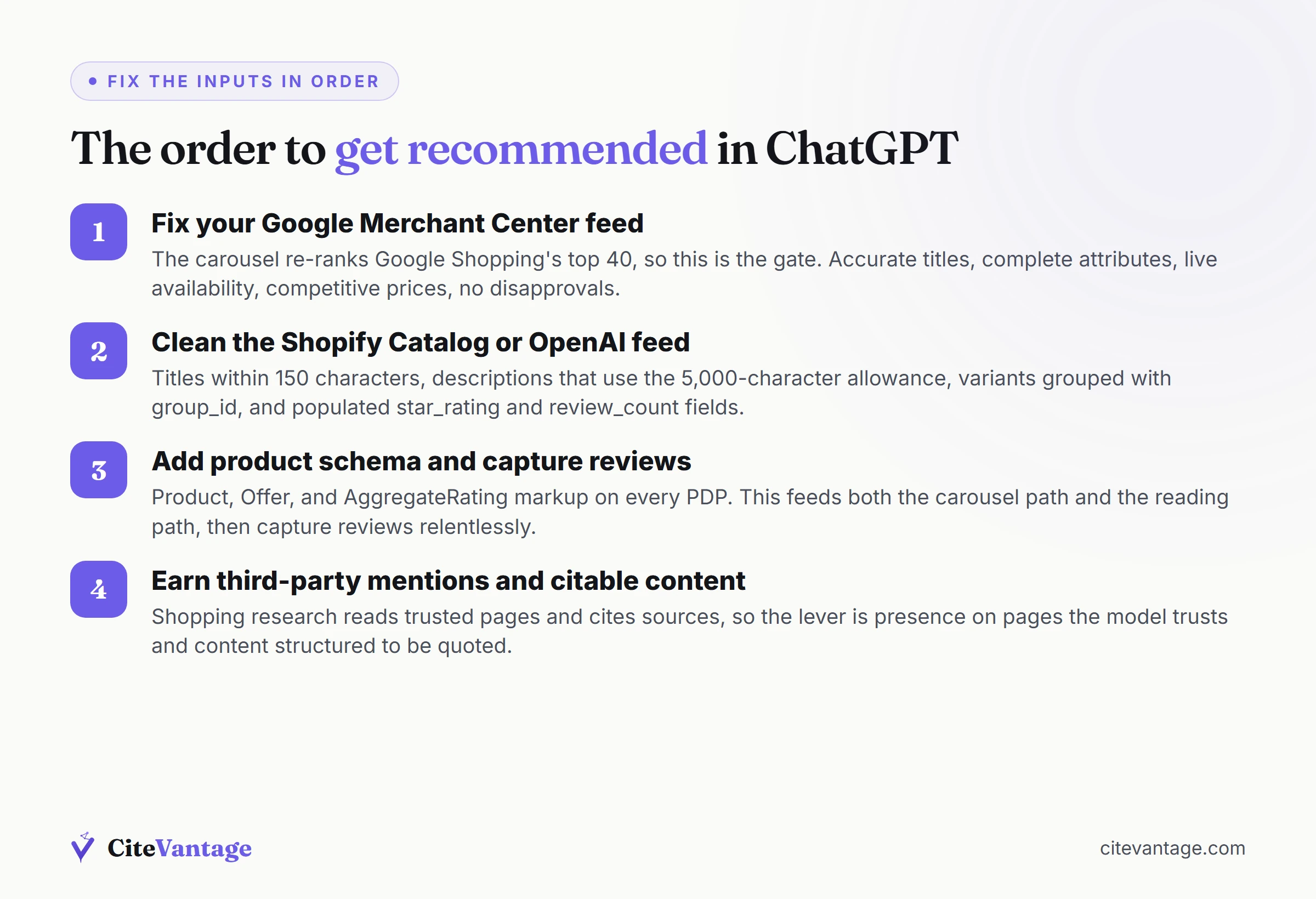
Fix the inputs in the order the machine consumes them. Google Merchant Center feed first, because the carousel leans on Google Shopping’s top 40. Catalog and feed hygiene second. Product schema and review capture third. Third-party mentions last, because those feed the conversational path rather than the carousel.
Everyone lists tactics. Almost nobody sequences them by mechanism, so merchants do the satisfying work before the load-bearing work. For a $1M-$10M DTC brand, the order looks like this:
- Fix your Google Merchant Center feed. The top-40 dependency makes this the gate. Accurate titles, complete attributes, live availability, competitive prices, no disapprovals. If you are invisible in Google Shopping for your money queries, you are invisible in the ChatGPT carousel too. Start here even though it feels like 2019 homework.
- Clean up your Shopify Catalog or submit the OpenAI feed. Titles within 150 characters that lead with what the product is. Descriptions that use the 5,000-character allowance to answer real buyer questions. Variants grouped with group_id. Populate star_rating and review_count; empty review fields concede the quality factor to whoever filled theirs in.
- Product page schema and review capture. Product, Offer, and AggregateRating markup on every PDP. This feeds both surfaces: it is structured metadata for the carousel path and parseable trust for the reading path. Then capture reviews relentlessly, because they are the visible quality signal on both.
- Earn third-party mentions and citable content. Shopping research reads trusted pages and cites sources, so the lever is presence on pages the model trusts and content structured to be quoted. Our playbook on how to get cited by ChatGPT covers this path in full.
One observation from our citation-audit work that reframes step 4: we have watched DA-10 sites beat DA-90 sites inside ChatGPT answers. Authority is not the lever founders assume it is. Being extractable and mentioned is.
Notice the split. Steps 1 and 2 target the carousel. Steps 3 and 4 target shopping research and conversational recommendations. Two prizes, two levers, and the feed work comes first because it gates the surface with the most predictable mechanics. Our ecommerce GEO service runs the sequence end to end. RIPT Apparel, an apparel brand in this exact fight, is our primary ecommerce proof. We rewrote titles and fixed indexing across 30 priority pages, and the RIPT Apparel case study has the numbers. When the catalog is far bigger, the same play scales, as in scaling 5,000 product titles with AI.
What changed with Instant Checkout and the March 2026 pivot?
On March 24, 2026, OpenAI extended its Agentic Commerce Protocol to product discovery and began allowing merchants to use their own checkout experiences. That walked back standalone Instant Checkout as the endgame. The battleground moved from checkout to discovery, and most guides published before March are stale on this.
The announcement, “Powering Product Discovery in ChatGPT,” carried the details. Target, Sephora, Nordstrom, Lowe’s, Best Buy, The Home Depot and Wayfair integrated. Feeds became deliverable through providers including Salesforce and Stripe. Walmart announced an in-ChatGPT app. OpenAI’s merchant page adds the commercial terms: no fees on purchases that start in ChatGPT, US-only for now, and a self-serve merchant portal planned later this year.
Read the direction, not just the facts. OpenAI spent 2025 building a checkout and spent early 2026 letting merchants keep their own. The money question stopped being “can people buy inside ChatGPT” and became “which products does ChatGPT surface at all.” Guides still pitching Instant Checkout as the goal are optimizing for last year’s product.
Can you pay to appear in ChatGPT shopping recommendations, and what else can’t you control?
No. OpenAI states product results are organic, selected independently, and not influenced by partnerships. But several inputs sit outside your control too: the model’s priors, Memory personalization, price-data lag and US-only availability. Any agency promising guaranteed carousel placement is selling something that does not exist.
The honest list of what you cannot fix:
- Model priors. The model arrives with opinions about categories and brands from training. You influence this slowly, through the third-party record, not through anything on your own site.
- Memory personalization. Two users asking the identical question can get different carousels, because Memory and Custom instructions are ranking context. There is no single “the” result to screenshot and celebrate.
- Price-data lag. Feeds refresh on their own schedule. A flash sale may not reach the carousel while it is running.
- US-only availability. No merchant action changes the rollout map.
- The ads surface. OpenAI sells ads separately, and the feed spec’s is_ads_eligible flag exists for it. Ads are separate from product results, per OpenAI, and buying them does not touch organic selection.
Anyone selling certainty here is selling past the evidence. What you can control, the feeds, the data quality, the schema, the mentions, is plenty.
How big is AI shopping traffic really?
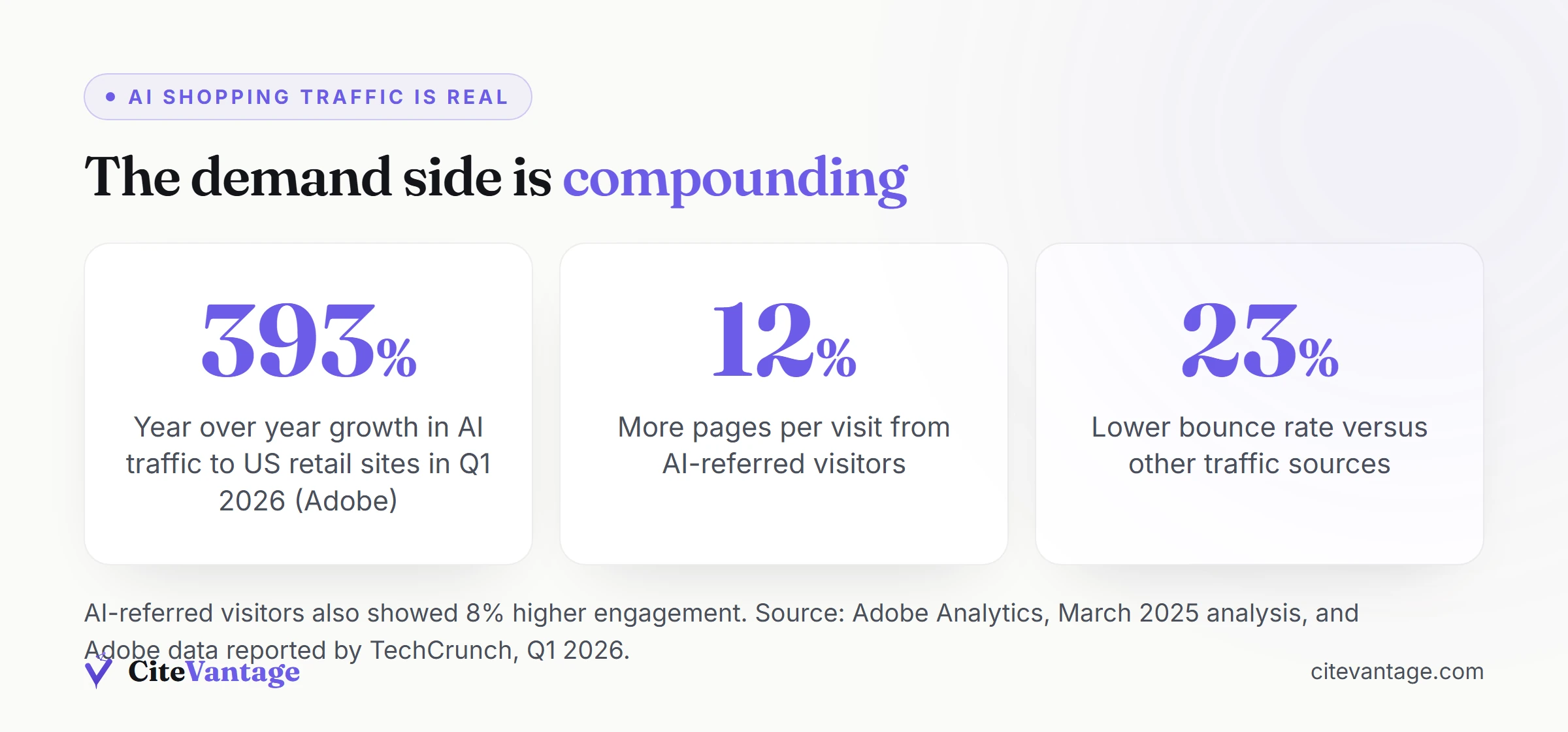
Big, and growing fast. ChatGPT reached 900 million weekly active users with 50 million paying subscribers, announced in February 2026 per TechCrunch. Adobe data shows AI traffic to US retail sites grew 393% year over year in Q1 2026, and those visitors engage more once they land, not less.
Adobe’s numbers deserve the extra beat because they answer the “is this traffic any good” objection. In Adobe’s March 2025 analysis, AI-referred visitors showed 8% higher engagement, viewed 12% more pages per visit, and bounced 23% less than other traffic sources. In the same report’s 5,000-respondent survey, 39% had used generative AI for online shopping, and 92% of those said it enhanced the experience.
Now set that against the supply side. In our audit of 181 ecommerce brands, 87% were cited zero times across four AI engines. Demand for AI shopping answers is compounding while most brands contribute nothing the machine can recommend. That gap is the opportunity.
Want to know whether ChatGPT recommends your products today? Run the free AI Visibility Snapshot. It checks your brand across ChatGPT and three other engines and shows you exactly what buyers see when they ask about your category. Takes a few minutes to request. No sales call required.
Frequently asked questions
Can users buy directly inside ChatGPT?
+
Mostly no, as of 2026. OpenAI's merchant FAQ says it is moving away from a standalone Instant Checkout experience: users discover and evaluate products in ChatGPT, and purchases complete on merchant-owned websites or apps. OpenAI states there are no fees on purchases that start in ChatGPT. Shopping is currently live for US users only.
Do I need a product feed if ChatGPT already crawls my site?
+
Not strictly. OpenAI says feeds are optional but give you greater control over how your products appear. Shopify and Etsy catalogs are already integrated, so merchants on those platforms are in the pool with no application. Everyone else can apply for the feed at OpenAI's merchant page.
Does ChatGPT shopping research show sponsored or paid product recommendations?
+
No. OpenAI states product results are selected independently and are not ads, nor influenced by any partnerships. An is_ads_eligible flag exists in the feed spec because OpenAI runs a separate ads surface, but by OpenAI's own wording, ads are separate from product results.
What is ChatGPT Instant Checkout?
+
The original way to buy without leaving ChatGPT. As of March 2026, OpenAI is moving away from it as a standalone endgame: the Agentic Commerce Protocol now covers product discovery, and merchants can route buyers to their own checkout. Discovery is where the merchant battle actually happens now.
Where is shopping in ChatGPT available today?
+
The US only, for now. OpenAI's merchant page confirms shopping is currently live for ChatGPT users in the U.S., with a self-serve merchant portal planned later this year. The merchant application accepts companies headquartered anywhere, so non-US brands selling to US shoppers can still apply; shoppers outside the US do not see the carousel yet.
See where AI is hiding your brand
Free multi-engine audit across ChatGPT, Gemini, Google AI & Perplexity.
See who AI names instead of me