SEO for Ecommerce Product Pages: PDP Content That Converts and Gets Cited by AI
By Abdul Subkhan Published
Images in this guide are free to reuse (CC BY 4.0). Credit CiteVantage with a link to this page.
SEO for ecommerce product pages now has two jobs, and one page has to do both at once. To build digital pdp content-details that drive conversions and geo/aeo visibility, you build a single page where every element earns its place twice. It hands the AI a clean fact to cite, and it confirms the human who already trusts the AI’s pick. One page doing two jobs, not two separate builds.
Most advice splits these apart. The AI-visibility guides live in one corner of the internet and the conversion guides live in another, and they almost never meet. So the founder who reads both ends up building a page that satisfies neither: thin, extractable copy that does not sell, or slick sales copy the AI cannot read. This is the guide that treats your Shopify or WooCommerce product page as a single artifact, engineered for both.
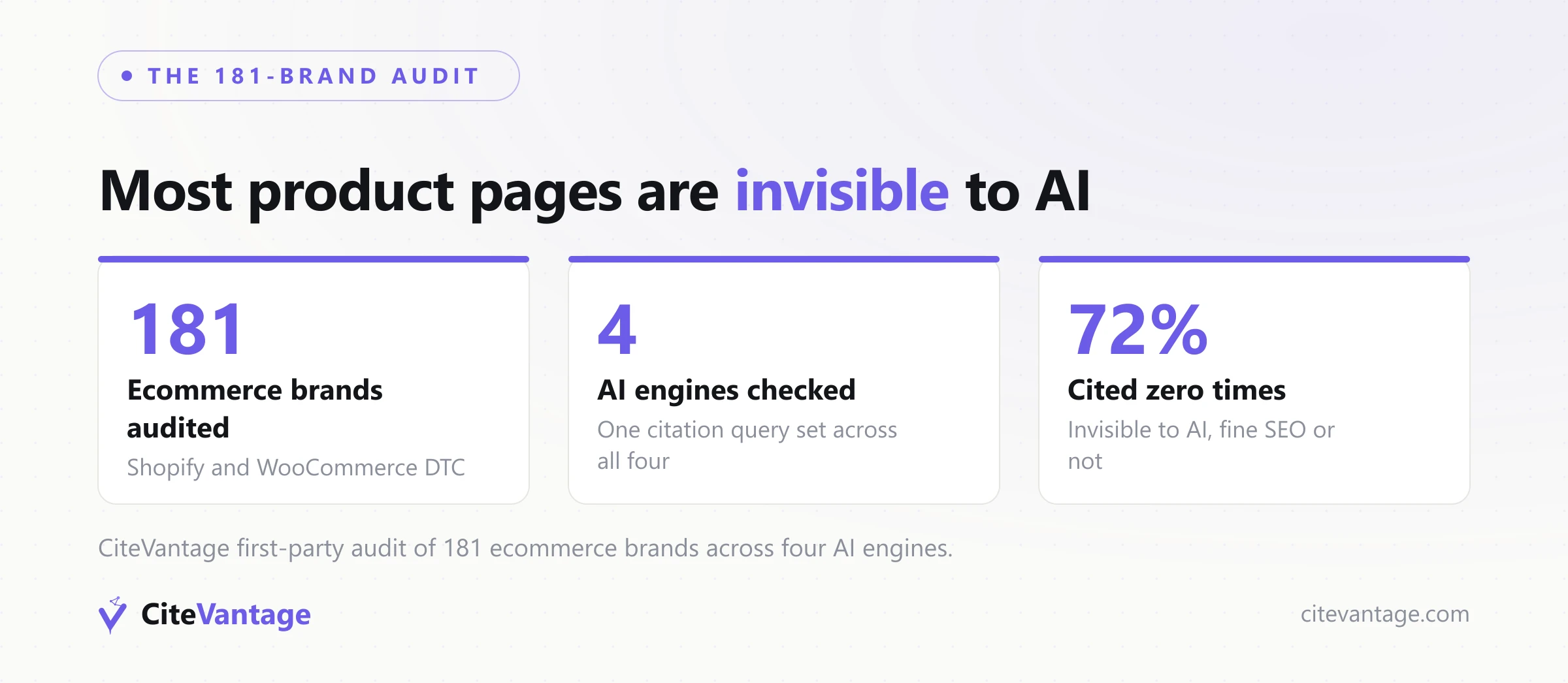
Start with the size of the problem. In our audit of 181 ecommerce brands across four AI engines, 87% were cited zero times. Most had fine SEO. They just were not built to be quoted.
How AI search changed SEO for ecommerce product pages
An SEO page ranks a link the shopper clicks. An AI answer reads the page, extracts the facts, and answers for the shopper directly. So the product detail page stops being a destination and becomes a source document. The question is no longer only “does this rank,” it is “can the engine read this, trust it, and quote it.”
Two things every engine checks, and the ALM Corp teardown names them well: consistency and consensus. Consistency means your title, description, schema and feed all agree on the same price, the same name, the same claim. Consensus means trusted third parties say the same thing about you. Get both and you become quotable. Miss either and you get skipped.
The shift is not theoretical. BrightEdge, reported by ziptie, tracked a 206% increase in retail keywords triggering Google AI Overviews across two months. The queries your buyers type are moving into AI answers fast, and the page that gets read is the one built to be read. For the mechanics underneath this, our explainer on answer engine optimization goes deeper than we can here.
Digital PDP content-details that drive conversions and GEO/AEO visibility: one build, two jobs
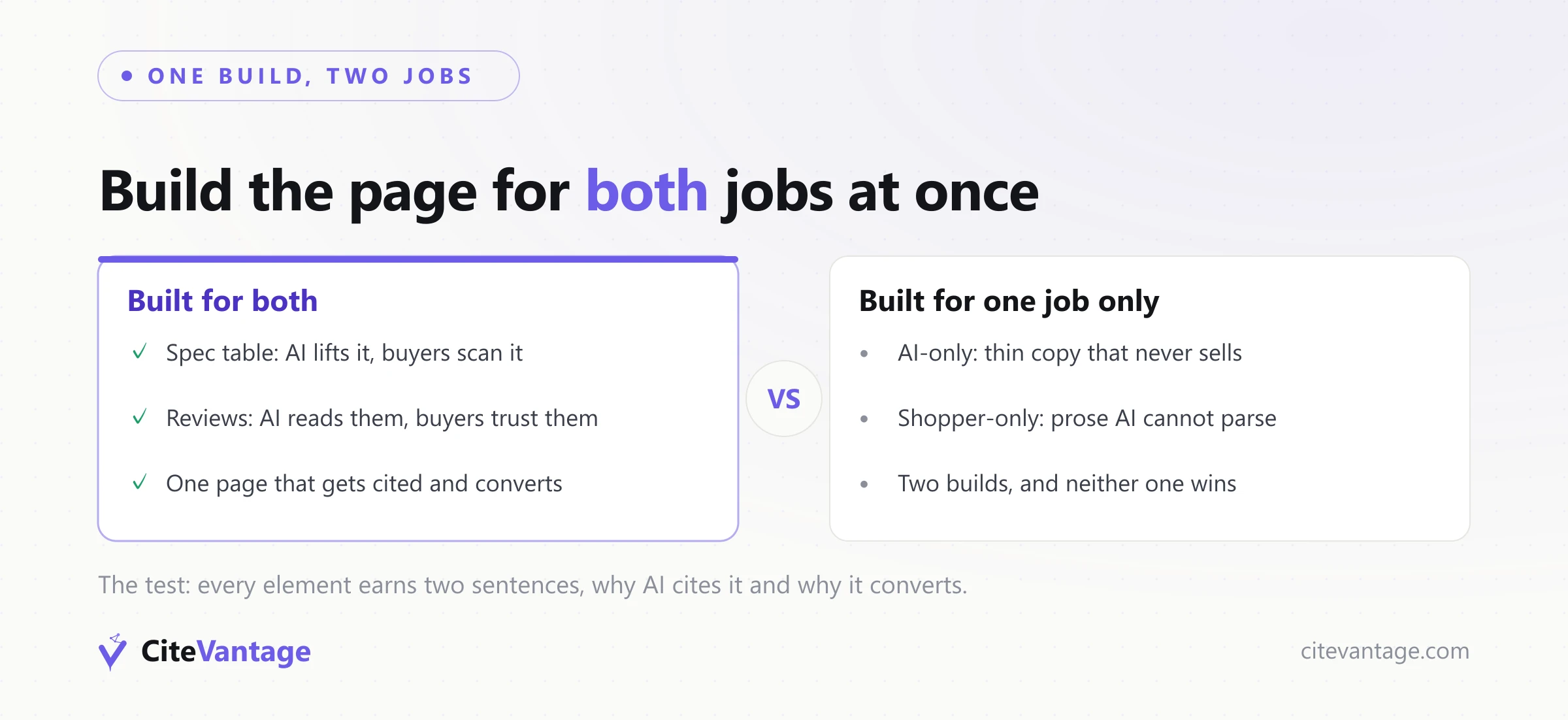
One idea drives the whole build. The same elements that make an AI cite you are the elements that convert the human, if you build them for both on purpose. A clean spec table is a fact the engine lifts and a fast answer the shopper scans. A real review is trust language the AI reads and social proof the buyer needs.
You are not choosing between the machine and the person. You are serving both with one honest page.
Two separate builds fail in predictable ways. Build for the AI alone and you get thin, keyword-flat copy that extracts cleanly but never closes a sale. Build for the shopper alone and you get persuasive prose an engine cannot parse into a fact. Digital pdp content-details that drive conversions and geo/aeo visibility come from refusing that trade.
The test is simple. For every element on the page, write two sentences: why AI cites it, and why it converts. If an element cannot earn both, it is decoration. This is GEO product page optimization done as one job, and it sets up the checklist further down.
What the AI-referred shopper actually wants on the page
They arrive pre-sold. The AI already recommended you, so the page’s job shifts from convincing a cold browser to confirming a warm buyer. That changes what the page needs to do. Less hard re-selling. More fast proof, clear specs and a frictionless path to the button they already came to press.
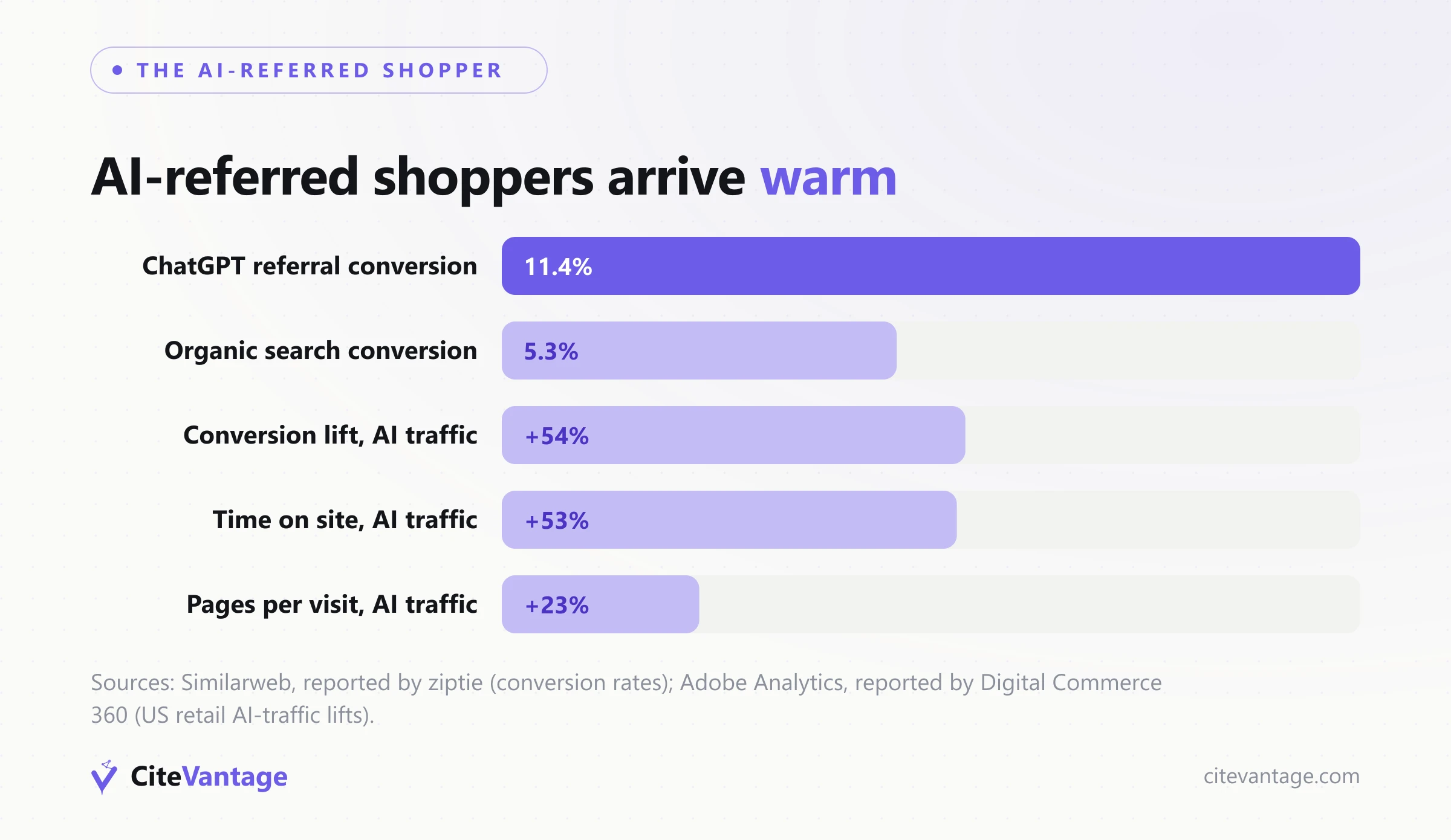
The numbers back the shift. Adobe Analytics, reported by Digital Commerce 360, found AI-source traffic to US retail sites grew 138% year over year and converted 54% better than non-AI traffic, with those visitors spending 53% more time on site and viewing 23% more pages, across more than a trillion retail visits. Similarweb, reported by ziptie, put ChatGPT ecommerce referrals at 11.4% conversion versus 5.3% for organic search. Warmer traffic, higher intent.
So the design rule is confirm, do not convince. Lead with the fact that closes the doubt. Put the spec, the review theme, and the returns clarity where a scanning buyer sees them first. If you want the deeper picture of how the engine picked you before the click, see how ChatGPT shopping picks products.
What structured data and page elements you actually need
Complete Product schema, real reviews, conversational descriptions and one clean spec table, all consistent across the visible page, the JSON-LD and the merchant feed. That is the base layer of digital PDP content-details that drive conversions and GEO/AEO visibility. It is table stakes, not a differentiator, but skip it and nothing above it works.
Google Search Central lists the Product fields that matter: name, image, offers (price, priceCurrency, availability), review and aggregateRating (only if the ratings are visible on the page), brand, and GTIN or MPN, plus a return policy. Google states plainly that providing both structured data on the page and a Merchant Center feed maximizes your eligibility to appear in richer ways. Which schema types matter, and why, is covered in our guide on schema markup for AI search.
A minimal, honest Product block looks like this:
{
  "@context": "https://schema.org",
  "@type": "Product",
  "name": "Trailhead Merino Crew",
  "brand": { "@type": "Brand", "name": "YourBrand" },
  "gtin": "0123456789012",
  "aggregateRating": {
    "@type": "AggregateRating",
    "ratingValue": "4.6",
    "reviewCount": "212"
  },
  "offers": {
    "@type": "Offer",
    "price": "68.00",
    "priceCurrency": "USD",
    "availability": "https://schema.org/InStock"
  }
}
One rule on that block: only mark up what a shopper can actually see on the page. Invisible schema is a consistency break, and ChatGPT penalizes data that disagrees with the visible page. Add a real FAQ or Q&A section too. Google AI Mode leans on question-and-answer structure, and reviews double as AI vocabulary and human trust: Baymard found 88% of shoppers trust user reviews as much as a personal recommendation.
Do you optimize differently for ChatGPT, Perplexity, and Google AI Mode?
The build is about 90% shared. The last 10% differs by engine, and one table settles it. Get the consistent, quotable page right first, then tune the edges. Build the shared 90% once and it carries every engine. None of this replaces the base layer above.
| Engine | What it reads | What it rewards | Your one move |
|---|---|---|---|
| ChatGPT (Shopping) | The product page directly | Consistent data, clear review themes | Keep every element saying the same thing |
| Perplexity | Page plus heavy third-party sources | Comparative depth, external consensus | Earn honest mentions, add a real comparison |
| Google AI Mode / AI Overviews | Product schema plus Merchant Center | FAQ and Q&A structure | Ship schema, feed, and a real FAQ block |
The surface is early. Sellers Commerce, reported by ziptie, found only about 0.3% of AI Overviews currently cite ecommerce sources. Read that as opportunity, not absence. There is an open slot for the store that shows up clean and consistent. For the engine that leans hardest on outside sources, see how Perplexity picks its sources; the ChatGPT shopping guide linked above covers the rest.
The element-by-element checklist for digital PDP content-details that drive conversions and GEO/AEO visibility
One page, run down the list. Each row has to earn its place twice, once for the AI and once for the buyer. This is the table the AI-visibility guides skip and the conversion guides skip, because they each only care about one column. Digital pdp content-details that drive conversions and geo/aeo visibility live in this table.
| PDP element | Why AI cites it | Why it converts |
|---|---|---|
| Title and H1 | Names the exact product entity to extract | Confirms the buyer landed on the right item |
| Conversational description | Answers real questions in quotable prose | Speaks to the shopper, not a keyword |
| Spec table | Clean facts AI lifts straight into an answer | Fast scan for the warm buyer |
| Product schema | Machine-readable price, brand, availability | Powers rich results the shopper trusts |
| Real reviews plus aggregateRating | Review-theme language and a trust signal | 88% trust reviews like a personal tip |
| ”Best for [buyer]” line | A literal extraction target for AI | Tells the right person this is for them |
| High-definition images | Alt text and context the crawler reads | 67% find visuals more convincing than copy, per Baymard |
| Live price and availability | Current facts AI will not cite if stale | Removes the top pre-purchase doubt |
| FAQ block | Feeds Q&A-hungry engines like AI Mode | Answers objections before they stall the sale |
| Shipping and returns clarity | Structured policy AI can quote | Clears a top reason carts get abandoned |
| Merchant feed sync | Consistency across the whole surface | Keeps the buyer from seeing a wrong price |
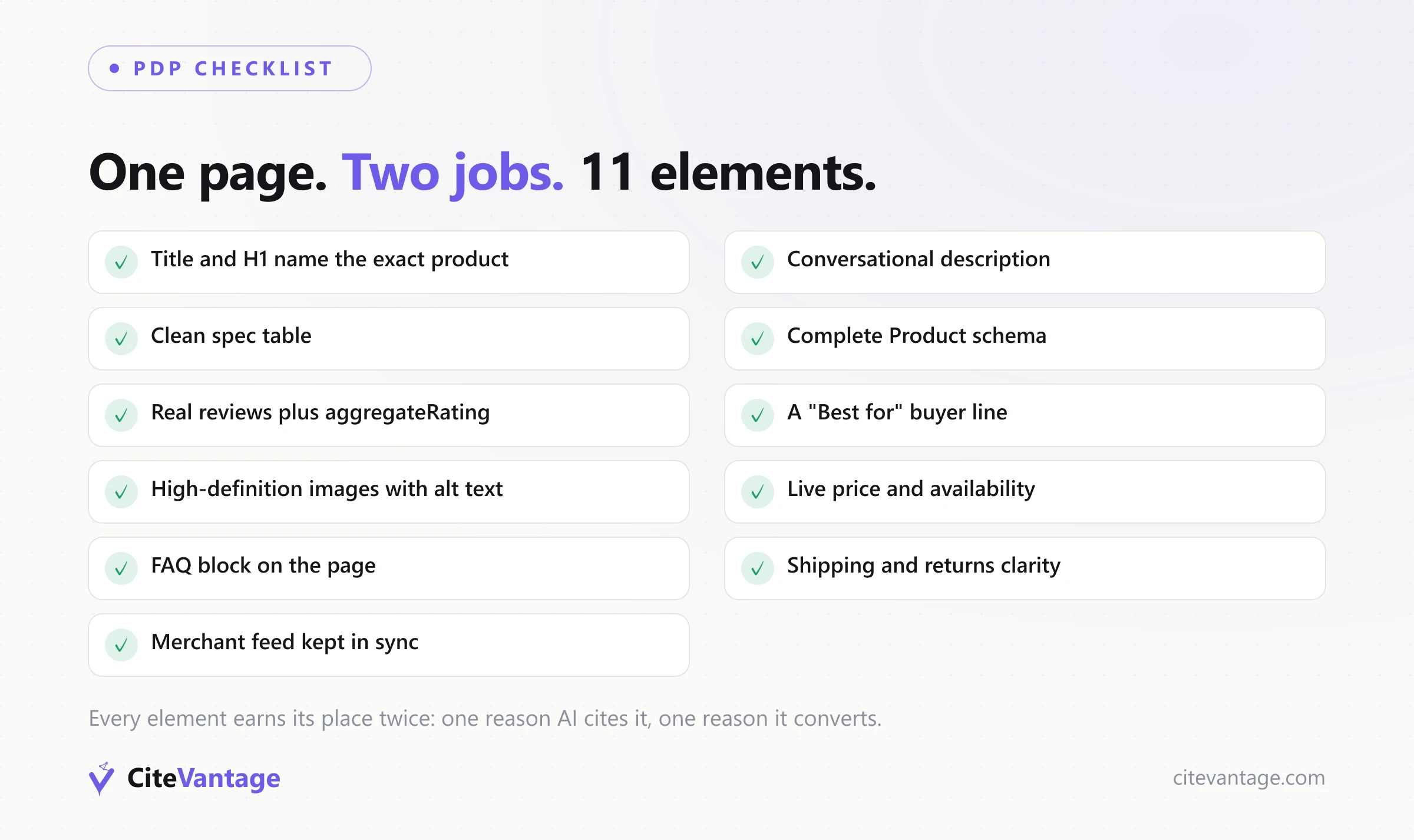
This is AEO for ecommerce product pages in practice. Every row is a small decision that pays twice. For the strategy layer above the page, our ecommerce GEO service covers how these fit into a full store.
What does not move the needle
Some popular tactics do nothing for AI citation, and naming them saves you money. Schema alone, with no matching visible content, is the big one. It parses, then gets ignored, because there is no consistent page or outside consensus behind it. We have watched this directly across our multi-engine audits: the markup was clean, the citation never came.
The rest of the non-movers:
- Awards and certifications with no external source backing them. ALM Corp notes high-visibility brands often show awards, but the award only counts when a third party confirms it off your site.
- Keyword-stuffed descriptions. AI reads for meaning and themes, not density, and a stuffed page reads worse to the human too.
- Facts rendered only in JavaScript that a crawler never executes. If the price or spec is not in the HTML, treat it as invisible.
- Chasing word count. A 2,000-word page that buries the answer loses to a 200-word block that states it cleanly.
Do not pay for any of these as an “AI visibility” line item. None of them add up to digital PDP content-details that drive conversions and GEO/AEO visibility. They are motion, not progress.
Can a small DTC store beat big brands in AI answers?
Yes, and we have watched it happen. We have seen DA-10 sites beat DA-90 sites inside ChatGPT answers, because the engine was not ranking backlinks, it was picking the cleanest source for the question. A small store with a tight, consistent, quotable page often is that source. Size does not decide this. Clarity does.
That is the part the incumbent guides assert but never show. They tell you a small brand “can compete.” Our first-party audits are where we actually see it: the DA-90 brand with the messy, inconsistent page gets passed over, and the small store that answered the question cleanly gets named. RIPT Apparel is the kind of product-level work where this plays out, and you can read the RIPT Apparel case study for the fuller picture.
Per MobiLoud’s 2026 product page benchmarks, the typical product page converts somewhere around 1.5% to 3%, with top performers at 4% to 8%. Moving 2.0% to 2.5% is a 25% revenue lift on the same traffic. When that traffic is also arriving warmer from AI, the page that earns the citation is the same page that closes the sale.
Want to see which of your products AI names today? Run the free AI Visibility Snapshot and check ChatGPT, Perplexity, and Google AI Overviews together, before you change a thing.
Frequently asked questions
How long does it take to see results from product page AI optimization?
+
Weeks for the first movement, not days. Once your crawlers are open and the page leads with clean, quotable facts, engines re-crawl on their own clock and start pulling you in. We run citevantage.com as client #1 and track this on our own citation sprints. It is a program you maintain, not a switch.
What if my products have very few reviews?
+
Start with the reviews you have and never fake counts. Baymard found 88% of shoppers trust user reviews as much as a personal recommendation, so even a handful of honest ones carry weight. Seed a real Q&A block on the page, answer the questions buyers actually ask, and let genuine reviews accumulate. AI reads review language for themes, so a few specific, true reviews beat dozens of vague ones.
Should I allow AI crawlers like GPTBot, PerplexityBot, and ClaudeBot?
+
Yes. Blocking them removes you from the answer entirely. Many stores block these bots by accident through a security plugin or CDN default, then wonder why AI never names them. Open GPTBot, OAI-SearchBot, PerplexityBot and ClaudeBot in robots.txt. It is a one-line fix and a common reason a product is invisible.
Does schema markup alone get my product recommended by AI?
+
No. Schema helps AI parse the page, but it does not buy a citation on its own. What builds digital pdp content-details that drive conversions and geo/aeo visibility is consistency plus consensus: the visible page, the Product schema, and the merchant feed all saying the same thing, backed by third parties who mention you. Schema supports that. It does not replace it.
Can a small DTC store beat big brands in AI answers?
+
Yes, and we have watched it happen. A DA-10 store can be named over a DA-90 brand inside a ChatGPT answer when its page gives the engine the cleaner, more consistent, more quotable fact. AI is not ranking your backlinks here. It is picking the best source for the question. A small store with a tight page often is that source.
Does AEO replace traditional SEO for product pages?
+
No. Answer engine optimization sits on top of clean SEO, it does not remove it. The same facts feed both. A page that Google finds fast, crawlable and cleanly structured is also the page AI can read and quote. You are building one page that serves both rather than choosing between them.
See where AI is hiding your brand
Free multi-engine audit across ChatGPT, Gemini, Google AI & Perplexity.
See who AI names instead of me