AEO for product search: how shoppers now find and choose products inside AI answers
By Abdul Subkhan Published
Images in this guide are free to reuse (CC BY 4.0). Credit CiteVantage with a link to this page.
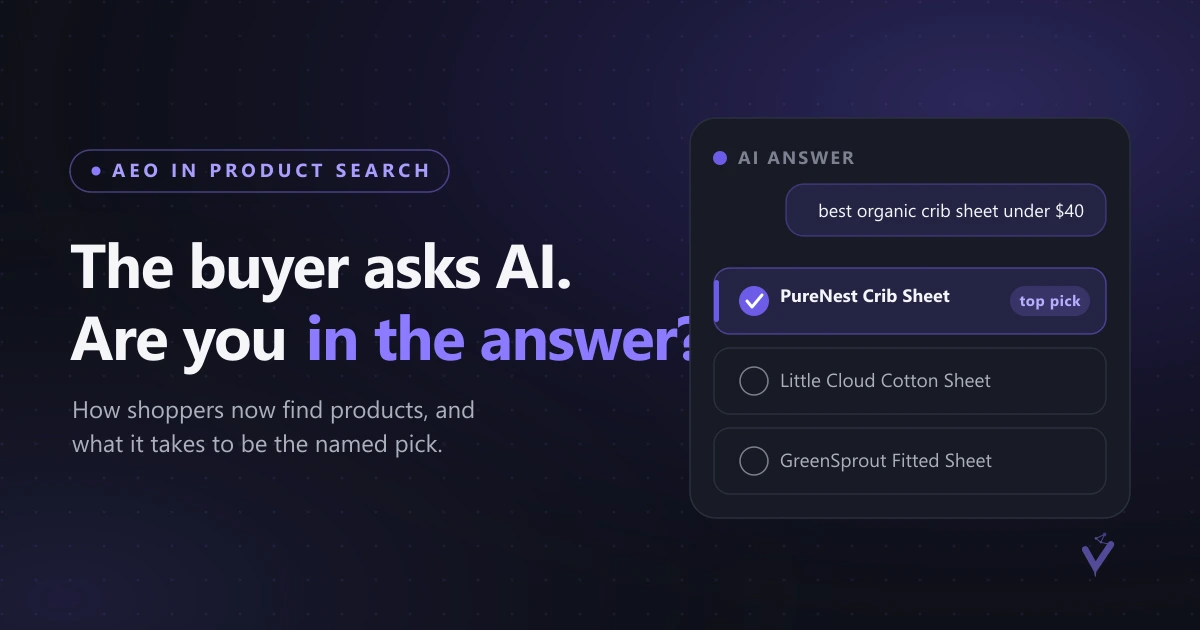
AEO for product search moves discovery off the ten blue links and into a single AI answer. A buyer asks ChatGPT, Perplexity or Google’s AI Overviews a full question and gets back a short list of named products. If that answer never names your store, you are not in the running, no matter where you sit on Google.
You rank fine. You have watched ChatGPT answer a question in your own category and skip your brand anyway. That gap is the whole story here, and it is already measurable, not a forecast.
This article walks the new buyer path from the shopper’s seat, shows why Google authority does not carry into AI answers, and ends with the one thing to check this week.
Key takeaways
- Buyers increasingly start a product search inside an AI answer, not on a results page.
- The path compressed. Browse many tabs became ask once, compare in the answer, decide.
- Ranking on Google does not guarantee a mention. In our 181-brand audit, 87% of stores were cited zero times across four AI engines.
- AEO in product searching is about being the source the answer is built from, not the tenth link underneath it.
What is AEO for product search?
AEO for product search is the work of getting your products named inside AI-generated answers. AEO stands for answer engine optimization. An answer engine is any tool that returns a written answer instead of a list of links, so ChatGPT, Perplexity, Gemini, Copilot and Google’s AI Overviews all count. The goal is simple. Be in the answer.
SEO earns you a spot on a results page. AEO earns you a spot inside the recommendation itself. Related, not identical, and the full contrast comes a few sections down. For the plain definition and where the term came from, our guide to what answer engine optimization actually means goes deeper than we need to here.
How do shoppers find products with AI now?
The journey collapsed into three moves inside one conversation. A shopper asks a full question, the AI compiles a shortlist, and the shopper refines it right there instead of opening more tabs. Discover, compare, decide, all in a single chat. The results page, the category grid, the ten review sites open in the background, most of that is gone.
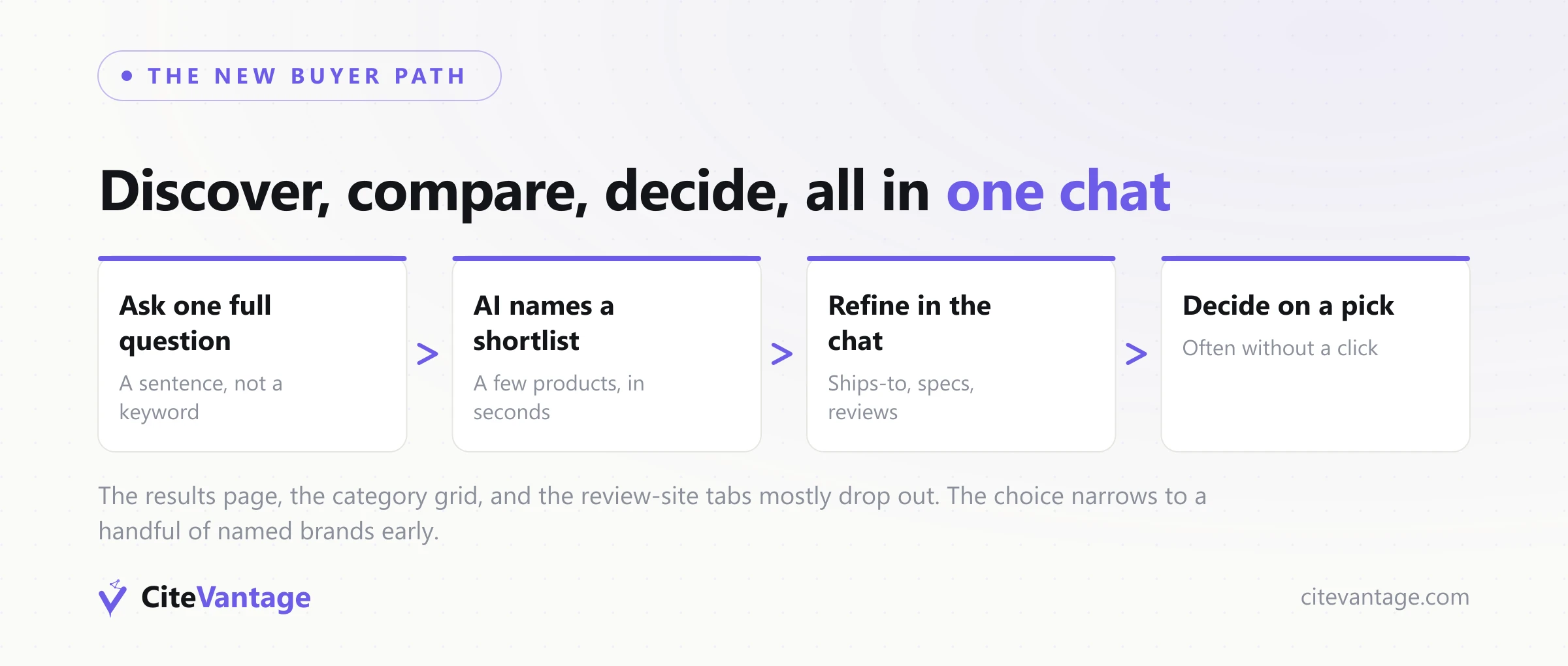
Here is the shift in one view.
| Step | Old path (search results) | New AI-answer path |
|---|---|---|
| Discover | Type two words into Google, scan the grid, open several category and review-site tabs | Ask one full-sentence question and get a named shortlist back in seconds |
| Compare | Flip between tabs, cross-check specs and prices by hand | Refine in the same chat: “which of those ships to Canada and has no dyes” |
| Decide | Return to the winning tab, read more, then buy | Trust the named pick or ask for the buy link, often without a click |
Discover
The buyer opens with a long, specific prompt, not a keyword. Something like “best organic cotton crib sheet for a hot-sleeper baby under 40 dollars.” No results page appears. The engine reads that whole sentence, weighs the constraints, and returns a short list of named products. Miss that shortlist and the buyer never learns you exist.
Compare
The comparison happens inside the answer. The shopper stays in the same chat and narrows it. “Which of those ship to Canada.” “Which have no synthetic dyes.” “Which one has the best reviews for durability.” Each follow-up used to be a new tab and a new search. Now it is one line, and the engine does the cross-checking that the buyer used to do by hand.
Decide
Then the buyer asks for the link, or just trusts the pick. This is where zero-click shopping bites. The brand that got named has effectively won the decision before your site is ever loaded. For the mechanics of how an engine assembles that shopping list, see our breakdown of how ChatGPT builds a shopping recommendation. The point for now is blunt. The choice narrows to a handful of named brands early, and being named is the whole game. Once a buyer does click through, the page still has to close the sale, which is why we build product pages that win the AI citation and convert the shopper as one job, not two.
How is AEO for product search different from SEO?
SEO wins a ranking on a results page. AEO in product searching wins a mention inside the answer. One hands the buyer a list of blue links to sort through. The other hands them a recommendation with your name in it, or without. Same store, two very different competitions, and doing well at one does not settle the other.
| What changes | SEO for a product store | AEO for a product store |
|---|---|---|
| What the buyer sees | A page of ranked links | A written answer with a few named products |
| What you compete for | Position on the results page | A mention inside the answer |
| What gets measured | Rankings, clicks, sessions | Whether you are named, and how prominently |
| Where the click happens | On your listing, to your site | Often nowhere. The pick is made in the answer |
The unit you optimize changes with it. SEO rewards the page. AEO rewards the passage an engine can lift and trust, plus the outside sources that back you up. Ahrefs, in an analysis of 15,000 queries, found only about 12% of URLs cited by AI tools overlap with Google’s top ten organic results. Ranking and being cited are close to separate signals. Our full side-by-side on GEO, SEO, and AEO lays out where they touch and where they split.
Is AEO just SEO rebranded?
No, and the proof is in who gets named. If AEO were only SEO with a new label, the stores that rank would be the stores AI recommends. They are not. The sites that win a Google position and the sites that win an AI mention overlap far less than you would expect, and we see that gap in almost every audit we run.
Start with our own data, written flat. In our audit of 181 ecommerce brands, 87% were cited zero times across four AI engines, and many of them ranked on page one of Google. Decent SEO, clean tech, real backlinks and still invisible the moment an AI answered a question about their category. For a client-side view of that gap, see our UAE home decor case study.
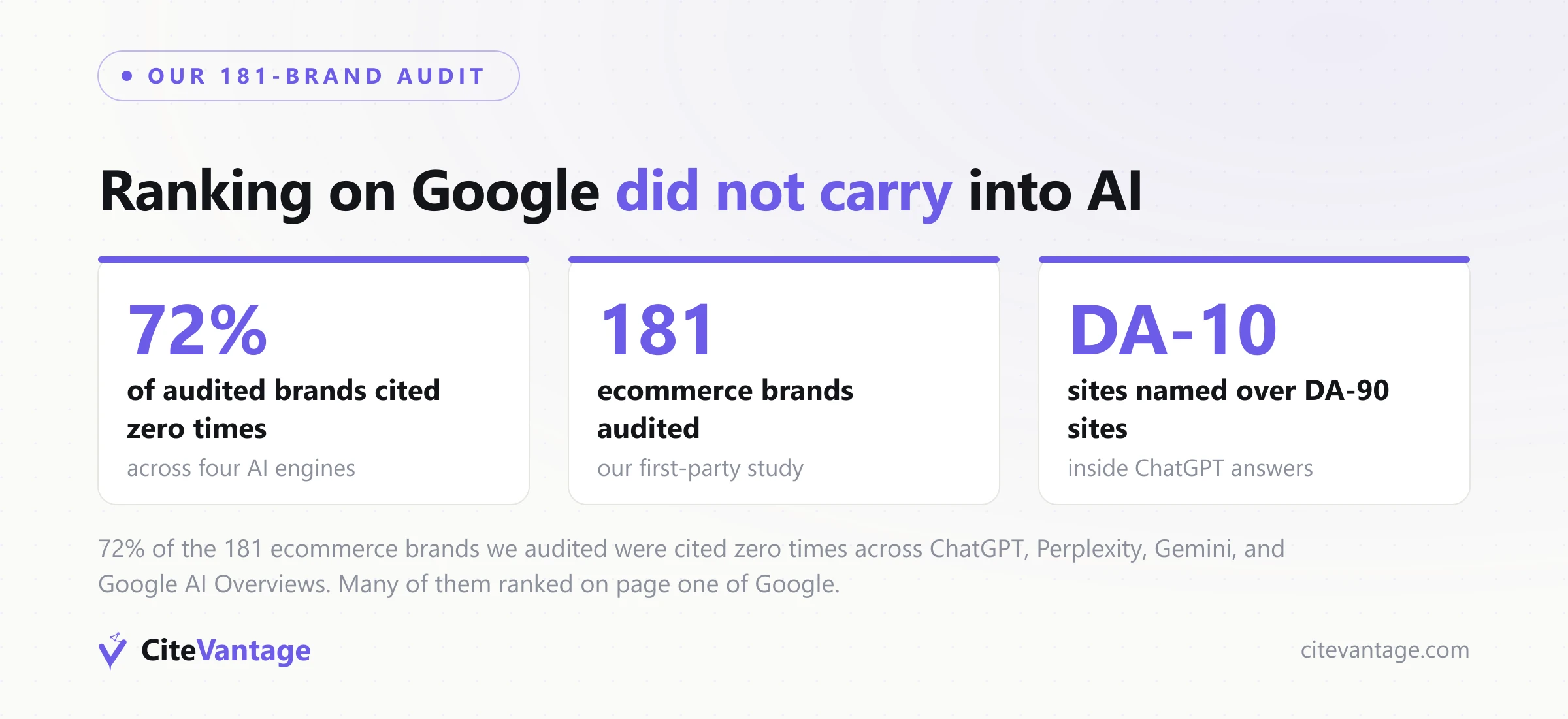
The second piece is what we watch inside ongoing citation audits. We have seen DA-10 sites get named over DA-90 sites inside ChatGPT answers. Domain authority, the number SEO built its whole model around, barely moves whether AI recommends you.
There is an external number that anchors why this matters. Pew Research Center, in a controlled study of 900 participants, found only about 1% of users click a link inside a Google AI Overview, with click-through on those searches falling to roughly 8% from 15%. The buyer reads the answer and stops. So being the answer is worth far more than sitting one link below it.
Google authority does not automatically transfer to AI recommendation. That gap is the entire reason answer engine optimization exists as separate work. If you want the diagnosis of why a store goes missing, our piece on why your brand is invisible to AI covers the usual causes.
Which AI engines do shoppers use to find products?
More than one, which is the trap. A store has to be visible across the set, not just the engine the founder happens to use. The working shortlist is ChatGPT, Google AI Overviews and AI Mode, Perplexity, Gemini and Copilot. Each surfaces products a little differently, and they do not agree with each other much.
- ChatGPT. Names products from what it learned in training plus live web results, leaning on consensus and widely-cited sources.
- Google AI Overviews and AI Mode. Sit on top of the search you already know, pulling a shortlist above the old blue links.
- Perplexity. Retrieves in real time and shows its sources, often pulling heavily from Reddit and review pages.
- Gemini. Weights brand-owned pages and Google’s own index more than most.
- Copilot. Runs on Microsoft’s stack and surfaces products inside that ecosystem.
The adoption is not small. McKinsey, in its report “New front door to the internet,” found that about 50% of consumers now intentionally use AI-powered search, and projects roughly 750 billion dollars in consumer spend flowing through it by 2028. Reach matters too. eMarketer’s H1 2026 forecast puts US generative-AI users at 133.0 million this year, or 39.2% of the population. At that size it has stopped being a niche channel and become where a large share of your buyers already start.
Does AI shopping traffic actually convert better?
Yes, and the reversal is recent. AI-referred visitors now convert better than visitors from other sources, a flip from a year ago. Fewer visits, but hotter ones. The buyer already got a recommendation before they arrived, so they land closer to the decision than a cold searcher ever did.
The numbers come from Adobe Analytics, reported across TechCrunch, Yahoo Finance, and Digital Commerce 360. In March 2026, AI-referred traffic converted 42% better than non-AI traffic, a reversal from 38% worse a year earlier. Those visits also drove 37% more revenue per visit. And AI-referred traffic to US retail sites grew 393% year over year in the first quarter of 2026, from an analysis of more than a trillion visits.
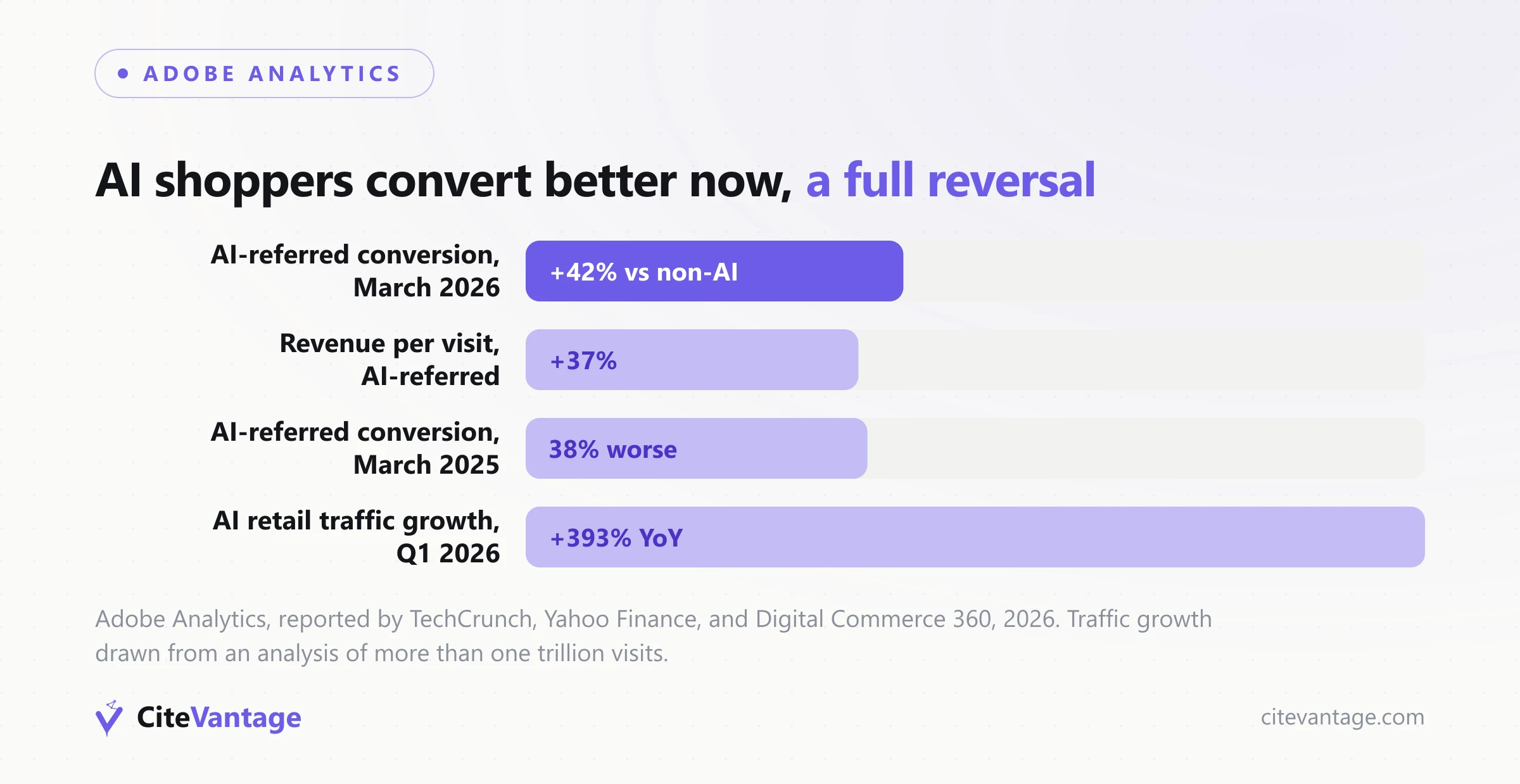
Read it the way it matters to you. Fewer clicks, worth more each. Being named is not a smaller prize because the click count drops. It is a larger one per visit.
Where should you start with AEO for product search this week?
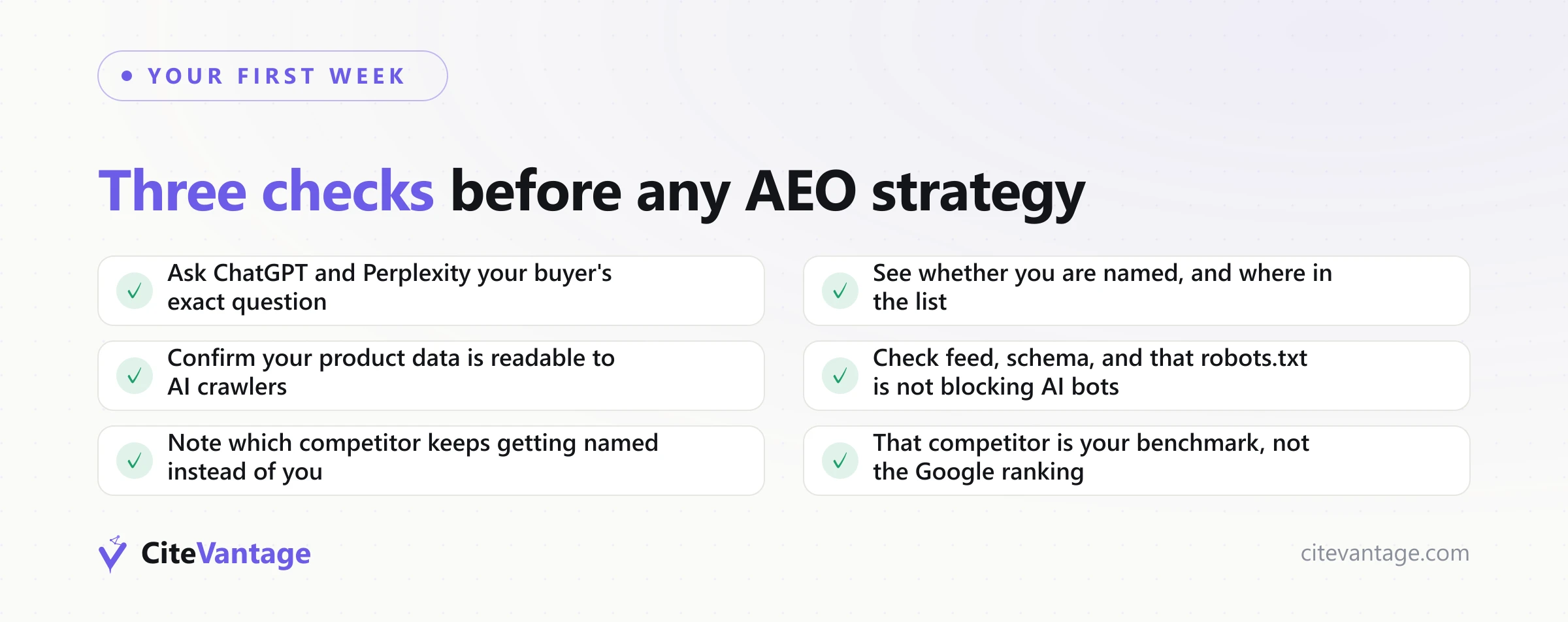
Before any strategy, find out whether AI names you at all. That single answer decides everything after it. There is no point tuning schema and reviews if you have not confirmed the engines currently skip you, and there is no point panicking if they already name you. Check first, then act on what you find.
Three moves, in order.
- Ask ChatGPT and Perplexity the exact question your buyer would ask. “Best [your product category] for [use case].” See whether you get named, and where in the list.
- Confirm your product data is even readable to AI crawlers. Check your feed, your schema, and that robots.txt is not quietly blocking the AI bots.
- Note which competitor keeps getting named instead of you. That is your real benchmark, not the Google ranking.
If you would rather see the full picture across engines at once, our free AI Visibility Snapshot checks whether AI names your store on the questions your buyers actually ask. And for the wider program behind AEO in product searching, our ecommerce services page lays out how the pieces fit.
None of this is a switch you flip. It is a read, then a plan. But you cannot plan around a gap you have not looked at yet.
Frequently asked questions
What is zero-click shopping in AEO in product searching?
+
The buyer gets the answer and the pick without ever loading a results page or your site. They ask an AI engine for the best product in a category, it names a short list, and they act on it. In AEO in product searching, the sale is often decided inside the answer, before a single click reaches your store.
What is agentic commerce (UCP and ACP)?
+
A step past recommendation. Agentic commerce is when an AI assistant does not just name a product but completes the purchase for the shopper, using emerging checkout protocols like UCP and ACP. McKinsey projects agentic commerce could reach 3 to 5 trillion dollars globally by 2030. It is early, but the direction is set: the assistant becomes the buyer.
How do I get my products recommended by ChatGPT?
+
Be the source the answer is built from. That means product data an AI crawler can actually read, clear specifics on your pages, and mentions on the sites the engine already trusts. Ranking on Google is not the same signal. You are optimizing to be quoted inside the answer, not to sit at position four on a results page.
Do product reviews affect what AI recommends?
+
Yes. Reviews are a data feed an AI engine reads to judge whether your product fits the question. Volume, recency and the specific language buyers use all feed the model's read of you. Thin or missing reviews leave the engine guessing, and it tends to name the store it can describe with confidence instead.
Is AEO in product searching worth it if I already rank on Google?
+
Ranking helps, but it does not carry over on its own. In our audit of 181 ecommerce brands, 87% were never cited once across four AI engines, and plenty of them ranked on page one. We have watched DA-10 sites get named over DA-90 sites inside ChatGPT. If AI never mentions you, a good Google position does not fix that.
See where AI is hiding your brand
Free multi-engine audit across ChatGPT, Gemini, Google AI & Perplexity.
See who AI names instead of me