Images in this guide are free to reuse (CC BY 4.0). Credit CiteVantage with a link to this page.
Shopify Answer Engine Optimization AEO Best Practices for a Store That Gets Cited
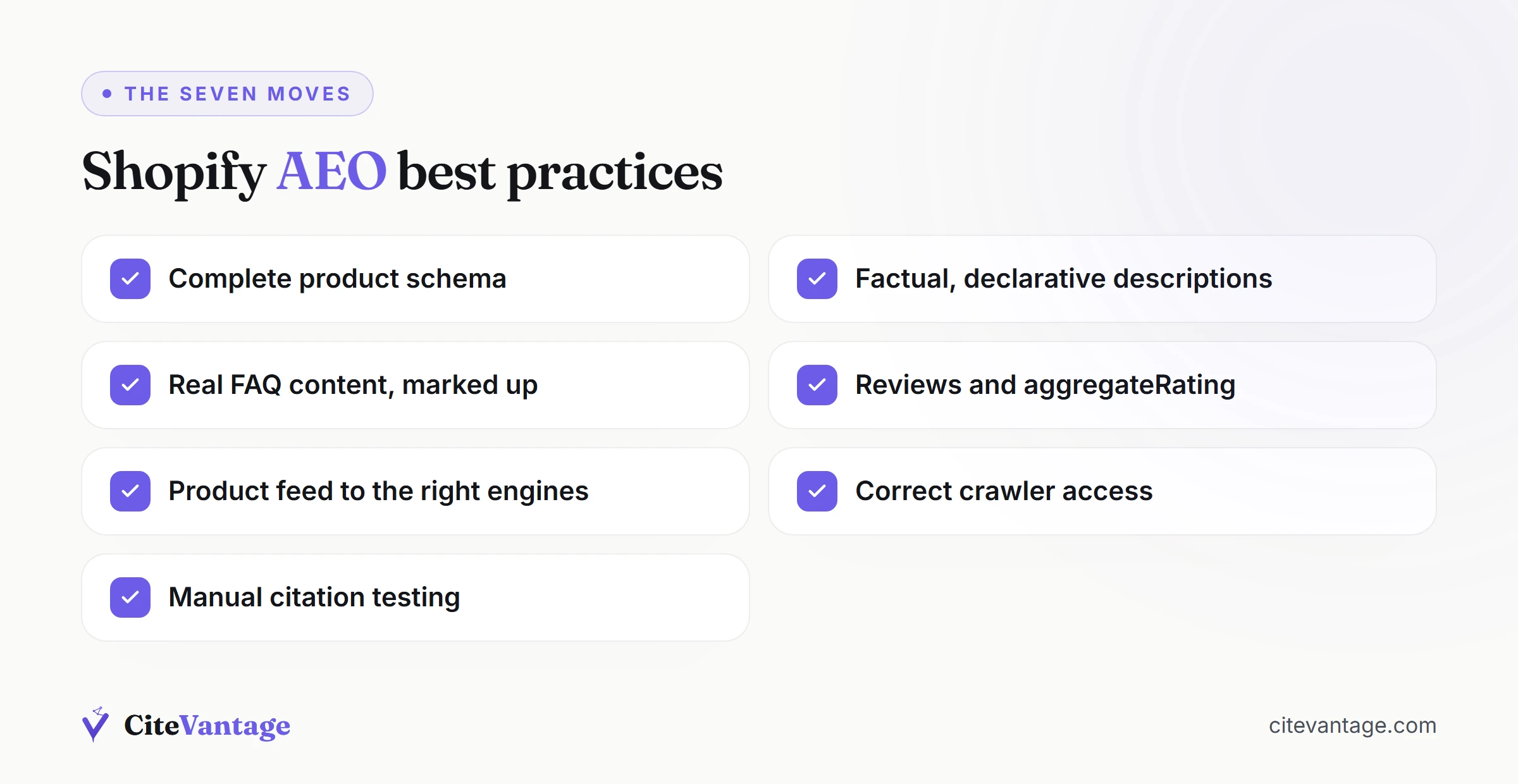
The Shopify answer engine optimization AEO best practices come down to seven moves: complete product schema, factual descriptions, real FAQ content, reviews, a product feed to the right engines, correct crawler access, and manual citation testing. Most guides bolt on an eighth step that is plain wrong for Shopify. We fix that one here too.
That eighth step is the robots.txt advice. Almost every ranking page tells you to unblock AI bots as if Shopify walls them off by default. It does not. Hold that thought.
First, why any of this is worth an afternoon. Orders coming to Shopify stores from AI-powered search grew 15x since January 2025, Shopify president Harley Finkelstein said on the company’s Q4 2025 earnings call. Fresh numbers back it up: AI-referred orders grew nearly 13x year over year and AI referral sessions more than 8x, per Shopify’s Q1 2026 commerce data. This is an order channel now. Not a science project.
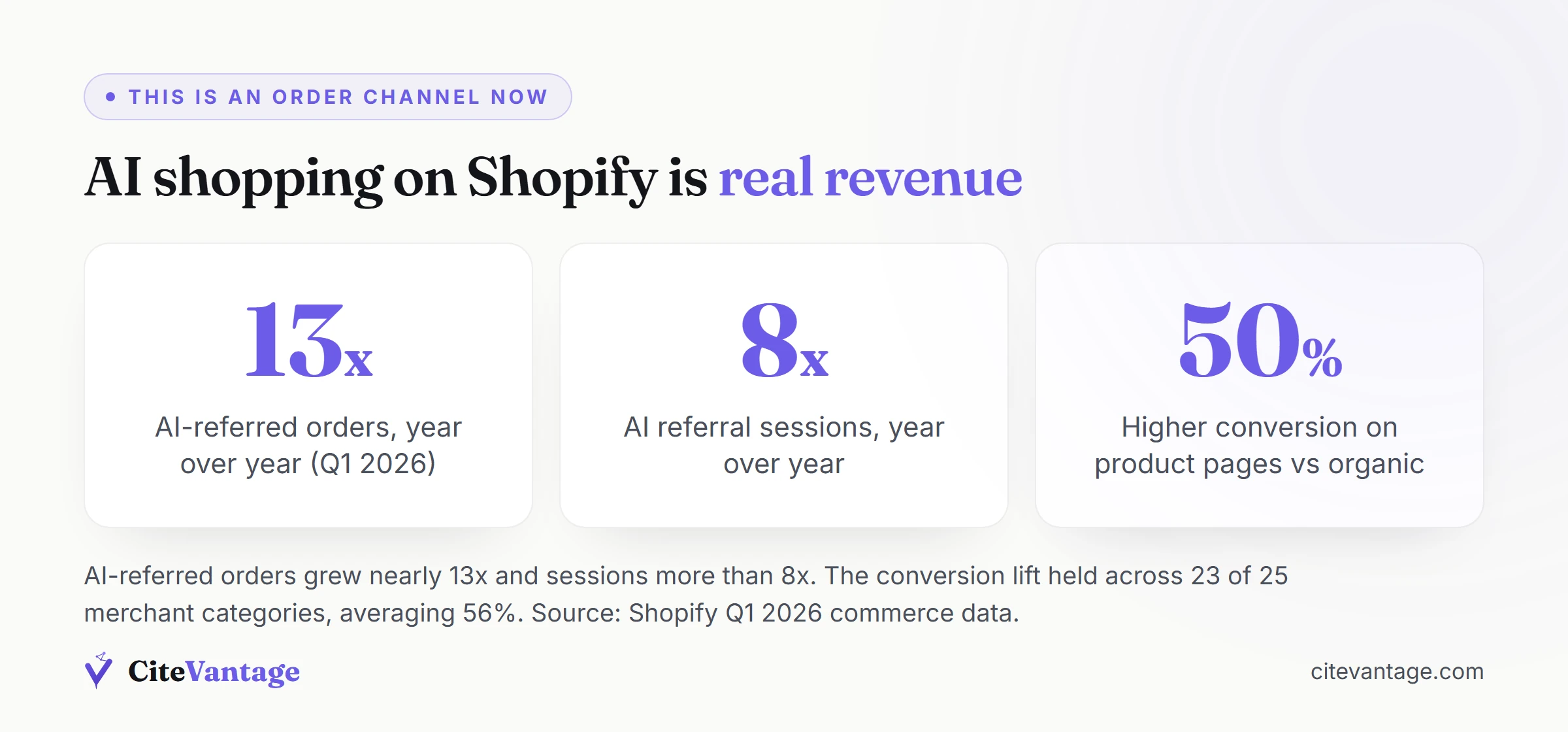
And the buyers who arrive this way are better buyers. AI-referred shoppers convert at nearly 50% higher rates than organic search on product detail pages, and that lift held across 23 of 25 merchant categories, averaging 56%, per the same Shopify data. Average order value runs 14% higher. More than half of AI-referred sessions start on a product page, versus 20% for organic.
So the founder question underneath all this is fair. You already rank on Google. You have paid for SEO before and watched nothing change. Why would AEO be different? Because the work below is not another ranking gamble. It is making your store answerable, and answerable is what AI quotes.
Key takeaways
- Seven table-stakes moves win most of it: schema, factual descriptions, FAQ content, reviews, a product feed, crawler access, and citation testing.
- Shopify does not block AI crawlers by default. The recycled “unblock GPTBot” advice is wrong for most stores. Check first.
- GPTBot is a training crawler, not the citation bot. Live ChatGPT answers run on OAI-SearchBot and ChatGPT-User.
- Schema makes a product eligible. Answerable content and entity trust are what actually get you cited. In our 181-brand audit, 72% were cited zero times, and it was not a schema problem.
- One build serves both AEO and GEO. You do not run two projects.
What are the Shopify answer engine optimization AEO best practices?
The Shopify answer engine optimization AEO best practices are a single citability build, not a pile of tricks. You give a product page complete structured data, a clear factual answer to the buyer’s real question, and access for the crawlers that read it. Optimize the page so a human gets a straight answer, and the machines follow. One build. Both audiences.
AEO means winning the direct answer when someone asks an engine a question instead of typing a search. On Shopify, that question is almost always a shopping one. “Best merino base layer for winter running.” “Waterproof duffel under 40 liters.” The engine wants a confident, structured answer, and it assembles that answer from pages it can read cleanly. If you want to see how a shopper actually gets to that question, our piece on AEO in product searching and the new buyer path walks the discover, compare, decide sequence in full.
Here is the part worth internalizing before you spend a dollar. The same page work that wins the plain-language answer is the work that gets you cited. You are not optimizing for a robot and a human separately. You optimize for the buyer, in a structured way, and the engine inherits it. Our full breakdown of what answer engine optimization actually is goes deeper on the mechanics.
Seven practices carry the weight. Schema, descriptions, FAQ content, reviews, feed, crawler access, testing. The rest of this page is each one, plus the three places competitors get Shopify specifically wrong.
AEO vs GEO for a Shopify store: one build, not two projects
For a Shopify store, AEO and GEO are the same build seen from two angles. AEO is winning the direct answer. GEO is being named and recommended inside a longer generative response. You do not run two programs, buy two audits, or pay two invoices. Optimize the product page to answer the buyer’s question with structure and proof, and both outcomes fall out of the same work.
A lot of agencies sell these as separate checklists. It makes the scope look bigger. It is not honest for ecommerce. The lever in both cases is the same page being answerable, trustworthy, and reachable. Where they differ is only in what the engine does with it afterward.
| Dimension | AEO (answer engine optimization) | GEO (generative engine optimization) | What you actually build on Shopify |
|---|---|---|---|
| Goal | Win the direct answer to a buyer question | Get named inside a longer AI recommendation | An answerable, structured product page |
| Where it shows | ChatGPT answer, Perplexity result, AI Overview snippet | “Best X for Y” style AI shopping lists | Both, from the same page |
| The core work | Clear factual answer, FAQ, schema | Entity trust, mentions, consistent data | Schema plus content plus off-site trust |
| The outcome | Your product is the answer | Your brand is in the shortlist | Cited more often, across engines |
| Effort | One citability build | The same build | You pay once |
The takeaway is boring on purpose. It is one project. If someone quotes you two, ask which page work is actually different between the two. Our GEO vs SEO vs AEO comparison lays out where the three overlap and where they genuinely diverge.
Get your product schema complete and correct
Complete Product JSON-LD is the first table-stakes move. AI shopping answers are assembled from structured data, so a product page needs brand, price, priceCurrency, availability, GTIN or MPN, material, dimensions, and aggregateRating, not a name and a photo. Shopify’s own guidance is blunt about it: “AI relies primarily on structured data rather than visual inference.” Missing fields make you harder to quote.
Most Shopify themes ship partial Product schema. Name, price, image, maybe availability. That gets you into Google’s rich results and no further. AI shopping surfaces want the identifiers and attributes that let them match your product to a specific query, and that is where thin markup fails.
| Field | Why AI needs it | Where Shopify gets the value |
|---|---|---|
| brand | Ties the product to your entity | Vendor field or product metafield |
| price + priceCurrency | Answers “how much” and filters by budget | Variant price |
| availability | AI skips out-of-stock items | Inventory status |
| gtin / mpn | Matches your product to the exact SKU across engines | Barcode / metafield |
| material | Filters “merino”, “stainless”, “organic cotton” queries | Product metafield |
| size / dimensions | Answers fit and space questions | Variant options / metafield |
| aggregateRating | Trust signal AI leans on for recommendations | Reviews app (Judge.me, Loox, Yotpo) |
One honest line, because it sets up a later section. Schema makes a product eligible to be quoted. It does not make you cited. We have watched fully marked-up stores stay invisible while a thinner competitor got named. Structure is necessary. It is not sufficient. Our technical rail on which schema types matter for AI search covers the full field spec.
Write factual, declarative product descriptions
Citable descriptions are factual and declarative: spec plus use case, written the way a knowledgeable person would answer a question. Not a 15-word mood blurb. AI lifts text it can quote without editing, so a description that states what the product is, what it is made of, and what it is for is one it can drop straight into an answer. Vague copy gives it nothing to pull.
Think about the buyer’s actual question and answer it in the copy. Not “elevate your everyday carry.” Say what it holds, what it weighs, what it is made from, and who it suits. “22-liter roll-top pack in 400D recycled nylon, fits a 16-inch laptop, built for bike commuting in wet weather.” An engine can quote that. It cannot quote a vibe.
Shopify’s guidance names a specific structure worth using: Q&A formatting is one of the most effective content shapes for AI search. So write the buyer’s question into the page and answer it plainly underneath. Which brings us to the next move.
Add FAQ content that answers real buyer questions
Real buyer Q&As, on product and collection pages, with FAQPage schema, are among the highest-leverage content you can add. Answer the questions people actually ask before buying: sizing, materials, care, shipping, comparisons. Mark them up with FAQPage schema. Keep the answer visible on the page, never marked up on hidden content. Then let reviews and aggregateRating carry the trust signal underneath.
The trick is answering questions a buyer genuinely types, not questions that flatter the product. “Does this run small?” “Is it machine washable?” “How is it different from the Pro version?” Those are the ones an engine gets asked and needs a source for. Give it a clean answer and you become that source.
Reviews matter here too, and not just for conversion. Ratings feed aggregateRating, and a product with real review volume reads as trustworthy to both a shopper and an engine deciding what to recommend. No reviews, no aggregateRating, one less eligibility signal.
Submit a product feed to the right engines
A product feed is separate from schema, and AI shopping answers depend on it. Submit a feed to Google Merchant Center for AI Overviews and to Bing for ChatGPT shopping, with full Google product category, custom attributes like material and dimensions, and identifiers like GTIN or MPN. Schema lives on your page. The feed pushes your catalog into the graphs these engines query. You want both.
Context for how seriously the platform takes this. Shopify has structured more than 1 billion products with clean attributes, real-time pricing, and accurate inventory to support AI discovery across surfaces including ChatGPT and Microsoft Copilot, Shopify president Harley Finkelstein said on the company’s Q1 2026 earnings call. Your job is to make sure your catalog is in that structured pipe with complete data, not half-filled fields.
Feeds are unglamorous. They also quietly decide whether your products can appear in a shopping answer at all. Fill every attribute you can.
Does Shopify block AI crawlers by default? The robots.txt myth
No. Shopify does not block AI crawlers by default, and this is where most guides mislead you. Shopify’s default robots.txt already allows GPTBot, OAI-SearchBot, PerplexityBot, and ClaudeBot. The only default disallows are admin, cart, checkout, and internal search paths. So the recycled “unblock the AI bots in robots.txt” advice is solving a problem you probably do not have.
Read a dozen Shopify AEO posts and you will see the same instruction, phrased as if Shopify locks these crawlers out and you must free them. It is copied from generic SEO advice and it does not match how Shopify ships. According to craftshift’s technical writeup, consistent with Shopify’s Help Center guidance, the default file allows the major AI crawlers and blocks only the account and cart paths you would never want indexed anyway.
Two practical points. First, check your own robots.txt before you change anything. Visit yourstore.com/robots.txt and look. If GPTBot and OAI-SearchBot are not disallowed, there is nothing to fix, and blindly following recycled advice risks breaking a file that was fine.
Second, if an app or a past edit actually did block a crawler, you cannot edit robots.txt directly on Shopify. You customize it through the robots.txt.liquid template: Online Store, Themes, Edit code, add a robots.txt.liquid template, and adjust the rules there. That is the real method. Most stores never need it.
Why allowing GPTBot does not get you cited
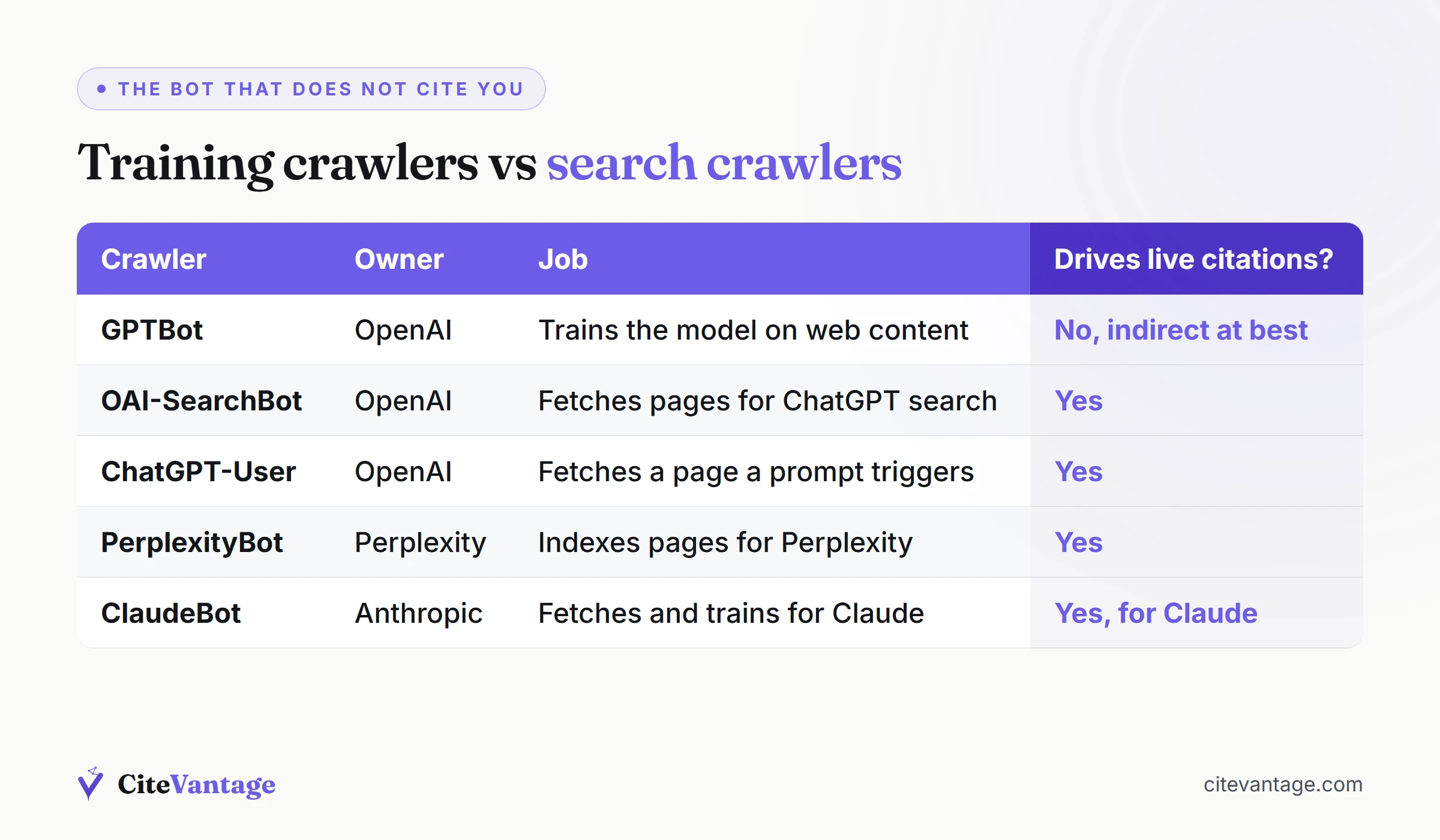
Allowing GPTBot does nothing for your live ChatGPT citations, because GPTBot is the wrong bot. GPTBot is OpenAI’s training crawler. The crawlers that power live ChatGPT shopping answers are OAI-SearchBot and ChatGPT-User. Allow all three, sure. But allowing GPTBot alone and then expecting to show up in a live answer is the productive-feeling move that quietly does nothing.
This is worth slowing down on, because it is the exact trap the robots.txt myth leads into. A founder reads “allow GPTBot,” adds the line, feels done, and waits for citations that were never going to come from that bot. The training crawler feeds the model’s background knowledge over time. The search crawlers fetch pages to build a live answer right now. Different jobs.
| Crawler | Owner | Job | Drives live citations? |
|---|---|---|---|
| GPTBot | OpenAI | Trains the model on web content | No, indirect at best |
| OAI-SearchBot | OpenAI | Fetches pages for ChatGPT search results | Yes |
| ChatGPT-User | OpenAI | Fetches a page when a user’s prompt triggers it | Yes |
| PerplexityBot | Perplexity | Indexes pages for Perplexity answers | Yes |
| ClaudeBot | Anthropic | Fetches and trains for Claude | Yes, for Claude |
Allow all of them. Then stop treating crawler access as the finish line. It is the entry ticket, not the win.
Why does ChatGPT recommend your competitors and not you?
Usually because your competitor is more answerable and more trusted as an entity, not because they have more schema or a bigger domain. This is the uncomfortable part. In our audit of 181 ecommerce brands across four AI engines, 72% were cited zero times when the engine answered questions about their own category. Most had fine SEO. They just were not built to be quoted, and their entity was thin.
Here is the observation that reframes the whole game for most founders. We have watched DA-10 sites beat DA-90 sites inside ChatGPT answers. Domain authority, the number SEO trained you to chase, barely moves AI citations. What moves them is whether your content answers the question cleanly and whether trusted third parties already mention your brand. An engine repeats consensus. If nobody it trusts names you, it does not invent you.
So schema volume is not the dividing line between cited and invisible. Answerable content and entity trust are. A store with complete markup and a vague, unmentioned brand loses to a store with a clear answer and a handful of real mentions. The RIPT Apparel case study shows what closing that gap looked like for one ecommerce brand.
That is why the last two practices exist. You have to measure this, and you have to be honest about how long it takes.
How do you track whether AI is citing your Shopify store?
You track it with a fixed prompt set and referrer data, on a set cadence, not by vibes. Write down 10 to 20 buyer questions your category gets asked. Run them across ChatGPT, Perplexity, Gemini, and Claude on the same schedule, monthly at minimum, and log whether you were named. In GA4, filter for AI referral sources to see sessions and orders arriving from those engines. Now you have a baseline.
Everyone says “track your AI citations.” Few say how. The concrete version is two things running in parallel. One, a manual prompt log: same questions, same engines, same day each month, a simple yes or no on whether your brand appeared and where. Two, GA4 referral filtering for domains like chatgpt.com, perplexity.ai, and the rest, so you can see the traffic and the orders, not just the mentions.
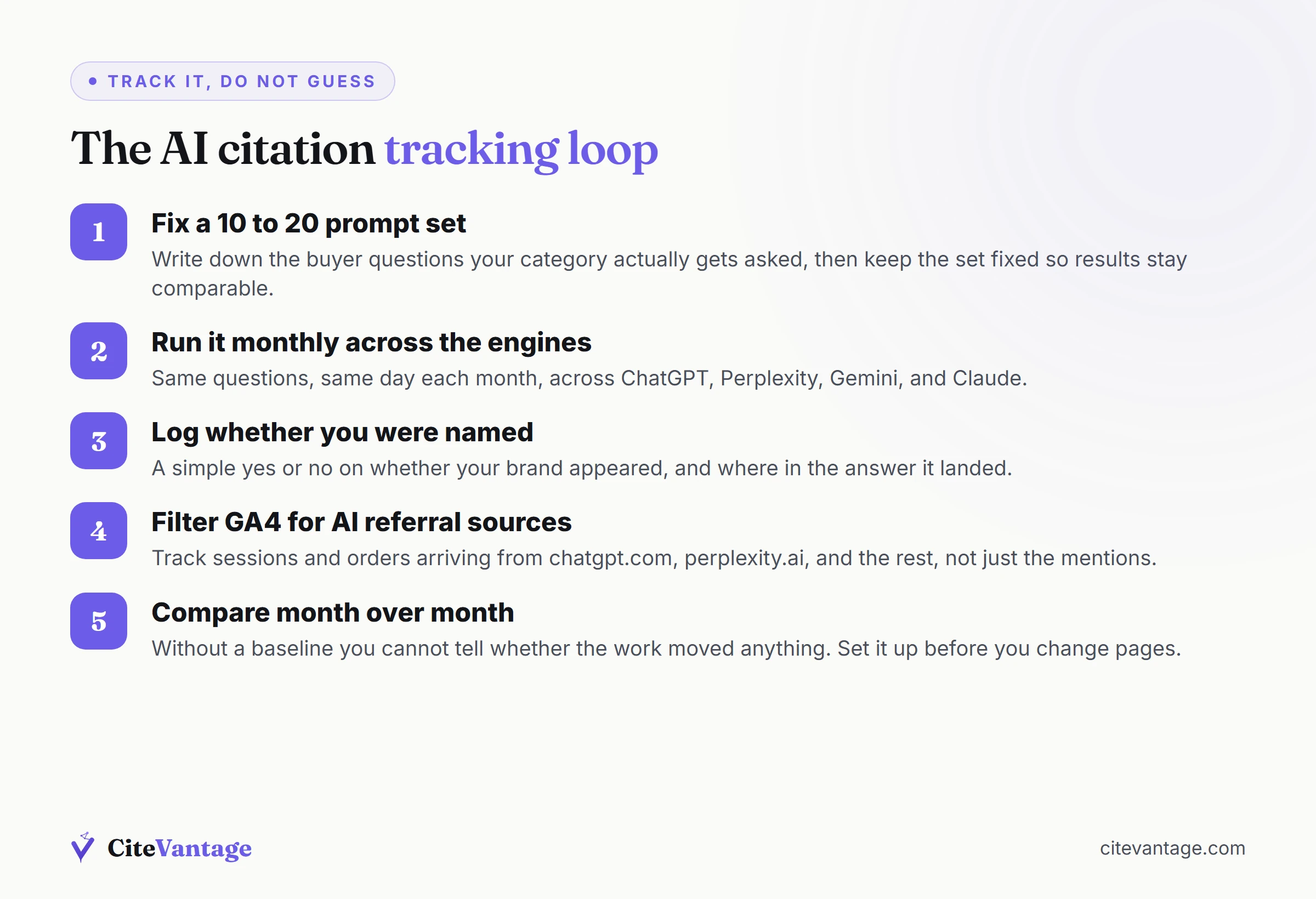
Without a baseline you cannot tell whether the work moved anything. Our guide to running an AI visibility audit gives you the prompt-set method in full. Set it up before you start changing pages, not after.
How long do the Shopify answer engine optimization AEO best practices take to work?
The fast wins reach eligibility in about 2 to 6 weeks. The slow part takes months. Schema, the product feed, factual descriptions, and a robots.txt check are quick to ship and quick to register, so a store can become eligible to be cited inside roughly a month. Being named repeatedly across your category is a different timeline, because that depends on authority and mentions, which build slowly.
Split it honestly. Weeks one to six: complete your Product schema, submit the feeds, rewrite your top product and collection descriptions, add FAQ content, confirm crawler access. That is the eligibility layer, and Perplexity in particular can start reflecting it fast. Then the long game: earning mentions on the sites engines already trust, keeping your entity data consistent everywhere, and publishing the comparison content that gets you into shortlists. That runs for months and it compounds.
A sprint fixes the first layer. It does not buy the second one overnight, and any promise that it does is a guess dressed up as a guarantee. The stores that stay cited are the ones that keep the program running after the fast wins land.
Where to start
Run a free check before you rebuild anything. Our free AI Visibility Snapshot shows you which buyer questions in your category already return an answer, whether your Shopify store is named or your competitors are, and where the gaps sit. That is your baseline. If you want the full ecommerce program behind it, our Shopify and DTC AEO services build the whole citability layer for you.
Two things you can do this week regardless. Open yourstore.com/robots.txt and confirm the AI crawlers are not disallowed, because the myth cuts both ways and an app may have broken it. Then rewrite your three best-selling product pages into complete schema plus a factual, question-answering description. Those two moves cover most of the eligibility gap for most stores. When you rewrite those pages, build them to do both jobs at once: our guide to product page content that converts and wins GEO and AEO shows how each element earns its place for the AI and the buyer together.
Frequently asked questions
Does Shopify block AI crawlers by default?
No. Shopify’s default robots.txt allows GPTBot, OAI-SearchBot, PerplexityBot, and ClaudeBot, and only disallows admin, cart, checkout, and search paths. The common “unblock your AI bots” advice assumes a block that is not there. Check yourstore.com/robots.txt first. If an app broke it, fix it through the robots.txt.liquid template, not by editing the file directly.
Does allowing GPTBot get my store cited in ChatGPT?
No. GPTBot is OpenAI’s training crawler. Live ChatGPT shopping answers run on OAI-SearchBot and ChatGPT-User. Allow all three, but do not expect GPTBot alone to produce citations. Crawler access is the entry ticket. The content those search crawlers can quote is what actually earns the mention.
What schema does a Shopify store need for AI search?
Complete Product JSON-LD: brand, price, priceCurrency, availability, GTIN or MPN, material, dimensions, and aggregateRating. Most themes ship only the basics. Shopify says AI relies primarily on structured data rather than visual inference, so fill every field you can. Then remember schema makes you eligible, not cited. Answerable content and trust close the rest of the gap.
Do I need Bing Merchant Center for ChatGPT shopping?
For the ChatGPT shopping channel, yes. That surface pulls from Microsoft’s product graph, so a Bing feed matters there, while Google Merchant Center feeds AI Overviews. Submit both with full product categories, attributes, and identifiers. A feed is separate from your on-page schema, and AI shopping answers depend on the feed to surface your catalog.
How long do the Shopify answer engine optimization AEO best practices take to work?
The eligibility wins land in about 2 to 6 weeks: schema, feed, descriptions, and a robots.txt check. Authority takes months. Being named repeatedly across your category depends on mentions and entity trust, which build slowly and compound. A sprint fixes the fast layer. The durable presence comes from keeping the program running after that.
Frequently asked questions
Does Shopify block AI crawlers by default?+
No. Shopify's default robots.txt already allows the major AI crawlers, including GPTBot, OAI-SearchBot, PerplexityBot, and ClaudeBot. The only default disallows are admin, cart, checkout, and internal search paths. Most guides tell you to unblock these bots, which implies Shopify blocks them. It does not. Check your own robots.txt before you touch anything.
Does allowing GPTBot get my store cited in ChatGPT?+
No, and this trips up a lot of merchants. GPTBot is OpenAI's training crawler. The bots that power live ChatGPT shopping answers are OAI-SearchBot and ChatGPT-User. Allowing GPTBot alone does nothing for the citations you see inside a live answer. Allow all three, then focus on the content those crawlers actually quote.
What schema does a Shopify store need for AI search?+
Complete Product JSON-LD. That means brand, price, priceCurrency, availability, GTIN or MPN, material, dimensions, and aggregateRating, not just a name and a photo. Shopify's own guidance says AI relies primarily on structured data rather than visual inference. Schema makes a product eligible to be quoted. It does not, on its own, make you cited.
Do I need Bing Merchant Center for ChatGPT shopping?+
For the ChatGPT shopping channel, yes. ChatGPT's shopping surface pulls from Microsoft's product graph, so a Bing Merchant Center feed matters there. Google Merchant Center feeds AI Overviews. Submit both, with full product categories, attributes, and identifiers. A feed is separate from schema, and AI shopping answers lean on it.
How long do the Shopify answer engine optimization AEO best practices take to work?+
The fast wins reach eligibility in about 2 to 6 weeks: schema, feed, descriptions, and a robots.txt check. The slow part is authority. Being named repeatedly across your category takes months of mentions and entity trust. A sprint fixes the eligibility layer. It does not buy authority overnight, and anyone promising that is guessing.
See where AI is hiding your brand
Free multi-engine audit across ChatGPT, Gemini, Google AI & Perplexity.
Get your free audit