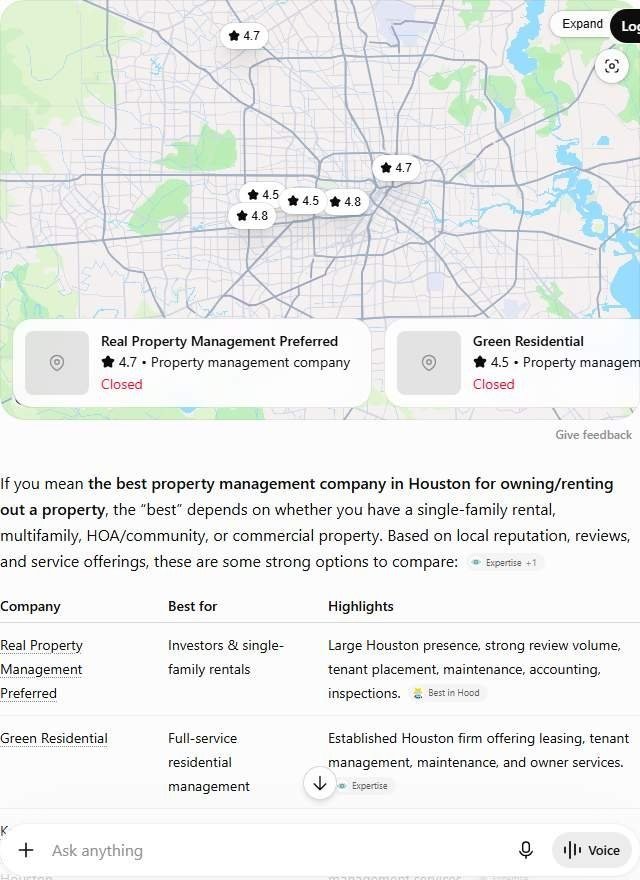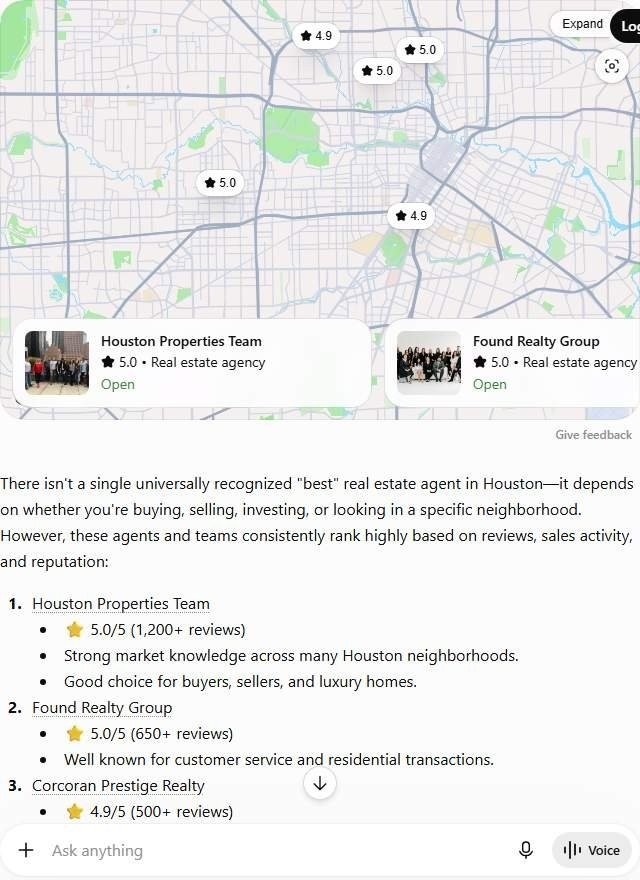

The real estate keywords worth an agent’s time pair one place with one intent, such as “best listing agent Katy TX” or “realtor for townhomes and condos in Katy TX”, and each gets its own page. You can find them free in Search Console, your Business Profile’s search terms and Google autocomplete. Broad keywords for real estate, such as “homes for sale” with no place attached, are a portal fight that a solo agent rarely wins, in our judgment.
Exact wording also matters less than the long keyword lists imply. In our 500-query Houston study, when AI engines were asked the same “best agent” question four ways for 40 Houston-area places, 79.2% of the names they gave came up under only one wording and 2.2% under all four. Asking the identical question a second time changes the list too, so the figure shows how loose these answers are and proves nothing about wording on its own.
Our real estate SEO guide covers the profile, reviews and site basics. This post stays on choosing real estate keywords and giving each one a home.
What are the best keywords for real estate agents?
The best keywords for real estate agents combine a place you serve with a need you meet, such as selling in Katy or condos in Montrose. Buyers start online: for purchases from July 2024 to June 2025, NAR’s Generational Trends report found 46% began by looking at properties for sale online and 52% found the home they bought on the internet. Your keywords should catch them by area and need.

A good agent keyword has up to four parts, and most strong ones use two or three of them:
- Place. A city, suburb, neighborhood or ZIP code you actually work.
- Intent, meaning buying, selling, relocating, investing or simply finding an agent.
- Property type, where it narrows the need: condos, new construction, acreage, luxury homes.
- Your own name and your team’s. A referred buyer types it to check you out, and a referral from a friend, neighbor or relative was how 43% of buyers found their agent in the same NAR report.
That report is NAR’s 2026 Home Buyers and Sellers Generational Trends, and its figures cover purchases from July 2024 to June 2025. It also found buyers typically searched for 10 weeks, 70% used a mobile phone or tablet in the search, and 85% used an agent as an information source.
Agents still handle most moves. NAR’s 2026 Profile of Home Buyers and Sellers, covering transactions from July 2025 to June 2026, found 90% of buyers and 92% of sellers used an agent, the sellers’ figure an all-time high. NAR has an interest in agents staying relevant, so weigh its numbers with that in mind. More sourced figures sit on our page of real estate SEO statistics.
What matters for your list is which agent those buyers find. The portals already top every intent in the citation data below, so the place in your keyword does most of the work.
What types of real estate keywords are there?
Real estate keywords fall into intent groups: finding an agent, selling, first-time buying, relocating, investing, luxury, new construction and condos. We used those eight groups, plus 20 metro-wide questions, to write 500 Houston questions for AI engines, and each group drew a different mix of cited sites, from sothebysrealty.com on luxury questions to newhomesource.com on new construction. Give each group its own page.
The table uses one Katy wording per intent from our September 2026 question set. Citation shares come from three of the study’s four surfaces, ChatGPT, the Gemini API and Perplexity, because the Gemini web app returned no source links. Each share is that site’s portion of all citations within the intent.
| Intent | One wording we asked | Citations counted | Most-cited sites (share of that intent’s citations) | Page that should own it |
|---|---|---|---|---|
| Finding an agent | best real estate agent in Katy TX | 2,180 | zillow.com 10.9%, har.com 10.2%, realtor.com 7.0%, fastexpert.com 6.1% | Home and about pages, with your name and area |
| Selling | I am selling my house in Katy. Who should I list with? | 1,168 | zillow.com 10.6%, har.com 9.5%, homelight.com 6.0%, realtor.com 5.7% | A selling page for each main area |
| Relocation | I am moving to Katy and need a realtor to help me find a home. Who is good? | 563 | zillow.com 12.1%, har.com 9.4%, realtor.com 8.0%, fastexpert.com 4.3% | A relocation guide for the city |
| Luxury | best luxury real estate agent Katy | 712 | har.com 8.0%, zillow.com 5.2%, sothebysrealty.com 4.5%, realtor.com 4.2% | A luxury page, if you sell at that level |
| New construction | who helps with new construction homes in Katy? | 797 | zillow.com 7.2%, realtor.com 4.5%, har.com 4.1%, newhomesource.com 3.5% | A page naming the new communities you work |
| Condos and townhomes | realtor for townhomes and condos in Katy TX | 553 | har.com 11.4%, realtor.com 11.2%, zillow.com 9.0%, homes.com 5.6% | A condo page, or a neighborhood page where condos dominate |
The last column is our recommendation. The data shows who gets cited for each intent and says nothing about which page layout wins.
Read down the fourth column and the portals hold the top rows almost everywhere, while the sites beneath them change with the question. HomeLight, an agent referral network, shows up on selling questions, a luxury brokerage brand on luxury, and new-home portals on new construction, where answers also named the most firms: 8.2 on average, against 4.2 for condo answers. New construction also had the flattest spread of citations, with its top site on 7.2%, and investor questions, left out of the table, came close, with har.com leading on 7.3%.
How do you find real estate keywords for free?
Start with the words people already used to reach you. Search Console shows the queries your site appeared for, your Business Profile lists the search terms that found it each month, and Google autocomplete reflects real searches, with your location taken into account. Keyword Planner is free once you finish Google Ads account setup, billing details included, but its figures are estimates, and Trends shows only relative interest.
Sources Google documents
Each of these is free, and Google’s own help pages say what each one measures and where it stops.
| Tool | What it shows, in Google’s words | Limit to know |
|---|---|---|
| Search Console performance report | Queries grouped “by the search query users typed” | Rare queries are withheld; the table shows at most 1,000 rows |
| Business Profile performance | ”The search terms people used to find your business.” | Updated at the start of each month; “You can’t directly manage these queries.” |
| Google autocomplete | Predictions that “reflect real searches that have been done on Google” | Shaped by “The location a query is coming from” and “Your past searches” |
| Keyword Planner | ”estimates of the searches” a keyword receives | Needs finished Google Ads account setup, with billing information; counts include “close variants” |
| Google Trends | Interest “scaled on a range of 0 to 100” | Uses “only a sample of Google searches”; never a search volume |
Google’s Keyword Planner page calls it “a free keyword search tool”, while its help page says “You must complete your account setup by entering your billing information” before even the basic features open, and its average monthly searches figure counts a keyword “and its close variants”, so no number belongs to one exact string. Run autocomplete signed out or in a private window, set to the market you work.
The limit that hurts agents most is in the first row. Google’s Daniel Waisberg wrote in 2022 that “Anonymized queries are those that aren’t issued by more than a few dozen users over a two-to-three month period,” and Google’s troubleshooting page still says “some rare or long-tail rows might be omitted from the table.” A phrase like “realtor for acreage near Fulshear” could reach your site every month and never show up in the report. In our experience paid tools thin out at the same level: CiteVantage’s Ahrefs US pull of 2026-10-29 gives national figures such as 250 searches a month for “keywords for real estate”, yet a suburb plus “listing agent” often shows no volume at all. Long-tail real estate keywords are still worth having; you judge them by fit.
Sources only you have
For real estate keyword research, these are the sources we recommend most, because they hold the exact phrasing buyers and sellers use with you, which no tool records:
- Lead form messages and email inquiries, copied word for word into one file.
- The questions people ask on the first call, written down the same day.
- Portal inquiry notes, where a buyer typed a question about a specific home.
- Whatever sellers ask at listing appointments.
Do exact keywords still matter when buyers ask AI?
Less than most keyword lists suggest. When we asked AI engines the same “best agent” question four ways for 40 Houston-area places, 79.2% of the names they gave appeared under only one wording, and 2.2% appeared under all four. Asking the identical question again also changes the list. Google says its AI features may fan a question out into related searches, so cover the whole intent on one page.

The four wordings were “best real estate agent in [place] TX”, “who is the best realtor in [place], TX?”, “top real estate agents [place] texas” and “real estate agents near me [place]”. We put each to four surfaces between 18 and 22 September 2026, which produced 2,598 combinations of a name, a surface and a place, and 2,058 of those turned up under one wording only. By surface, the share seen under a single wording was:
- ChatGPT: 257 of 385 names, or 66.8%.
- The Gemini API, 584 of 817 (71.5%).
- Gemini web app: 410 of 499, or 82.2%.
- Perplexity at 807 of 897 (90.0%).
The names were pulled out of the answers by rules, and the labels in this round were made by an AI reviewer, so read these as names as extracted, some of which are not businesses. Run-to-run churn is the bigger caveat. Our November Houston report put 100 of its questions to ChatGPT and Gemini again, twice, and found: “For the average ChatGPT question, between 26% and 38% of the firms that either of two runs named were named by both runs. For Gemini the range is 10% to 15%.” Measured the same way across the four September wordings, ChatGPT’s average overlap was 16.4% and the Gemini web app’s 8.0%. That is lower than the repeat overlap, which hints that rewording adds change on top of chance, but the rounds used different months and question sets, so read it as suggestive; we have not run a controlled test.
Half the September questions were keyword-style and half conversational, and the conversational half drew slightly more names, 5.79 per counted answer against 5.37, which is a small lean from one market in one month.
Google’s guidance on AI features says “There are no additional requirements to appear in AI Overviews or AI Mode, nor other special optimizations necessary,” and that AI Overviews and AI Mode may use a “query fan-out” technique, “issuing multiple related searches across subtopics and data sources.” Its SEO Starter Guide adds: “Google’s language matching systems are sophisticated and can understand how your page relates to many queries, even if you don’t explicitly use the exact terms in them.” For a Katy selling page, that means answering the questions around a sale (pricing, timing, the homes you have sold nearby) instead of repeating four phrasings of “best listing agent”. Our guide to AI search for real estate agents covers the rest of the AI side.
To test wordings in your own market, borrow ours: the November report asked up to 30 per place, from “Who is the best listing agent in Katy, TX?” to “Which realtor in Katy, TX sells homes the fastest?”. The September answers as a CSV and the question set as JSON are public, so you can recompute the 79.2% yourself.
How do you map keywords to pages without them competing?
Give every page one primary keyword and one intent, and keep a single sheet that records which page owns which term. The one-owner rule is our judgment; Google’s closest guidance asks that each piece of content live at one URL. Most agent sites need five page types (service, neighborhood, listing, guide and about), and each should own a different group of real estate keywords.
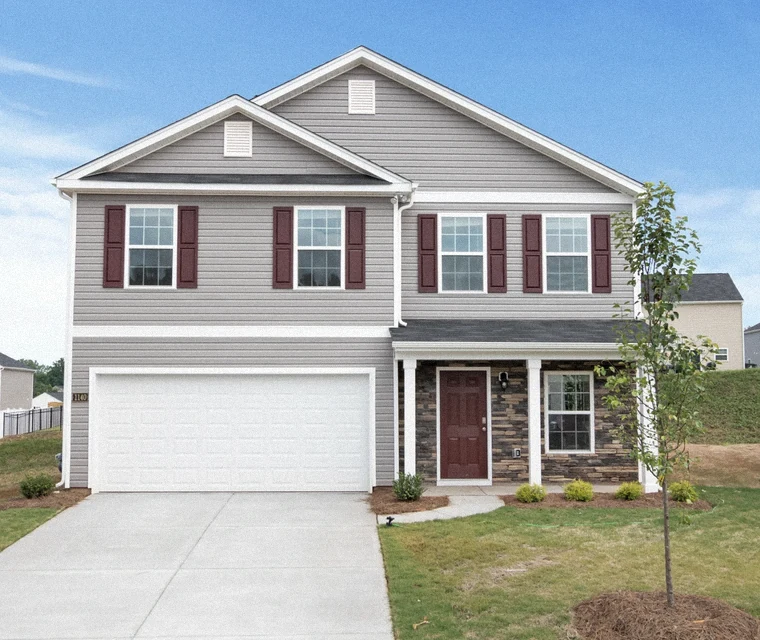
NAR
of buyers who used the internet rated photos very useful, NAR found.
Photo: Curtis Adams, Pexels
Google’s starter guide asks site owners to “try to ensure that each piece of content on your site is only accessible through one individual URL; having two pages that contain the same information about your promotions can be a confusing user experience”. That passage is about duplicate content. We found no Google page that names two different pages chasing one keyword, which SEOs call cannibalization; in our experience such pages split the result. The same guide says “the keywords in the name of the domain (or URL path) alone have hardly any effect beyond appearing in breadcrumbs,” so a keyword-heavy domain buys you little.
| Page type | Intent it owns | Example primary keyword | What it should contain |
|---|---|---|---|
| Service page | Selling or buying in your main area | listing agent Katy TX | How you sell, homes you have sold there, how to reach you |
| Neighborhood page | Researching an area | living in Cinco Ranch | Homes, amenities, distances and commute times |
| Listing page | One specific home | the street address | Photos, full property detail, a floor plan where you have one |
| Guide page | One question buyers or sellers ask | moving to Katy from Houston | A direct answer with local specifics and a date |
| About page | Your name and your team’s | your name plus “realtor Katy” | License, brokerage, areas, reviews and recent sales |
The NAR report shows what buyers value on those pages. Among buyers who used the internet, 81% rated photos very useful, 77% detailed property information, 57% floor plans, 44% agent contact information and 34% neighborhood information. Real estate news or articles came near the bottom at 7%. That figure rates usefulness and says nothing about traffic, but it is a fair warning for keyword-led blogging: a guide page earns its place when it answers a question buyers actually ask.
Real estate listing keywords, the address and feature phrases on a listing page, run into the duplicate problem our guide covers, because the same MLS record sits on the portals. The sheet itself needs four columns: the primary keyword, its close variants, the URL that owns it and the date you last checked it. Search it before you write a new page, and if a page already owns the intent, improve that one.
Which real estate keywords should agents avoid?
Avoid real estate keywords that describe who should live in a place. Federal fair housing rules bar housing ads that indicate a preference by familial status and six other protected classes, including through word choice. “Family-friendly” phrasing appears in two of the keyword lists we read. Describe what is actually there: named parks, schools nearby, commute times and the homes themselves.

The regulation, 24 CFR 100.75, covers ads indicating “any preference, limitation or discrimination because of race, color, religion, sex, handicap, familial status, or national origin.” It reaches “Using words, phrases, photographs, illustrations, symbols or forms which convey that dwellings are available or not available to a particular group of persons,” and also “Selecting media or locations for advertising the sale or rental of dwellings which deny particular segments of the housing market information about housing opportunities.” In our reading, a keyword aimed at one group is a word choice and a placement choice at the same time.
Two of the keyword lists we read suggest “family-friendly” neighborhoods as a target, one adds “safest neighborhoods” and “best school districts near me”, and we found no mention of fair housing on either page. Fair housing attorney Amy Glassman told HomeLight: “You can describe features that you think are family friendly, but you shouldn’t say they’re family friendly.” That is one lawyer’s advice, published on the blog of a company that runs an agent referral network, so treat it as guidance; it sits close to the regulation’s own text.
Swaps we would make, as our judgment and not legal advice:
- “Family-friendly neighborhoods” becomes “homes near [named park]” or “neighborhoods near [named school]”.
- A “safe neighborhood” claim becomes a factual description you can source, or nothing.
- “Best for seniors” becomes “single-story homes in [area]” or “downsizing in [area]”.
Buyers do phrase questions this way: one of the 30 wordings in our November report was “Which realtor in Katy, TX is best for a family moving for the schools?” Answering a buyer who asks you is a conversation. A page built to target families as a group is advertising, which is where the regulation’s language applies in our reading. Some states protect more classes than the federal list, so check your state’s rules and your brokerage’s advertising policy too.
Broad head terms with no place attached also belong on the avoid list, since the portals hold them. So does any keyword density target, including one keyword list’s advice to use the keyword once every 100 words: Google’s starter guide publishes no such figure, says “keyword stuffing is against Google’s spam policies,” and adds that “Google Search doesn’t use the keywords meta tag.”
How do you check whether your keywords are working?
Compare against a dated baseline each month. Search Console shows queries, clicks and impressions by page, your Business Profile lists the search terms that found you at the start of each month, and AI engines need the same buyer questions run on fixed dates. Expect gaps, because Search Console withholds rare queries and caps its table at 1,000 rows.
Our checks, in the order we run them:
- Search Console, page by page. Each page’s top queries should match the intent you gave it. When two pages share a top query, one of them needs a different job.
- Business Profile search terms. New area names appearing there are candidates for new pages, and the figures land early in the month, sometimes taking up to five days.
- AI answers. Run the same buyer questions on the same date each month, signed out, with memory off. With ChatGPT’s repeat overlap at 26% to 38% in our November check, one answer is a snapshot, so judge the trend across months.
The measurement section of our real estate SEO guide covers Search Console’s report for AI Overviews and AI Mode, and what to track beyond keywords.
Want to see who AI names for your buyers’ questions?
Running a few buyer questions yourself is a fair start, and the wordings above give you plenty to work with. If you would rather see the whole picture for your market, enter your website and an email address on our free AI visibility audit page. We ask 50 questions on each of four engines (ChatGPT, Perplexity, Gemini and Copilot), screenshot every answer and send back the agents named instead of you, with the plan to change those answers. It needs no call and no card, and the report arrives within 48 hours. If you want a team to build the pages afterwards, that is what our real estate SEO agency service covers.
Frequently asked questions
What are real estate keywords?
The words buyers and sellers type or say when they look for homes, areas or agents.
Real estate keywords are worth targeting when they combine a place with an intent your site can serve, such as a neighborhood plus homes for sale or a suburb plus listing agent. For purchases from July 2024 to June 2025, NAR found 46% of buyers began by looking online at properties for sale, so these searches start early in the move.
How many keywords should a real estate agent target?
One primary keyword per page, plus its close variants.
We have found no public evidence for a fixed number per market. In our judgment the right count is the number of areas and intents you can write a genuinely useful page for. Google's SEO Starter Guide says its language matching systems can understand how a page relates to many queries even without the exact terms, so one good page covers its variants.
Are long tail keywords for real estate worth it?
Yes, with a caveat.
Specific place-and-intent phrases match how buyers ask, but many are searched so rarely that Search Console hides them. Google treats queries that are not issued by more than a few dozen users over two to three months as anonymized. In our experience keyword tools often show no volume for a suburb-level phrase either, so judge long-tail terms by how well they fit a page you can write.
Can I use 'family-friendly' as a real estate keyword?
Better not.
24 CFR 100.75 bars housing advertising that indicates a preference by familial status, including through the words used. One fair housing attorney advises describing the features and leaving the label off. Name the parks, the schools nearby and the commute times instead, and check your state's rules and your brokerage's advertising policy, which can go further.
Do I need a paid keyword tool?
Not to start.
Search Console, your Business Profile search terms, Google autocomplete and Keyword Planner (free once you finish Google Ads account setup, billing details included) cover most of what a solo agent needs. Paid tools add estimates. In our experience those estimates are often too small to show for a single suburb, so the questions in your own inbox tell you more.
Does keyword density matter on a real estate site?
No.
Google's SEO Starter Guide gives no density target. It says Google's systems can understand how a page relates to many queries even when the exact terms are missing, and that keyword stuffing is against Google's spam policies. Write the page for the buyer's question and use the phrase where it reads naturally.
3,310 words in 8 sections, 6 questions answered. Our charts and graphics are free to reuse (CC BY 4.0). Credit CiteVantage with a link to this page. Photographs are credited to their photographers and are not covered.