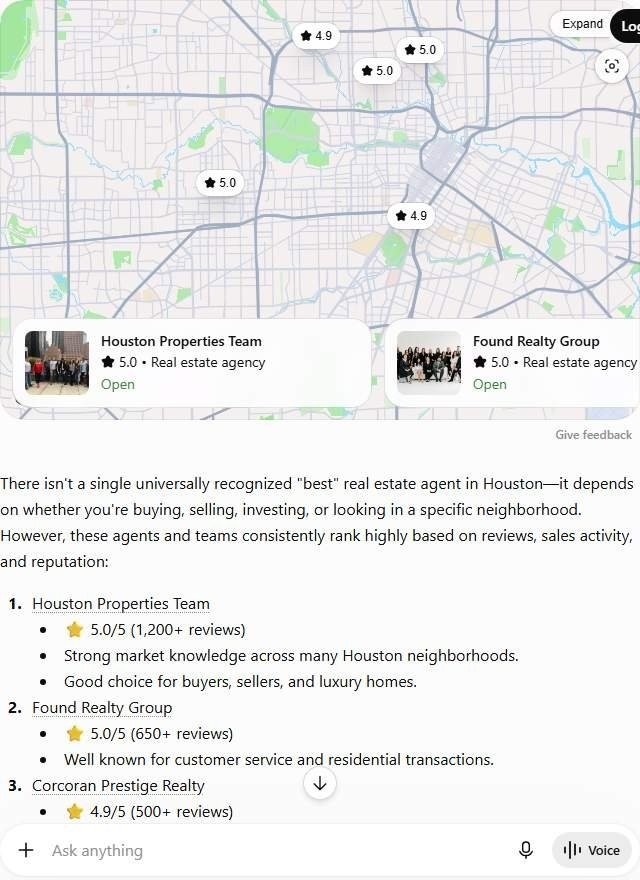

Real estate SEO is how agents and brokerages get found on Google without paying for clicks, through a complete Google Business Profile, steady reviews, pages only they can write and mentions on other sites. It now also shapes whether AI assistants name you. In our study of 2,000 AI answers about Houston, an estimated 94.0% of the Houston Association of Realtors’ 50,000-plus members were never named.
This guide covers the whole job in the order the evidence supports, from the profile and reviews to the website, links, AI answers and measurement, and ends with a checklist. Every figure names its source, mostly Google’s own documentation, NAR, the FTC and measured studies, because many statistics repeated in this niche trace back to aggregator blogs or to surveys from 2020 and 2021.
What is real estate SEO?
SEO in real estate is the work that makes an agent, team or brokerage show up, unpaid, when people search Google for an agent, a home or a neighborhood. It covers four areas: the Google Business Profile, the website, mentions and links on other sites, and technical health. AI answers draw on the same four areas.

Real estate SEO, defined: the practice of making an agent’s or brokerage’s Google Business Profile, website and third-party mentions easy for Google and AI assistants to find and recommend for local buying and selling searches.
| Area | What it covers | What the evidence says |
|---|---|---|
| Local | Google Business Profile, reviews, the map pack | Google says local results are mainly based on relevance, distance and popularity (Google) |
| On-site | Service pages, neighborhood pages, listings | A dedicated page for each service is the top local organic factor (Whitespark 2026 expert survey) |
| Off-site | ”Best agents” lists, directories, press, portal profiles, links | Presence on curated “best of” lists is the top AI visibility factor (Whitespark 2026 expert survey) |
| Technical | Indexing, crawl access, duplicate listings, schema | A page must be indexed and eligible for a snippet to appear in Google’s AI features (Google) |
Whitespark’s 2026 Local Search Ranking Factors are the opinions of 47 local search experts, and Whitespark sells local SEO software, so they count for less than Google’s own documentation.
Is real estate SEO dead or evolving in 2026?
Evolving. Google says AI Overviews and AI Mode need no special optimization beyond normal SEO, and Conductor found AI Overviews on only 4.5% of Google queries in the real estate sector in autumn 2025. What changed is who gets named: in our Houston study, an estimated 94.0% of HAR’s 50,000-plus members never appeared in 2,000 AI answers.
Google’s guidance on AI features in Search is short and worth reading in the original. It says: “There are no additional requirements to appear in AI Overviews or AI Mode, nor other special optimizations necessary.” It adds that “there’s also no special schema.org structured data that you need to add.” So ordinary SEO is still the entry ticket, and the open question is which agent an AI engine names once your pages qualify.
Where do buyers and sellers actually find an agent?
Mostly through people they know, which is the part of the picture most real estate SEO advice skips. These figures come from NAR’s 2026 Home Buyers and Sellers Generational Trends Report unless marked, and NAR also has an interest in agents staying relevant.
- 43% of buyers found their agent through a referral from a friend, neighbor or relative.
- Websites account for 6% of how buyers found their agent, and 3% of buyers first contacted the agent through the agent’s own site.
- 46% of buyers’ first step was looking online for properties for sale, and 52% found the home they bought on the internet.
- Sellers picked reputation as the most important factor in choosing a listing agent 35% of the time, against 4% for commission.
- In NAR’s 2025 Technology Survey, 12% of REALTORS named their business website as the technology bringing the most quality leads, against 39% for social media.
A referred buyer still looks you up before calling, though. What that buyer finds is your Google profile, your reviews and whatever the portals and AI engines say about you, which is why the website comes second in this guide.
What gets an agent named by AI?
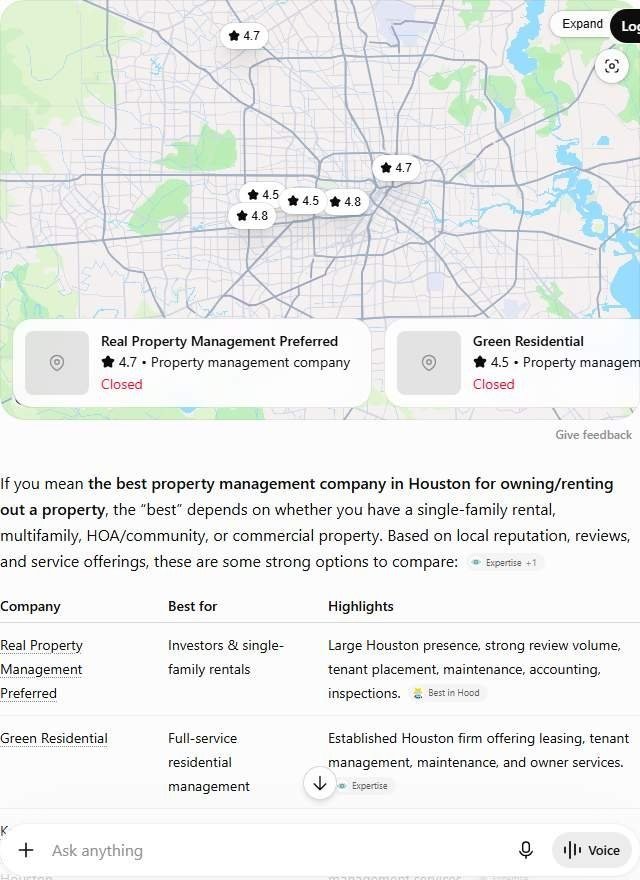
Mostly sources other than the agent’s own site. In the 500-Query Houston Real Estate AI Visibility Study we ran in September 2026 across ChatGPT, Perplexity and Gemini, a firm’s own domain appeared in the citations of an answer naming it between 8.4% and 10.4% of the time, flat from the 50 most-named firms down to the 3,255 named once. Of 7,503 citations, 29.9% went to portals (Zillow 9.1%, HAR 8.6%, Realtor.com 6.3%) and 13.7% to agent referral networks such as FastExpert and HomeLight, so 43.6% went to intermediaries. Those citation shares cover three of the study’s surfaces, because the Gemini web app returned no source links.
Local Falcon’s Realtor AI Visibility Index, which asked five AI platforms three versions of “best real estate agent near me” in the 100 largest US cities in August 2026, found agents’ own websites made up roughly one citation in nine, and 91.5% of the ranked agents and teams it checked that had a website were never cited at all. It also found Google’s AI Overviews returned nothing seven times out of ten on those questions. Local Falcon sells AI visibility tracking software. Conductor’s real estate benchmarks point the same way from the traffic side: AI referrals were 1.01% of real estate site traffic from May to September 2025, with ChatGPT sending 95.2% of them, though Conductor’s “real estate” is the investment and property sector measured on enterprise domains, and Conductor sells AEO software.
Visibility also rarely carries from one engine to the next. In our 150-query real estate AI search study, 1,077 of 1,297 cited domains (83%) reached a single engine. We ran that study, and citevantage.com was one of the three domains every engine cited, so weigh it with that in mind. Local Falcon measured the same pattern for agents, with 82.6% of named agents named by a single platform and no other.
| Aspect | Google local pack | AI answers |
|---|---|---|
| Top-rated factor (Whitespark 2026 expert survey) | Primary Google Business Profile category | Presence on curated “best of” lists |
| Largest measured source | Google publishes no weights; it names relevance, distance and popularity | Google Business Profile, 36.6% of all citations, nearly all from Google AI Mode (Local Falcon) |
| The agent’s own website | Not among Whitespark’s top three local pack factors | About one citation in nine (Local Falcon); own domain in 8.4% to 10.4% of answers naming the firm (CiteVantage Houston study) |
| Reviews | Google: more reviews and positive ratings “can help your business’s local ranking” | Authority of third-party review sites is the fifth AI factor (Whitespark) |
| How to check | Search Console and Business Profile performance | Search Console’s AI report for Google; count names by hand or with a tool elsewhere |
The step-by-step version, with a five-minute self-test and a 30-day plan, is in our guide to AI search for real estate agents. To see what real answers look like for one market, our page of AI search results for Houston real estate shows them.
How does local SEO for real estate work?
Local SEO for real estate runs on the Google Business Profile. Google says local results are mainly based on relevance, distance and popularity, and that more reviews and positive ratings can help. The same profile feeds Google’s AI: Local Falcon found it supplied 72.5% of Google AI Mode’s citations on “best real estate agent near me” searches across the 100 largest US cities.

Google’s help page on local ranking has one line worth repeating to anyone selling map pack placement: “There’s no way to request or pay for a better local ranking on Google.” Distance depends on where the searcher is standing, so what you control is how relevant your profile is to the search and how prominent your business is. In Local Falcon’s study the profile drew 116,196 citations, the largest single source overall, but 116,189 of them came from Google AI Mode, where it supplied 72.5% of citations. It was not among the top 10 sources on ChatGPT, Gemini, Grok or AI Overviews, so treat the profile as the asset that pays on Google’s two scoreboards, the map pack and AI Mode. The step-by-step version, with Google’s rules for agents quoted in one table, is in our guide to local SEO for real estate agents.
Your own profile or the brokerage’s?
Google’s Business Profile guidelines use real estate agents as their example of an individual practitioner. An agent who is public-facing and can be contacted at the verified location “should create their own dedicated Business Profile.” A practitioner who is the only public-facing professional at a branded location should share the organization’s profile instead, and a virtual office is not eligible at all.
Should your profile name include keywords?
We advise against it, even though the experts lean the other way. The 47 experts in Whitespark’s 2026 survey rated “Keywords in GBP Business Title” the third strongest local pack factor, with 223 points. Google’s guidelines say “Including unnecessary information in your business name isn’t permitted”, and profiles that do it risk suspension. A suspended profile drops out of the map pack and out of Google AI Mode’s biggest citation source in the same moment, so keep the name you trade under in the real world.
How do you get reviews without breaking the rules?
Ask every client, the same way, and leave the wording to them. BrightLocal’s 2026 Local Consumer Review Survey of 1,002 US adults found 97% read reviews online and 41% always read them, up from 29% a year earlier, while use of ChatGPT and other generative AI for local recommendations rose from 6% to 45%. The survey covers all local businesses, and BrightLocal sells an AI visibility tracker. Two sets of rules apply, and they differ:
- The FTC. Its rule on fake reviews and testimonials “went into effect on October 21, 2024.” It bans fake reviews, incentives conditioned on a particular sentiment, undisclosed insider reviews and review suppression, and courts can impose civil penalties for knowing violations. The rule exempts general requests to all purchasers to review their experience.
- Google. The Maps user contributed content policy bans incentives “in exchange for posting any review”, bans merchants who “selectively solicit positive reviews”, and bans asking for reviews “that include specific content”.
- Where they differ. The FTC targets sentiment-conditioned incentives, while Google bans incentives for any review, so follow Google’s stricter line. The FTC also says undisclosed incentives can still breach the FTC Act.
That last Google rule matters if you read advice that tells agents to ask clients to work keywords into their reviews, because Google bans asking for reviews that include specific content. One request, sent to every client at the same point in the transaction, with the same link and no reward or script, stays inside both rule sets.
How do you do SEO for a real estate website?
Build pages only you can write, and keep the rest indexable. Whitespark’s 2026 expert survey ranks a dedicated page for each service first for local organic ranking. IDX listings rarely help on their own, because the same MLS data sits on portals and many agent sites and Google shows one version. Neighborhood pages must also follow fair housing rules.
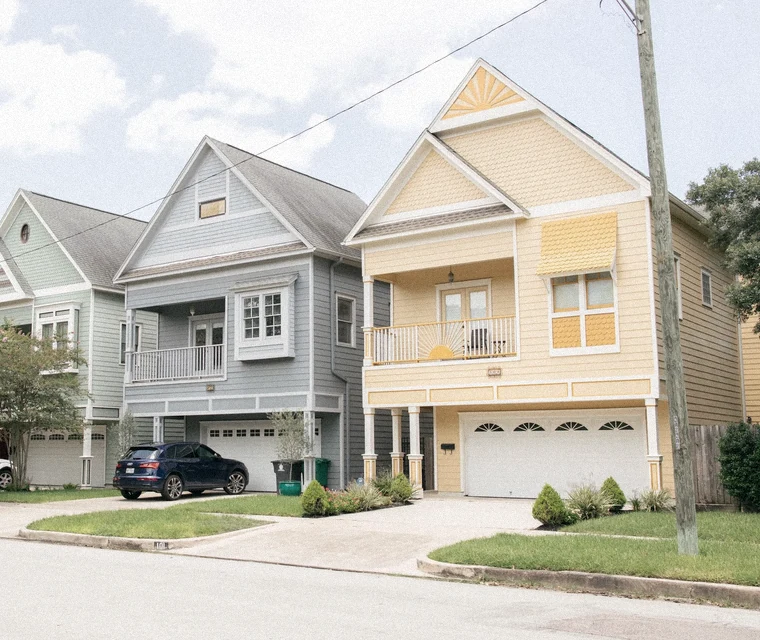
NAR
of buyers who used the internet rated neighborhood information very useful, NAR found.
Photo: Diego Ramirez, Pexels
Service and neighborhood pages
A service page means one page each for buying, selling, relocation or property management, whichever you actually offer. Which phrase each page should own, and how to keep two pages from chasing the same one, is covered in our guide to real estate keywords. Property management companies serve two searchers, owners and renters, so the plan differs; see our property management SEO guide. Neighborhood pages are worth the effort when they come from first-hand knowledge: NAR found 34% of buyers who used the internet rated neighborhood information very useful.
They also carry a legal risk that the top-ranking real estate SEO guides we reviewed do not mention. Under 24 CFR 100.75 it is unlawful to publish a housing advertisement that indicates “any preference, limitation or discrimination because of race, color, religion, sex, handicap, familial status, or national origin.” That reaches “words, phrases, photographs, illustrations, symbols or forms,” and even “selecting media or locations for advertising” in a way that denies particular groups information about housing. Describe the homes, amenities, distances and commute, and avoid any language that signals who should live there. State rules and your brokerage’s advertising policy can go further, so check both.
IDX, duplicate listings and sold homes
Duplicate listings cost you nothing in penalties and gain you little in rankings. Google’s canonicalization documentation says “some duplicate content on a site is normal and it’s not a violation of Google’s spam policies,” and that a site’s canonical preference “is a hint, not a rule.” NAR’s 2026 technology report found 26% of agents use a personal website with IDX and 96% use the MLS, so an IDX page shows the same record every competing MLS member can show.
- Expect the portal version to rank. This is our reading, and no Google document we read says it: when the same listing sits on a portal and on your site, the portal’s page usually wins.
- Tidy duplicates inside your own site, such as filtered search URLs. Google’s guide to consolidating duplicate URLs rates redirects and rel=“canonical” as strong signals and sitemap inclusion as weak, and the signals stack.
- Decide what happens to sold and expired listings. For a listing with a known end date, the
unavailable_afterrobots rule tells Google not to show the page after that date. A 404 or 410 suits a page you remove, and a sold page with real commentary on the sale is a third option. These are our recommendations, and Google sets none of them as a rule.
Schema and technical basics
Google’s structured data gallery lists 25 feature types, including Local business and Review snippet, and has no RealEstateListing or RealEstateAgent feature. Markup still helps machines read your name, address and service area consistently, so use RealEstateAgent or LocalBusiness markup that matches the visible page; our schema markup guide for AI search covers the setup. The technical bar that matters most is simpler: pages have to be indexed and reachable, which our test of whether AI crawlers can reach your site walks through. Treat both as hygiene, since they make you eligible and do nothing on their own to get you named.
How do real estate agents earn links and mentions?
Through local lists, directories, press and partners. Whitespark’s experts rank presence on curated “best of” lists as the top factor for AI visibility, and the quality of inbound links as the third factor for local organic ranking. In our Houston study, portals and agent referral networks took 43.6% of AI citations.

The sources below are the ones we would work through first. They are our recommendations, with the evidence noted where it exists.
- Local “best agents” roundups. These are the lists Whitespark’s experts put first for AI visibility, so ask how each one picks its agents and what it needs from you.
- Your real estate association and chamber of commerce member directories; check whether yours links out to member websites.
- Local press and sponsorships, where a market update or a community event gives a reporter a reason to name you.
- Lender, builder and inspector partners who keep a “recommended agents” page.
- Portal and referral network profiles. When an AI answer cites Zillow or FastExpert next to your name, that page is where the engine read about you, so complete it with the same care as your website.
- Your own “best agents in [city]” page. In Local Falcon’s study, 18 of the 25 most-cited agent websites carried one. If you publish one, list real local agents alongside yourself and say how you chose them, because a page that only praises its author gives a reader no reason to trust it.
Skip bought links and automated directory blasts. They add risk and none of the evidence above points to them.
How do you measure real estate SEO performance?
Track three things: Search Console clicks and impressions for the website, Business Profile calls, direction requests and website clicks, and how often AI engines name you. Since 31 August 2026 Search Console shows every site its impressions in Google’s AI Overviews and AI Mode. Other AI engines must be counted by hand or with a tool.
Google announced the generative AI performance reports in June 2026 and wrote that “as of August 31, 2026, we’ve rolled out these insights to all websites worldwide.” The reports show impressions by page, country, device and date, the announcement lists no click metric, and the same data is also included in the overall performance report.
| What to track | Where to find it | What to watch for |
|---|---|---|
| Clicks, impressions and queries | Search Console performance report | City, neighborhood and service queries, page by page |
| Impressions in AI Overviews and AI Mode | Search Console generative AI performance report | Impressions only, with no click metric listed; Google Search and Discover only |
| Calls, direction requests, website clicks and search terms | Business Profile performance | Search terms update at the start of each month |
| Names and citations in other AI engines | The same buyer questions, run on the same dates each month | 83% of cited domains reached one engine in our 150-query study, so check several |
| Where leads came from | Ask every new client | With 43% of buyers arriving by referral, this shows whether they looked you up first |
Write all of it down on day one as a dated baseline and compare monthly. One answer on one day is a snapshot, so judge the trend over several months.
What should a real estate SEO checklist include?
Twelve tasks, ordered by evidence. The profile and reviews come first because Google’s guidance and the AI citation data both point there. Third-party lists come next, then service and neighborhood pages, then the technical basics that keep pages indexable. Each task names the source behind it, so you can check our reasoning.

| # | Task | Why | Source |
|---|---|---|---|
| 1 | Claim your own Google Business Profile as an individual practitioner, or share the brokerage’s if you are its only public-facing agent | Google’s rule for agents | Google Business Profile guidelines |
| 2 | Pick the primary category with care and keep the name as your real-world name | Top local pack factor; unnecessary information in the name risks suspension | Whitespark 2026; Google |
| 3 | Ask every client for a Google review, the same way, with no incentive and no script | Reviews can help local ranking; incentives, gating and requested content are banned | Google; FTC |
| 4 | Get onto local “best agents” lists, association pages and directories | Top AI visibility factor; portals and referral networks took 43.6% of Houston citations | Whitespark 2026; CiteVantage Houston study |
| 5 | Publish an honest “best agents in [city]” page | 18 of 25 most-cited agent sites have one | Local Falcon |
| 6 | Build one page per service you offer | Top local organic factor | Whitespark 2026 |
| 7 | Write neighborhood pages from first-hand knowledge, inside fair housing rules | 34% of online buyers rate neighborhood information very useful; 24 CFR 100.75 | NAR; HUD regulation |
| 8 | Stop expecting raw IDX listing pages to rank on their own | Google shows one version of duplicates | Google Search Central |
| 9 | Handle sold and expired listings on purpose | unavailable_after, 404 or 410, or a sold page with commentary | Google Search Central |
| 10 | Keep schema matched to visible text, using RealEstateAgent or LocalBusiness | No real estate rich result; no special AI schema | Google Search Central |
| 11 | Check that pages are indexed and crawlable | AI features require snippet eligibility | Google Search Central |
| 12 | Record Search Console, Business Profile and AI names as a dated baseline | Google reports AI impressions; other engines differ | Google; CiteVantage 150-query study |
For the wider evidence base, our page of real estate SEO statistics holds 79 sourced figures. If you are budgeting for outside help, this cost read of 25 agencies shows the entry prices and contract terms they state.
Want to see who AI names in your market?
Running your buyer questions yourself is a fair start. If you would rather see it done properly, enter your website and an email address on our free AI visibility audit page, and we send back the answers AI engines give those questions, the agents they name instead of you and what to fix first. The report arrives within 48 hours, with no call needed. If you want a team to do the work afterwards, that is what our real estate SEO agency service covers.
Frequently asked questions
How much does real estate SEO cost?
It depends on how many areas you cover, how many pages need writing and whether anyone builds links for you.
For context on what agents spend, NAR's 2026 technology report found 36% of agents spend $50 to $250 a month on technology overall and 22% spend more than $500. No public figure shows what SEO pays back for a solo agent, so treat any return-on-investment promise with care and ask how it will be measured.
Does a real estate company need a full-time SEO?
Usually not, in our judgement.
NAR reports a median REALTOR gross income of $59,200 in 2025, so a dedicated full-time hire rarely makes sense for a solo agent or a small team. The core tasks, meaning the profile, reviews and a handful of service and neighborhood pages, fit part-time work, whether that is you or outside help. A brokerage with many agents and dozens of area pages is the exception, because the page count alone becomes a job.
How long does real estate SEO take to work?
Nobody can give you an honest number in advance, because no reliable public figure exists for agents.
The 10-month break-even quoted on several real estate SEO guides comes from one agency's own client campaigns, which ran at about $120,000 a year in fees and gave no sample size. What you can do is take a dated baseline before you start (map pack positions, Search Console impressions and the names AI engines give for your buyer questions) and measure against it every month.
Can I do real estate SEO myself?
Mostly, yes.
The Google Business Profile, the review routine and your service and neighborhood pages are within reach of a solo agent. The technical pieces, such as canonical tags on IDX pages, sold-listing handling and schema, usually sit with your website platform, so ask your vendor how it handles them. If you decide to bring in help, read our questions to ask before you hire a real estate SEO agency first.
Do I need a separate Google Business Profile from my brokerage?
Often, yes.
Google's Business Profile guidelines say an individual practitioner such as a real estate agent should create their own dedicated profile if they are public-facing and can be contacted at the verified location. The exception is a practitioner who is the only public-facing professional at a branded location, who should share the organization's profile. Either way, keep the name as your real-world name, because Google does not permit unnecessary information in it.
Does schema markup help real estate SEO?
It helps machines read your facts, and it earns no special search feature for real estate.
Google's structured data gallery lists 25 feature types, including Local business and Review snippet, and has no RealEstateListing or RealEstateAgent feature. Google also says AI Overviews and AI Mode need no special schema. Use RealEstateAgent or LocalBusiness markup that matches what the page visibly says, and treat it as hygiene.
3,583 words in 8 sections, 6 questions answered. Our charts and graphics are free to reuse (CC BY 4.0). Credit CiteVantage with a link to this page. Photographs are credited to their photographers and are not covered.