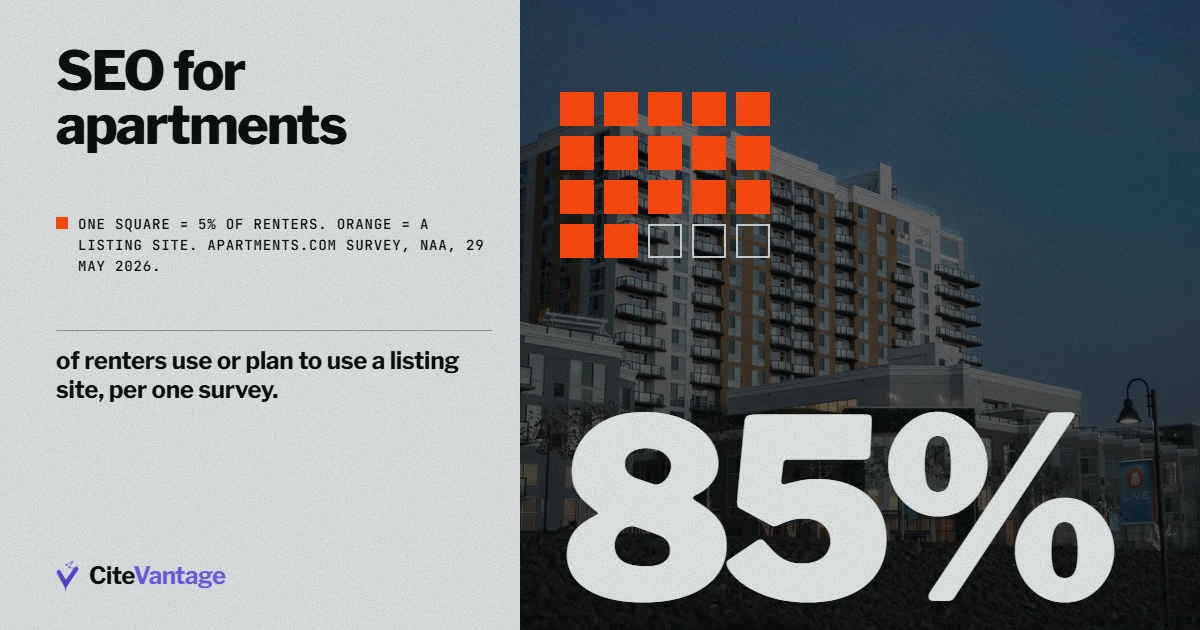
SEO for apartments works through three things an operator controls: a crawlable page for each community and floor plan, a Google Business Profile for each leasing office, and rents and availability written as text instead of locked in a widget. It does not replace the listing sites. In Apartments.com’s survey of over 15,000 US adults planning to rent, 85% said they use or plan to use a listing site, and 35% ranked search engines third. This guide sorts what an operator can win in search from what the portals keep, and says where our evidence stops.
Renters now ask an assistant which communities fit their budget and move-in date, so SEO for apartments also has to get a community named in that answer. The facts below, floor plans and rents in crawlable text, reviews that mention resident experience and consistent listings, are what an engine reads before it names a community. We cover the measurement side as multifamily GEO.
CiteVantage sells AI visibility work to apartment operators, so we have a stake in the topic. Everything below comes from public pages we read on 10 November 2026 and from our own published real estate studies. We have not measured how AI engines answer renter questions about apartment communities, and we mark each place where that gap matters. If you are choosing an agency, our comparison of 11 multifamily SEO agencies covers that decision. This page is about the work itself.
What does SEO for apartments have to win?
It has to win renters who have no property in mind yet, because most of them have none. The National Apartment Association’s write-up of the Apartments.com survey says 87% of renters don’t have a specific property in mind, and that the average renter plans to research 10 properties and seriously consider three. A renter who already knows your name will find you with almost any setup. The ones still up for grabs are typing a neighbourhood, a rent ceiling or a dog’s weight into a search box.
Here is every renter figure we could read and attribute, with who ran the survey, because that changes how much weight it carries.

| Finding | Figure | Sample and date | Who ran it |
|---|---|---|---|
| Use or plan to use a listing site | 85% | Over 15,000 US adults planning to rent; reported 29 May 2026; field dates not given | Apartments.com, a listing site |
| Speak to friends or family for recommendations (ranked second) | 37% | Same survey | Apartments.com |
| Search engines (ranked third) | 35% | Same survey | Apartments.com |
| Cite AI chatbots | 5% | Same survey | Apartments.com |
| Want unit-specific photos | 77% | Same survey | Apartments.com |
| Want unit-specific floor plans | 67% | Same survey | Apartments.com |
| Search property or property manager websites | 30% | 2,105 US renters, 13 to 22 May 2024 | AppFolio, a software vendor |
| Call a manager’s reputation on review sites very important or important | 88% | Same survey | AppFolio |
| Expect a reply to an inquiry within 24 hours | 76% | Same survey | AppFolio |
Three limits apply. A listing site ran the first set and a software vendor ran the second, and each has a reason to like its own channel. The first four rows add up to 162%, so renters named several sources and they are not shares of one total. And we could not read the other large renter studies: Zillow’s renter report returned an access error to our fetch tool, and the National Multifamily Housing Council’s renter page carried only the title “Coming Soon! The Next Generation of Renter Insights”. We used nothing from either.
The AI row needs its own warning. Apartments.com’s 5% is the only US figure with a stated sample that we could read. A J Turner Research blog post dated 21 July 2026 says 45.9% of renters “say they now use AI tools for apartment searching or review analysis”, and that page states no sample size, dates or method. The two questions differ, so some of the gap may be wording. We would not plan around either number.
Where does SEO for apartments beat the listing sites, and where does it not?
It beats them on your own name and details, contests the middle, and probably loses the broad city query. That order is our expectation from how the pages are built. We did not pull US search results for this guide, so look at your own market in a logged-out window before you believe us.
| Query type | Example | Who we expect to hold it | What the operator controls |
|---|---|---|---|
| Community name | ”Example Flats Austin” | The operator | The site, the Business Profile, one consistent name |
| Community plus a detail | ”Example Flats pet policy” | The operator, if the answer is text on a page | Floor plan, policy and fee pages |
| Neighbourhood plus a constraint | ”pet friendly apartments near [employer] under [rent]“ | Contested | Neighbourhood pages, floor plan pages, reviews that name the area |
| City-wide | ”apartments in [city]“ | The portals | Almost nothing except the accuracy of the feed |
Every row in that table is our judgement, and we have no data for the city-wide row. The renter figures are consistent with the pattern without proving it: 87% have no specific property in mind, which is the situation the broad and constraint queries serve.

Search engines
of renters put search engines third in the same survey, behind listing sites at 85% and friends or family at 37%.
Photo: 652234, Pixabay
The record behind all of it is your property management system. RentCafe’s 30 April 2026 release says many of its properties run on Yardi software, so their listing data “flows directly from the source”, and that its ChatGPT app shows “real-time pricing, photos, floor plans, and amenities”. Zillow announced an app in ChatGPT on 6 October 2025 that supports rentals. Our reading is that a wrong rent in the system can be wrong on your site, on the portals and inside a chat window at once. In our view, fixing that record is among the cheapest apartment marketing SEO work there is.
Does it hurt to publish the same floor plans the portals publish? We found no Google page that says your copy of your own unit data is penalised, and none that addresses apartment listing feeds at all. The practical problem is different. A page that only repeats what the portal prints gives a searcher no reason to choose it. What the portal copy usually lacks is the content the renter surveys point to:
- Photos of the actual unit, which 77% of renters in the Apartments.com survey want
- Measured floor plans, wanted by 67%
- A pet table with the breeds, weight limits and fees, in text
- Parking, storage and move-in specials, dated
- The neighbourhood as a resident lives in it, with the commute to a named employer if you have the facts
How should you build community, floor plan and availability pages?
Give every community one page and every floor plan its own page, and print rent and availability as text on both. Nearly all renters, 99% in the Apartments.com survey, agree that unit-specific information is important. A page that carries it in text can be read by crawlers and by a person on a phone.
| Page | What belongs on it | The failure to look for |
|---|---|---|
| Community | Name as it appears on the sign, address, phone, leasing hours, unit mix, rent range, pet and parking rules, specials, tour link | A hero video and a contact form with no rents |
| Floor plan (one each) | Bedrooms, bathrooms, size, starting rent, units available now, unit photos, the plan drawing | One plans page where every plan loads by script from a vendor widget |
| Availability | A text table of units, dates and rents, updated from the feed | Prices that appear only after a click, inside an iframe |
| Neighbourhood | What a resident does within walking or driving distance, with named places and times | A stock paragraph about the city that fits every community in it |
The last column is a checklist for your own pages. We did not count how often these failures occur.

Scripts need care. Google’s JavaScript documentation says that “If the content isn’t visible in the rendered HTML, Google won’t be able to index it”, and that “not all bots can run JavaScript”. Google does render scripts, so a widget is not automatically invisible. The risk is a widget that serves its content from another domain in an iframe, and while Google’s robots meta tag documentation says it can index a page’s content when it is embedded through an iframe, we found no statement on whether a vendor widget’s content counts toward your page. So test it. Put an exact sentence from the widget in quotation marks next to your domain with the site: operator, once the page has been crawled. If nothing comes back, assume engines are not reading it.
Links need the same care. Google says it “can only discover your links if they are <a> HTML elements with an href attribute”, so a floor plan card that opens through a click handler may never be crawled.
The mistake we would warn against hardest in SEO for apartments is the page factory. Google’s spam policy lists “Having multiple domain names or pages targeted at specific regions or cities that funnel users to one page” as doorway abuse, and “Creating substantially similar pages that are closer to search results than a clearly defined, browseable hierarchy”. An operator with twelve communities in one metro is exactly the case that tempts a template. Try the swap test: replace the community’s name and neighbourhood with a sister community’s, and if every sentence on the page still holds, the page has no facts of its own. Write the rents, the policies and the neighbourhood by hand, and let each community compete only for its own name and its own streets.
How should an apartment community set up its Google Business Profile?
One profile for each leasing office that meets customers in person, with a plain name. Google’s eligibility page lists “Rental or for-sale properties such as vacation homes, model homes, or vacant apartments” as ineligible, and then says “Sales or leasing offices, however, are eligible for verification.” So the profile describes the office a renter can visit, and an individual unit never gets one.
The rules that bite for apartments, all from Google’s help pages:
- One per location. Google says “Do not create more than one page for each location of your business, either in a single account or multiple accounts.” A management company that opened a second profile for the clubhouse is probably breaking it, and the model unit is ineligible anyway.
- The real name only. Google says including unnecessary information in the name isn’t permitted and could result in suspension. Its list of what the name must not include has marketing taglines, service or product information and location information. Its example is that “Equinox near SOHO” is not acceptable and “Equinox SOHO” is. So “Example Flats Luxury Apartments for Rent in Austin” is a risk, and “Example Flats” is the safe name.
- Bulk verification from 10. Google’s bulk verification page applies when “Your spreadsheet has 10 or more profiles from the same business”, and says agencies with more than one business in one account can’t bulk verify. A portfolio operator should plan the account structure before the spreadsheet.
Reviews are where apartment local SEO has the most rules. Google’s local ranking page says ranking comes from relevance, distance and prominence, and that “More reviews and positive ratings can help your business’s local ranking.” Its content policy bans offering incentives “in exchange for posting any review or revision or removal of a negative review”, bans “selectively solicit positive reviews from customers”, and says a conflict of interest may include current or former employment. For a leasing team that means no rent credit for a five-star review, no asking only the happy residents, and no reviews written by the staff.
What works inside those rules is boring, and we recommend it without having measured it for apartments: send every resident the same request at a set point, such as 30 days after move-in, and reply to every review in a few sentences that name something specific. AppFolio’s survey found 88% of renters call a manager’s reputation on review sites very important or important, which is reason enough to answer the bad ones.
Which schema helps, and what does it not do?
Schema lets a page state its facts in a form software can read, and Google gives apartments no rich result for it. Google’s structured data gallery names Local business and Vacation rental among its features and none for apartments or long-term rentals, as of the page we read on 10 November 2026. Google’s structured data policy also says “Don’t mark up content that is not visible to readers of the page”, so schema has to match the page a renter sees.
Schema.org itself has the types. ApartmentComplex sits under Residence and Place and carries numberOfAccommodationUnits, numberOfAvailableAccommodationUnits, numberOfBedrooms, petsAllowed and tourBookingPage. FloorPlan is its own type with floorSize, numberOfBedrooms, numberOfBathroomsTotal and numberOfAvailableAccommodationUnits, and schema.org describes the typical use as an ApartmentComplex that has an accommodationFloorPlan which is a FloorPlan. Of five pages we opened from searches for this topic (ButterflyMX, PERQ, OuterBox, LinkGraph and an NAA article), none names these properties, so here is a worked example. Every value is invented.
{
  "@context": "https://schema.org",
  "@type": "ApartmentComplex",
  "name": "Example Flats",
  "url": "https://www.example.com/",
  "address": {
    "@type": "PostalAddress",
    "streetAddress": "100 Example Street",
    "addressLocality": "Austin",
    "addressRegion": "TX",
    "postalCode": "78701"
  },
  "numberOfAccommodationUnits": { "@type": "QuantitativeValue", "value": 240 },
  "petsAllowed": "Dogs and cats, two per apartment, 60 lb limit",
  "tourBookingPage": "https://www.example.com/tour/",
  "accommodationFloorPlan": {
    "@type": "FloorPlan",
    "name": "B2",
    "numberOfBedrooms": 2,
    "numberOfBathroomsTotal": 2,
    "floorSize": { "@type": "QuantitativeValue", "value": 1010, "unitCode": "FTK" },
    "numberOfAvailableAccommodationUnits": { "@type": "QuantitativeValue", "value": 4 }
  }
}
Generate that from the same feed that prints the visible page, so the availability count cannot drift away from the text. We recommend it because it removes ambiguity, and we have no measurement that schema changes which communities an AI engine names. Our guide to schema markup for AI search covers the general case.
What do speed and tour booking add to SEO for apartments?
They affect whether a visit becomes a tour. Google’s web.dev guidance says Largest Contentful Paint should occur “within 2.5 seconds” of the page starting to load, an Interaction to Next Paint of 200 milliseconds or less, and a layout shift of 0.1 or less, measured at the 75th percentile of page loads. A floor plan page with a large photo gallery is the place to check first, since it carries the biggest images.
In our view the reply matters more than the load time. AppFolio’s survey found 76% of renters expect to hear back about a listing within 24 hours. A tour link on every community, floor plan and availability page, marked up with tourBookingPage, and a form that reaches a person quickly deserve more attention than another 500 words of copy about the city. Count tours by the page they came from. If your booking tool hides the source, that is the first thing to fix, because without it you will never know whether any of the rest worked.
How do AI answers choose apartment communities?
We do not know yet, because nobody has published a measurement for apartments and we have not run one. What exists is a delivery path and a set of adjacent studies. The delivery path is the one above: RentCafe and Zillow now show listings inside ChatGPT, and RentCafe says its data flows from the property’s own management software.
The studies are ours, and they concern other questions. This table says what each measured and whether it plausibly carries over to a renter asking for an apartment.
| Our published study | What it measured | What it does not tell an apartment operator |
|---|---|---|
| 500-query Houston study | Of 7,503 citations in AI answers about agents, 29.9% went to portals (Zillow 9.1%) and 13.7% to agent referral networks | Agents, not apartments. The portals that matter for rentals are different |
| Same study | A firm’s own domain appeared in the citations of an answer naming it 8.4% to 10.4% of the time | Whether a community’s own site does better or worse is untested |
| 150-query study | 1,077 of the 1,297 domains cited, 83%, were cited by only one of five engines | Renter questions were not in the set |
| Real estate AI visibility data, property manager set | 184 questions about managers in one Florida city: all three engines named a common firm in 24.6% of questions, and 13.2% of answers to owner “situation” questions named no firm | Owner questions, one city, not renters |
Read those as directions. The Houston page does not state the account or location conditions of its capture. The 150-query study ran from a Pakistani IP with the chat engines signed in, as our property management SEO guide says, and the data page says every answer comes from one capture setup. None of it is a US logged-out measurement of renter questions.
Even so, one practical point probably carries over: the five engines in our 150-query study mostly cited different domains, so a check on one engine tells you little about the others. What we would do about AI answers, in order:
- Make the facts identical everywhere. Name, address, phone, rents, pet rules and fees should match across the property management record, the feeds, the site and the profile. If the feed flows into a chat app, a mismatch reaches the renter there.
- Write the answers renters ask for as plain text. Our multifamily service page lists the questions we run: a budget ceiling, large dogs, parking included, move-in specials, a commute to a named employer, complaints about maintenance. Each one is a sentence your pages should answer in text.
- Run your own test. Write ten renter questions with your city and a constraint, put each to ChatGPT, Perplexity, Gemini, Copilot and Google AI Overviews in a fresh session, and record who is named and which sources are cited. Repeat monthly, with the date on every answer.
- Do not buy a promise. No agency controls what an engine says, and a guaranteed answer is a red flag in any pitch. Our agency comparison lists the questions to ask before you sign.
What is the 90-day order of work for apartment SEO?
Fix the record first, rebuild pages second, widen to neighbourhoods third, and measure at the end. The order is our recommendation. We have no measured timeline for SEO for apartments and distrust any that arrives without data, so the plan is built on checkpoints and not on promised results.
| Days | Work | Done when |
|---|---|---|
| 1 to 14 | Pick one community. Compare its rent, availability, pet rules and fees across the property management record, the feeds, the site and the profile. Fix the profile (one per leasing office open to visitors, real name, hours, few categories). Record tours by source | Every fact matches in all four places and the profile is verified |
| 15 to 45 | Rebuild the community page, one page per floor plan and a text availability table. Add schema generated from the same feed. Add a tour link to each page. Check speed against the three Core Web Vitals thresholds | The widget-sentence test returns your pages and LCP is 2.5 seconds or less at the 75th percentile |
| 46 to 75 | Add neighbourhood and policy pages written from facts only you hold. Start the one-request review routine and reply to existing reviews. Remove or rewrite template pages across sister communities | The swap test fails on every page, meaning each page now has facts of its own |
| 76 to 90 | Compare Search Console clicks by page, profile calls and direction requests, tours and leases by source, and a repeat of the ten-question AI test against day 1 | You can say which pages produced tours, and what the AI answers named that they did not name on day 1 |
Do the first two rows on one community before you scale. Most of this plan costs time more than money. The one thing we would not skip is a named person who owns the property management record.
Want to see how AI answers describe your community?
Our multifamily service page describes the work we do on rents, floor plans and the questions renters ask. To see where your SEO for apartments stands before anyone sells you anything, run the free AI visibility audit: enter your community’s website, an email address and your property’s name and city in the “What do you sell?” box, and within 48 hours you get 200 questions on ChatGPT, 200 on Gemini and 50 to 100 on Perplexity as almost 500 screenshotted answers, with no call and no card.
If you manage buildings for owners and want owner leads as well as renter inquiries, our property management SEO guide covers that side. If you are weighing agencies, the multifamily agency comparison shows what 11 of them print about prices, terms and results.
Frequently asked questions
What is SEO for apartments?
Work that makes a community easy to find in Google search, Google Maps and AI answers.
It covers crawlable community, floor plan and availability pages, a Google Business Profile for each leasing office, reviews, accurate listing feeds and tracked tours. It sits beside the listing sites and does not replace them.
Do listing sites like Apartments.com hurt a community's own SEO?
We found no Google page saying they do.
The sites matter because renters use them: 85% in Apartments.com's survey. They likely hold broad city searches, which we did not measure. Your site's job is your name, your floor plans and the neighbourhood queries between, with unit photos and policies the portal copy lacks.
Does ChatGPT recommend specific apartment communities?
It can show them, and we have not measured how often it names them.
RentCafe launched an app in ChatGPT on 30 April 2026, and Zillow's ChatGPT app, announced 6 October 2025, supports rentals. Apartments.com's survey put AI chatbots at 5% of renters, so treat any larger claim without a stated method with care.
Can each apartment building have its own Google Business Profile?
Its leasing office can, if it meets customers in person during its stated hours.
Google lists vacant apartments as ineligible for a profile and says sales or leasing offices are eligible for verification. It also says not to create more than one page for each location. Each community gets one profile, with a plain name.
How many reviews does a community need to rank in the map pack?
Google gives no number.
It says local ranking rests on relevance, distance and prominence, and that more reviews and positive ratings can help. It also bans incentives for reviews and selectively soliciting positive ones. Ask every resident the same way at a set point, and reply to the negative reviews too.
How do you measure whether SEO for apartments is working?
Count tours and leases by source, because traffic alone does not fill units.
Add Search Console clicks by community and floor plan page, Business Profile calls and direction requests, and a set of ten renter questions put to several AI engines each month. Keep the first month as your baseline and write the date on every answer.
3,569 words in 9 sections, 6 questions answered. Our charts and graphics are free to reuse (CC BY 4.0). Credit CiteVantage with a link to this page. Photographs are credited to their photographers and are not covered.