
Brand mentions in AI Overviews track how often other sites mention you more closely than they track your backlinks, and the studies that compare the two are correlations run by vendors. A mention is your name in the answer text. A citation is a source the engine links, and the two can move apart: in our Houston study of 1,917 answers, a cited domain matching the firm’s name appeared in only 8.4% to 10.4% of the answers that named the firm.
CiteVantage sells AI visibility work to real estate firms, so we gain if you hire us. Everything below comes from pages we read on 15 November 2026 or from studies already published on this site, and we ran no new measurement for this post. Where a figure comes from a company that sells a tracker, a listings product or other software, we say so next to the figure. Our examples are real estate because that is the work we do, and the reasoning applies to any business that buyers ask AI about.
If you only want to know whether you are named today, our guide on how to check if ChatGPT recommends your brand takes about ten minutes. This post is about what moves the answer.
How do brand mentions in AI Overviews differ from citations?
A mention is your name in the answer text, a citation is a source the engine lists or links, and one answer can carry either, both or neither. Semrush’s 2026 AI Visibility Index covers 126 million US prompts from January to April 2026. It says “Brand mentions and citations measure different forms of visibility” and reports that on Gemini the overlap between mentioned brands and cited domains “can be as low as 30%”. That is the June 2026 release; Semrush has published later releases that we did not read. Semrush sells a brand visibility platform, and the release does not say how it matched brands to domains, so read the 30% as a pointer.
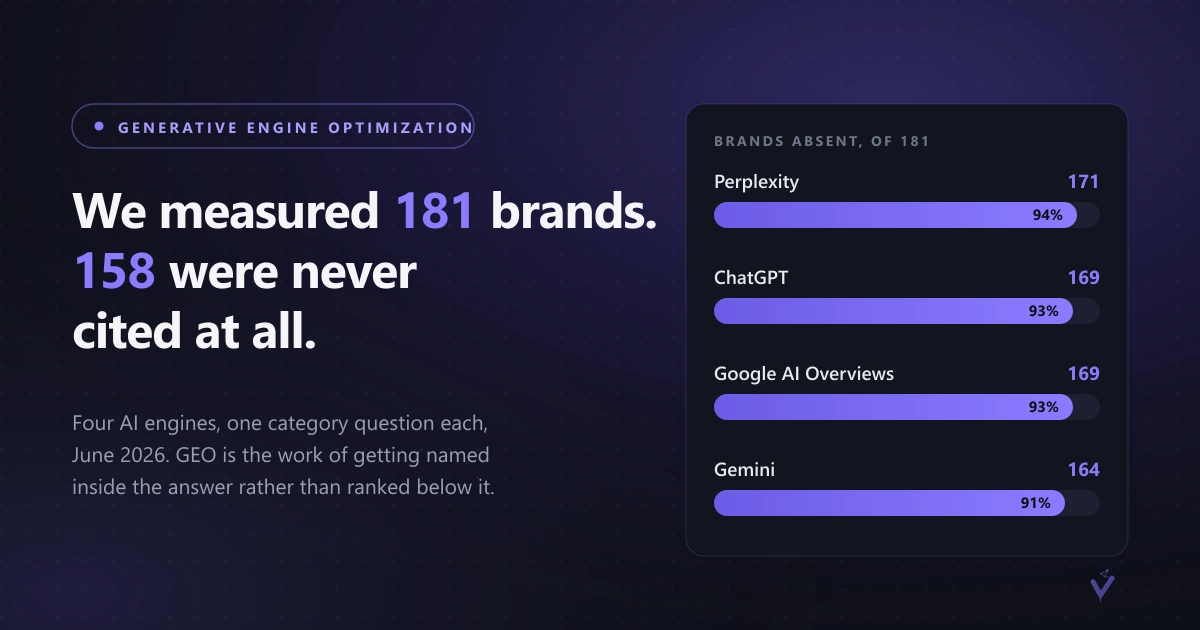
Our 181-brand study counted the two separately. We put one unbranded buying question per brand to four engines in June 2026. A brand counted as cited when its own domain appeared as a source, and as mentioned when the answer named it without citing its site. The brands were US ecommerce advertisers, not agents, and the study page says Gemini was its weakest leg because of rate limits.
| Engine (181 brands, one question each) | Absent | Named, site not cited | Site cited |
|---|---|---|---|
| ChatGPT | 169 | 4 | 8 |
| Perplexity | 171 | 9 | 1 |
| Google AI Overviews | 169 | 5 | 7 |
| Gemini | 164 | 5 | 12 |
Perplexity named nine of those brands without citing their sites and cited the site of one. Gemini ran the other way, with five and twelve. Counts this small cannot rank the engines. They show that both outcomes occurred in one sample and in different proportions on each engine.
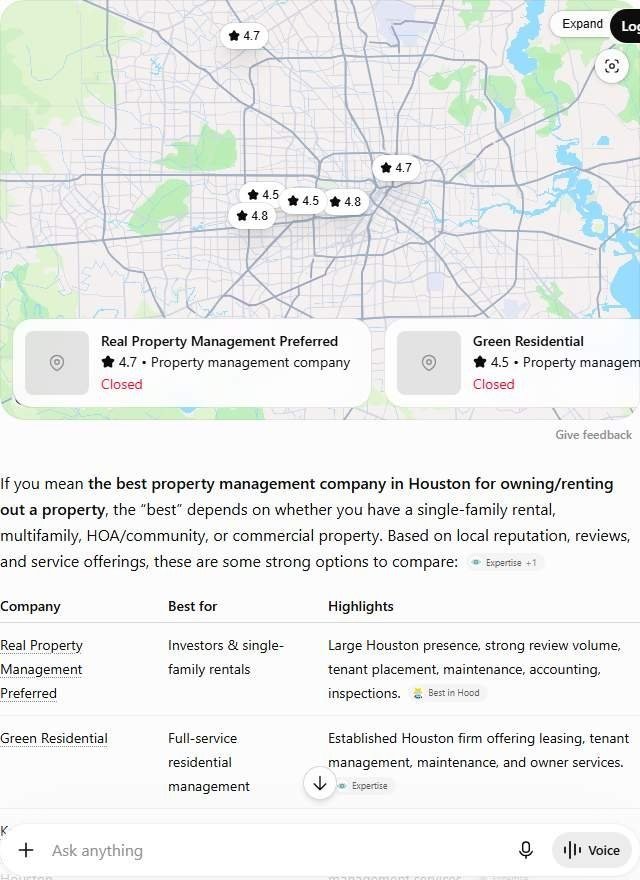
Real estate shows the same split from the other side. The Houston study put 500 questions to four AI surfaces (ChatGPT, Perplexity and two Gemini surfaces) in September 2026 and kept 1,917 answers about Houston. A script extracted the firm names from each answer and counted a hit when a cited domain’s text matched the firm’s name. For each firm we took the share of its answers with a hit, then averaged that within four overlapping exposure bands: the 50 most-named firms, ranks 51 to 500, firms named twice or more, and firms named once. The bands gave 8.8%, 10.4%, 8.8% and 8.4%. In roughly nine of ten answers that named a firm, no domain matching the firm’s name was among the citations. Across all 7,503 citations, 29.9% went to property portals and 13.7% to agent referral networks.
Three limits sit on that figure. It is a string match on names a script extracted, so a firm whose domain does not resemble its name counts as a miss, and the true rate is more likely higher than lower. Gemini’s web answers list no URLs and are counted in the base, and so are ChatGPT answers, about 45% of which (203 of 453) list none. Leaving the Gemini web answers out, our recompute from the published CSV gives roughly 10% to 12%, which is not a figure on the study page. And an engine can read a site without citing it, which the study page itself says makes the number a floor on influence. The full tier table is on the Houston study page.
Where do brand mentions in AI Overviews and other answers come from?
In the published studies, mentions by other sites track a brand’s appearance in answer text more closely than backlinks do, while listings, profiles and your own pages supply the links. All of it is correlation or description, and most of it was run by companies that sell tracking, listings or software. The table separates what each study measured, because a mention study and a citation study cannot be subtracted from each other.
| Source | Feeds | Evidence and who ran it | Limit |
|---|---|---|---|
| Branded web mentions on other sites | Mentions | Ahrefs, 75,000 brands, May 2025: correlation 0.664 with AI Overview brand visibility; backlinks 0.218. Ahrefs sells Brand Radar | Brands with Domain Rating above 40; the 26% with zero mentions were left out; Ahrefs says correlation is not causation |
| Reddit mentions in ranking threads | Mentions | Ahrefs, 10,000 US brands and 260 million non-branded prompts, November 2026: 0.75 for Reddit mentions in ranking threads; the seven mention types ran from 0.60 (TikTok) to 0.75 (Reddit), combined across AI Overviews, AI Mode and ChatGPT | Ahrefs writes that it cannot say mentions cause AI visibility. Within search-volume bands the webpage-mention link was weaker (0.34 to 0.54 against 0.70) but still present |
| YouTube mentions | Mentions | Ahrefs, 75,000 brands, December 2025: about 0.737 across ChatGPT, AI Mode and AI Overviews | One figure for three engines; correlation. In our 150-query study youtube.com was also the most-cited domain in Google AI Overviews, with 55 citations |
| Google page-one rankings | Mentions | Seer Interactive, 10,000 GPT-4o answers, January 2025: about 0.65 with mentions; backlinks “weak or even neutral”. We did not check what Seer sells | API model, not the ChatGPT app; finance and SaaS questions, not real estate |
| Property portals and referral networks | Citations | CiteVantage Houston, September 2026: 43.6% of 7,503 citations. Local Falcon, August 2026: Zillow 15.9% of citations, 86.9% of them pointing at a city list | One metro and one run for ours, matched by name on script-extracted names. Local Falcon sells rank tracking and used three “near me” phrases |
| Google Business Profile | Citations | Local Falcon, 37,500 queries in 100 US cities: 36.6% of all citations and 72.5% inside Google AI Mode | ”Best realtor near me” style queries only. Google’s own page lists checking that Business Profile information is up to date |
| Your own site and listings | Citations | Yext, 6.8 million citations, October 2025: websites 44%, listings 42% | Yext sells listings management and does not describe how it sorted sources. Its 86% headline adds these two rows |
| Wikipedia | Citations | Profound, 680 million citations, August 2024 to June 2025: 7.8% of all ChatGPT citations (47.9% of citations to its ten most-cited sources) | A citation figure from a company whose business we did not check. We did not find a study testing whether a page changes mentions |
Local Falcon deserves a second look, because its method blurs the line this post is about. It counted an agent as named only when AI linked to the agent’s website or to a profile page carrying the agent’s name. Its finding that 91.5% of ranked, website-publishing agents were never cited is therefore a link measure, and an agent could have been named in text and still counted as absent.

Here is what we make of the table, and it is our reading. A name probably arrives from the places that already describe you: portal and referral-network profiles, your Business Profile, reviews, local press and the roundups that rank agents in your area. The link then goes to whichever page the engine used to build the answer, which in Houston was often a portal or referral network. We have not tested that completing a profile changes a mention, and no study in the table did either.
Do four AI surfaces name brands from the same places?
Mostly no. In our Houston data the four surfaces named mostly different brands, and the engine owners document very little about how brands are chosen. On the 432 questions all four surfaces answered, 87.2% of extracted names came from only one surface, and 51 names, 1.2%, from all four. A labelled sample of real agents across all queries put the one-surface share at 83.3%. Two of the four surfaces are both Gemini, and they shared 13.7% of their combined list, the highest pair. Citations tell a similar story in our 150-query real estate study: 1,077 of 1,297 cited domains (83.0%) reached one of five engines, and 3 reached all five.
| Engine | What its owner documents | What we or others measured |
|---|---|---|
| Google AI Overviews | Google’s “AI features and your website” page says there are “no additional requirements to appear in AI Overviews or AI Mode, nor other special optimizations necessary”. A supporting link needs a page that is indexed and eligible to show with a snippet, and Google says indexing and serving are not guaranteed | Ahrefs, November 2026: 18% of brands had zero AI Overview mentions on non-branded prompts, against 46% on ChatGPT. Local Falcon’s introduction says AI Overviews gives “nothing at all” seven times out of ten; the page does not define “nothing” or show how it was counted |
| ChatGPT | OpenAI’s crawler page says OAI-SearchBot “is used to surface websites in search results in ChatGPT’s search features”, and that opted-out sites “will not be shown in ChatGPT search answers”, though they can still appear as navigational links | Houston: 599 ChatGPT citations, 48.7% to portals and 11.0% to referral networks. Ahrefs, December 2025: ChatGPT “seems to be less influenced by established brand dominance than AI Mode or AI Overviews” |
| Perplexity | Perplexity’s help page says each answer includes numbered citations linking to the original sources, and that it draws on “authoritative sources like articles, websites, and journals” | 150-query study: sources on 142 of 150 answers, 7.7 per answer that had sources, 618 distinct domains. Profound: Reddit was 6.6% of all Perplexity citations from August 2024 to June 2025 |
| Gemini | Gemini Apps Help says “Not all responses include related links or sources” | 150-query study: sources on 55 of 150 answers, 1.3 per answer that had sources. Houston: web app answers carried no cited URLs. Semrush: Gemini cites an average of 3 sources per response against 15 for ChatGPT |
Read the Gemini row twice. On a surface that often shows no sources, a mention is the only visible result, so a Gemini check that only counts links will report you as absent when you may be named. The one-engine reach figures above also mean a win on one engine tells you little about the next. The per-engine tactics have their own guides: how to get cited by ChatGPT, by Perplexity and by Gemini, plus our Google AI Overviews guide.

The parts of Google’s page we read cover eligibility, query fan-out and Business Profile upkeep. We found nothing in them on how a brand gets named, and the OpenAI page we read documents crawlers and not selection. Everything about who gets named comes from outside measurement.
Why do the studies disagree about where AI names come from?
They measure different things on different questions, so most of the disagreement is apparent. Ahrefs and Seer counted names in answer text. Yext, Local Falcon and Profound counted sources. When Yext says 86% of citations come from sources a brand can directly manage or strongly influence, and Ahrefs says off-site mentions correlate most with visibility, both can hold, because one counts links and the other counts names.
Yext’s buckets also overlap with ours in a way worth stating. A profile on a portal is a listing a brand controls, so it would sit in Yext’s “listings” at 42% and in our “portals” at 29.9%. We cannot confirm how Yext sorted each source. Our two studies are consistent with the question changing the sources. The 150-query study asked about hiring a provider for real estate marketing, lead generation and AI search visibility, and 88% of its citations went to ordinary company websites, a bucket the page calls deliberately blunt, with all four major property portals together drawing 35 citations. The Houston study asked what a buyer or seller asks when looking for an agent, and portals and referral networks took 43.6%. The studies also differ in engines, dates, who is asking and how citations were classified, so this is not a controlled comparison.
Because the question may change the sources, test your own category questions instead of borrowing a number from a study about someone else’s market.
How do you tell whether AI mentions your brand, cites it, or both?
Ask unbranded questions with your place written in, and record three things for each answer: whether you are named, whether you are linked, and which domains were listed as sources. Use the wording a buyer uses, such as “who is the best property manager in Tampa, FL”. Never put your own name in the question. Our research data page leaves out questions that name a business for the same reason: an engine asked about a business will name it.
Run each question in a fresh chat, and run it more than once. We repeated 100 Houston questions about two weeks after the first answers. For the average ChatGPT question, between 26% and 38% of the firms that either of two runs named were named by both, and for Gemini the range was 10% to 15% (the data page does not say which Gemini surface). A single clean answer proves little in either direction.
Score each answer the way the check guide does: 2 for named and linked, 1 for named only, 0 for absent. The domains in your sources column are the sites to work on, because those are the pages the engine used for your market. Our guide to AEO tools that track brand mentions covers when a paid tracker is worth it and what none of them can see. Until then, a spreadsheet and ten questions is enough.
What is a 30-day order of work for brand visibility in AI search?
Fix access, take a baseline, make your facts match everywhere, finish the profiles your baseline shows the engines using, then measure again. The order is ours. The evidence behind each step is in the sections above, and none of it is a controlled test of that step.
| Days | Work | Done when |
|---|---|---|
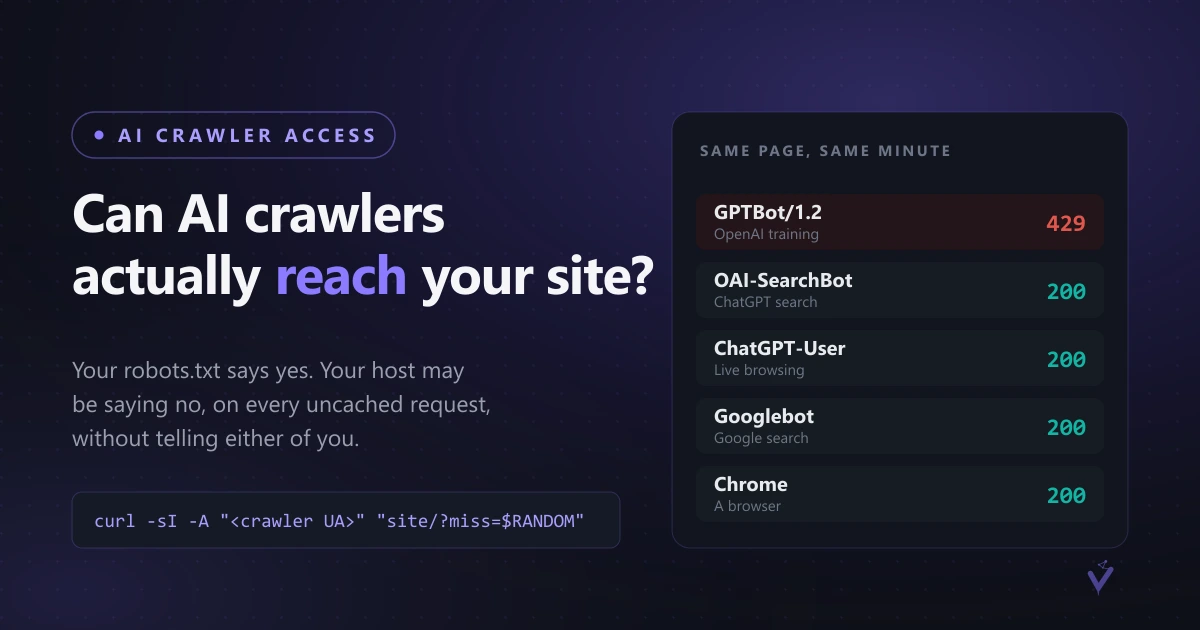
| 1 to 3 | Allow OAI-SearchBot in robots.txt and confirm your host serves it. Check that your key pages are indexed and can show a snippet. Our guide on whether AI crawlers can reach your site has the test | OpenAI’s documented condition and Google’s documented condition are both met |
| 4 to 10 | Run the baseline: ten unbranded questions on ChatGPT, Perplexity, Gemini and Google AI Overviews, each repeated twice. Log named, linked and source domains | A sheet holds every name and every source domain, with dates |
| 11 to 17 | Make your business name, service area, phone and one-line description identical on your site, your Business Profile and every portal or referral-network profile you hold | A copy-and-paste check finds one version of the facts in every place |
| 18 to 26 | Take the five source domains your baseline shows most often for your market and finish your profile on each. Ask the owner of any “best agents in your area” page an engine cited whether you can be included | Each of those domains carries a complete, current profile or listing for you |
| 27 to 30 | Re-run the same questions in the same way and compare against the baseline, name by name | You can say which names and which sources changed, and you have written the date on each answer |
Thirty days is enough to set this up and measure it once. We have no data saying it is enough to move who gets named, and the Houston repeat shows why one comparison proves little. Plan for monthly re-runs. The fuller real estate version of this plan is in our guide to AI search for real estate agents, and the city-level detail is in how to rank in ChatGPT.
What do we not know about brand mentions in AI Overviews?
We do not know what causes a mention, and nothing in this post changes that. The list below is where our confidence stops.
- Cause. Ahrefs writes that it cannot say mentions cause AI visibility, and that brand size explains part of the link, though the link persisted inside brand-size bands at 0.34 to 0.54. Seer calls its own study a first phase that only spots correlations. A big brand collects both mentions and AI visibility, so working on mentions may not move yours.
- Whose numbers these are. Ahrefs, Semrush, Yext and Local Falcon each sell a product that benefits from the topic. We did not check what Seer and Profound sell. We cite their methods where they published one.
- Our own capture conditions. The 150-query study ran once from a Pakistani IP with Perplexity, Gemini and Copilot signed in and ChatGPT in a temporary chat with memory off, as our property management SEO guide records, and the Houston page does not state its account or location conditions. We cannot call any of our figures a clean US, logged-out measurement.
- What the Houston match can show. It is a name match on script-extracted names. It cannot show whether a firm’s real website was cited when its domain does not resemble its name, and it cannot show influence, because an engine can read a page without citing it. Gemini web answers and about 45% of ChatGPT answers list no URLs, and both are in the base.
- Selection. Google’s, OpenAI’s and Perplexity’s pages describe eligibility, crawling and display. We found none that says how a brand is chosen to be named.
- Buyer behaviour. We have no measure of how many people act on a name in text compared with a link.
If an agency promises you a mention in a set number of days, ask what they measured and from where.
Want to see who AI names instead of you?
Our real estate AI SEO service describes what we do for agents and brokerages. To see where you stand before anyone sells you anything, run the free AI visibility audit: enter your website, the email to send the report to and what you sell in the “What do you sell?” box, and within 48 hours you get 50 questions on each of ChatGPT, Perplexity, Gemini and Copilot as 200 screenshotted answers, with no call and no card. The audit does not cover Google AI Overviews, so run your questions in Google yourself and add the result to your sheet.
For the data behind the Houston figures, the 500-query Houston study publishes every tier and the method.
Frequently asked questions
How do you get brand mentions in AI Overviews?
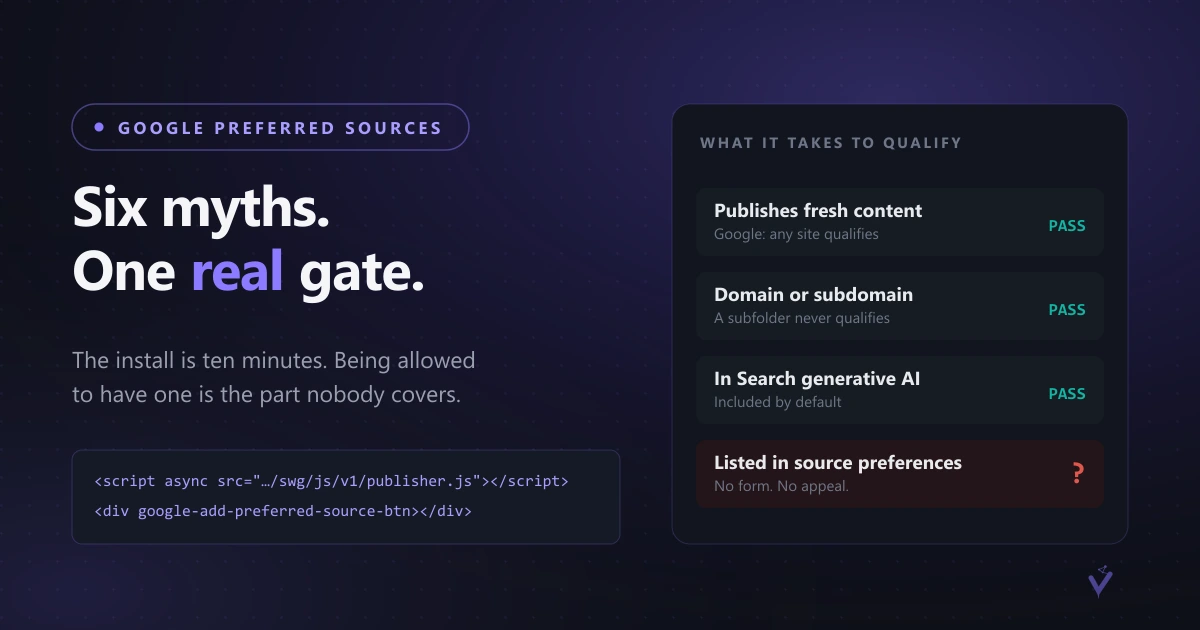
Google says nothing beyond normal Search eligibility is required.
Google also says indexing and serving are not guaranteed, and we found no Google page on how a brand gets named. The studies we read tie mentions to how often other sites discuss you, as correlation only. Start by being indexed, then make your facts match across sites.
What is the difference between a brand mention and a citation?
A mention is your name in the answer text, and a citation is a source the engine links.
They can come apart. In our Houston study a cited domain matching the firm's name appeared in only 8.4% to 10.4% of the answers that named it, so a buyer can read your name and be sent to a portal.
Do backlinks help brand mentions in AI answers?
Weakly, in the studies we read.
Ahrefs found backlinks correlated 0.218 with AI Overview brand visibility, against 0.664 for branded web mentions. Seer Interactive called backlinks weak or even neutral for GPT-4o mentions. Both are correlations, so they argue for prioritising mentions and prove nothing about cause.
How long does it take to improve brand visibility in AI search?
Nobody has measured it, so we will not give a number.
Thirty days is enough to fix your profiles, set a baseline and re-run the same questions. It is not a tested timeline for a change in who gets named. Our own repeat runs show answers move between runs, so judge trends over months, not days.
How often should you check your AI brand mentions?
Monthly, with the same unbranded questions each time.
One run is a weak guide. In our Houston repeat, for the average ChatGPT question only 26% to 38% of the firms named by either of two runs were named by both, and for Gemini 10% to 15%. Write the date on every answer you save.
Can an AI answer name my business without linking to my website?
Yes, and our Houston data suggests it is common.
A cited domain matching the firm's name appeared in only 8.4% to 10.4% of the answers that named it, by a name match that probably undercounts. Gemini's web answers carried no URLs at all, so there a name was the only visible result.
3,236 words in 8 sections, 6 questions answered. Our charts and graphics are free to reuse (CC BY 4.0). Credit CiteVantage with a link to this page. Photographs are credited to their photographers and are not covered.